
UCSC-VLAA/ALPS has 33 GitHub stars and 1 forks. GitHot measured 0 stars in 24 hours. Last checked 2026-11-09 14:48 UTC. Last push 2026-10-22.
🏔️ ALPS: Visual State Encoders for World Models
What you can do
- 🎯 State. The lowest aggregate LIBERO state-probe error among ViT-B encoders, matching the 3.5x larger V-JEPA 2-L.
- 💬 Language. A native text tower: image-text retrieval within 2 points of the best image-text encoders.
- 🖼️ Pixels. A lower reconstruction ℓ1 error than every compared encoder not trained to reconstruct pixels or latents.
- 🤖 Control. The highest mean policy success on LIBERO: 83.4% with BERT instructions, 85.5% with ALPS's own text tower.
Measured star growth
- in 24h
- 0
- in 7 days
- Collecting history
- in 15 days
- Collecting history
- in 1 month
- Collecting history
Net star changes over overlapping periods, not daily totals. Missing measurements are left blank. Stars measure attention, not software quality.
README.md
Original🏔️ ALPS: Visual State Encoders for World Models
A Language-aligned, Pixel-renderable State encoder




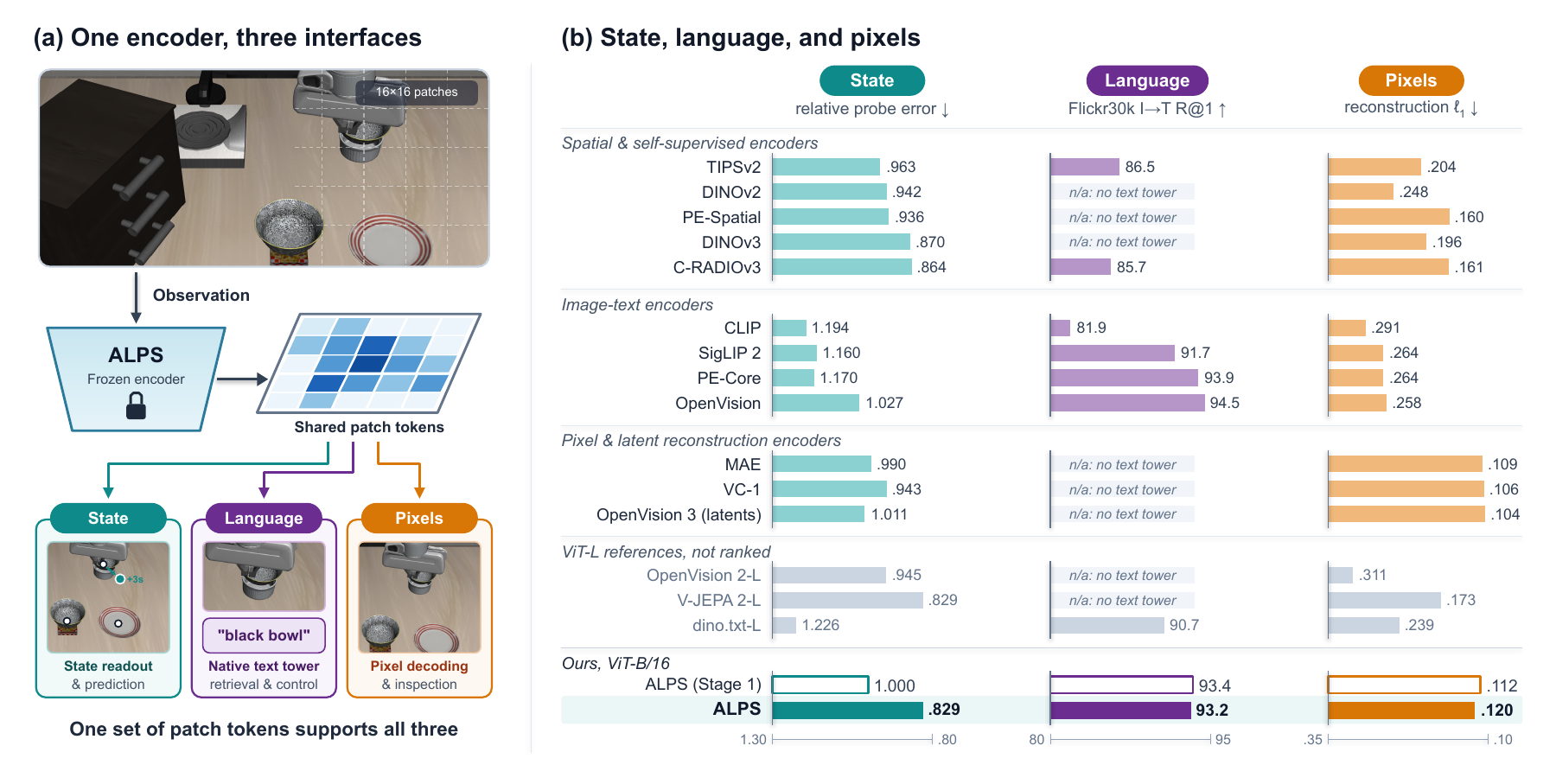
World models predict and plan in the token space of a frozen visual encoder, so the encoder decides what they can see. ALPS is a ViT-B/16 whose patch tokens give world models and robot policies a state they can predict, instruct and inspect: the tokens carry physical-state information, align with language through ALPS's own text tower, and decode back into pixels. Public encoders tend to excel at one of these capabilities; ALPS brings all three into one set of patch tokens, and no compared encoder is better than ALPS on all three.
Highlights
- 🎯 State. The lowest aggregate LIBERO state-probe error among ViT-B encoders, matching the 3.5x larger V-JEPA 2-L.
- 💬 Language. A native text tower: image-text retrieval within 2 points of the best image-text encoders.
- 🖼️ Pixels. A lower reconstruction ℓ1 error than every compared encoder not trained to reconstruct pixels or latents.
- 🤖 Control. The highest mean policy success on LIBERO: 83.4% with BERT instructions, 85.5% with ALPS's own text tower.
- 🌍 Planning. Leads or ties the best world-model planning results on PushT, Wall and Granular, and renders the world model's predicted futures as images.
- 📷 Still images and text only. Pretrained from scratch without video, actions or an external teacher model.
Results at a glance
Frozen encoders under one protocol (the encoders of the paper's policy experiments; all fifteen public encoders are in the
figure above and in eval/README.md). Best value of each column in bold.
| Encoder | State err. ↓ | IN-1k ↑ | Flickr I→T ↑ | ℓ1 ↓ | LIBERO (BERT) ↑ | LIBERO (own text) ↑ |
|---|---|---|---|---|---|---|
| CLIP-B/16 | 1.194 | 68.4 | 81.9 | .291 | 75.0 | 79.2 |
| SigLIP 2-B/16 | 1.160 | 77.6 | 91.7 | .264 | 81.4 | 84.8 |
| DINOv2-B/14 | .942 | n/a | n/a | .248 | 78.4 | n/a |
| DINOv3-B/16 | .870 | n/a | n/a | .196 | 79.0 | n/a |
| C-RADIOv3-B | .864 | 66.5 | 85.7 | .161 | 78.2 | 81.8 |
| ALPS (Stage 1) | 1.000 | 74.5 | 93.4 | .112 | 81.1 | - |
| ALPS | .829 | 73.4 | 93.2 | .120 | 83.4 | 85.5 |
State err.: object position error of an attentive probe on the frozen tokens of LIBERO frames (now, 1 s and 3 s ahead; mean), relative to ALPS (Stage 1). IN-1k: ImageNet-1k zero-shot top-1 (%). Flickr I→T: Flickr30k image-to-text R@1 (%). ℓ1: reconstruction error of an evaluation decoder on 1,000 held-out ImageNet images. LIBERO: mean policy success (%) over Long, Goal, Spatial and Object, with LIBERO's BERT instruction embedding or the encoder's own text tower. n/a: no text tower released; -: not run.
Quick start
git clone https://github.com/UCSC-VLAA/ALPS.git && cd ALPS
pip install -e .                 # torch, numpy, pillow
pip install -e ".[test]"         # + safetensors, timm, transformers, pytest
import torch, alps
from PIL import Image

model = alps.load("alps-vitb16")                          # downloads alps_vitb16.safetensors from Hugging Face
x = alps.center_crop_transform(Image.open("image.jpg"))   # [1, 3, 224, 224], normalized

with torch.no_grad():
    out = model.encode_image(x)
    z = out["tokens"]            # [1, 196, 768]  raw patch tokens: the visual state
    g = out["pooled"]            # [1, 768]       LayerNorm(mean(z))
    img = model.image_embedding(tokens=z)                      # L2-normalized
    txt = model.text_embedding(["a robot arm opens the top drawer", "a photo of a dog"])
    probs = (model.contrastive_scale() * img @ txt.T).softmax(-1)
| Model | File | Description |
|---|---|---|
alps-vitb16 |
alps_vitb16.safetensors |
ALPS, the model of the paper (Stage 1 + Stage 2) |
alps-stage1-vitb16 |
alps_stage1_vitb16.safetensors |
ALPS (Stage 1), before cross-view refinement |
The weights are published with the paper in the Hugging Face repository
UCSC-VLAA/ALPS, together with the eight ALPS policies of the LIBERO experiments
(eval/libero_policy). alps.load also takes a local file or
"hf-hub:<org>/<repo>/<file>", and torch.hub.load("UCSC-VLAA/ALPS", "alps_vitb16") works as well.
Usage notes
- Tokens. The state is the set of raw patch tokens after the last block, without a final LayerNorm, row-major over the 14 x 14 grid. World models, policies and probes in the paper read these tokens.
- Inputs. RGB in [0, 1], normalized with the ImageNet mean and standard deviation. Natural images: shorter side to
256, central 224 crop (
alps.center_crop_transform). Simulator frames: resize the whole frame to 224 (alps.resize_transform). Other resolutions work when the side is a multiple of 16; the position table is then interpolated from the 14 x 14 training table. - Precision. Use float32 or bfloat16. float16 overflows in the deeper blocks.
- Encoder only.
alps.load_encoder(path)returns theVisionTransformeralone. - timm.
alps.timm_compat.create_timm_model(path)returns a standard timmvit_base_patch16_224with the ALPS weights (forward_features(x)[:, 1:]are the raw tokens). - Zero-shot classification.
alps.zeroshot.imagenet_classifier(model)builds the ImageNet classifier of the paper's evaluation (OpenAI CLIP class names and 80 templates, as in CLIP_benchmark). - Pixels.
alps.decoderholds the evaluation decoder (tokens -> SDXL autoencoder latents -> image); train one for any encoder witheval/reconstruction/train_decoder.py.
How ALPS is trained
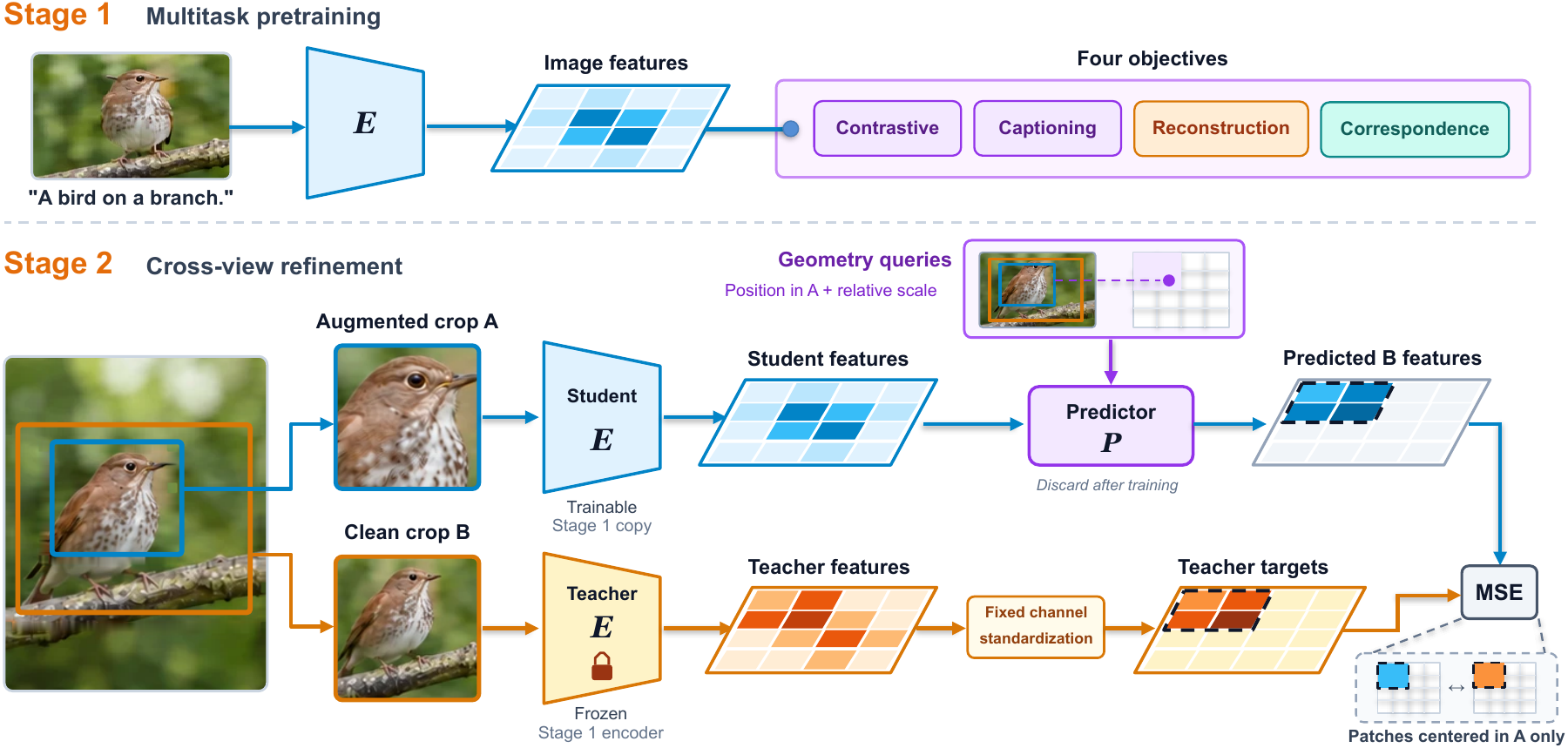
- Stage 1 trains a ViT-B/16 from scratch on image-text pairs with contrastive alignment, captioning, pixel reconstruction and cross-view dense correspondence over unnormalized patch tokens (128 px, then 224 px).
- Stage 2 refines the encoder on single images by cross-view self-distillation: from an augmented crop, a predictor reads the student's tokens and predicts the frozen Stage-1 teacher's standardized tokens at the corresponding locations of a clean crop. The language interface of Stage 1 is kept unchanged.
The refinement reduces the Stage-1 state-probe error by 17% while changing image-text retrieval by at most 0.5 points; the same refinement degrades retrieval by 7 to 12 points on SigLIP 2 and CLIP.
Pixels from tokens
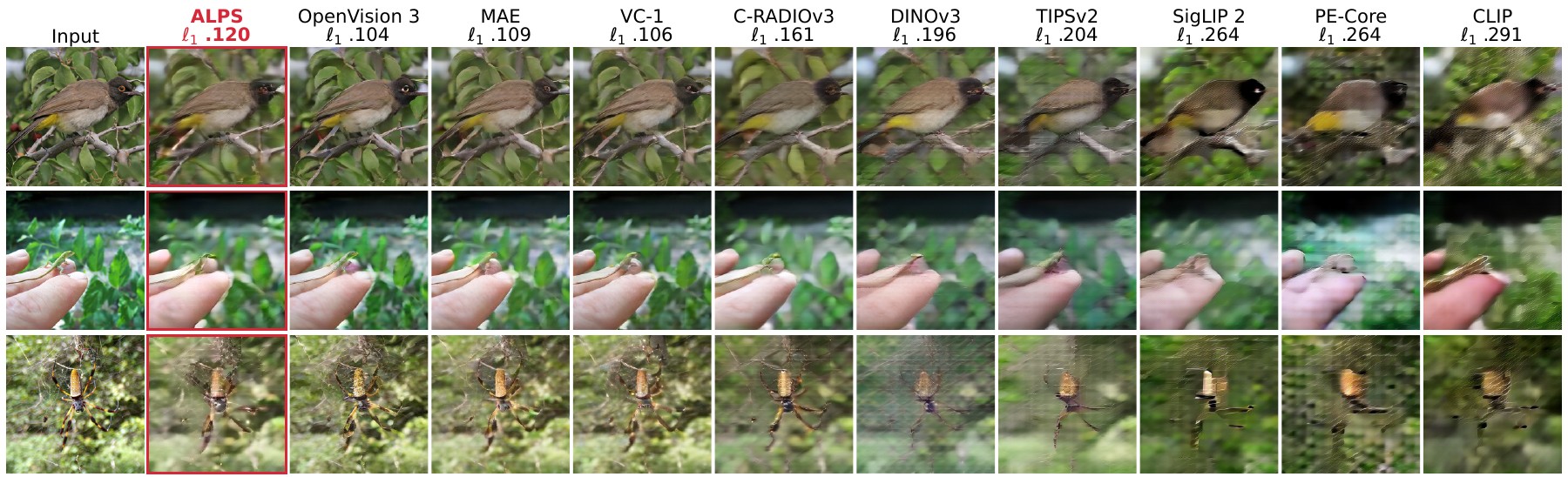
An evaluation decoder trained on each encoder's frozen tokens (mean ℓ1 on 1,000 held-out ImageNet images).
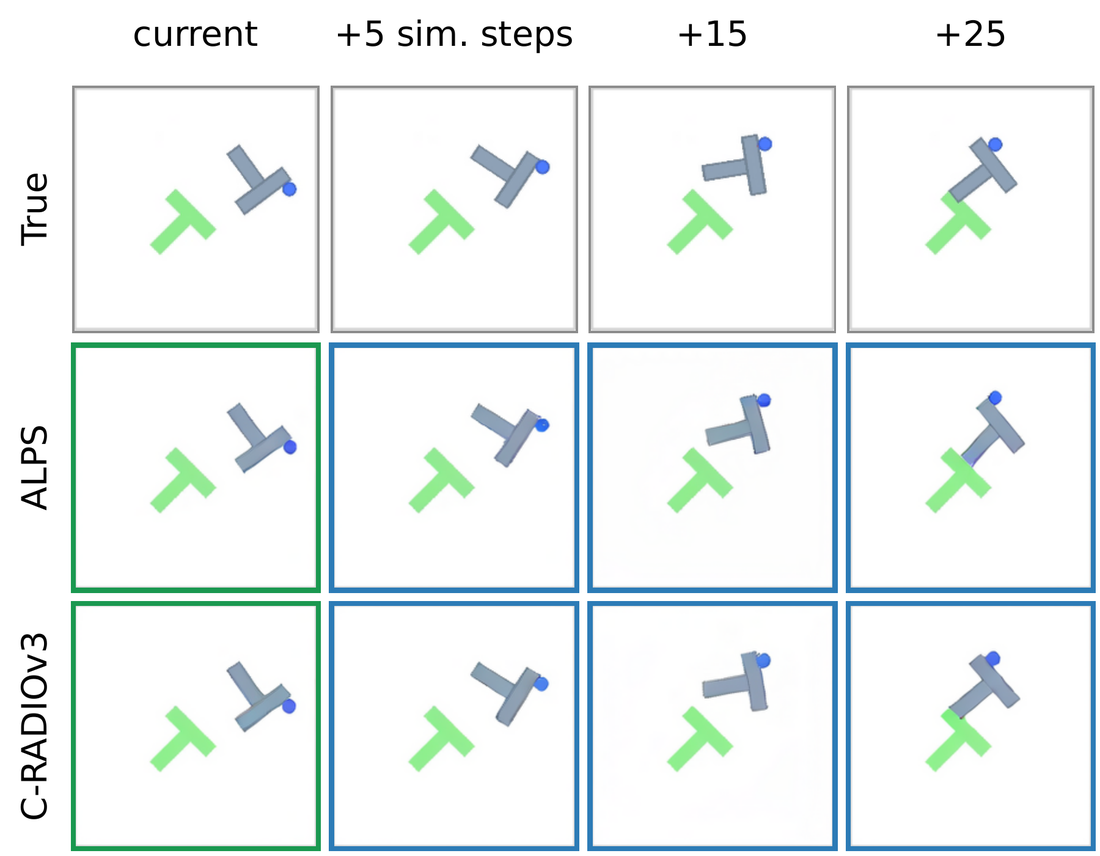
World-model predictions on PushT, decoded to pixels: true frames (top), and for ALPS and C-RADIOv3 the decoder outputs from real current tokens (green) and from open-loop predicted tokens given the recorded actions (blue).
What is in this repository
| Folder | Contents |
|---|---|
alps/ |
PyTorch inference package: encoder, text tower, tokenizer, zero-shot helper, evaluation decoder, weight conversion, timm export |
eval/ |
The unified evaluation of frozen encoders used for every table of the paper, with one interface for ALPS and fifteen public encoders: LIBERO state probe, language, reconstruction, DAVIS / SSv2, LIBERO policies, DINO-WM and LeWorldModel world models |
train_jax/ |
The JAX/Flax code ALPS was trained with (Stage 1 at 128 then 224 pixels, Stage 2), reduced to the paths of the released model |
train_torch/ |
A PyTorch re-implementation of both stages, with parity tests against the JAX code |
tools/ |
Conversion and parity-check scripts |
docs/ |
Model card and validation record: the paper's numbers reproduced with this code |
The training data are not released; train_jax/README.md describes the record format the input pipelines expect.
Training and converting checkpoints
train_jax/ trains both stages on TPUs or GPUs; train_torch/ does the same in PyTorch (DDP) and writes alps
safetensors files directly. Checkpoints of the JAX code convert in three steps (the first two in the JAX environment):
python tools/export_flax_params.py --ckpt runs/stage1b/checkpoints --out stage1b_params.npz     # language interface
python train_jax/export_encoder.py --ckpt runs/stage2/checkpoints --subtree encoder --out stage2_encoder.npz
python tools/convert_checkpoint.py --stage1 stage1b_params.npz --encoder stage2_encoder.npz --out alps_vitb16.safetensors
The converted PyTorch model reproduces the float32 Flax forward of the training code to a relative error below 2e-5 on the released weights.
Tests
pytest                                          # inference package + evaluation code (tests/, eval/), CPU
cd train_jax && pytest tests/                   # JAX training code, in the JAX environment
cd train_torch && pytest tests/                 # PyTorch training code
tests/test_flax_parity.py compares the PyTorch modules with the Flax modules of the training code; generate its
reference file with tools/parity/flax_reference.py in a JAX environment. docs/VALIDATION.md lists
what was checked before the release.
Citation
If you use ALPS, please cite the paper:
@article{liu2026alps,
  title   = {ALPS: Visual State Encoders for World Models},
  author  = {Liu, Yanqing and Zhang, Letian and Liu, Chengzhi and Wang, Zijun and Mei, Jieru and Fei, Hongliang and Zhou, Yuyin and Xie, Cihang},
  journal = {arXiv preprint arXiv:2610.30120},
  year    = {2026}
}
Acknowledgements
We would like to thank the TPU Research Cloud (TRC) program, the Google Cloud Research Credits program, and the Google TPU Builder Award for supporting our computing needs.
ALPS builds on many open-source projects, and we thank their authors and maintainers.
- Training. The JAX training code is based on big_vision and CLIPA and runs on JAX, Flax, optax and Orbax. Stage 1 trains on DataComp-1B with the captions of Recap-DataComp-1B; Stage 2 uses images of the public image-editing datasets listed in the paper. The Stage-2 constant token is an encoding of flan-T5, and the tokenizer uses the BERT WordPiece vocabulary.
- World models. Planning and world-model training follow DINO-WM, which our evaluation patches; the Reacher experiments use LeWorldModel and stable-worldmodel.
- Simulators. MuJoCo (LIBERO, PointMaze, and Reacher through dm_control), PyFleX as packaged by AdaptiGraph (Granular, Rope) and pymunk (PushT).
- Robot policies. The policy experiments use LIBERO (its benchmark, demonstrations and BC-Transformer policy), robomimic and robosuite.
- Video. DAVIS label propagation follows the evaluation of DINO and is scored with davis2017-evaluation; the SSv2 probe follows V-JEPA 2.
- Language and pixels. Zero-shot prompts come from CLIP as distributed with CLIP_benchmark; the evaluation decoder renders through the SDXL autoencoder and is scored with LPIPS.
- Compared encoders. DINOv2 and dino.txt, DINOv3, C-RADIOv3, SigLIP 2, CLIP, PE-Core and PE-Spatial, TIPSv2, OpenVision 1, 2 and 3, MAE, VC-1 and V-JEPA 2, loaded through timm, open_clip, Transformers and torch.hub.
- Libraries. PyTorch, Diffusers, safetensors and TensorFlow.
- Evaluation data. ImageNet, COCO, Flickr30k, DAVIS-2017, Something-Something v2, the LIBERO demonstrations and the datasets of DINO-WM and stable-worldmodel.
License
The code is released under the Apache License 2.0. Third-party components and their licenses are listed in
THIRD_PARTY.md; the weights of the compared encoders keep their own licenses.
Explore related projects
tensorflow/tensorflow
An Open Source Machine Learning Framework for Everyone
201,400 starshuggingface/transformers
🤗 Transformers: the model-definition framework for state-of-the-art machine learning models in text, vision, audio, and multimodal models, for both inference and training.
168,668 starsAUTOMATIC1111/stable-diffusion-webui
Stable Diffusion web UI
165,261 starsComfy-Org/ComfyUI
The most powerful and modular diffusion model GUI, api and backend with a graph/nodes interface. The fastest local inference engine in the world.
145,835 stars