
ToRvaLDz/trailhead
ToRvaLDz/trailhead has 33 GitHub stars and 2 forks. GitHot measured 0 stars in 24 hours. Last checked 2026-11-14 18:46 UTC. Last push 2026-11-13.
Measured star growth
- in 24h
- 0
- in 7 days
- Collecting history
- in 15 days
- Collecting history
- in 1 month
- Collecting history
Net star changes over overlapping periods, not daily totals. Missing measurements are left blank. Stars measure attention, not software quality.
About
Chart a project from a loose idea, then navigate it ticket by ticket on GitHub Issues.
Developer ToolsREADME.md
Original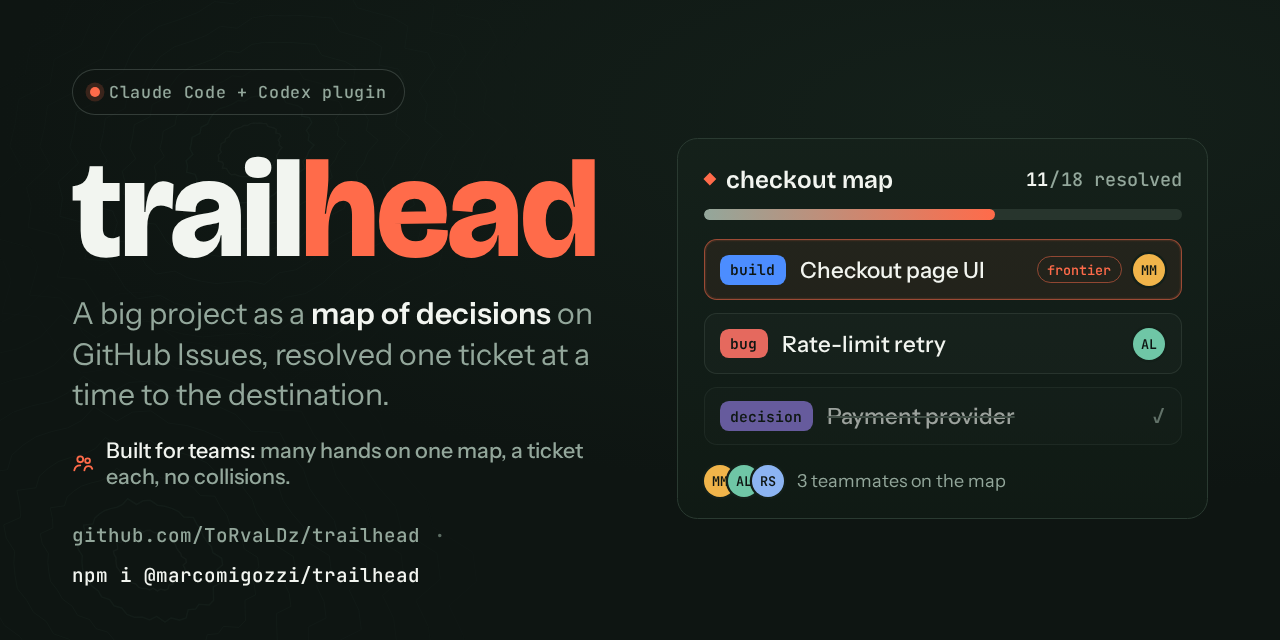
🇬🇧 English · 🇮🇹 Italiano






Your coding agent is brilliant at one ticket.
trailhead gives it the whole project.
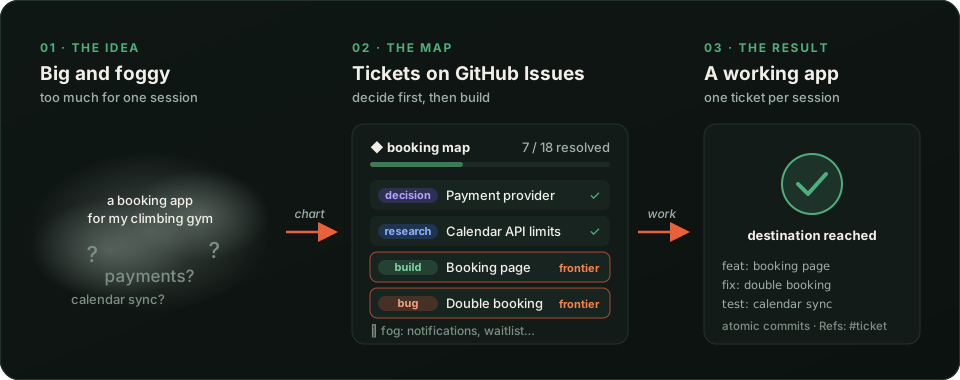
Start and drive large projects as a map of tickets on GitHub Issues,
resolving one at a time until the way to the destination is clear.
Documentation · Getting started · Commands · Changelog
🧭 The problem it solves
A real project doesn't fit in one agent session. Ask for "the whole app" and you get a confident guess; split it yourself and you become the project manager, the memory and the glue.
| 😵 Without trailhead | 🗺️ With trailhead |
|---|---|
| The agent guesses the big decisions and you find out three files later. | Decisions are tickets: options laid out, then a grilling, one question at a time, until you choose. |
| The plan lives in a chat that ends, or in local notes nobody else sees. | The plan lives on GitHub Issues: the map, the discussion, the plan and the verification, visible to the whole team. |
| Every session starts from zero: what was decided, what's left, what's next? | The frontier says what's takeable now; /trailhead:work picks it up with all the context. |
| Two agents in one checkout overwrite each other. | Assigning a ticket claims it, and each concurrent session gets its own worktree or clone. |
| "Done" means "it compiled". | Done means verified: tests, adversarial review and acceptance before the ticket closes. |
✨ What you get
🗺️ A map, not a listA big idea becomes one map issue with a child ticket for each decision, research question and piece of work. What you can't phrase yet waits in the fog until earlier answers clear it. |
⚙️ The right engine per ticketA decision is grilled to a choice, research gathers a fact, a build is planned and built, a bug is reproduced before it's fixed. |
🤖 Hand it a map, come back
|
👥 Built for teamsMany people and agents share one frontier, one ticket each. Pause, resume or split a ticket, and run several maps side by side. |
🎨 Mockups and acceptanceSee the screen before it's coded, and close a feature only after it was tried the way a user would. |
🛡️ Self-contained, with guardrailsNothing else to install: trailhead ships its own engine agents and ten guardrail hooks, on Claude Code and Codex CLI. |
⚙️ How a ticket gets built
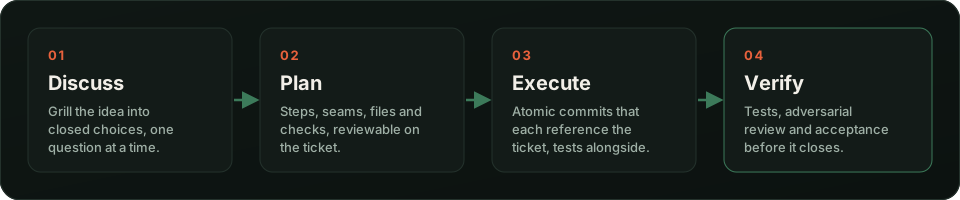
Every build ticket walks the same disciplined cycle, and every step is a comment on the ticket, so the reasoning stays next to the work.
🖥️ Live in Claude Code
The bundled mod puts the map beside the conversation: your tickets in progress, what needs you, and the frontier with a work button per ticket. A band above the prompt shows the ticket in play, and the session is named after it.
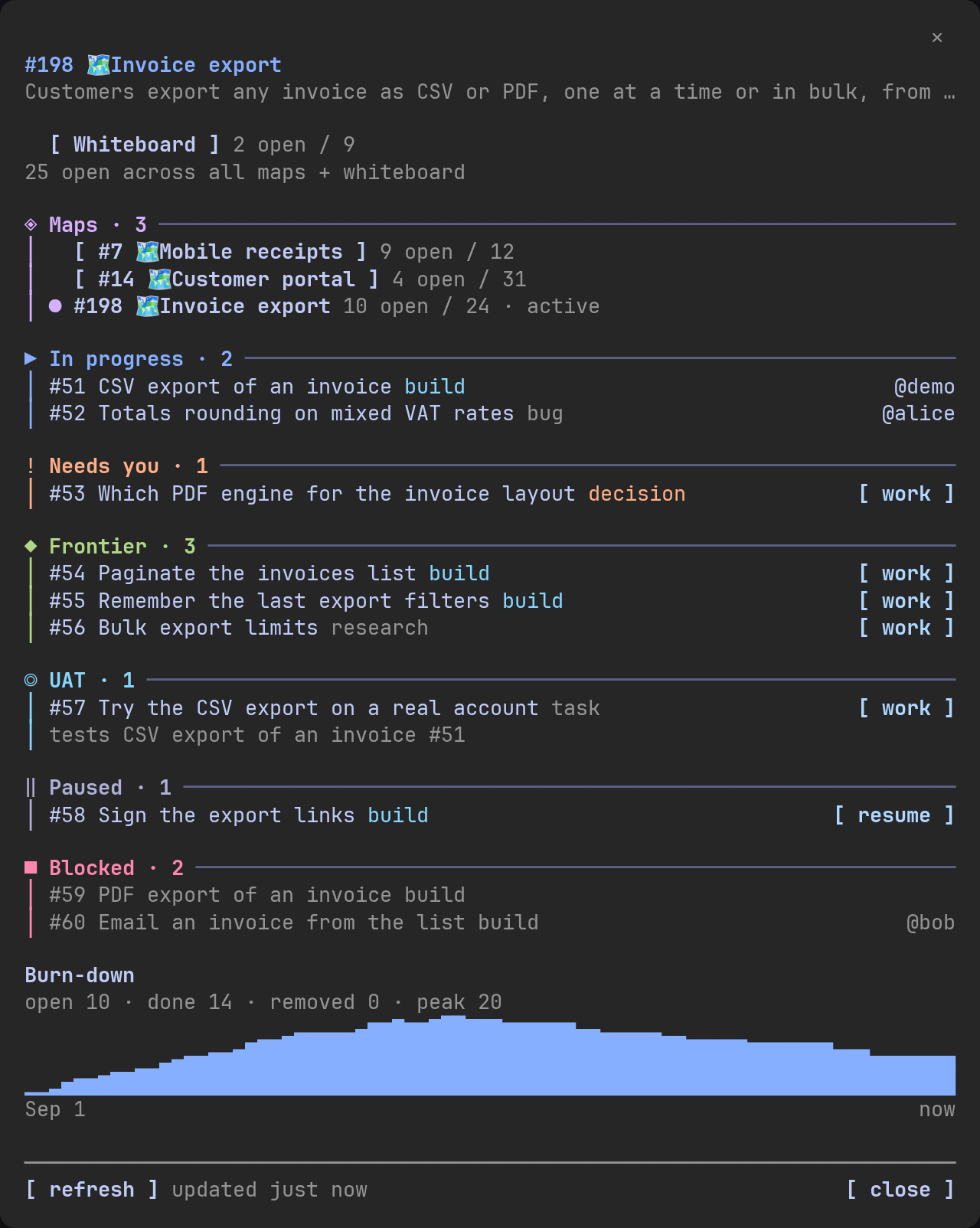 |
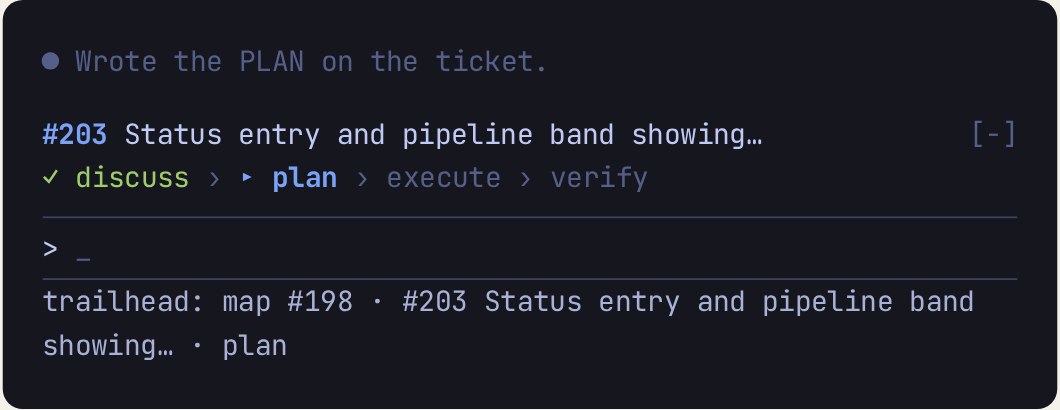
📍 Always know where you are. The band shows the ticket in play and its step: discuss, plan, execute, verify. ▶️ One click to start. Each frontier ticket has a work button that clears the context and starts it.
📉 See it shrink. The burn-down tracks the open tickets from the first one to the destination. |
🚀 Get started
You need an authenticated gh CLI and a GitHub repo.
# Claude Code plugin
/plugin marketplace add ToRvaLDz/trailhead
/plugin install trailhead@trailhead

# or with npm, for Claude Code or Codex CLI (Node 18+)
npx @marcomigozzi/trailhead
Then restart your agent and give it a destination:
/trailhead:new "a booking app for my climbing gym"   # chart a map from a loose idea
/trailhead:adopt                                     # or adopt an existing codebase
/trailhead:work                                      # work the next ticket on the frontier
On Codex the entry point is $trailhead. Every option is in Getting started.
📚 Learn more
| 🧠 Core concepts maps, frontier, fog, anchors |
🔄 Workflow the lifecycle and a worked example |
⌨️ Commands all 24 verbs |
| 👥 Working as a team claiming, isolation, CI capture |
🎨 Design mockups see it before it's built |
⚙️ Configuration models, TDD, isolation |
🙏 Acknowledgements
trailhead joins two ideas that each nail one half of the problem: a map of decisions to start a project, and a disciplined engine to build it. It is an original, self-contained methodology inspired by them. It does not copy or redistribute their code, and it invokes none of their skills; it reimplements the ideas as its own inline protocols:
- Matt Pocock: for Wayfinder, whose map / frontier / fog-of-war model is the backbone of trailhead's planning half, and whose
grilling,domain-modeling,prototype,research, andtddskills shaped trailhead's inline techniques. Seemattpocock/skills. - The open-gsd team: for GSD, whose
discuss → plan → execute → verifycycle, capture model, codebase mapping, and systematic debugging are the engine of trailhead's building half.
Thank you. If you like the ideas here, go star and use the originals: they go far deeper than trailhead's compact protocols.
MIT © Marco Migozzi (@ToRvaLDz) · trailhead.marcomigozzi.it