
The-Sentience-Company/easel has 61 GitHub stars and 5 forks. GitHot measured 0 stars in 24 hours and +1 in 7 days. Last checked 2026-11-15 21:09 UTC. Last push 2026-11-06.
Measured star growth
- in 24h
- 0
- in 7 days
- +1
- in 15 days
- Update delayed
- in 1 month
- Update delayed
Net star changes over overlapping periods, not daily totals. Missing measurements are left blank. Stars measure attention, not software quality.
About
A local review board for work an agent wants a human to look at — agent publishes, you annotate in the browser, feedback flows back as JSON.
AIREADME.md
Originaleasel
A local review board for work an agent wants a human to look at.
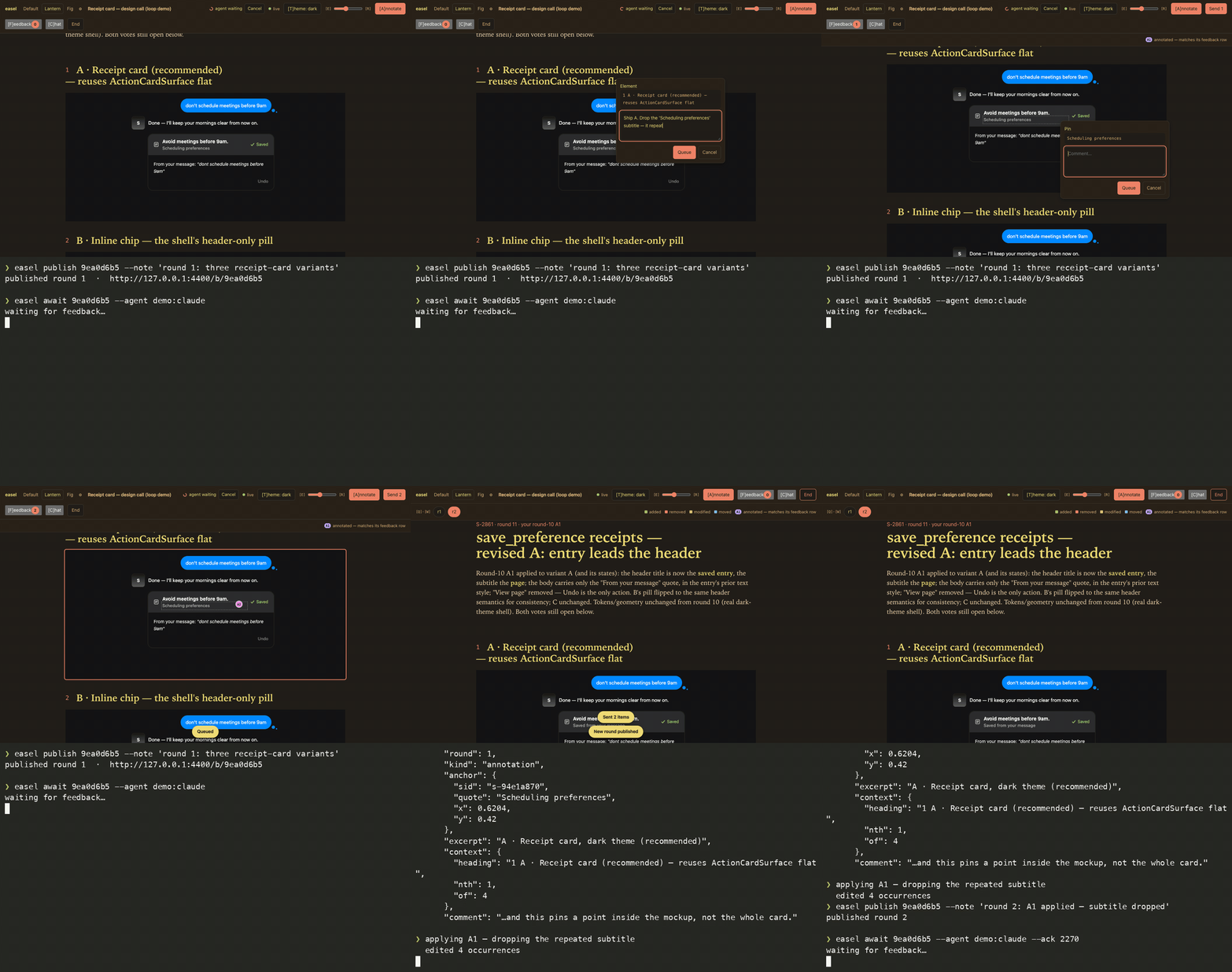
Above: the board in a browser. Below: the agent, blocked on one command, taking the feedback and republishing — the round it publishes lands in the open tab.
The agent publishes a page. You open it in a browser, annotate anything on it, and click Send. The agent — which has been blocked on a single command this whole time — gets your feedback back as JSON, applies it, and republishes. The second round arrives with diff markers showing exactly what changed since you last looked.
Nothing runs in the cloud. A easeld daemon runs under launchd on http://127.0.0.1:4400 and owns all state, so a board outlives the session that published it, survives a daemon restart, and can be handed between agents.
Screenshot tour → — a real review, round by round: annotations, decision widgets, diffs.
Why it exists
Agents produce work that is painful to review in a terminal: a plan, an eval run, a prompt diff, a comparison table, a design. The usual fallbacks are a wall of scrollback or a screenshot, and the feedback going back is a paragraph of prose describing which part you meant.
easel gives that exchange a page and a cursor. You point at the thing. The agent gets the annotation attached to the element you pointed at, and the next round shows you what moved.
Quickstart
Requires macOS and Node 22+. The install pulls a Chromium through Puppeteer, which mermaid-cli uses to render diagrams to SVG at publish time — expect the first npm install to be slow and roughly a gigabyte on disk.
git clone https://github.com/The-Sentience-Company/easel.git && cd easel
npm install                                    # deps + postinstall builds the whiteboard bundle
install/install.sh                             # idempotent; writes the plist, puts `easel` on PATH, waits for health
easel open --template page --data page.json    # → board key + URL
easel await <key> --agent my-project:claude    # blocks until you send feedback
Open the URL, annotate, hit Send — the blocked easel await returns your feedback as JSON and exits. Apply it, then easel publish <key> --note "round 2: …" republishes to the same key with diff markers against the previous round.
http://127.0.0.1:4400/ lists every board and marks which ones have an agent waiting on you.
Updates never install themselves. easel update is the manual upgrade; easel autoupdate on opts into a daily one — off by default because an auto-updater is standing permission to run whatever the remote ships next, and docs/usage.md § Auto-update explains the shipped one and why writing your own is worth the exercise.
The daemon sends an anonymous daily usage heartbeat; docs/usage.md § Telemetry says what it sends and how to turn it off.
To back out, install/install.sh --uninstall removes the agent, the plist, and the easel entry point. It leaves ~/.easel/ — your boards and database — deliberately intact; rm -rf ~/.easel is the separate, deliberate step that erases them.
The commands
| Command | Does |
|---|---|
easel open <file.html> |
publish a plain document |
easel open --template <review|eval|rulings|queue|page> --data <file.json> |
publish a structured board |
easel publish <key> --note "…" |
re-render the source as a new round |
easel await <key> --agent <id> |
block until feedback, cancel, or board end |
easel feedback <key> --since N |
read feedback without touching any cursor |
easel reply <key> <message> --agent <id> |
answer a chat message on the board |
easel status [key] |
list boards; warns when the daemon is behind its checkout |
easel end <key> |
close a board — reads keep working, writes 409 |
easel purge [--older-than 30d] |
delete untouched boards and shrink the DB |
easel update |
pull, rebuild, restart, health-check the installed checkout |
easel autoupdate on|off|status |
opt-in daily unattended update — off by default, deliberately |
easel telemetry on|off|status |
the anonymous daily heartbeat — on by default, what it sends |
What you get on the page
- Annotations on anything — any element or text selection. Each one gets a two-character badge (
A1,A2, …) shown both in the page gutter and on its feedback row, so you and the agent are always talking about the same anchor. - Rounds with diffs — republishing to the same key keeps the history. Round pills let you page back through every version, and changed blocks are marked added / modified / moved, down to word-level marks inside a diff block.
- Widgets — declare a
data-widget="vote|decision|approve|rating"with options and the daemon binds the behavior. Clicks queue as drafts alongside annotations and are delivered together on Send. - Diagrams you can draw on — a
```mermaidfence renders to inline SVG at publish time, and opens as an editable Excalidraw whiteboard in the browser. - Chat — for the feedback that has no anchor.
Nothing is delivered until you click Send, so a half-finished thought never wakes the agent.
Templates
| Template | Use it for |
|---|---|
review |
plans, designs, comparisons — prose sections plus decisions and votes |
eval |
eval runs — dossiers, blind compare, or an item matrix, chosen on data shape |
compare |
2–6 named arms side by side — before/after, variants — one verdict per case |
replay |
conversation exchanges replayed through 2–4 named arms — one reply per arm, one verdict per exchange |
gallery |
image candidates judged by looking — design concepts, generated imagery, UI states |
rulings |
labeled cases adjudicated one by one — answer keys, goldens, triage lists |
queue |
a worklist of items to triage |
page |
anything else — hand-authored HTML through the same shell and design system |
Templates take JSON and own their markup, so a generated board cannot reproduce the layout and contrast problems hand-written HTML kept hitting. Reach for page only when the shape genuinely is not one of the others; it accepts HTML composed from the shared sd-* class vocabulary.
Two things that bite
Sources need a durable home. Every publish re-reads the source file, so a path under /tmp breaks republish after a reboot. Keep sources somewhere permanent — ~/.easel/sources/ is the convention. Already-published rounds survive regardless; it is only re-rendering that breaks.
Agent ids are workspace-scoped. Use <workspace>:<name>, e.g. my-project-worktree:claude. A bare name collides with another workspace's, and the two then share a feedback cursor and supersede each other's waits. The server keeps one cursor per id, so the same id always resumes with exactly its unacked backlog — while a brand-new id replays the board's entire history.
Layout
| Path | Holds |
|---|---|
daemon/ |
the server: HTTP, SSE, waiters, store |
cli/easel.js |
every command above |
chrome/ |
the browser UI wrapped around a rendered round |
templates/ |
the publishable shapes |
render/ |
mermaid, diff, and excalidraw pre-render |
skills/ |
the agent-side guide — how an agent drives all of the above |
install/ |
installer, updater, launchd plist template |
docs/ |
usage.md (flow), api.md (routes), templates/page.md (the sd-* vocabulary), design-system.md |
Development
npm test                          # node --test
node render/build-excalidraw.mjs  # rebuild the whiteboard bundle
The e2e harness spawns scratch daemons on allocated ports, so the suite never touches your running daemon. Editing anything under chrome/, render/, daemon/, or templates/ and skipping the bundle rebuild fails the whole suite with a stale-bundle error rather than a scatter of unrelated assertion failures.
chrome/easel.css is read from disk per request, so style changes are live on save. Everything else is cached by the running daemon and needs a restart — install/install.sh does that for you, and after merging, easel update is what moves the resident daemon onto new code.
Credits
easel was built after using lavish-axi, which pioneered this loop — an agent writes an artifact, a local browser UI collects annotations, and a long poll carries the feedback back. easel takes the same idea toward durable multi-round boards: a persistent daemon, rounds with visual diffs between them, and per-agent feedback cursors that survive restarts. The dark theme and table treatment started from lavish's, which is MIT licensed.
License
Copyright © 2026 The Sentience Company.
easel is fully open source — not open core — under the Apache License 2.0. Run it at work, modify it, put it on every machine in the company, ship it inside something you sell. Nothing you write stays open because of us: the boards easel renders are yours, and so is anything that drives it over the HTTP API or the easel command. There is no separate commercial edition; this is the whole thing.
The one reservation is the name. Apache 2.0 grants no trademark rights (§6) — a fork is yours to distribute, but call it something other than easel. See NOTICE.