
Tencent-Hunyuan/FlashTopK
Tencent-Hunyuan/FlashTopK has 14 GitHub stars and 2 forks. GitHot measured +1 stars in 24 hours. Last checked 2026-11-11 06:09 UTC. Last push 2026-11-09.
Fast, exact fused top-k selection for learned sparse attention training and inference, from HyScale (Tencent Hy).
What you can do
- Fast: the fastest open-source implementation.
- Robust: stays fast on trained and untrained indexers. Adaptive key pruning decides per call whether to skip keys by a score bound.
- Exact: the true top-k. Rows the sampled threshold misses are rescored on the GPU.
- Deterministic: the same bits on every run. Ties at the k-th score keep the smallest key indices.
Measured star growth
- in 24h
- +1
- in 7 days
- Update delayed
- in 15 days
- Update delayed
- in 1 month
- Update delayed
Net star changes over overlapping periods, not daily totals. Missing measurements are left blank. Stars measure attention, not software quality.
README.md
Original
FlashTopK: Fast Fused Top-k Selection for Sparse Attention Training and Inference


FlashTopK is a fast, exact and deterministic fused top-k selection kernel for learned sparse attention, in both training and inference.
On a full prefill, FlashTopK is 1.7-3.3x faster than dense scoring + FlashInfer top-k (DeepGEMM / cuDNN scoring) on trained indexers, and 1.2-2.0x faster on untrained indexers.
News
[2026/10] We have released HyScale: Scaling Long-Context Training for Learned Sparse Attention.
Highlights
- Fast: the fastest open-source implementation.
- Robust: stays fast on trained and untrained indexers. Adaptive key pruning decides per call whether to skip keys by a score bound.
- Exact: the true top-k. Rows the sampled threshold misses are rescored on the GPU.
- Deterministic: the same bits on every run. Ties at the k-th score keep the smallest key indices.
- CP-compatible: each row's threshold comes from a strided sample of its own window, so context parallelism needs no selection from another rank.
Support
| Sparse attention | Models | GPUs | Operands |
|---|---|---|---|
| Token-level selection, as in DeepSeek Sparse Attention (DSA) | GLM-5.1, GLM-5.2, GLM-5.3, GLM-5.3-Flash, Hy4-preview: indexers of 32 heads × 128 | NVIDIA Hopper (SM90): H800, H20, H100, H200; NVIDIA SM100 and SM103 | FP8 or BF16, topk up to 4096 |
Hardware and model support lists which GPUs are tuned.
Getting started
Install
FlashTopK needs Python 3.10+, PyTorch 2.6+, Triton 3.3+ and CuTe DSL (nvidia-cutlass-dsl) 4.5+. SM100 GPUs also need a CUDA 12.8+ driver.
pip install -e .            # torch >= 2.6, triton >= 3.3, nvidia-cutlass-dsl >= 4.5, apache-tvm-ffi
pip install -e .[test]      # pytest for the test suite
Quick start
For each query t, FlashTopK selects the topk keys s of its window [ks[t], ke[t]) with the largest indexer score:
I_{t,s} = \sigma_s \sum_{h=1}^{H_I} w_{t,h}\,\mathrm{ReLU}\big(\mathbf{q}_{t,h}^{\top}\mathbf{k}_s\big)
Here qt,h is head h of q[t], ks is kv[s], wt,h is head h's weight in weights[t], σs is kv_scales[s] (1 for BF16 keys) and HI = 32 is the number of heads. A causal prefill chunk of 4096 queries over 128K FP8 keys:
import torch
import flashtopk

num_q, seq_len_kv = 4096, 128 * 1024
q = torch.randn(num_q, 32, 128, device="cuda").to(torch.float8_e4m3fn)        # 32 heads of dimension 128
kv = torch.randn(seq_len_kv, 128, device="cuda").to(torch.float8_e4m3fn)       # one key per token
kv_scales = torch.rand(seq_len_kv, device="cuda") * 0.02 + 0.01                # FP8 keys need per-key scales
weights = torch.randn(num_q, 32, device="cuda") * 0.1                          # per-head weights, float32

# The queries are the last num_q tokens: query i sees keys [0, seq_len_kv - num_q + i + 1).
ke = torch.arange(seq_len_kv - num_q + 1, seq_len_kv + 1, device="cuda", dtype=torch.int32)
ks = torch.zeros_like(ke)

indices = flashtopk.select(q, kv, weights, ks, ke, kv_scales, topk=2048)  # [4096, 2048] int32
The first call in a process compiles the kernels it needs, about 15 seconds in all. Selector.plan() compiles them up front.
Usage
flashtopk.select(q, kv, weights, ks, ke, kv_scales=None, topk=2048, ...)  # indices; return_scores=True adds scores
selector = flashtopk.Selector(topk=2048, dtype=...).plan(max_rows, max_kv)  # owns the workspace, compiles up front
selector.run(q, kv, weights, ks, ke, kv_scales)                             # select's arguments and outputs
torch.ops.flashtopk.select(...)                                             # select as a custom op, for torch.compile
flashtopk.windows_from_cu_seqlens(cu_seqlens_q, cu_seqlens_k)               # causal windows of packed sequences
The API reference covers every argument, the workspace, last_info, configuration and training with context parallelism.
Performance
Speedup of one full prefill (query rows = keys = the sequence length) over dense scoring + FlashInfer top-k on H800, with FP8 or BF16 operands. The performance report has H20 and SM100 as well.
Trained indexer
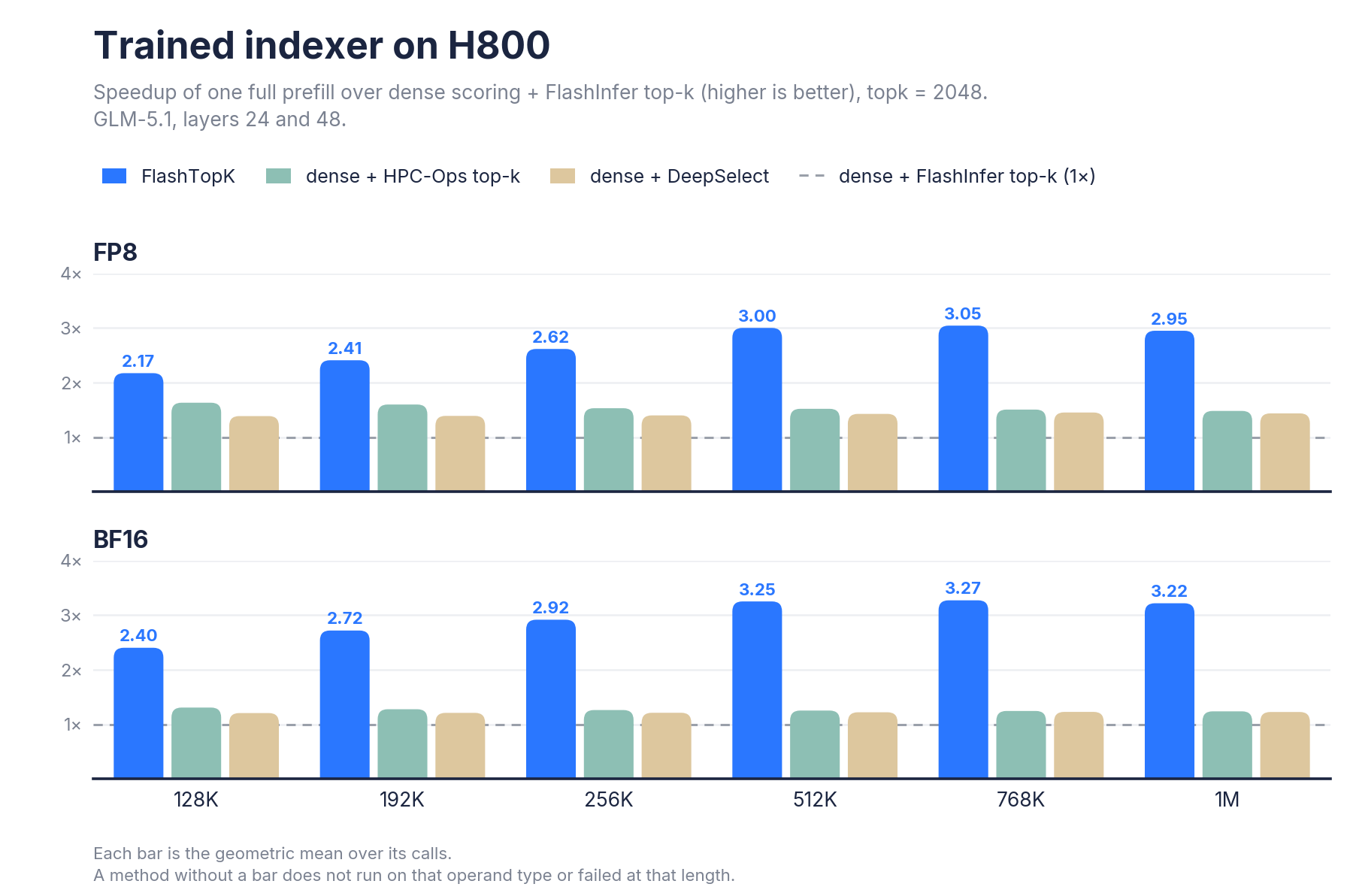
FlashTopK is the fastest at every length, and its lead grows with the length.
Untrained indexer
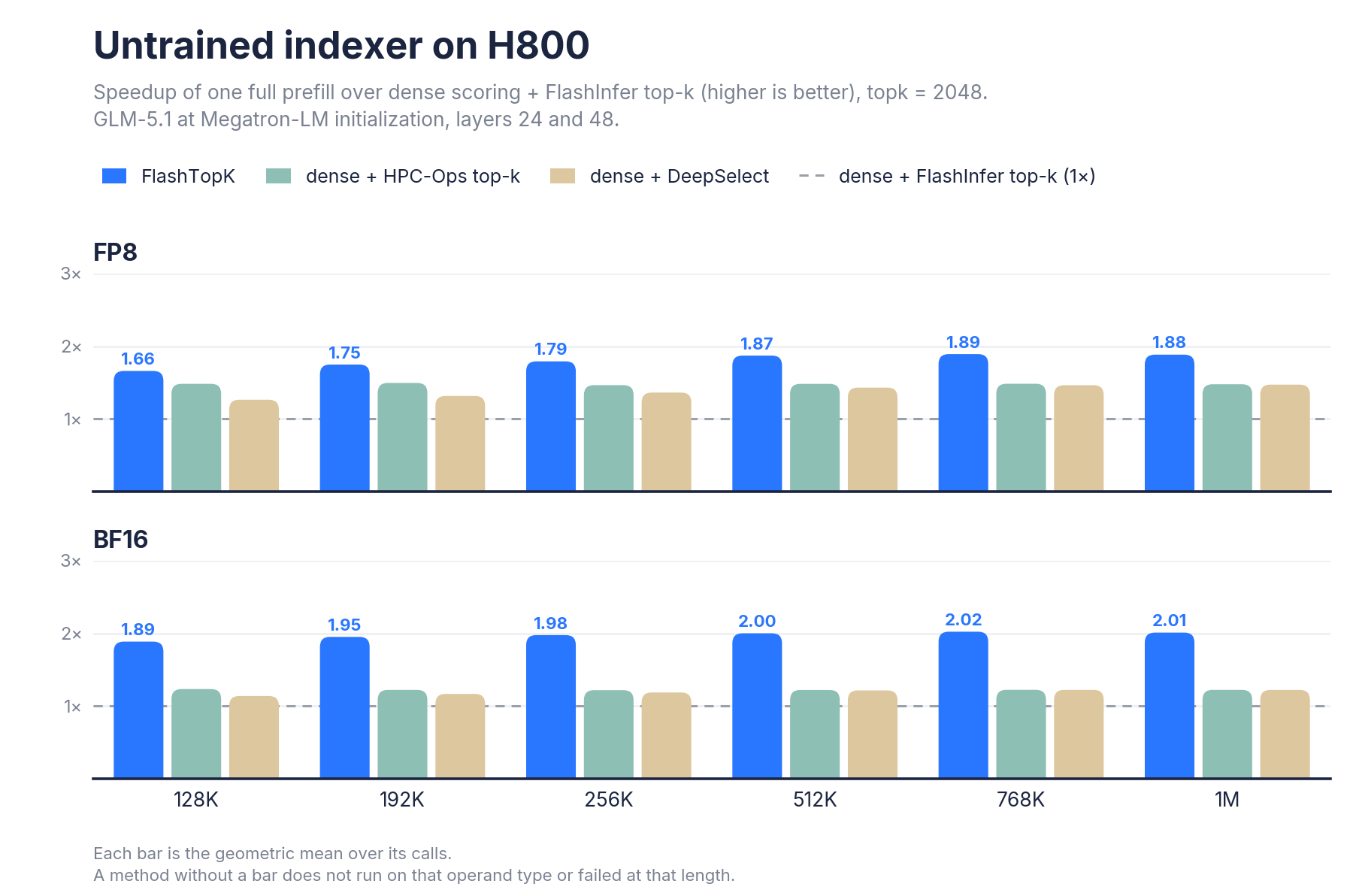
The score bound skips few keys, so FlashTopK mostly scans; it still leads at every length.
The performance report describes the setup and the methods compared. It also has the results on random indexer weights and keys. reproduce/ provides pinned setup, inputs, comparison benchmarks and scripts to regenerate the figures.
Roadmap
- Block-level learned sparse attention, such as CSA in DeepSeek-V4 and QSA in Qwen3.8-Flash-Next.
- Paged KV cache; today the keys must be contiguous, with one contiguous window per query row.
- Indexers with other head counts, such as the 64 heads of DeepSeek-V3.2.
License
FlashTopK is released under the Apache License 2.0. See LICENSE and NOTICE for details.
Acknowledgments
FlashTopK builds on FlashInfer and TensorRT-LLM (the SM100 scan pipeline, which the pruning and refine kernels share), LiteTopK (gate calibration and candidate selection) and DoSA (the score bound of key pruning). NOTICE lists the files each part derives from.
Citation
@misc{deng2026hyscale,
  title         = {HyScale: Scaling Long-Context Training for Learned Sparse Attention},
  author        = {Yangshen Deng and Xinjing Huang and Yulong Wang and Yunzhuo Liu and Jun Hu and Shuyong Tan and Chun-Chih Tseng and Mingji Han and Ray Ying and Key Zhang and Luo Mai},
  year          = {2026},
  eprint        = {2610.32057},
  archivePrefix = {arXiv},
  primaryClass  = {cs.AI},
  url           = {https://arxiv.org/abs/2610.32057},
}
Explore related projects
tensorflow/tensorflow
An Open Source Machine Learning Framework for Everyone
201,505 starshuggingface/transformers
🤗 Transformers: the model-definition framework for state-of-the-art machine learning models in text, vision, audio, and multimodal models, for both inference and training.
168,815 starsAUTOMATIC1111/stable-diffusion-webui
Stable Diffusion web UI
165,289 starsComfy-Org/ComfyUI
The most powerful and modular diffusion model GUI, api and backend with a graph/nodes interface. The fastest local inference engine in the world.
146,271 stars