
TangYuan96/MiniGPT-3D
TangYuan96/MiniGPT-3D has 132 GitHub stars and 9 forks. GitHot measured 0 stars in 24 hours. Last checked 2026-11-16 18:57 UTC. Last push 2026-03-20.
Measured star growth
- in 24h
- 0
- in 7 days
- Collecting history
- in 15 days
- Collecting history
- in 1 month
- Collecting history
Net star changes over overlapping periods, not daily totals. Missing measurements are left blank. Stars measure attention, not software quality.
About
[MM 2024] [Need only a 3090] MiniGPT-3D: Efficiently Aligning 3D Point Clouds with Large Language Models using 2D Priors
AIREADME.md
Original
MiniGPT-3D: Efficiently Aligning 3D Point Clouds with Large Language Models using 2D Priors
Yuan Tang Xu Han Xianzhi Li* Qiao Yu Yixue Hao Long Hu Min Chen
Huazhong University of Science and Technology South China University of Technology





🏠 About

🔥 News
- [2024-08] 💥 We release the training and inferencing codes, model checkpoints of paper, and the gradio demo codes for MiniGPT-3D.
- [2024-08] 🍾 Check out our exploration of 3D data-efficient point-language understanding GreenPLM.
- [2024-07] 🎉 Our Mamba3D is also accepted by ACM MM 2024! We achieve 92.64% Acc. SoTA on the ScanObjectNN supervised learning classification with only linear complexity! Check it out!
- [2024-07] 🎉 Our MiniGPT-3D is accepted by ACM MM 2024!
- [2024-05] 💥 We release the paper of MiniGPT-3D.
📋 Contents
- 🔍 Overview
- 💬 Dialogue Examples
- 📦 Training and Evaluation
- 📝 TODO List
- 🔗 Citation
- 📄 License
- 📚 Related Work
- 👏 Acknowledgements
🔍 Overview
Model
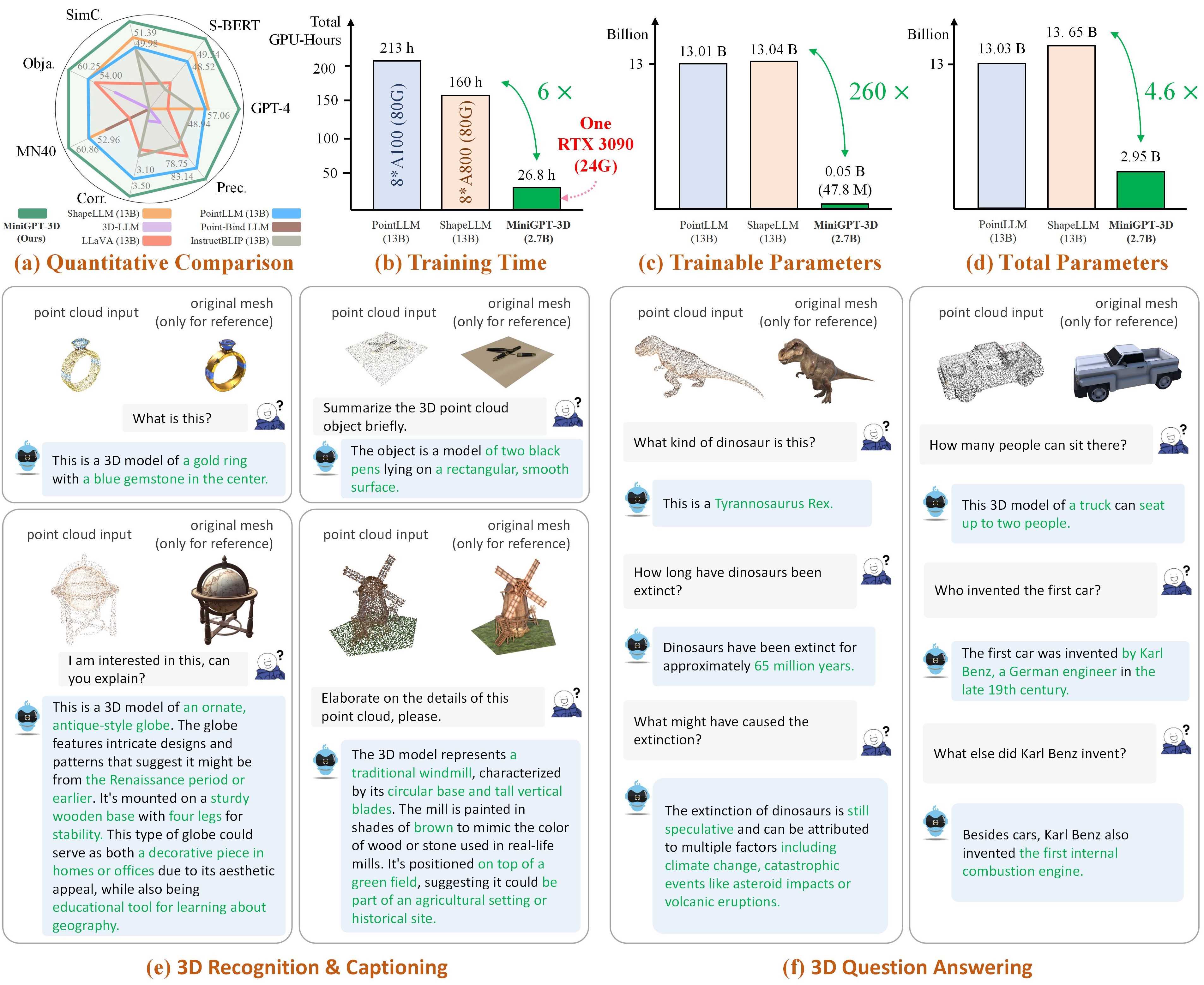
- We present MiniGPT-3D, an efficient and powerful 3D-LLM that aligns 3D points with LLMs using 2D priors. It is trained with 47.8 M learnable parameters in just 26.8 hours on a single RTX 3090 GPU.
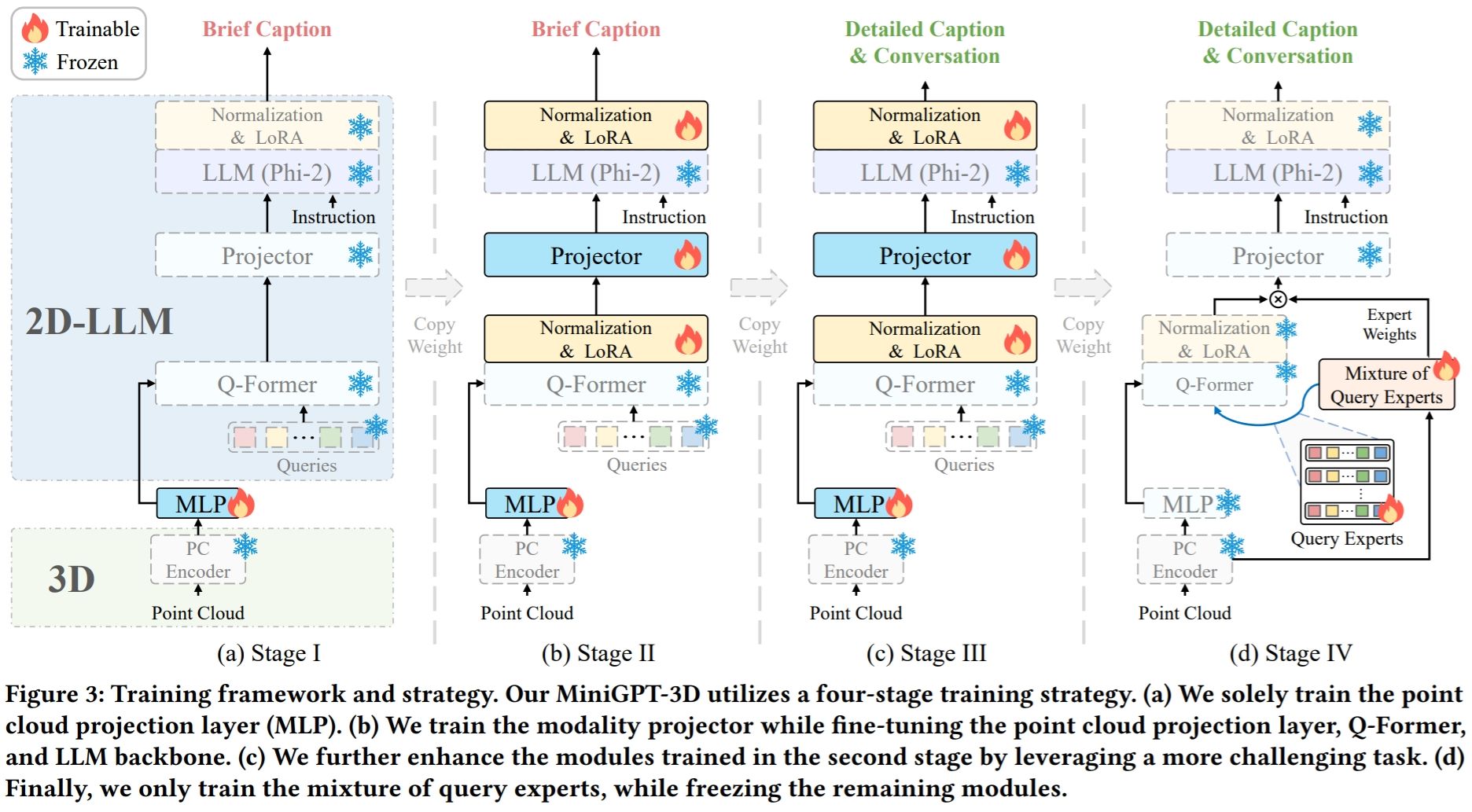
- We propose an efficient four-stage training strategy in a cascaded way, gradually transferring the knowledge from 2D-LLMs.
- We design the mixture of query experts to aggregate multiple features from different experts with only 0.4M parameters.
- Extensive experiments show the superior performance of MiniGPT-3D on multiple tasks while reducing the training time and parameters by up to 6x and 260x, respectively.
Note: MiniGPT-3D takes the first step in efficient 3D-LLM, we hope that MiniGPT-3D can bring new insights to this community.
Experiment Results
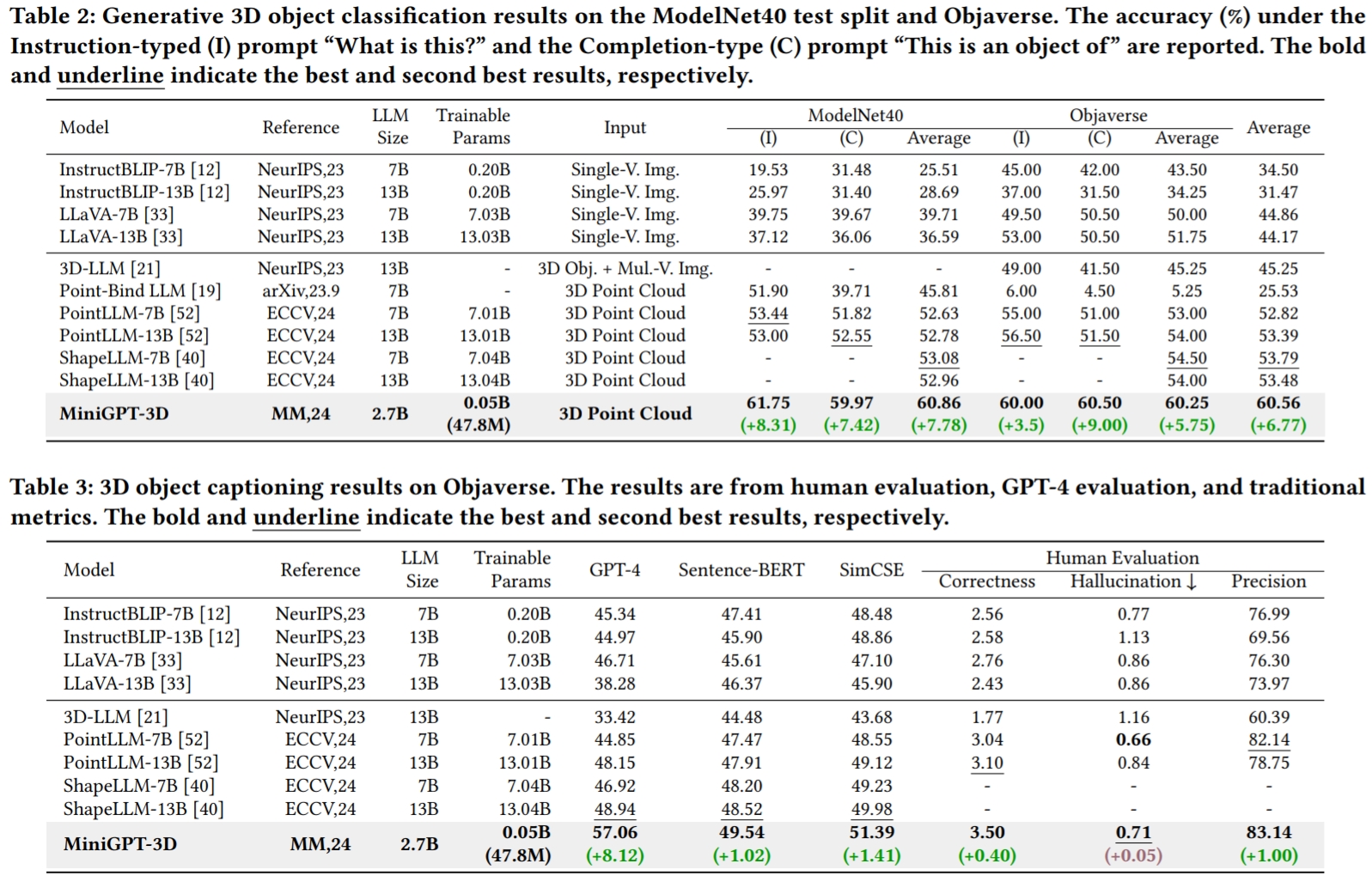
Quantitative Comparisons with baselines [Using close-source LLM GPT-3.5 and GPT-4 to evaluate].
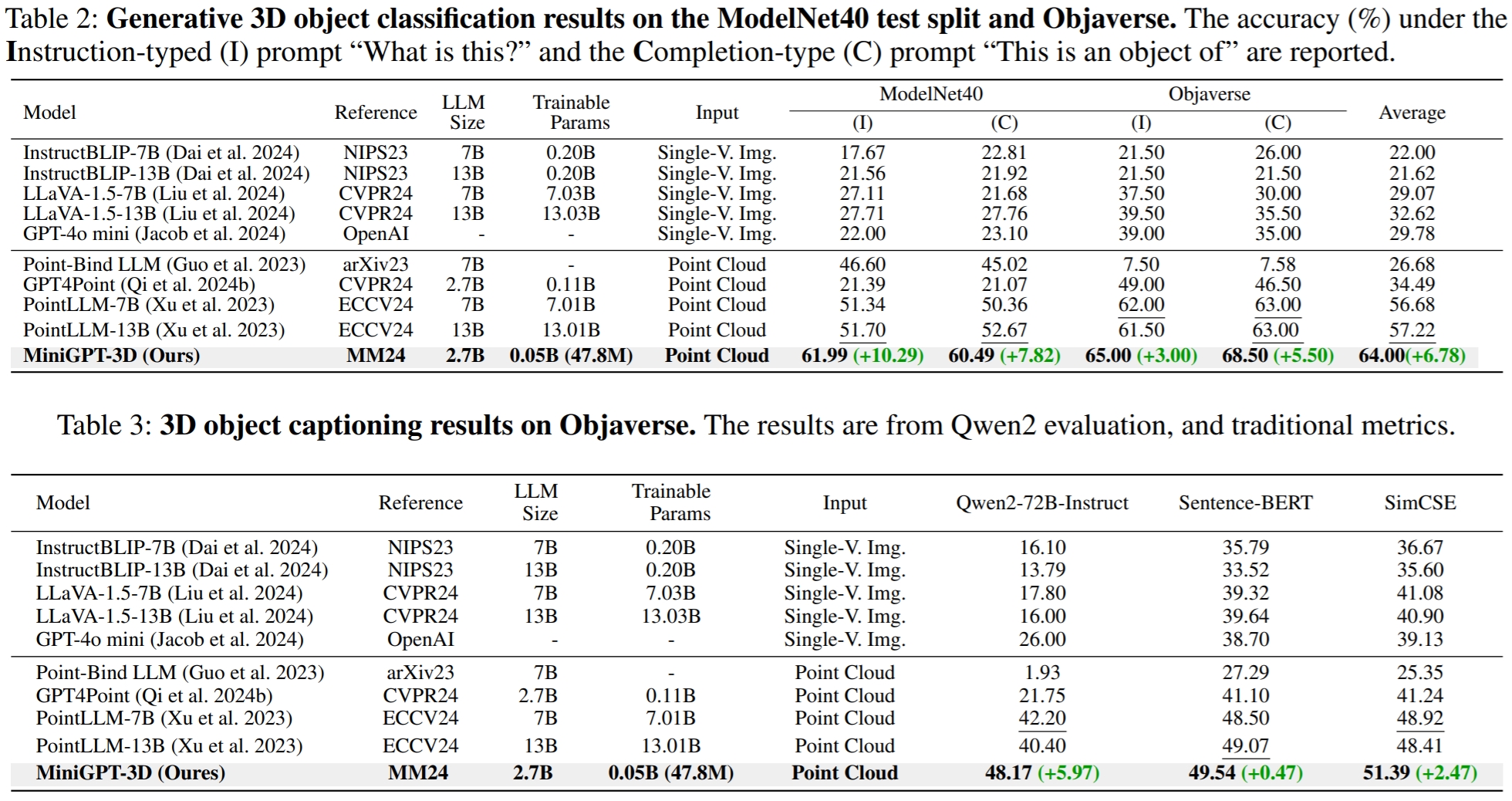
Quantitative Comparisons with baselines [Using open-source LLM Qwen2-72B-Instruct to evaluate]
The results refer from GreenPLM.
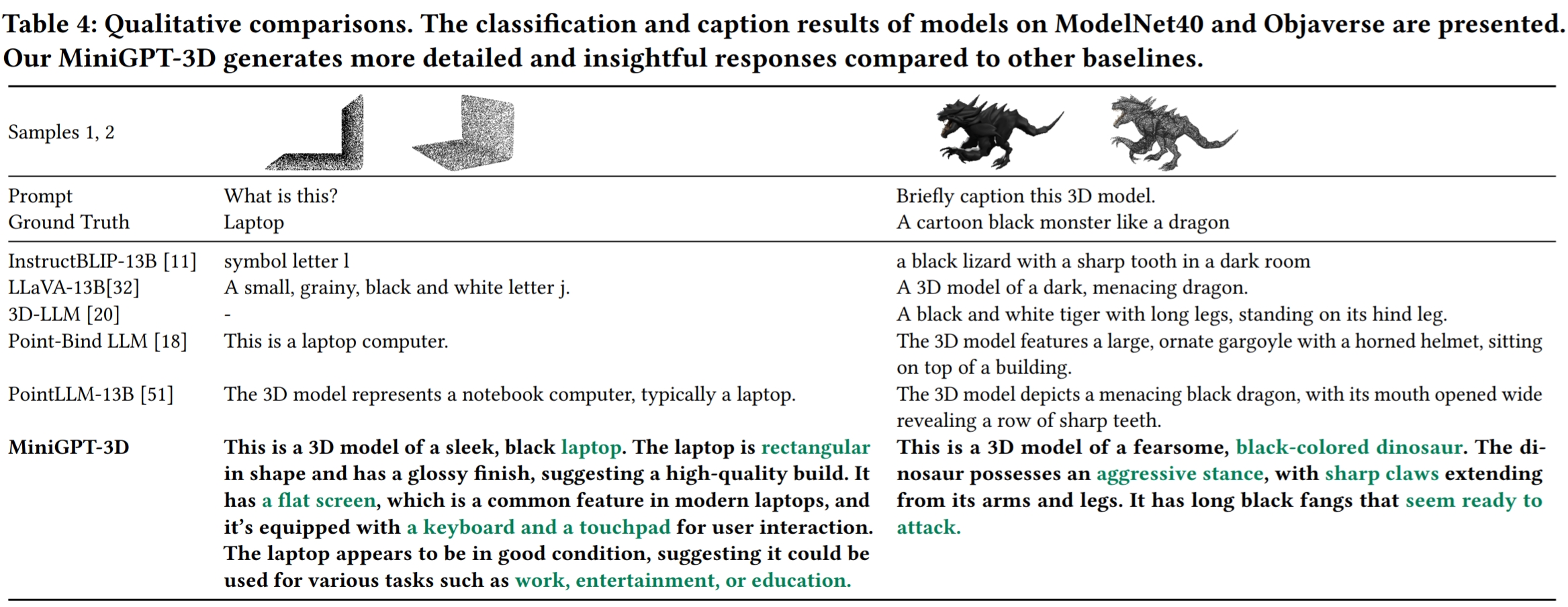
Qualitative Comparisons with baselines.
💬 Dialogue Examples
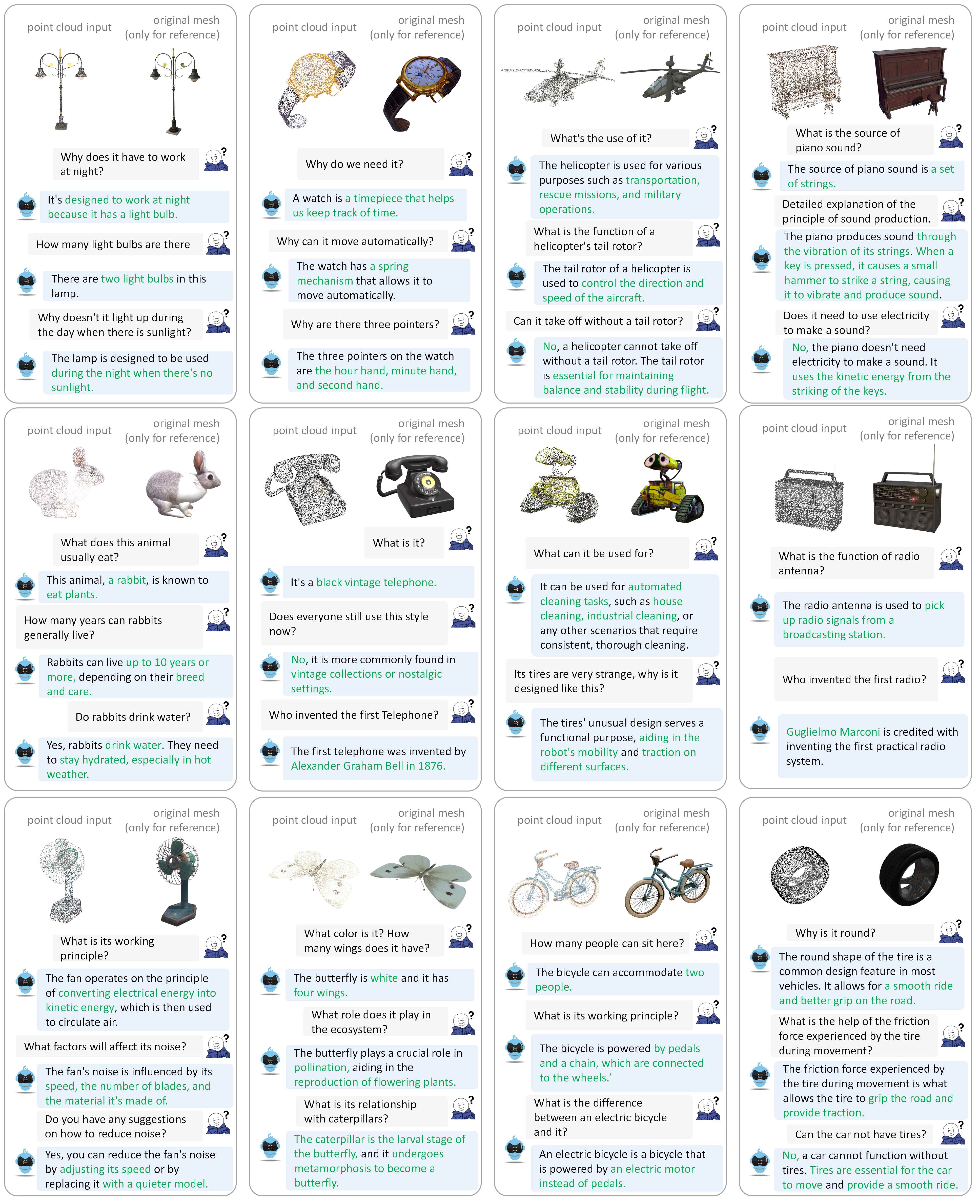
Please refer to our paper for more dialogue examples.
📦 Training and Evaluation
Installation
We test our codes under the following environment:
- One RTX 3090 GPU (24G)
- Ubuntu 18.04.5
- NVIDIA Driver: 515.105.01
- CUDA 11.7
- Python 3.9.18
- Pytorch 2.0.0
To start:
Clone this repository.
git clone https://github.com/TangYuan96/MiniGPT-3D.git
cd MiniGPT-3D
Install packages
By default, you have installed conda.
conda env create -f environment.yml
conda activate minigpt_3d
bash env_install.sh
Data Preparation
- Download all data files. They require about 78GB of storage space.
- Organize 660K Objaverse colored point clouds. Run the following command to merge the two files into one and uncompress it. This will produce a folder named
8192_npycontaining 660K point cloud files named{Objaverse_ID}_8192.npy. Each file is a numpy array with dimensions (8192, 6), where the first three dimensions arexyzand the last three dimensions arergbin [0, 1] range.
Then, move all files incat Objaverse_660K_8192_npy_split_a* > Objaverse_660K_8192_npy.tar.gz tar -xvf Objaverse_660K_8192_npy.tar.gz8192_npyfolder to./data/objaverse_datafolder. - Organize annotation files. Move all json files and txt files to
./data/anno_datafolder. - Organize the test data file of ModelNet40. Move
modelnet40_test_8192pts_fps.datto./data/modelnet40_datafolder.
Finally, the overall data directory structure should be:
MiniGPT-3D/data
|-- anno_data
|   |-- PointLLM_brief_description_660K.json
|   |-- PointLLM_brief_description_660K_filtered.json
|   |-- PointLLM_brief_description_val_200_GT.json
|   |-- PointLLM_complex_instruction_70K.json
|   |-- object_ids_660K.txt
|   `-- val_object_ids_3000.txt
|-- modelnet40_data
|   |-- modelnet40_test_8192pts_fps.dat
|-- objaverse_data
|   |-- 00000054c36d44a2a483bdbff31d8edf_8192.npy
|   |-- 00001ec0d78549e1b8c2083a06105c29_8192.npy
|   .......
Weight Preparation
We sort out the model weights required by MiniGPT-3D during training and inference.
- Download model weights.
- Move the the
params_weightfolder toMiniGPT-3Dproject folder.
Finally, the overall data directory structure should be:
MiniGPT-3D
|-- params_weight
|   |-- MiniGPT_3D_stage_3       # Our MiniGPT-3D stage III weight, needed to verify the results of paper
|   |-- MiniGPT_3D_stage_4       # Our MiniGPT-3D stage IV weight, Needed to verify the results of paper
|   |-- Phi_2                    # LLM weight
|   |-- TinyGPT_V_stage_3        # 2D-LLM weights including  loRA & Norm of LLM and  projector
|   |-- all-mpnet-base-v2        # Used in the caption traditional evaluation
|   |-- bert-base-uncased        # Used in initialize Q-former
|   |-- pc_encoder               # point cloud encoder
|   `-- sup-simcse-roberta-large # Used in the caption traditional evaluation
|-- train_configs
|   `-- MiniGPT_3D
|   .......
Gradio Conversation Demo
You can run the following command to start a local gradio conversation demo:
python UI_demo.py --cfg-path ./eval_configs/MiniGPT_3D_conv_UI_demo.yaml --gpu-id 0Then, copy the link
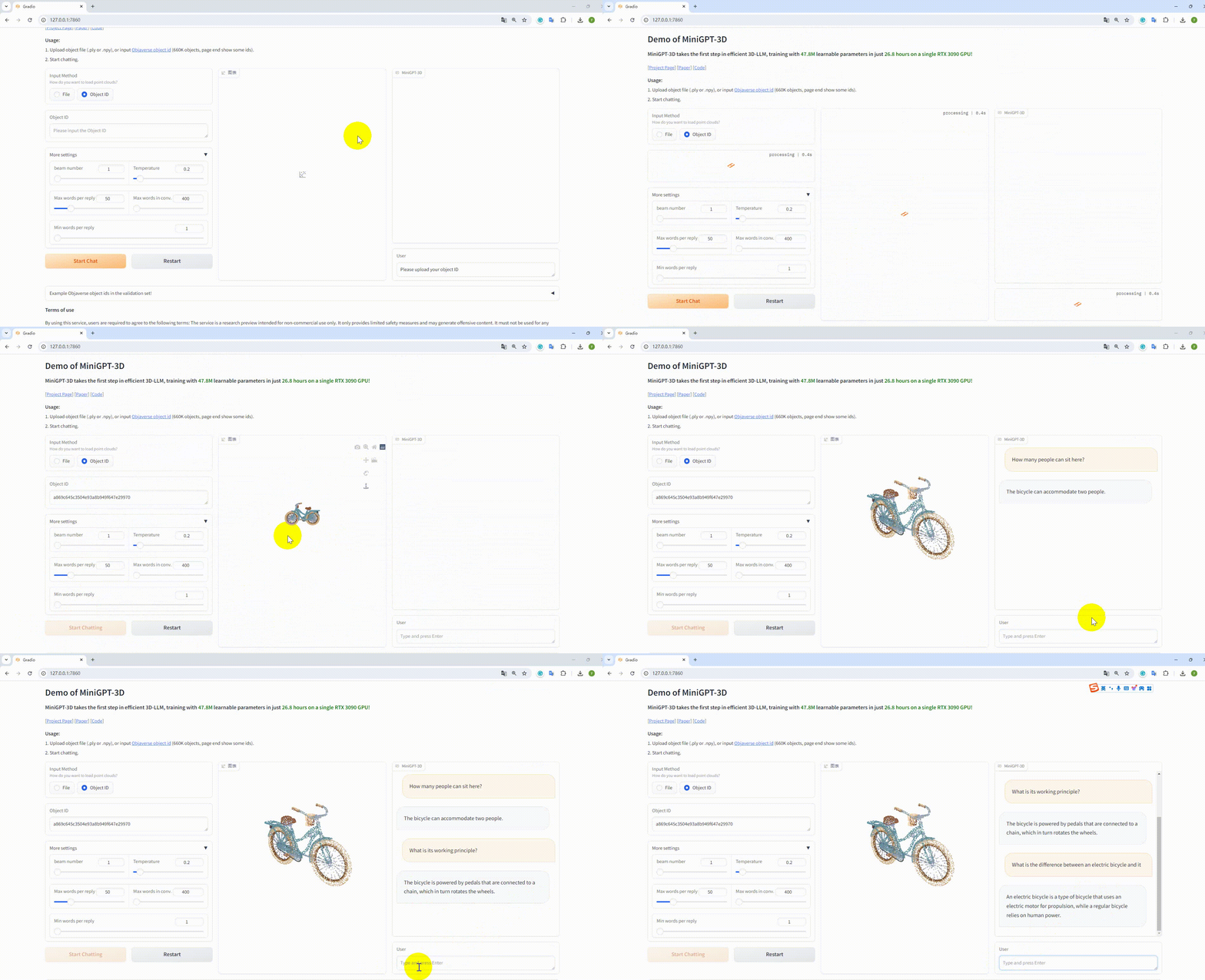
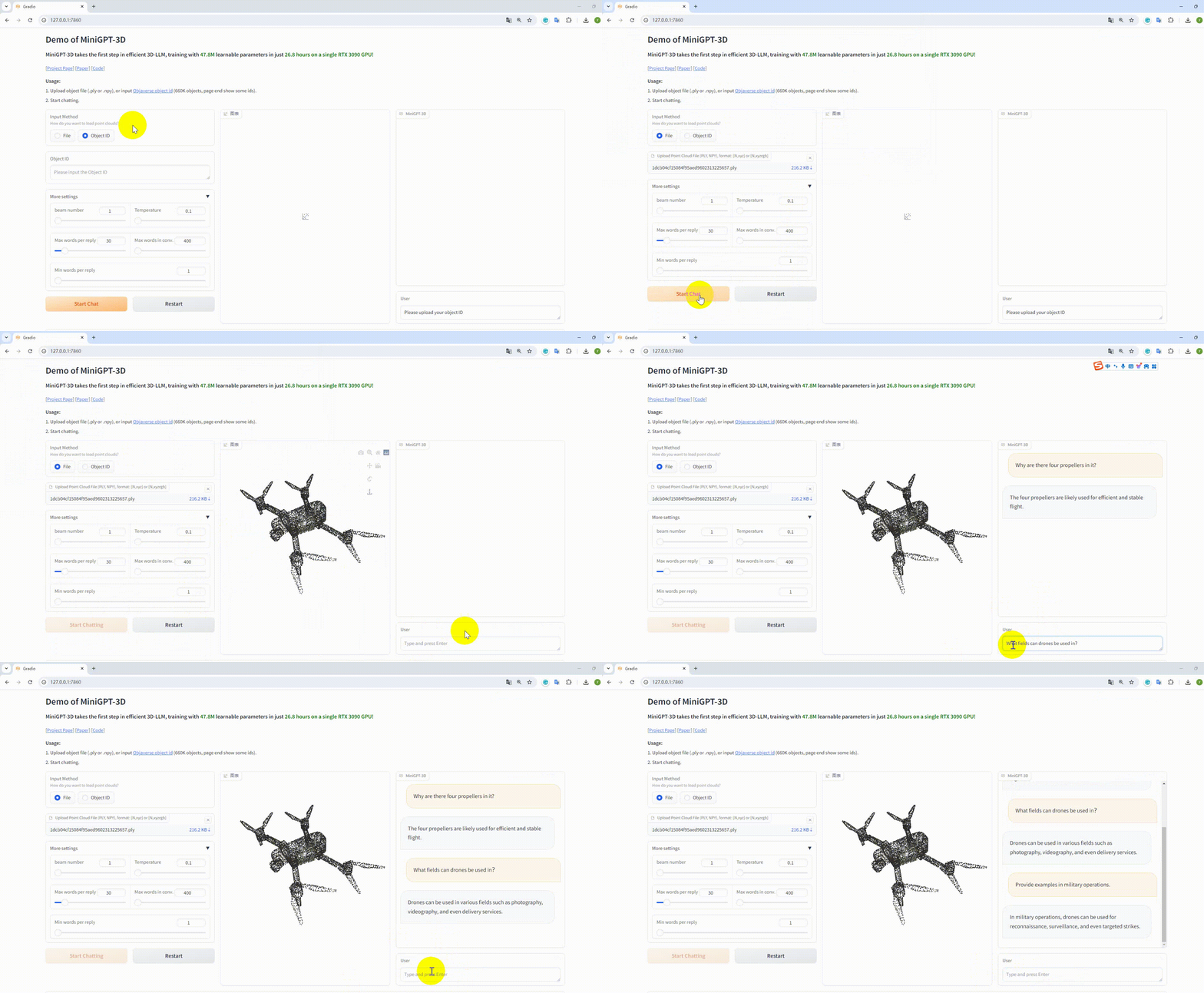
http://127.0.0.1:7860/to your browser, you can input the supported Objaverse object id (660K objects) or upload one object file (.ply or .npy) to talk with our MiniGPT-3D.
Example: Input the object ID:
Example: Upload the object file:
Train
Edit the output path of each Stages
If you want to use the default output path of each Stages, you can ignore the following steps.
- Set your output path of Stage I to here at Line 44 and here at Line 8.
- Set your output path of Stage II to here at Line 51 and here at Line 7.
- Set your output path of Stage III to here at Line 66 and here at Line 7.
- Set your output path of Stage IV to here at Line 66.
Train Stage I
CUDA_VISIBLE_DEVICES=0 python train.py --cfg-path ./train_configs/MiniGPT_3D/stage_1.yaml
Train Stage II
CUDA_VISIBLE_DEVICES=0 python train.py --cfg-path ./train_configs/MiniGPT_3D/stage_2.yaml
Train Stage III
CUDA_VISIBLE_DEVICES=0 python train.py --cfg-path ./train_configs/MiniGPT_3D/stage_3.yaml
Train Stage IV
CUDA_VISIBLE_DEVICES=0 python train.py --cfg-path ./train_configs/MiniGPT_3D/stage_4.yaml
Evaluation
A. Set the output path of Stage III & IV in evaluation configuration
If you just want to verify the results of our paper, you can ignore the following steps:
Set your the output path of Stage III to here at Line 8.
Set your the output path of Stage IV to here at Line 9.
B. Output the result jsons
Output the result of open vocabulary classification on objaverse
# Prompt 0:
export PYTHONPATH=$PWD
CUDA_VISIBLE_DEVICES=0 python pointllm/eval/eval_objaverse.py --out_path ./output/test --task_type classification  --cfg-path ./eval_configs/benchmark_evaluation_paper.yaml    --prompt_index 0
# Prompt 1: export PYTHONPATH=$PWD CUDA_VISIBLE_DEVICES=0 python pointllm/eval/eval_objaverse.py --out_path ./output/test --task_type classification --cfg-path ./eval_configs/benchmark_evaluation_paper.yaml --prompt_index 1Output the result of close-set zero-shot classification on ModelNet40
# Prompt 0:
export PYTHONPATH=$PWD
CUDA_VISIBLE_DEVICES=0 python pointllm/eval/eval_modelnet_cls.py --out_path ./output/test  --cfg-path ./eval_configs/benchmark_evaluation_paper.yaml    --prompt_index 0
# Prompt 1: export PYTHONPATH=$PWD CUDA_VISIBLE_DEVICES=0 python pointllm/eval/eval_modelnet_cls.py --out_path ./output/test --cfg-path ./eval_configs/benchmark_evaluation_paper.yaml --prompt_index 1Output the result of object captioning on objaverse
export PYTHONPATH=$PWD
CUDA_VISIBLE_DEVICES=0 python pointllm/eval/eval_objaverse.py --out_path ./output/test  --task_type captioning  --cfg-path ./eval_configs/benchmark_evaluation_paper.yaml    --prompt_index 2
C. Evaluate Json Results
a. Evaluate with close-source LLM from OpenAI [Not recommended]
In GreenPLM, we have noticed that the close-source LLMs GPT-3.5 and GPT-4 have two major drawbacks: inconsistent API versions and high evaluation costs (~35 CNY or 5 USD per one evaluation). For instance, the GPT-3.5-turbo-0613 model used in PointLLM and our MiniGPT-3D is no longer maintained, making it difficult to replicate the results.
The following steps are for evaluation using OpenAI API. Maybe it does not work! (click to expand)
- Evaluate the open vocabulary classification on objaverse
   export PYTHONPATH=$PWD
   export OPENAI_API_KEY=sk-****
   python pointllm/eval/evaluator.py --results_path /path/to/evaluation/PointLLM_brief_description_val_200_GT_Objaverse_classification_prompt0.json  --model_type gpt-4-0613 --eval_type open-free-form-classification --parallel --num_workers 15
   export PYTHONPATH=$PWD
   export OPENAI_API_KEY=sk-****
   python pointllm/eval/evaluator.py --results_path /path/to/evaluation/PointLLM_brief_description_val_200_GT_Objaverse_classification_prompt1.json  --model_type gpt-4-0613 --eval_type open-free-form-classification --parallel --num_workers 15
- Evaluate the close-set zero-shot classification on ModelNet40
   export PYTHONPATH=$PWD
   export OPENAI_API_KEY=sk-****
   python pointllm/eval/evaluator.py --results_path /path/to/evaluation/ModelNet_classification_prompt0.json  --model_type gpt-3.5-turbo-0613 --eval_type modelnet-close-set-classification --parallel --num_workers 15
   export PYTHONPATH=$PWD
   export OPENAI_API_KEY=sk-****
   python pointllm/eval/evaluator.py --results_path /path/to/evaluation/ModelNet_classification_prompt1.json  --model_type gpt-3.5-turbo-0613 --eval_type modelnet-close-set-classification --parallel --num_workers 15
- Evaluate the object captioning on objaverse
export PYTHONPATH=$PWD
export OPENAI_API_KEY=sk-****
python pointllm/eval/evaluator.py --results_path /path/to/evaluation/PointLLM_brief_description_val_200_GT_Objaverse_captioning_prompt2.json --model_type gpt-4-0613 --eval_type object-captioning --parallel --num_workers 15
b. Evaluate with open-source Qwen2-72B-Instruct [Recommend]
In GreenPLM, we propose new 3D object classification and caption benchmarks using GPT-4 level open-source Qwen2-72B-Instruct to make evaluations cost-effective and results consistently reproducible.
- You can get the DASHSCOPE_API_KEY from aliyun. The evaluation may require 9 CNY (~ 1.3 USD).
- If you have enough GPU resources, you can also build your own Qwen2-72B-Instruct service, following the Qwen2. Then evaluate the results for free!
- Evaluate the open vocabulary classification on objaverse
export PYTHONPATH=$PWD
export DASHSCOPE_API_KEY=sk-xxx
python ./pointllm/eval/evaluator_opensource_llm_QwenAPI.py  \
        --results_path /path/to/evaluation/PointLLM_brief_description_val_200_GT_Objaverse_classification_prompt0.json  \
        --eval_type open-free-form-classification  \
        --model_type qwen2-72b-instruct \
        --parallel --num_workers 4
export PYTHONPATH=$PWD
export DASHSCOPE_API_KEY=sk-xxx
python ./pointllm/eval/evaluator_opensource_llm_QwenAPI.py  \
        --results_path /path/to/evaluation/PointLLM_brief_description_val_200_GT_Objaverse_classification_prompt1.json  \
        --eval_type open-free-form-classification  \
        --model_type qwen2-72b-instruct \
        --parallel --num_workers 4
- Evaluate the close-set zero-shot classification on ModelNet40
export PYTHONPATH=$PWD
export DASHSCOPE_API_KEY=sk-xxx
python ./pointllm/eval/evaluator_opensource_llm_QwenAPI.py  \
    --results_path /path/to/evaluation/ModelNet_classification_prompt0.json  \
    --eval_type modelnet-close-set-classification  \
    --model_type qwen2-72b-instruct \
    --parallel --num_workers 4
export PYTHONPATH=$PWD
export DASHSCOPE_API_KEY=sk-xxx
python ./pointllm/eval/evaluator_opensource_llm_QwenAPI.py  \
    --results_path /path/to/evaluation/ModelNet_classification_prompt1.json  \
    --eval_type modelnet-close-set-classification  \
    --model_type qwen2-72b-instruct \
    --parallel --num_workers 4
- Evaluate the object captioning on objaverse
export PYTHONPATH=$PWD
export DASHSCOPE_API_KEY=sk-xxx
python ./pointllm/eval/evaluator_opensource_llm_QwenAPI.py  \
        --results_path /path/to/evaluation/PointLLM_brief_description_val_200_GT_Objaverse_captioning_prompt2.json  \
        --eval_type object-captioning  \
        --model_type qwen2-72b-instruct \
        --parallel --num_workers 4
c. Traditional Metric Evaluation
For the object captioning task, run the following command to evaluate model outputs with traditional metrics Sentence-BERT and SimCSE.
CUDA_VISIBLE_DEVICES=0 python pointllm/eval/traditional_evaluator.py --results_path /path/to/evaluation/PointLLM_brief_description_val_200_GT_Objaverse_captioning_prompt2.json
Run local gradio demo using your weights
Set your the output path of Stage III here at Line 8.
Set your the output path of Stage IV here at Line 9.
You can run the following command to start a local gradio conversation demo:
python UI_demo.py --cfg-path ./eval_configs/MiniGPT_3D_conv_UI_demo.yaml --gpu-id 0
📝 TODO List
- Release inferencing codes with checkpoints.
- Release training codes.
- Release evaluation codes.
- Release gradio demo codes.
- Add online demo.
🔗 Citation
If you find our work helpful, please consider citing:
@article{tang2024minigpt,
  title={MiniGPT-3D: Efficiently Aligning 3D Point Clouds with Large Language Models using 2D Priors},
  author={Tang, Yuan and Han, Xu and Li, Xianzhi and Yu, Qiao and Hao, Yixue and Hu, Long and Chen, Min},
  journal={arXiv preprint arXiv:2405.01413},
  year={2024}
}
📄 License

This work is under the Creative Commons Attribution-NonCommercial-ShareAlike 4.0 International License.
📚 Related Work
Together, Let's make LLM for 3D great!
- Point-Bind & Point-LLM: aligns point clouds with Image-Bind to reason multi-modality input without 3D-instruction data training.
- 3D-LLM: employs 2D foundation models to encode multi-view images of 3D point clouds.
- PointLLM: employs 3D point clouds with LLaVA.
- ShapeLLM: combines a powerful point cloud encoder with LLM for embodied scenes.
- GreenPLM : expands the text space to reduce the need for 3D-text data pairs, or requiring only text data.
🌟 Star History
👏 Acknowledgements
We would like to thank the authors of PointLLM, TinyGPT-V, MiniGPT-4, and Octavius for their great works and repos.