
SilenceX12138/TabStruct
SilenceX12138/TabStruct has 31 GitHub stars and 3 forks. GitHot measured 0 stars in 24 hours. Last checked 2026-11-15 00:36 UTC. Last push 2026-10-08.
What you can do
- Generate tables: SMOTE, CTGAN, TVAE, Bayesian networks, ARF, normalizing flows, diffusion models, and additional registered wrappers.
- Evaluate synthetic data: density estimation, privacy preservation, ML efficacy, and structural fidelity.
- Predict: classification and regression with linear models, random forests, KNN, XGBoost, neural networks, TabPFN, and TabFORGE adapters.
- Compare consistently: shared dataset loading, split IDs, preprocessing, saved CSVs/checkpoints, W&B summaries, and Optuna tuning.
Measured star growth
- in 24h
- 0
- in 7 days
- Collecting history
- in 15 days
- Collecting history
- in 1 month
- Collecting history
Net star changes over overlapping periods, not daily totals. Missing measurements are left blank. Stars measure attention, not software quality.
About
🗼 [ICLR 2026 Oral] Official implementation of “TabStruct: Measuring Structural Fidelity of Tabular Data”
AIREADME.md
Original[ICLR 2026 Oral] TabStruct – Tabular Structural Fidelity




[!IMPORTANT] Official code for the paper "TabStruct: Measuring Structural Fidelity of Tabular Data", published in The Fourteenth International Conference on Learning Representations (ICLR 2026 Oral).
TabStruct provides a shared experimental pipeline for tabular generation, predictive modelling, and evaluation of structural fidelity.
Authored by Xiangjian Jiang, Nikola Simidjievski, and Mateja Jamnik, University of Cambridge, UK.
📌 Overview
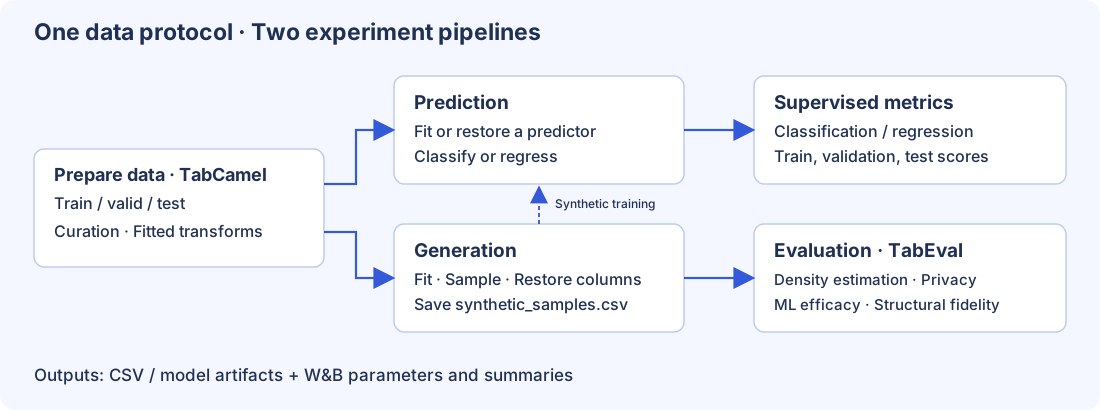
TabStruct is an end‑to‑end benchmark for tabular data generation, prediction, and evaluation. It ships with ready‑to‑use pipelines for
- generating high‑quality synthetic tables,
- predicting with machine learning models, and
- analysing results with a rich suite of metrics – especially those that quantify structural fidelity.
The benchmark is designed for both research and applied workflows: you can run standard baselines out of the box, or plug in custom generators/predictors and fairly evaluate them under the same protocol. All components are designed to plug‑and‑play, so you can mix, match, and extend them to suit your own workflow.
📚 Key Features
- Generate tables: SMOTE, CTGAN, TVAE, Bayesian networks, ARF, normalizing flows, diffusion models, and additional registered wrappers.
- Evaluate synthetic data: density estimation, privacy preservation, ML efficacy, and structural fidelity.
- Predict: classification and regression with linear models, random forests, KNN, XGBoost, neural networks, TabPFN, and TabFORGE adapters.
- Compare consistently: shared dataset loading, split IDs, preprocessing, saved CSVs/checkpoints, W&B summaries, and Optuna tuning.
📐 Evaluation dimensions
- Density estimation – How well does the synthetic data approximate the real distribution?
- Privacy preservation – Does the generator leak sensitive records?
- ML efficacy – How do models trained on synthetic data perform compared to real data?
- Structural fidelity – Does the generator respect the causal structures of real data?
The model reference lists current registry identifiers and dependencies. The registry extends beyond the models evaluated in the paper.
🚀 Installation
Use Python 3.10 or later, and run commands from a Git checkout of the public repository. The runtime locates its output directory through the checkout's .git directory.
git clone https://github.com/SilenceX12138/TabStruct.git
cd TabStruct
conda create -n tabstruct python=3.10.18
conda activate tabstruct
bash scripts/utils/install.sh
For an already prepared environment, python -m pip install -e . installs the checkout in editable mode; individual generators may need additional packages. See Getting started for requirements and CPU execution.
📊 Logging with W&B
Configure your W&B entity and project in src/tabstruct/common/__init__.py, then authenticate with wandb login. Logging is online by default; --disable_wandb disables it for a local check.
✅ Quick sanity check
Train and save a linear classifier on the Credit dataset:
python -m src.tabstruct.experiment.run_experiment \
  --pipeline prediction \
  --task classification \
  --model lr \
  --dataset credit-g \
  --device cpu \
  --save_model \
  --tags tutorial-prediction
TabCamel loads the named dataset, so the first run may download data. The runner reports metrics for the training, validation, and test splits. Saved models are written to logs/<configured-project>/<run-id>/lr.pkl, and W&B records the path as best_model_path.
--task, --model, and --dataset are required. Validation is split from the rows remaining after the test split: the default --test_size 0.2 --valid_size 0.1 gives approximately 72% training, 8% validation, and 20% test data.
💥 Example Workflows: Generate and evaluate synthetic data
Generate a classification table without running the metric suite:
bash docs/tutorial/example_scripts/generation/train.sh
The runner saves synthetic_samples.csv in the run directory and records generated_data_path. Pass that file to the evaluation tutorial:
bash docs/tutorial/example_scripts/generation/eval.sh \
  logs/<configured-project>/<run-id>/synthetic_samples.csv
This enables structural fidelity evaluation with --enable_eval_structure. TabEval evaluates the synthetic table, while a separate prediction run on synthetic training rows measures ML efficacy. See the evaluation guide for all four dimensions, split behavior, and evaluator configuration.
📖 Documentation
| Start here | Contents |
|---|---|
| Getting started | Install, configure logging, run and restore a model |
| Overview | Public modules and implemented workflow |
| Data and preprocessing | Dataset schema, split semantics, curation, transforms |
| Workflows | Generation, prediction, checkpoints, tuning |
| Evaluation | Four evaluation dimensions and TabEval integration |
| Tutorials | Complete scripts and expected outputs |
| CLI · API · Models | Supported flags, interfaces, identifiers |
| Developer guide | Add a model and build the public documentation |
📖 Citation
@inproceedings{jiang2026tabstruct,
  title={TabStruct: Measuring Structural Fidelity of Tabular Data},
  author={Jiang, Xiangjian and Simidjievski, Nikola and Jamnik, Mateja},
  booktitle={The Fourteenth International Conference on Learning Representations},
  year={2026}
}

@inproceedings{jiang2025well,
  title={How Well Does Your Tabular Generator Learn the Structure of Tabular Data?},
  author={Jiang, Xiangjian and Simidjievski, Nikola and Jamnik, Mateja},
  booktitle={ICLR 2025 Workshop on Deep Generative Model in Machine Learning: Theory, Principle and Efficacy},
  year={2025}
}