
ShawTim/gemini-app2api
ShawTim/gemini-app2api has 21 GitHub stars and 3 forks. GitHot measured +9 stars in 24 hours. Last checked 2026-11-15 01:40 UTC. Last push 2026-11-13.
What you can do
- Scoped OpenAI Compatibility (Chat & Responses): Supports GET /v1/models, POST /v1/chat/completions, and POST /v1/responses with JSON or incremental SSE streaming, reasoning_effort / reasoning.effort mapping, and static PNG/JPEG/WebP image input.
- Caller-Owned Function Tools: Clients declare JSON Schema functions (including Responses type: "namespace" groups), execute approved calls locally, and replay results. The gateway validates every tool name and argument schema before emission—never executing shell commands or touching your workspace.
- gemini-argon - Flagship Pro-tier mode for complex coding, architecture, and multi-step agent loops - 8 - context_window: 128000 (advisory client budget)
- gemini-hydrogen - Gemini 4 Hydrogen for low-latency everyday reasoning and fast interactive tasks (upstream Hydrogen attribution verified) - FAST (1) - context_window: 512000 (advisory client budget)
Measured star growth
- in 24h
- +9
- in 7 days
- Collecting history
- in 15 days
- Collecting history
- in 1 month
- Collecting history
Net star changes over overlapping periods, not daily totals. Missing measurements are left blank. Stars measure attention, not software quality.
About
Zero-dependency native HTTP/2 gateway connecting your Gemini subscriptions to OpenAI-compatible coding agents (Cursor, Cline, Codex, Pi, DSH) with multi-account pooling & bilingual console.
Self-hostedREADME.md
OriginalGemini App2API
Your coding agents. Your Gemini subscriptions. One zero-dependency native HTTP/2 gateway.
Connect your own eligible Gemini accounts to OpenAI-compatible IDEs, CLI agents, and SDKs through a self-hosted Node.js gateway—featuring incremental SSE, caller-owned tool validation, multi-account failover, and a bilingual operations console.





English · 繁體中文 · Quick Start · Connect Your Client · API Reference · Operations
[!IMPORTANT] Unofficial interoperability research project. Not affiliated with, endorsed by, or sponsored by Google. Using third-party clients or gateways may violate Google's Terms of Service—your accounts, your responsibility. You must supply your own eligible Google accounts and a compatible OAuth client profile; no credentials, tokens, or Google binaries are distributed. Read the full Disclaimer.
Why Gemini App2API?

🧢 MGGA — Make Gemini Great Again: A frontier GigaChad model trapped inside a consumer chat harness.
Ever noticed how Gemini can feel constrained inside the consumer Gemini App—losing thread context or struggling to drive multi-step local engineering workflows? The bottleneck is rarely the base model; it is the consumer chat harness wrapped around it.
- Free the model into real engineering harnesses: Connect Cursor, Cline, Roo Code, OpenAI Codex CLI, PI-Desktop, Cherry Studio, or Open WebUI via standard
/v1/chat/completionsand/v1/responsesendpoints while keeping full conversation history and local tool execution under your client's control. - Native HTTP/2 protocol—not brittle web scraping: Communicates directly with Gemini's Robin HTTP/2 service using pure Node.js built-ins (
node:http2,node:crypto), without headless browsers, cookie scraping, or patching local desktop binaries. - Multi-account pooling for rolling usage windows: Intensive agentic coding can hit a single account's 5-hour or weekly window quickly. Pool multiple accounts you legitimately own with soft session affinity, read-only official usage bars, and configurable quota failover.
- Built to protect agent loops: Prevents coding agents from discarding 3,000+ bytes of streamed code or infinitely re-sending full conversation histories when upstream streams reset mid-turn (see Completion Contract).
- Honest upstream boundaries: Decoupling the local client harness does not bypass Google's servers—all upstream context limits, rate limits, safety filters, and account entitlements remain enforced by Google.
How It Compares
| Dimension | Gemini App2API | Web / Cookie Scrapers | Desktop App Injection / MITM |
|---|---|---|---|
| Transport | Direct native HTTP/2 (ProcessQuery) + resumable image upload |
Fragile web DOM or reverse-engineered browser cookies | Binary hooks or local traffic interception |
| Auth lifecycle | Standard Google OAuth + refresh tokens in 0600 local state |
Frequent cookie expiration & CAPTCHA friction | Coupled to a single running desktop GUI session |
| Tool calling | Schema-validated prompt protocol + Responses namespace support |
Unvalidated text regex or unsupported | Limited to built-in consumer UI capabilities |
| Multi-account | Pooled routing, soft session affinity, batch usage & tier telemetry | Manual cookie swapping | Single active desktop user |
| Runtime footprint | Pure Node.js >= 22, 0 production npm dependencies |
Playwright / Puppeteer / heavy Python stacks | OS-specific app bundle & binary version lock |
Key Features
- Scoped OpenAI Compatibility (
Chat&Responses): SupportsGET /v1/models,POST /v1/chat/completions, andPOST /v1/responseswith JSON or incremental SSE streaming,reasoning_effort/reasoning.effortmapping, and static PNG/JPEG/WebP image input. - Caller-Owned Function Tools: Clients declare JSON Schema functions (including Responses
type: "namespace"groups), execute approved calls locally, and replay results. The gateway validates every tool name and argument schema before emission—never executing shell commands or touching your workspace. - Zero-Dependency, Security-First Runtime: Zero third-party production npm packages. Enforces
0700/0600private state permissions,scryptadmin password hashing, SHA-256 API key lookup digests with0600private-state key storage (returned only at creation or via authenticated CSRF-protected reveal requests), strictOrigin/Host/X-CSRF-Tokenadmin protections, and SSRF-guarded opt-in remote image fetching. - Bilingual Operations Console (
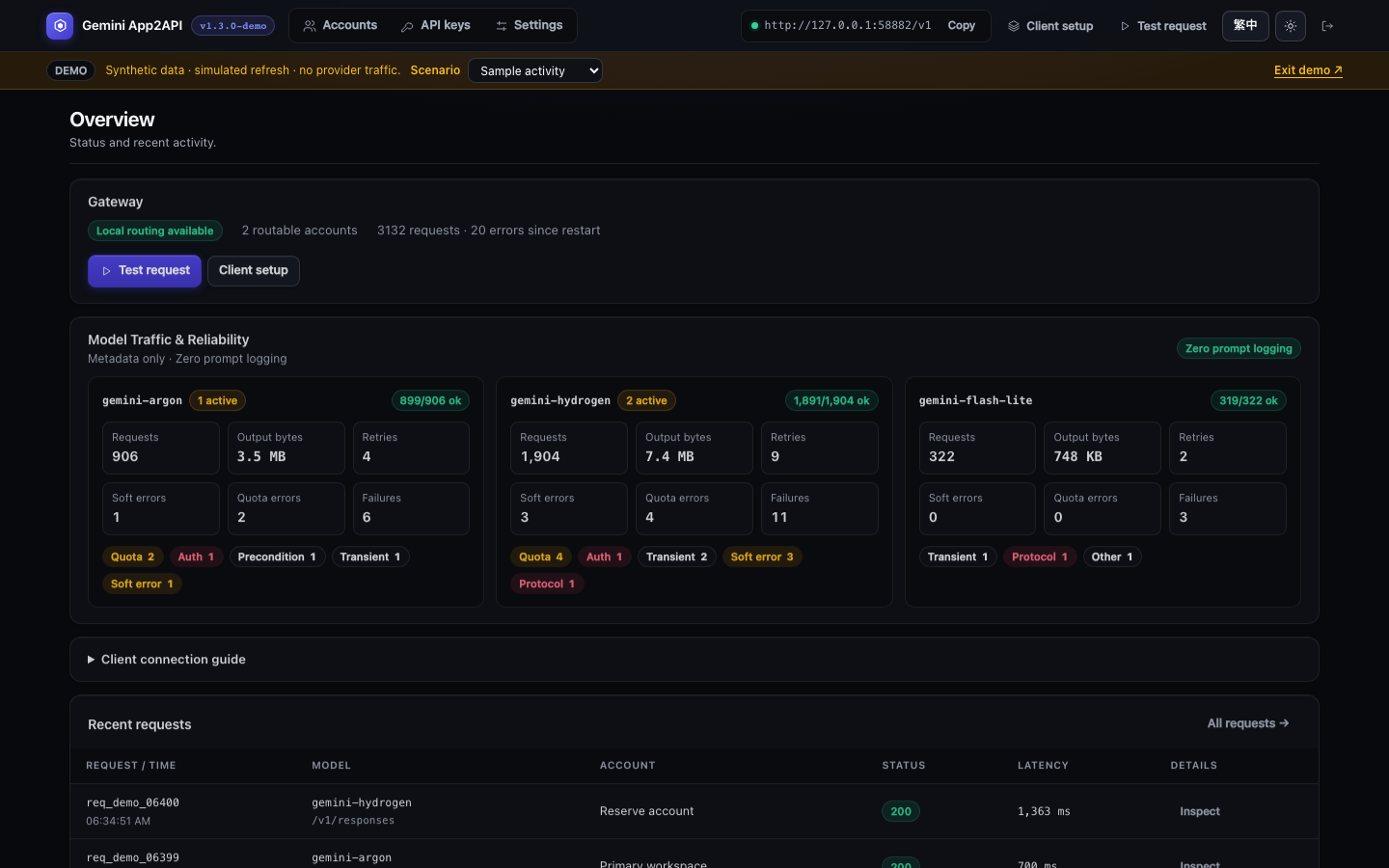
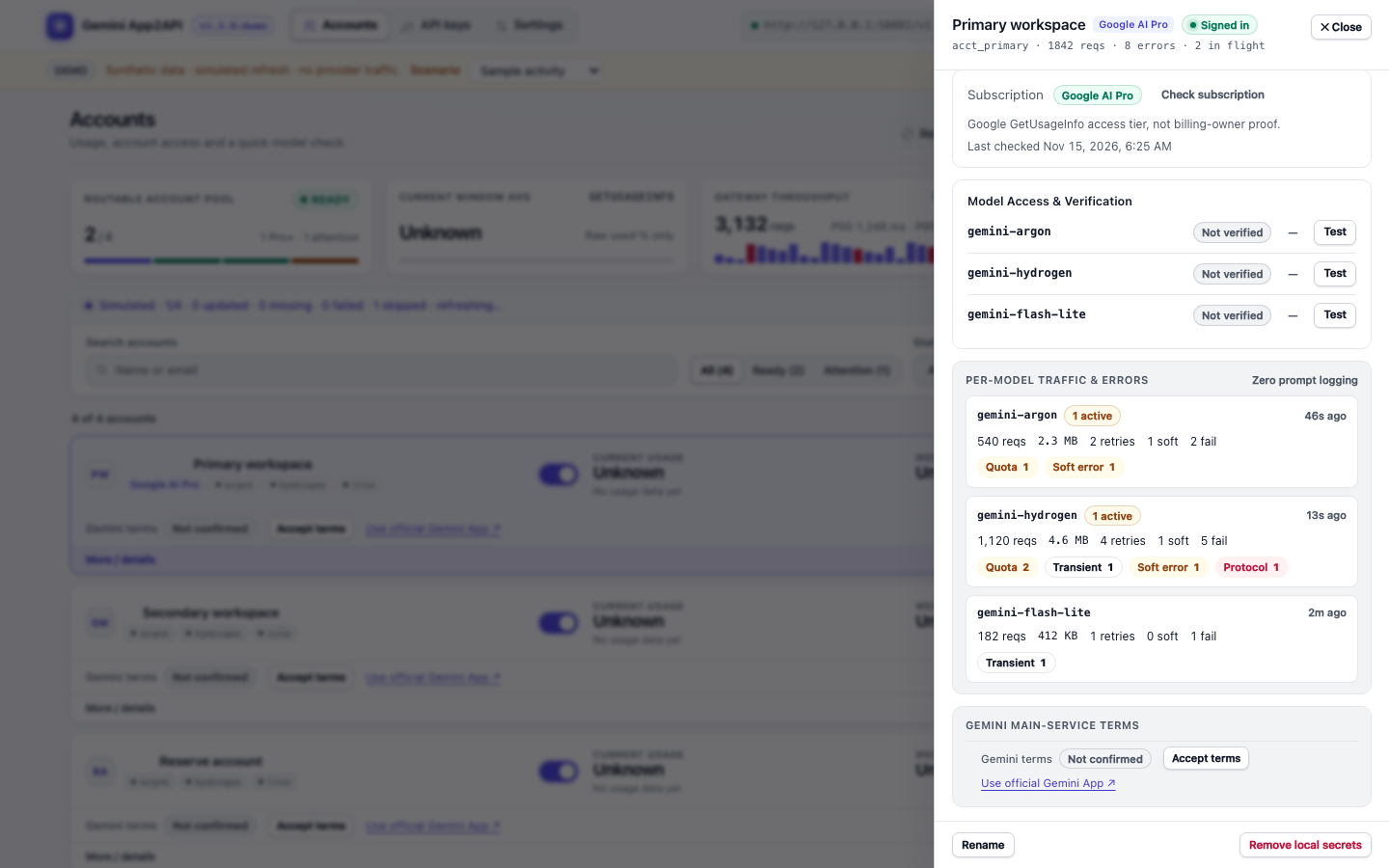
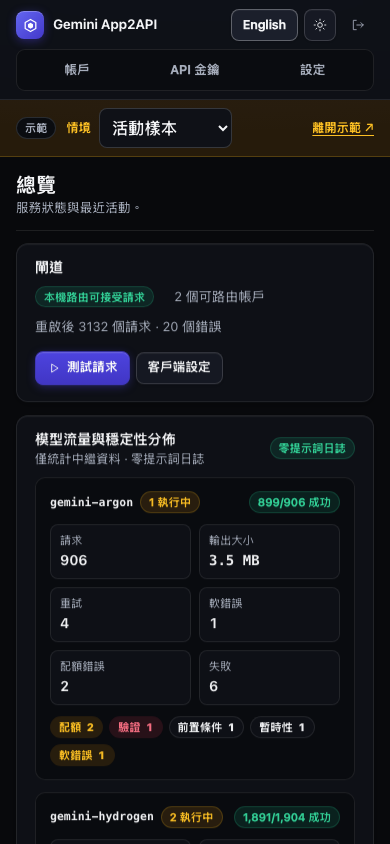
English/繁體中文): Inspect pool pulse and request-latency snapshot sparklines, review per-account Current usage / Weekly limit bars and model states in a slide-over inspector drawer, copy ready-to-paste client configs (Codex CLI,Cline,cURL), manage copyable client API keys, explicitly review or accept Gemini Terms of Service, and inspect sanitized HTTP/gRPC diagnostics across desktop and mobile.
| Light Theme — Account Inspector & Pool Pulse | Mobile Console — Traditional Chinese (繁體中文) |
|---|---|
 |
 |
Quick Start
1. Prerequisites
- Node.js 22+ (
>= 22.0.0), npm, a modern browser, and a Google account with Gemini access (macOS or Linux). - A compatible static OAuth client profile supplied from an authorized private source (not distributed in this repo; a Google AI Studio API key is a different service and cannot be substituted). Review the OAuth profile format and setup guide first.
2. Initialize and Start
From the repository root:
npm ci --omit=dev --ignore-scripts
export GATEWAY_DATA_DIR="$HOME/.gemini-app2api"

# Create a private 0600 .env without overwriting an existing one:
test -e .env || cp .env.example .env
chmod 600 .env
# Edit .env and set GATEWAY_ADMIN_PASSWORD to a unique 12–256 character secret.

node bin/gemini-gateway init
node bin/gemini-gateway import-profile < /private/path/oauth-profile.json
node bin/gemini-gateway start
Prefer Docker? Follow the hardened Docker Compose deployment guide (runs as
uid 1000with read-only rootfs, dropped capabilities, and loopback port publishing).
3. Sign In and Create a Client Key
Open http://127.0.0.1:18989/admin/ in your browser:
- Sign in with your
GATEWAY_ADMIN_PASSWORD(if left empty, passwordless admin is restricted strictly to loopback—see Remote access with TLS). - Under Accounts, click + Google sign-in and complete Google OAuth + MFA in your browser.
- Click Test on the account card to verify live model access (note: Test sends one real request and uses quota; OAuth sign-in alone does not verify model entitlement).
- Open API keys → Create key to generate and copy a client API key (you can copy, reveal, or revoke active keys there anytime).
Connect Your Client
Point any supported OpenAI-compatible client at your gateway:
| Setting | Value |
|---|---|
| Base URL | http://127.0.0.1:18989/v1 (or your HTTPS reverse-proxy URL /v1) |
| API Key | Client key generated in API keys (never your admin password or Google token) |
| Model | gemini-argon (Pro reasoning/coding), gemini-hydrogen (Gemini 4 Hydrogen), or gemini-flash-lite |
| Endpoints | /v1/chat/completions or /v1/responses (supported contract) |
Verify model discovery (zero quota used):
curl -fsS http://127.0.0.1:18989/v1/models \
  -H "Authorization: Bearer $GEMINI_GATEWAY_KEY"
Send a Chat Completions request (add "stream": true with curl -N for incremental SSE):
curl -fsS http://127.0.0.1:18989/v1/chat/completions \
  -H "Authorization: Bearer $GEMINI_GATEWAY_KEY" \
  -H "Content-Type: application/json" \
  -d '{"model":"gemini-argon","messages":[{"role":"user","content":"Hello!"}]}'
Client Setup Recipes
Cursor
- Open Cursor Settings → Models.
- Add custom model
gemini-argon(and optionallygemini-hydrogen). - Enable Override OpenAI Base URL, set it to
http://127.0.0.1:18989/v1(note: Cursor requires a publicly reachable HTTPS tunnel/reverse-proxy if its cloud relay mediates requests in your mode), and paste your gateway client API key.
Cline / Roo Code (VS Code)
- Choose API Provider:
OpenAI Compatible. - Base URL:
http://127.0.0.1:18989/v1 - API Key: Your gateway client key.
- Model ID:
gemini-hydrogen(recommended quota-friendly option for high-frequency multi-step agent loops) orgemini-argon(quota comparison); both support streaming, caller tool loops, and static image attachments.
OpenAI Codex CLI (~/.codex/config.toml)
Codex CLI speaks the /v1/responses protocol natively (including namespace tools and reasoning effort mapping). gemini-hydrogen is recommended as the quota-friendly option for high-frequency multi-step agent loops alongside gemini-argon (quota comparison):
model = "gemini-hydrogen" # or "gemini-argon" for flagship Pro reasoning
model_provider = "gemini_app2api"
model_reasoning_summary = "none"
web_search = "disabled"

[model_providers.gemini_app2api]
name = "Gemini App2API"
base_url = "http://127.0.0.1:18989/v1"
env_key = "GEMINI_GATEWAY_KEY"
wire_api = "responses"
Cherry Studio / Open WebUI / OpenAI SDKs
- Cherry Studio / Open WebUI: Add an OpenAI provider with API Host
http://127.0.0.1:18989/v1, paste your gateway client key, and fetch/v1/models(gemini-argon,gemini-hydrogen,gemini-flash-lite). - Official JS & Python SDKs: See runnable caller-tool loop examples in
examples/client.mjsandexamples/client.py. Always replay complete conversation history (includingtool_call_id/call_idpairs) on every turn.
Models and Capabilities
| Model Alias | Role & Tier | Native Mode | Advertised Context Metadata |
|---|---|---|---|
gemini-argon |
Flagship Pro-tier mode for complex coding, architecture, and multi-step agent loops | 8 |
context_window: 128000 (advisory client budget) |
gemini-hydrogen |
Gemini 4 Hydrogen for low-latency everyday reasoning and fast interactive tasks (upstream Hydrogen attribution verified) | FAST (1) |
context_window: 512000 (advisory client budget) |
gemini-flash-lite |
High-throughput lightweight tasks | 6 |
Not advertised |
Model aliases map to native Gemini App modes rather than pinned Google Cloud Vertex/AI Studio version strings, and model availability depends on each signed-in account's upstream entitlement.
context_window: 128000(gemini-argon) andcontext_window: 512000(gemini-hydrogen) are empirical advisory client budgets calibrated to single-turn recall, prefill latency, and the gateway's4 MiBrequest ceiling—not enforced token caps or official Google SLA guarantees.
Quota Consumption: gemini-argon vs gemini-hydrogen
[!WARNING]
gemini-argonconsumes roughly60xmore account quota thangemini-hydrogenon identical coding workloads. On a single Gemini AI Pro account,~4-5heavy (~15 KB output) coding turns ongemini-argoncan exhaust an entire 5-hour rolling window (429 NATIVE_QUOTA_EXHAUSTED), whereasgemini-hydrogenfits~290heavy coding turns (or~1,800agenttool_callsteps) in the same 5-hour window while responding~2x-4xfaster. Usegemini-hydrogenas your primary multi-step coding and tool-call workhorse, and reservegemini-argonfor architecture planning, hard debugging, or multi-account pooled setups (GATEWAY_QUOTA_FAILOVER=1).
Empirical GetUsageInfo measurements on identical non-dummy engineering turns (Gemini AI Pro accounts, Paid & Trial tiers observed at 1:1):
| Engineering Workload | gemini-hydrogen |
gemini-argon |
Argon Quota Multiple |
|---|---|---|---|
Heavy ~15 KB code review + rewrite (thinking=2) |
~0.017% weekly (< 1% 5h, ~60s) |
~1.05% weekly (~21% 5h, ~115s) |
~61x |
Multi-tool coding agent tool_call step (thinking=2) |
~0.003% weekly (< 1% 5h, ~4.6s) |
~0.074% weekly (~1.5% 5h, ~9.0s) |
~27x |
Standard ~10 KB SQL & migration plan (thinking=0) |
~0.0046% weekly (< 1% 5h, ~13s) |
~0.44% weekly (~8.5% 5h, ~49s) |
~75x-95x |
Single-account 5-hour window capacity (weekly pool ≈ 20x the 5-hour window) |
~290 heavy turns / ~1,800 tool steps |
~4-5 heavy turns |
— |
These figures are empirical observations via read-only GetUsageInfo telemetry (not official Google SLA figures), and upstream quota weights may change at any time.
Supported Capabilities
| Capability | Supported Scope |
|---|---|
| Endpoints | GET /v1/models, POST /v1/chat/completions, POST /v1/responses |
| Function Tools | Bounded JSON Schema validation, auto/none/required/named tool_choice, and Responses function-only namespace groups; executed strictly by the caller |
| Image Input | Up to 4 static PNG/JPEG/WebP images (<= 2 MiB combined) via data: URLs or opt-in SSRF-guarded public HTTP(S) URLs |
| Google Search | Opt-in "native_search": true (gemini-argon, thinking 2, text-only <= 16 KiB, no caller tools/images in the same turn) |
| Thinking Control | Synchronous thinking_level (0, 1, 2, 4; default 2) and OpenAI reasoning_effort (none/minimal→0, low→1, medium/high/xhigh→2); async Deep Think (3) rejected locally |
| Usage Accounting | Heuristic token estimates (estimated: true)—not official Google token counts or billing figures |
Security and Operational Principles
- Keep private state off Git and public networks: Never share
.env, OAuth client profiles, refresh tokens, client API keys, orGATEWAY_DATA_DIR. See SECURITY.md. - Client-owned history & permissions: The gateway never runs shell/file tools, never truncates or summarizes conversation history behind your back, and rejects silent upstream model downgrades.
- Explicit incomplete-turn semantics: Interrupted streams that already flushed usable output close cleanly with
incomplete: truemetadata so coding agents keep delivered work; always checkincompletewhen exact upstream completion matters. See COMPLETION_CONTRACT.md. - Deliberate recovery budgets: Enabling
GATEWAY_QUOTA_FAILOVER=1orGATEWAY_AUTOMATIC_RECOVERY=1helps survive single-account limits or transient resets, at the cost of additional upstream attempts when failures occur. See OPERATIONS.md and LOCKS_AND_LIMITS.md.
Documentation
| Document | Contents |
|---|---|
API Support & Contract (docs/API_SUPPORT.md) |
Endpoints, request/event schemas, tools, images, native search, and error codes |
Operations Guide (docs/OPERATIONS.md) |
Setup, .env config, Docker Compose, reverse-proxy TLS, launchd supervision, and troubleshooting |
Account Lifecycle (docs/ACCOUNT_LIFECYCLE.md) |
Google OAuth sign-in, explicit Gemini ToS consent, subscription snapshots, and quota semantics |
Completion Contract (docs/COMPLETION_CONTRACT.md) |
Partial-output preservation, GENERATION_FAILED zero-output handling, and caller dispositions |
Locks & Limits (docs/LOCKS_AND_LIMITS.md) |
Concurrency caps, wire/payload bounds, coalescing rules, and non-locking session design |
Verification & Testing (docs/CURRENT_CONTRACT_TESTS.md) |
Offline synthetic test suites, test safety boundaries, and dev dependencies |
Security (SECURITY.md) · Contributing (CONTRIBUTING.md) |
Security model, vulnerability reporting, and contribution workflow |
Changelog (CHANGELOG.md) · Disclaimer (DISCLAIMER.md) |
Release history and legal/account-risk notice |
MIT License · Disclaimer · Security Policy
Unofficial self-hosted interoperability software. No Google binaries, OAuth client profiles, or account credentials are distributed.