
Seeed-Projects/mobile-robot-full-stack-course
Seeed-Projects/mobile-robot-full-stack-course has 59 GitHub stars and 13 forks. GitHot measured 0 stars in 24 hours. Last checked 2026-11-16 23:27 UTC. Last push 2026-11-04.
What you can do
- Complete technology stack: covers Jetson, ROS 2, vision, LiDAR, SLAM, Nav2, VLN, robotic arms, and deployment optimization.
- Strict progression: starts from sensors and coordinate-system fundamentals, then moves into navigation, semantic understanding, and grasping.
- Real hardware practice: uses J501, cameras, LiDAR, chassis, PTZ, and robotic arms as the main validation platform.
- Verifiable chapter outputs: each module provides code, configuration, experiment steps, expected results, and common issues.
Measured star growth
- in 24h
- 0
- in 7 days
- Collecting history
- in 15 days
- Collecting history
- in 1 month
- Collecting history
Net star changes over overlapping periods, not daily totals. Missing measurements are left blank. Stars measure attention, not software quality.
About
An open-source, hands-on mobile robotics course covering Jetson, ROS 2, AI perception, SLAM, autonomous navigation, semantic understanding, and robotic manipulation.
Web & AppsREADME.md
OriginalMobile Robot Full-Stack Development in Practice
An open-source embodied intelligence and autonomous systems course based on reComputer J501 (Jetson AGX Orin)
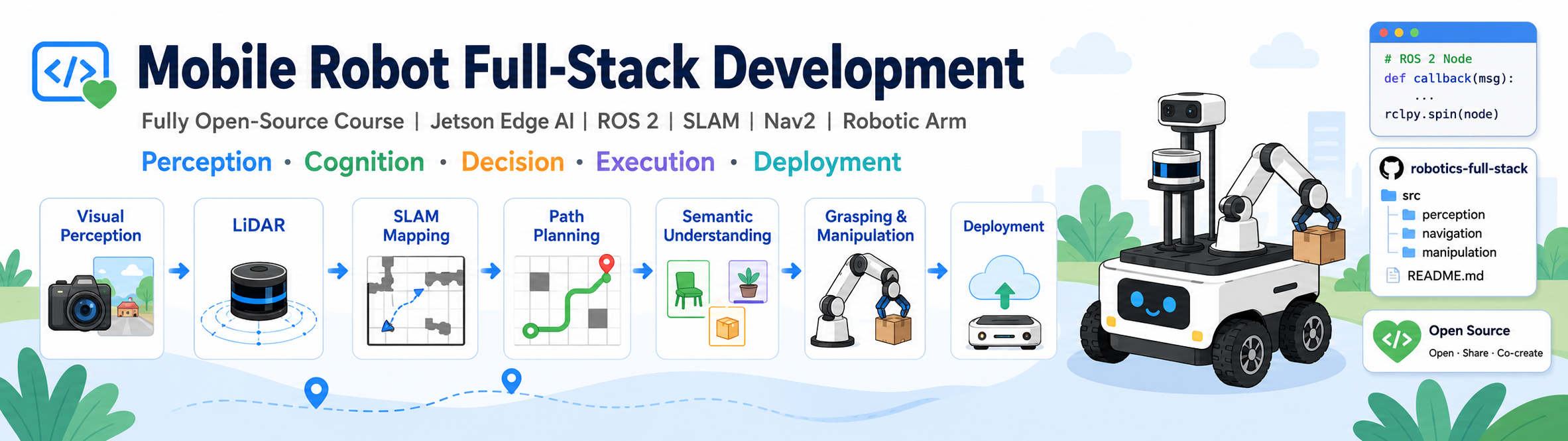
Build a complete mobile robotics development loop from sensor integration, AI perception, SLAM, and autonomous navigation to semantic understanding, active vision, and robotic grasping.




Project Overview
This project is an open-source hands-on course for robotics developers, AI engineers, and university students. It uses Seeed Studio reComputer J501 (Jetson AGX Orin 32GB/64GB) as the core compute platform and covers:
Perception -> Cognition -> Decision -> Actuation -> Deployment
The course emphasizes system integration on real robots rather than explaining only a single algorithm in isolation. The content will be opened progressively. If you are interested in this project, Star it and contribute with us.
Course Highlights
- Complete technology stack: covers Jetson, ROS 2, vision, LiDAR, SLAM, Nav2, VLN, robotic arms, and deployment optimization.
- Strict progression: starts from sensors and coordinate-system fundamentals, then moves into navigation, semantic understanding, and grasping.
- Real hardware practice: uses J501, cameras, LiDAR, chassis, PTZ, and robotic arms as the main validation platform.
- Verifiable chapter outputs: each module provides code, configuration, experiment steps, expected results, and common issues.
- Engineering-oriented: the course ends with TensorRT, DeepStream, Isaac ROS, system monitoring, and OTA.
Course Roadmap
flowchart LR
    M1[M1 Platform and Environment]
    M2[M2 Vision System]
    M3[M3 Multi-Sensor Fusion]
    M4[M4 AI Perception]
    M5[M5 SLAM and Reconstruction]
    M6[M6 Autonomous Navigation]
    M7[M7 Semantic Navigation]
    M8[M8 Active Vision]
    M9[M9 Robotic Arm Manipulation]
    M10[M10 Integrated Projects]
    M11[M11 Engineering Deployment]

    M1 --> M2
    M1 --> M3
    M2 --> M4
    M2 --> M5
    M3 --> M5
    M5 --> M6
    M4 --> M7
    M6 -. optional navigation background .-> M7
    M4 --> M8
    M6 --> M8
    M4 --> M9
    M7 --> M10
    M8 --> M10
    M9 --> M10
    M10 --> M11
Course Modules
The course is planned as 11 modules, about 43 class hours in total. Starting from July 22, 2026, the plan is to complete one module every two weeks. If there are no major changes, all modules are planned to be completed before December 22, 2026.
| Module | Theme | Main Content | Status |
|---|---|---|---|
| M1 | Platform Introduction and Development Environment | J501, JetPack, Docker, ROS 2 | ✅ Completed |
| M2 | Vision System Foundations | CSI, GMSL2, RGB-D, calibration, BEV | ✅ Completed |
| M3 | LiDAR and Sensor Fusion | LiDAR, IMU, GNSS, CAN-FD, PTP, EKF | ✅ Completed |
| M4 | AI Vision and Edge Acceleration | YOLO, tracking, segmentation, 6D pose, Isaac ROS | ✅ Completed |
| M5 | 3D Reconstruction and SLAM | ORB-SLAM3, Fast-LIO, R3LIVE, 3DGS, semantic maps | ✅ Completed |
| M6 | Decision Layer: Localization, Navigation, and Path Planning (4 class hours) | LiDAR mapping, map saving, AMCL relocalization, global/local planning, point-cloud obstacle detection | 🚧 Four lesson texts, formulas, diagrams, and simulation tutorials supplied; prediction, formation, and hardware pending |
| M7 | Vision-Language Navigation · Code | VLN fundamentals, LightNav principles, Jetson chassis simulation, refrigerator navigation demo | ✅ Completed |
| M8 | PTZ and Active Vision | PTZ control, target tracking, chassis coordination | ⏳ Planned |
| M9 | Robotic Arm and Manipulation | MoveIt 2, Pinocchio, hand-eye calibration, GraspNet | ⏳ Planned |
| M10 | Integrated Projects | inspection, BEV+3DGS, VLN, semantic grasping | ⏳ Planned |
| M11 | Deployment Optimization and Engineering | ONNX, TensorRT, DeepStream, monitoring, OTA | ⏳ Planned |
The progress status will be updated to
✅ Completedafter each module is released, together with the corresponding documentation, code, configurations, test results, and demo videos.
Core Hardware
| Category | Recommended Configuration |
|---|---|
| Main Controller | reComputer Robotics J5012 |
| Vision | CSI / GMSL2 / RGB-D cameras |
| Localization | LiDAR, IMU, GNSS |
| Actuation | Mobile chassis, 2-axis PTZ, reBot or compatible robotic arm |
| Bus | CAN-FD, UART, Ethernet |
| Power | Mobile robot power supply system |
You do not need to purchase all hardware at once. Early modules can be completed with only the J501 and a single camera. Navigation- and robotic-arm-related hardware can be added gradually later.
DM-H65 Chassis Python SDK
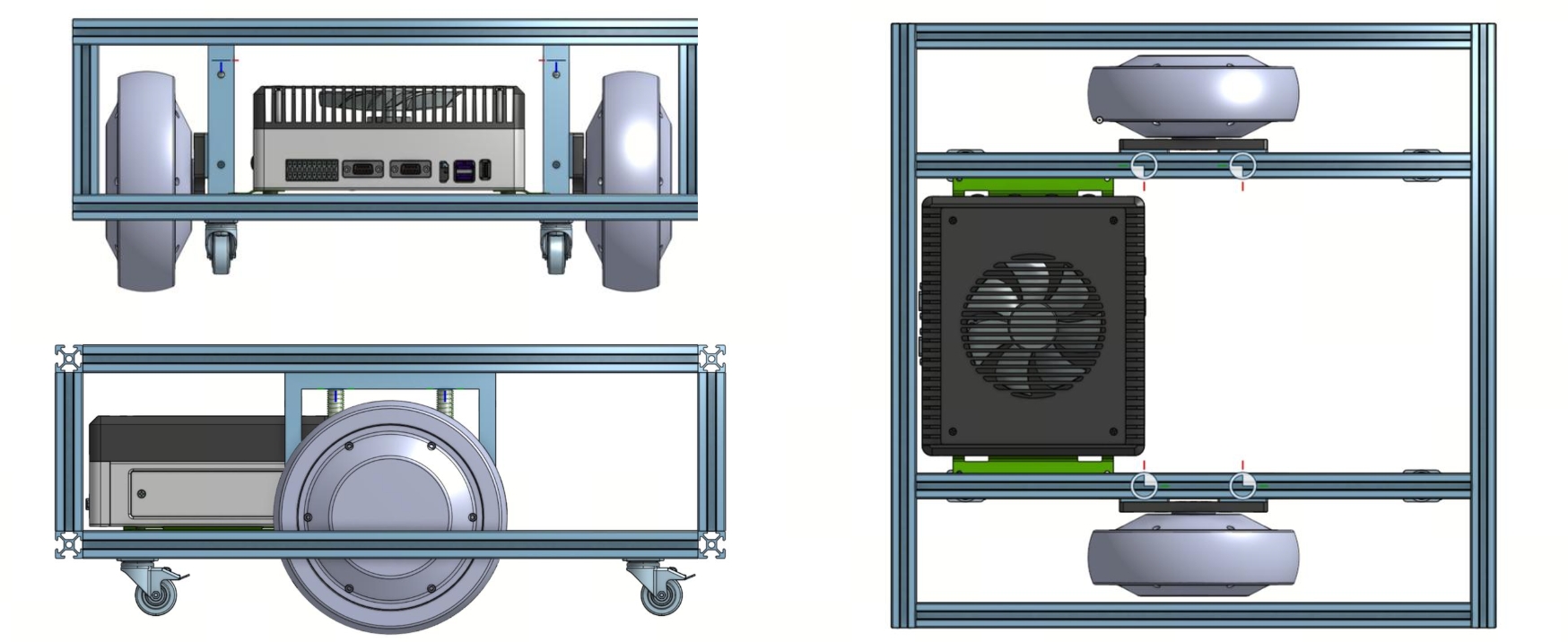
The repository includes an installable DM-H65 two-wheel chassis Python SDK with SocketCAN communication, differential-drive control, CLI diagnostics, Jetson services, and a remote debugging WebUI. This integration is Python-only; no C++ implementation is included.
Repository Layout
mobile-robot-full-stack-course/
├── hardware/             # Hardware-related files
├── docs/                 # Course documentation
├── modules/              # Per-module course code
├── projects/             # Integrated projects
├── robot_drivers/        # Mobile chassis Python drivers and WebUI
├── assets/               # Images and videos
├── README.md
├── README_CN.md
├── CONTRIBUTING.md
└── LICENSE
Intended Audience and Prerequisites
Suitable for:
- beginners in ROS 2 and robotics development;
- AI, computer vision, and edge computing engineers;
- developers of AMR, AGV, inspection robots, and service robots;
- university students, instructors, and lab teams.
Basic knowledge of Linux, Python, Git, and linear algebra is recommended. ROS 2, Docker, and Jetson basics will be introduced in the course.
Open-Source License
This project will be released in a fully open-source manner. All self-developed course content will be made public, including:
- course documentation and lab instructions;
- ROS 2 source code and configuration files;
- Dockerfiles, installation scripts, and deployment tools;
- model conversion, testing, and performance evaluation scripts;
- integrated project code and system integration solutions;
- publicly distributable sample data, images, and demo resources.
The specific license terms will be defined in the root LICENSE file and in any subdirectory-specific license notes. Code, documentation, data, and hardware design files may use different open-source licenses depending on content type.
Safety Notes
Robotic systems involve batteries, motors, robotic arms, and high-speed moving parts. Before operating real hardware, make sure to:
- configure an emergency stop;
- limit chassis and robotic-arm speed;
- check power and wiring;
- clear the motion range;
- finish simulation or low-speed validation first;
- avoid running unverified policies in crowded environments.
Acknowledgements
This course will use or reference open-source projects including ROS 2, NVIDIA Jetson, Isaac ROS, Nav2, MoveIt 2, OpenCV, PyTorch, Open3D, ORB-SLAM3, Fast-LIO, LIO-SAM, 3D Gaussian Splatting, GraspNet, and LeRobot.
From “seeing” to “understanding,” from “autonomous mobility” to “autonomous manipulation.”
Star, Watch, Fork, and contribute.