
SeanWong17/Mammalia-tree
SeanWong17/Mammalia-tree has 235 GitHub stars and 23 forks. GitHot measured 0 stars in 24 hours, +3 in 7 days, and +4 in 15 days. Last checked 2026-11-16 23:48 UTC. Last push 2026-08-08.
Measured star growth
- in 24h
- 0
- in 7 days
- +3
- in 15 days
- +4
- in 1 month
- Update delayed
Net star changes over overlapping periods, not daily totals. Missing measurements are left blank. Stars measure attention, not software quality.
About
DeepTime Mammalia:交互式哺乳纲演化树,3D 螺旋序幕 + D3.js 动态时间树,跨越 2 亿年 | Interactive mammalian phylogeny with 3D spiral intro & D3.js dynamic timetree spanning 200 Myr
LearningREADME_EN.md
Original
DeepTime Mammalia
Interactive Phylogenetic Tree of Mammals · Immersive Experience
From the embers of Synapsids to the flourishing Cenozoic.
A 200-million-year epic of life, flowing at your fingertips.
中文 | English





🌍 Full Chordate Atlas: Continue from mammals into fishes, amphibians, sauropsids, and birds in DeepTime Chordata.
📖 Introduction
DeepTime Mammalia is an interactive data visualization project running in modern browsers. Unlike dry textbook charts, this project leverages WebGL and CSS3D technologies to reconstruct our perception of "Deep Time" and evolution.
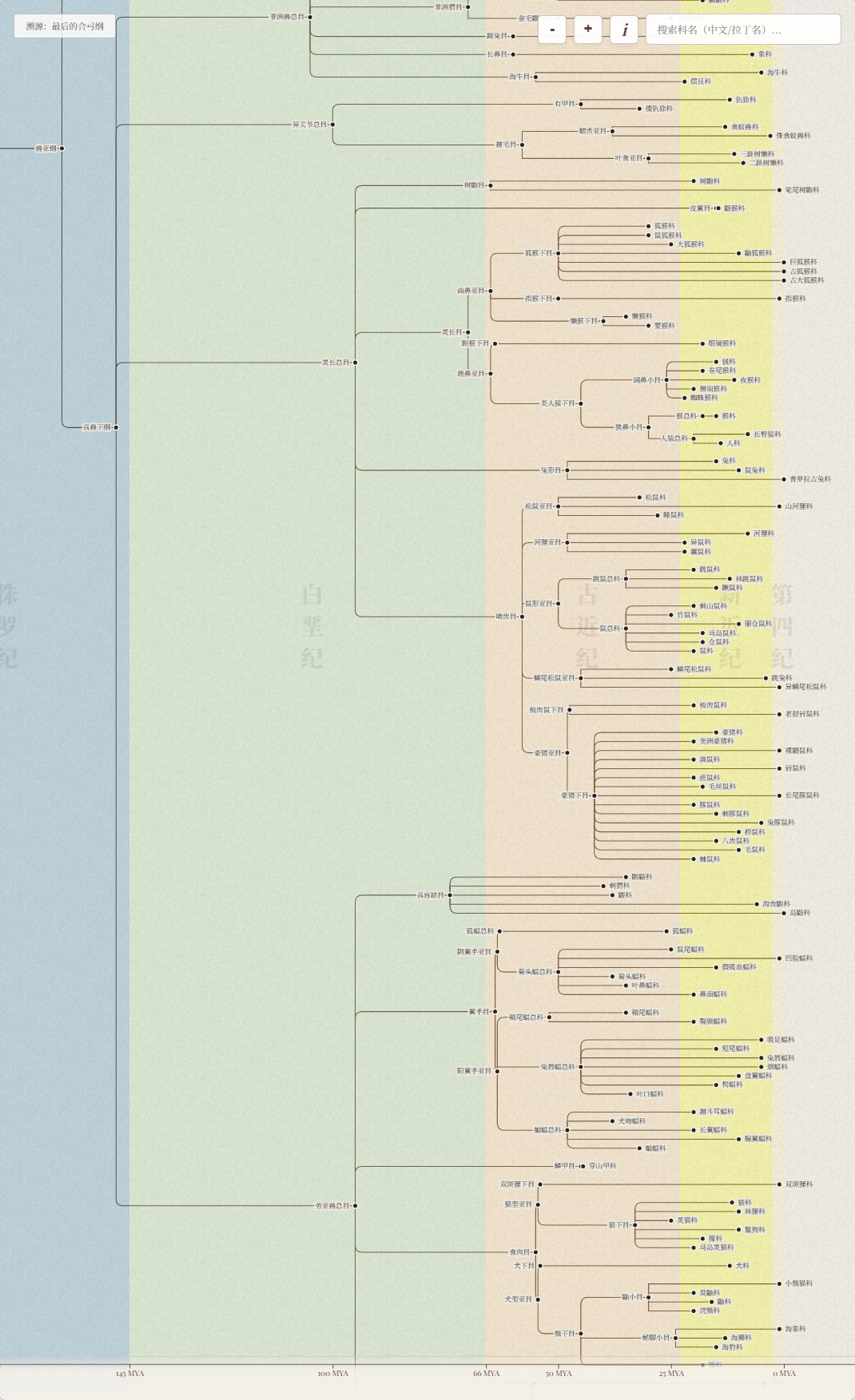
Based on the latest Mammal Diversity Database (MDD) v2.3, it presents the complex evolutionary branches—from the Synapsid ancestors of the late Permian to modern mammals (167 families, over a thousand nodes)—through a 3D double-helix gallery and a dynamic phylogenetic tree.
🌟 Highlight: This project contains not only scientific data but also a hidden "Easter Egg" mode about our ancestors, waiting for you to discover.
🧭 Related Project
If you want to continue along the other major amniote branch, take a look at the sister project DeepTime Sauropsida. It focuses on birds, crocodilians, turtles, tuataras, and squamates, placing living sauropsids back into roughly 300 million years of deep-time context.
👉 GitHub: https://github.com/SeanWong17/Sauropsida-tree
✨ Features
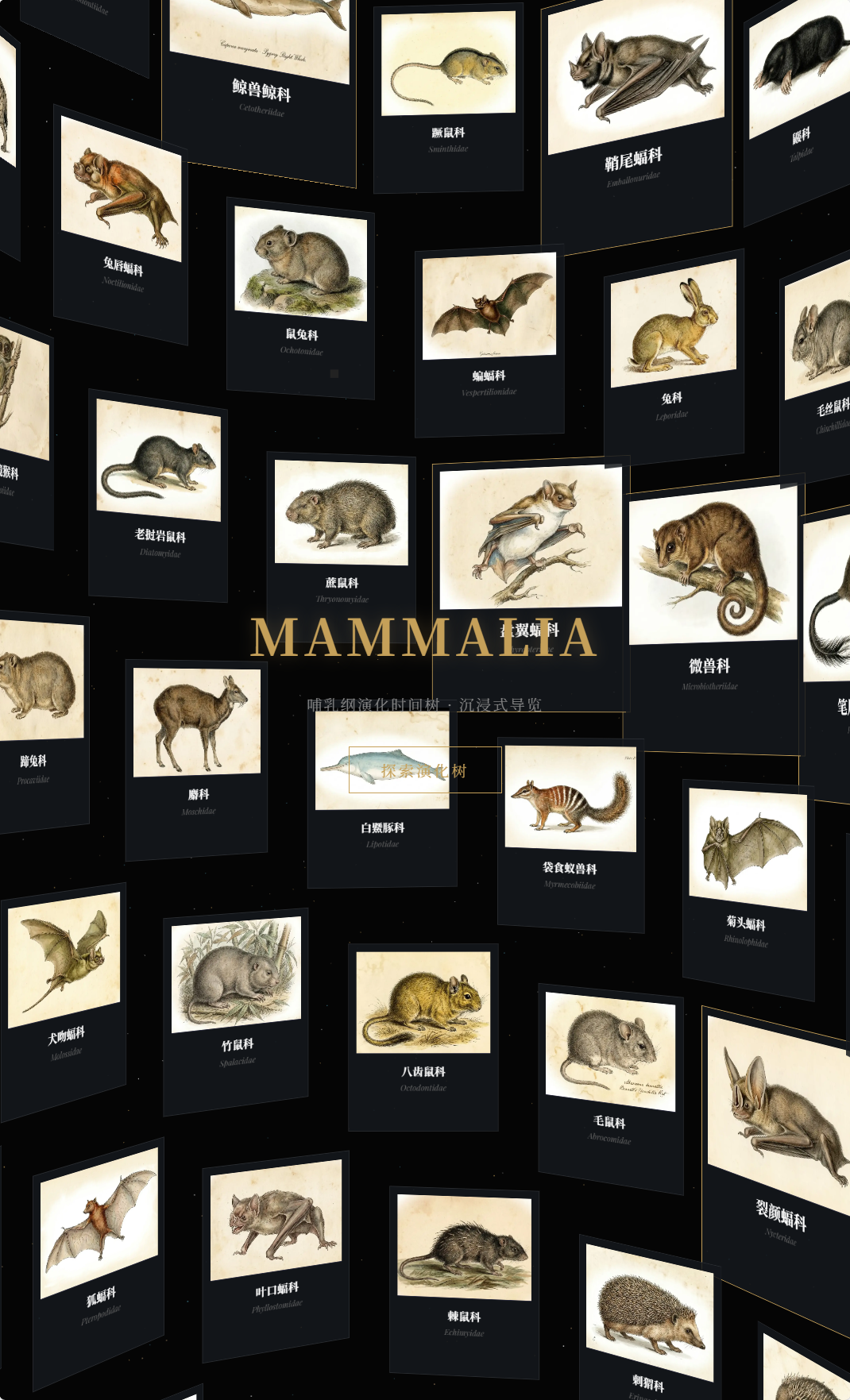
🌌 Immersive 3D Prologue
- DNA Helix Gallery: Built with
Three.js (CSS3DRenderer), symbolizing the genetic code of life. - Dynamic Starfield: A WebGL particle system that flows with mouse and touch interactions, creating a sense of profound time.
- Cinematic Transitions: Smooth camera movements seamlessly transition from the micro view (cards) to the macro view (phylogenetic tree).
🌿 Interactive Phylogeny
- Dynamic D3.js Tree: High-performance rendering supporting the expansion/collapse of branches from "Class" down to "Family" level.
- Full Gesture Support: Smooth mouse wheel zooming, pinch-to-zoom, and drag panning. Optimized for mobile devices.
- Geological Timeline: An integrated dynamic ruler at the bottom displays the geological epoch corresponding to the current viewport (MYA - Million Years Ago).
- Smart Search: Supports real-time search and highlighting by Latin scientific names or Chinese names.
🌐 Internationalization
- Language Toggle: One-click switch between Chinese and English interface.
- Smart Text Adaptation: Node names, descriptions, and UI elements automatically adapt to the current language.
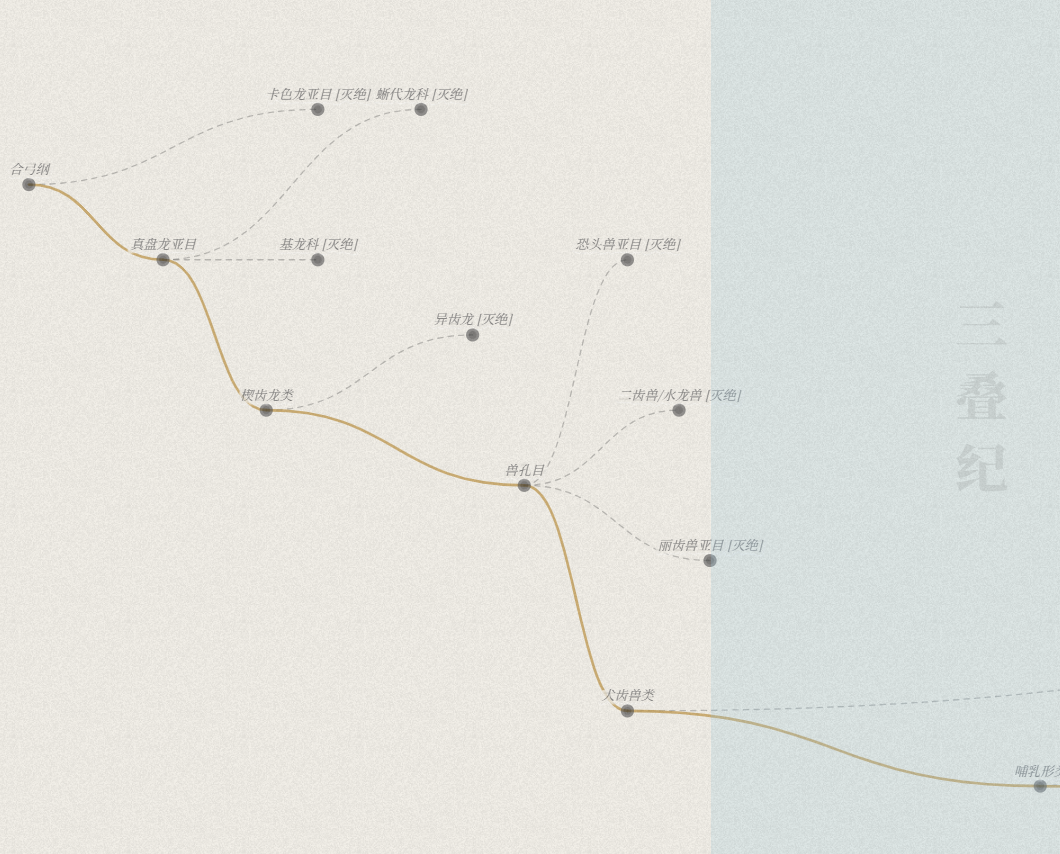
🥚 The Origin Easter Egg
- A hidden mode paying tribute to the resilience of life.
- Find and click the "Origin" (溯源) button to reveal a ghostly wireframe path crossing the great extinctions—the path we walked as the last survivors of the Synapsids.
⚡ Performance Optimization
- Responsive Design: Automatically adapts to desktop and mobile devices with optimized display.
- Dynamic Resource Loading: Adjusts particle count and rendering quality based on device performance.
- Modular Architecture: Clean code separation for easy maintenance and secondary development.
📸 Screenshots
| 3D Helix Gallery | Tree Overview |
|---|---|
 |
 |
| Specimen Card | Origin Easter Egg (Ghost View) |
|---|---|
 |
 |
🛠️ Tech Stack
This project uses Vanilla JavaScript (ES6+) with no runtime build step. Third-party browser dependencies are version-locked and self-hosted.
- Core: HTML5, CSS3, JavaScript
- Visualization: D3.js (v7) - Handles complex tree data structures and layout calculations.
- 3D Engine: Three.js (r128) - Handles WebGL particle backgrounds and CSS3D transformations.
- Animation: Tween.js - Handles smooth interpolation animations.
- Fonts: Self-hosted, unicode-range-split Noto Serif SC with no external font requests.
📂 Structure
The project adopts a modular design for easy maintenance and extension. Images are independent, content-hashed WebP assets loaded on demand, requiring no backend environment.
Mammalia-tree-main/
├── assets/                  # Static assets
│   ├── images/             # 167 on-demand WebP images
│   └── logo.png            # Project Logo
├── data/                    # Data files
│   ├── data.js             # Phylogenetic topology data (JSON Object)
│   └── images_manifest.js  # Content-hashed image manifest
├── examples/                # Screenshots for README
├── src/                     # Source code
│   ├── css/
│   │   └── style.css       # Main stylesheet
│   └── js/
│       ├── config.js       # Global configuration (performance, layout, etc.)
│       ├── i18n.js         # Internationalization (Chinese/English)
│       ├── utils.js        # Utility functions
│       ├── easter_egg_data.js  # Easter egg data
│       ├── gallery.js      # WebGL and CSS3D gallery
│       ├── tree.js         # D3 evolution tree
│       └── app.js          # Lifecycle and UI controller
├── scripts/                 # Validation, vendoring, and dev server
├── tests/                   # Node.js and Playwright regression tests
├── vendor/                  # Version-locked browser dependencies
├── index.html               # Entry point
├── package.json             # Development and test commands
├── README.md                # Chinese Documentation
└── README_EN.md             # English Documentation
🚀 How to Run
All runtime resources are local static files, so the project supports both direct preview and an included development server:
Method 1: Direct Open (Recommended for Quick Preview)
- Download: Clone or download the repository.
- Run: Simply double-click
index.htmlto run smoothly in your browser. - Note: No Node.js installation required, no local server configuration needed.
Method 2: Local Server (Recommended for Development)
npm install
npm start
Then visit http://127.0.0.1:4173. Before committing, run npm run check and npm run test:browser.
🔧 Customization
The project supports customization through src/js/config.js:
// Performance configuration
performance: {
    particleCount: { desktop: 2000, mobile: 1000 },  // Particle count
    cardCount: { base: 30, min: 35, max: 80 }        // Card count
}

// 3D scene configuration
scene3D: {
    helix: { radiusBase: 600, yStep: 30 },           // Helix radius and spacing
    camera: { targetZDesktop: 2000 }                 // Camera position
}

// Tree configuration
tree: {
    width: { desktop: 2000, mobile: 1200 },          // Tree width
    nodeSpacing: 45,                                 // Node spacing
    zoom: { scaleExtent: [0.15, 3] }                 // Zoom range
}
🤝 Credits & Disclaimer
The birth of this project relied on collaboration between the open-source community and AI technology:
- Data Basis: Taxonomy based on Mammal Diversity Database (MDD) v2.3 and Paleobiology Database.
- AI Assistance: Core code logic and Shader optimization assisted by Google Gemini.
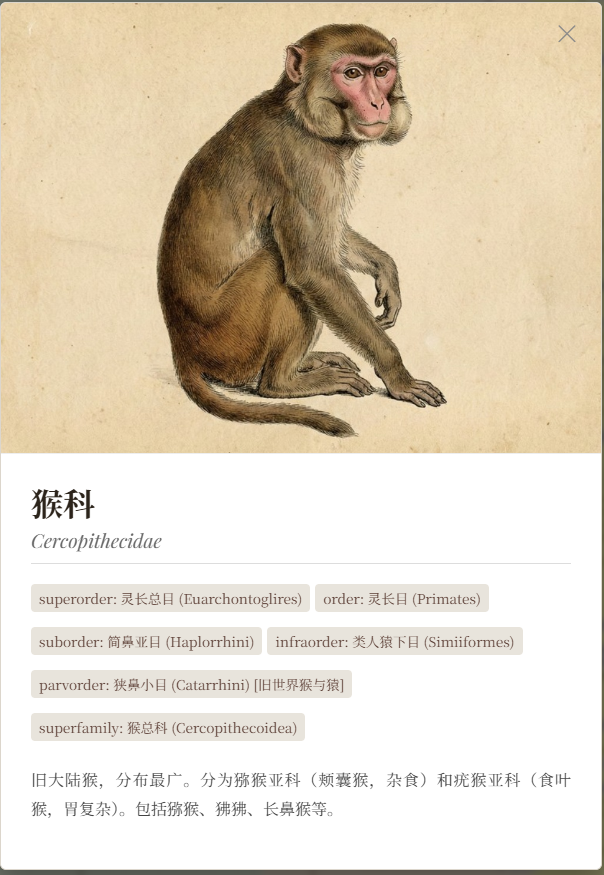
- AI Image Generation: Specimen restoration images generated by the AI model nanobanana.
- Note: AI-generated images are intended for artistic visual reference and may contain anatomical inaccuracies. Please do not use them for rigorous academic citations.
📄 License
This work is licensed under the Creative Commons Attribution-NonCommercial-ShareAlike 4.0 International License (CC BY-NC-SA 4.0).
- ✅ You are free to share and adapt this project.
- ❌ Commercial use is prohibited.
- 📝 Please attribute the original author: Sean Wong.