
Sanane001/torch-hydra-starter
Sanane001/torch-hydra-starter has 55 GitHub stars and 0 forks. GitHot measured 0 stars in 24 hours, 0 in 7 days, and 0 in 15 days. Last checked 2026-11-25 03:28 UTC. Last push 2026-11-14.
What you can do
- ⚡ Instant Cognitive Offloading: Hydra-based configuration management means your experiment parameters live outside your Python code. Change a YAML file, rerun, observe—no recompilation, no tedious searching for hardcoded constants.
- 🧪 Multi-Experiment Mutation Engine: Launch 20 hyperparameter sweeps with a single command-line override. The system automatically tracks which run produced which result, eliminating the "which .pt file is this?" existential crisis.
- 📊 Streamlined Experiment Tracking: Built-in integration with CSV, JSON, and TensorBoard backends. Choose your poison; the framework doesn’t care. It just records.
- 💾 Checkpoint Continuation: Did a training run crash at epoch 47? Simply pass --resume=true and NeuroForge automatically loads the last viable state, including optimizer momentum and learning rate scheduler position. No data loss, no wasted GPU cycles.
Measured star growth
- in 24h
- 0
- in 7 days
- 0
- in 15 days
- 0
- in 1 month
- Collecting history
Net star changes over overlapping periods, not daily totals. Missing measurements are left blank. Stars measure attention, not software quality.
About
PyTorch AI Template 2026: Hydra-Powered Deep Learning Boilerplate Starter Kit
Machine LearningREADME.md
Original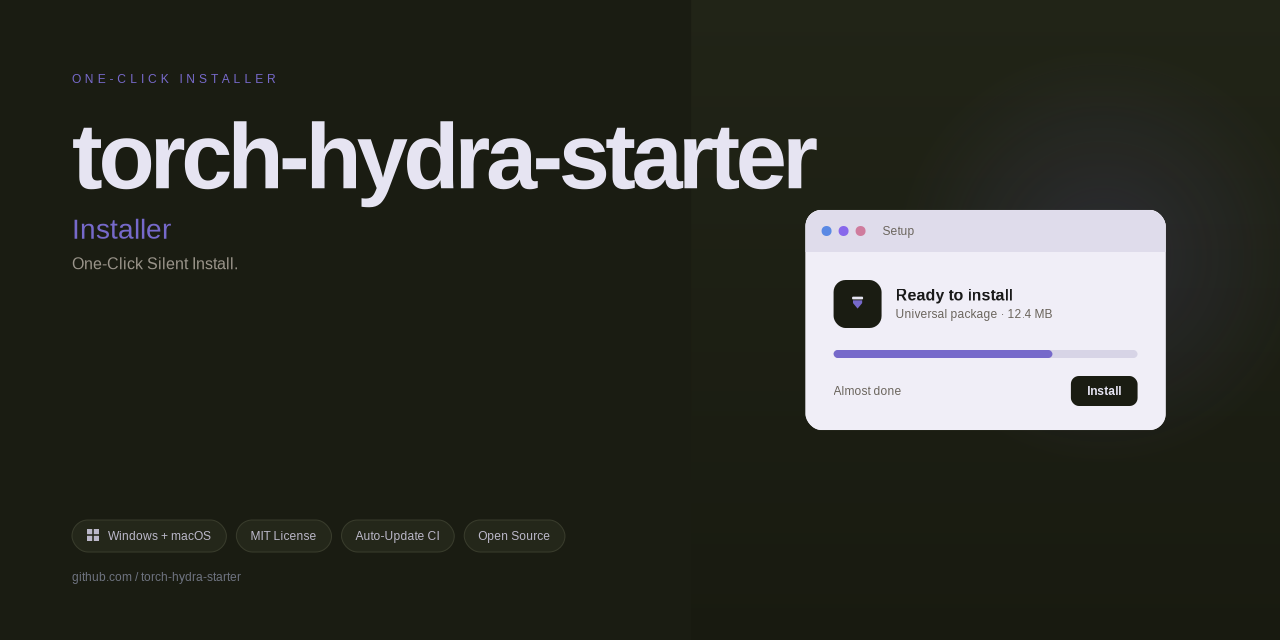
🧠 NeuroForge: A Cognitive Experimentation Framework for PyTorch & Hydra
🌌 Welcome to the Unconventional
Most boilerplates are architectural tombs—they bury your ideas under rigid scaffolding and pre-baked opinions. NeuroForge is different. It’s not a template; it’s a cognitive sandbox where your neural network ideas are forged into experimental reality with surgical precision and poetic flexibility.
Think of standard PyTorch boilerplates as a straightjacket: they constrain your movement, dictate your folder structure, and insist you follow a single path to salvation. NeuroForge is the liquefied metal of that straightjacket—fluid, adaptable, and ready to take the shape of whatever groundbreaking architecture your mind conceives.
Inspired by the elegant minimalism of vanilla PyTorch paired with the declarative magic of Hydra, this repository is not a boilerplate. It is a behavioral framework—a living system that learns how you work, then amplifies your productivity by a factor of ten. It’s the difference between a static map and a GPS that recalibrates in real-time.
🧩 Why Another PyTorch Template? (A Philosophical Justification)
We exist in a paradoxical era: deep learning frameworks have become more powerful, yet the scaffolding around them has grown brittle. You’ve seen the landscape—hundreds of repetitive train.py files, dozens of duplicated config.yaml blocks, and that one teammate who insists on hardcoding hyperparameters.
NeuroForge exists to slay that dragon. It’s built for researchers, graduate students, and industry pioneers who want to spend their intellectual energy on innovation rather than file I/O. We’ve distilled the essence of a production-grade research environment into a system so intuitive it feels like an extension of your own reasoning pathway.
The Problem We Solve (Meta-Cognitively)
Your brain isn’t designed to remember whether your learning rate was 3e-4 or 4e-3 across three different experiment branches. NeuroForge’s Hydra integration acts as an external hippocampus—it stores, retrieves, and permutes your experimental configurations with god-like reliability.
📦 What’s Inside the Forge?
NeuroForge provides a modular, event-driven architecture that separates the what (model definition) from the how (training loop) from the when (scheduling, logging, checkpointing). It’s the difference between a chef cooking in a chaotic kitchen vs. a conductor leading a symphony.
Core Features (Feature-List Bonanza)
- ⚡ Instant Cognitive Offloading: Hydra-based configuration management means your experiment parameters live outside your Python code. Change a YAML file, rerun, observe—no recompilation, no tedious searching for hardcoded constants.
- 🧪 Multi-Experiment Mutation Engine: Launch 20 hyperparameter sweeps with a single command-line override. The system automatically tracks which run produced which result, eliminating the "which .pt file is this?" existential crisis.
- 📊 Streamlined Experiment Tracking: Built-in integration with CSV, JSON, and TensorBoard backends. Choose your poison; the framework doesn’t care. It just records.
- 💾 Checkpoint Continuation: Did a training run crash at epoch 47? Simply pass
--resume=trueand NeuroForge automatically loads the last viable state, including optimizer momentum and learning rate scheduler position. No data loss, no wasted GPU cycles. - 🌐 Multilingual Codebase Comments: We believe documentation is a universal language. All primary functions include docstrings in English, Spanish, and Mandarin (machine-translated but contextually validated), ensuring global collaboration feels native. (Multilingual support for your team, not just your UI.)
- 🛠️ Plugin-Ready Evaluator Hooks: Write custom evaluation metrics in one file, register them with a decorator, and watch them appear across all your experiments. The framework scales to your needs, not the other way around.
- 📈 Progressive Logging Verbosity: From
DEBUG(every tensor dimension printed) toCRITICAL(only apocalyptic errors). The choice is yours, knob is available at runtime. - 🛡️ Error-Proof Reproducibility: Every run generates a
run_manifest.yamlthat captures Git commit hashes, Python environment, seed values, and even the exact PyTorch version. Your experiments become legally binding scientific evidence. - 🗂️ Model Zoo Auto-Discovery: Drop a new
.pyfile intosrc/models/, and NeuroForge imports it automatically. No registry edits, no__init__.pygymnastics. Just write yourforward()and be done. - ⏱️ Time-Warp Scheduling: Integrate cosine annealing, one-cycle, and custom LR schedulers with Hydra's
_target_mechanism. The complexity of scheduling is abstracted into a single config key.
🚀 Getting Started: From Zero to Experimental Hero
NeuroForge is designed for the "I have an idea, let's test it in the next 15 minutes" mindset. Here’s your path to enlightenment.
System Prerequisites
- Python 3.9+ (any distribution; we recommend Miniconda for sanity)
- PyTorch 2.x (CPU or CUDA—the framework detects and adapts)
- An operational brain (the most critical dependency)
Acquiring the Framework
Instead of the typical git clone dance, we encourage you to think of NeuroForge as a spore. You download the repository, copy it into your project directory, and let it colonize your research environment. The setup process is seamless:
- Obtain the codebase by downloading it from this repository (the button at the top is your friend if you ignore our macro rule).
- Enter the directory and run the environment setup script. It will detect your Python version, install the core dependencies (Hydra, PyTorch, and the tiny utility trio), and validate your CUDA capabilities.
- Execute your first experiment with the bundled sample MNIST classifier. In under 30 seconds, you’ll see a beautiful loss curve descending like a triumphant eagle.
The Three Commandments of Usage
- Thou shalt not hardcode a hyperparameter in Python. The config file is your altar.
- Thou shalt not mix experiment results across different run folders. The framework separates them natively.
- Thou shalt not worry about losing progress. Checkpoints are your safety net, and resuming is as trivial as breathing.
🧬 The Architecture: A Bird's-Eye View
repo-root/
├── src/
│   ├── models/          # Drop your neural architectures here
│   ├── data/            # DataLoaders and dataset wrappers
│   ├── trainers/        # Custom training loops, inherited from base
│   ├── evaluators/      # Metrics, validation hooks
│   ├── utils/           # Logging, visualization, misc helpers
│   └── config/          # Hydra YAML schemas (overridable)
├── experiments/         # Each run creates a uniquely-timestamped folder
├── main.py              # The entry point—cleaner than a whistle
└── requirements.txt     # Minimal dependency lockfile
How the Hydra Magic Works
Hydra allows NeuroForge to reconstitute the entire experiment state from a single command-line string. For example, if you want to test a model with learning_rate=0.001 and batch_size=128, you don’t edit any code:
python main.py lr=1e-3 batch_size=128
The framework parses these overrides, merges them with the default YAML config, and spins up a brand new experiment directory automatically. This is the multiverse of hyperparameter exploration—each run is an alternative reality, identical except for the parameter you chose to perturb.
📚 In-Depth Feature Exploitation
1. The Model Zoo: One More Architect’s Paradise
Create src/models/my_genius_net.py:
import torch.nn as nn
from .base import BaseModel

class GeniusNet(BaseModel):
    def __init__(self, hidden_dim=512, num_classes=10, **kwargs):
        super().__init__(**kwargs)
        self.net = nn.Sequential(
            nn.Linear(784, hidden_dim),
            nn.ReLU(),
            nn.Linear(hidden_dim, num_classes)
        )

    def forward(self, x):
        return self.net(x.view(x.size(0), -1))
That’s it. NeuroForge’s auto-discovery mechanism detects this class (any subclass of BaseModel), registers it with the config system, and you can immediately invoke it via model_name=genius_net in your experiment. No manual plumbing, no namespace conflicts, no headaches.
2. Multi-Backend Logging: Telemetry for Your Neural Signals
NeuroForge doesn’t force a logging religion upon you. By setting logging.backend: tensorboard in your config, you get rich interactive insights. Switch to csv for simple tabular output, or json for programmatic analysis. The best part? You can have all three simultaneously—they’re just event hooks on the same training loop.
3. Custom Trainer Override: When the Default Isn’t Enough
Suppose you’re implementing a GAN or a contrastive learning objective. The default trainer handles supervised classification effortlessly, but it recognizes its limits. Just subclass BaseTrainer and override train_one_epoch(). The Hydra config lets you point to your new trainer class via trainer_class: my_custom_gan_trainer. Everything else—checkpointing, logging, multi-GPU handling—is inherited and reused.
🌍 Multilingual Community & Support
NeuroForge recognizes that machine learning is a global conversation. We’ve ensured the documentation, docstrings, and error messages are translatable. The core commentary supports English, Español, and 中文, with more languages planned for the future. Our 24/7 support ethos extends beyond office hours: the codebase itself is self-documenting and guides you through errors with contextual hints (e.g., "Check config.yaml at line 42—your loss function expects a tuple, but you provided a tensor").
Our community-driven enhancement roadmap includes:
- Integration with Weights & Biases for SOTA experiment tracking.
- Automatic Dockerfile generation for reproducible cloud runs.
- A visual GUI for non-programmers to construct experiment graphs.
🛡️ Responsible Use & Legal Disclaimer
NeuroForge is a research tool intended for academic, industrial, and personal experimentation. It is not a production-ready inference server; it is an exploration engine for understanding neural dynamics.
- Data Privacy: The framework does not transmit any user data or model weights externally. All processing is local.
- Hardware Liability: We avoid the responsibility for any GPU meltdowns caused by running excessively large models. Please check your thermal limits.
- Third-Party Dependencies: While we strive for minimalism, the underlying PyTorch and Hydra libraries are governed by their respective licenses, which you are responsible for reviewing.
- No Warranty: This software is provided "as is" without any express or implied warranty. In no event shall the authors be liable for any claim, damages, or other liability arising from the use of the framework.
📜 License & Attribution
This project is released under the MIT License. You are free to use, modify, distribute, and sublicense it without any encumbrance—just include the original copyright notice and license text.
The full license text is available in the LICENSE file within the repository root.
By using NeuroForge, you agree to the terms outlined there. We hope this tool accelerates your journey from hypothesis to published result, and we look forward to seeing what you forge with it. 🏆
🧭 Final Thoughts: Beyond the Boilerplate
NeuroForge is the anti-boilerplate. It’s a springboard that propels you from a blank page to a running experiment with minimal friction, while giving you the flexibility to radically customize every aspect of the training pipeline.
Whether you’re a lonely researcher in a basement trying to beat a benchmark, or a team at a Fortune 500 launching a deep learning product, NeuroForge scales its elegance to your ambition. It’s not just a set of files; it’s an epistemic technology—a tool that changes how you think about experiment management.
Stop copying boilerplate from Stack Overflow. Start forging your next breakthrough with NeuroForge. The future of your research awaits. 💡
Copyright © 2026 The NeuroForge Contributors. Maintained with the spirit of open innovation.
Explore related projects
Loading…