
Samyrrrrrr990/openleads
Samyrrrrrr990/openleads has 71 GitHub stars and 16 forks. GitHot measured +8 in 7 days and +18 in 15 days. Last checked 2026-11-15 18:11 UTC. Last push 2026-11-04.
What you can do
- Local businesses, any city - OpenStreetMap (Overpass and Nominatim) - "accountants in Toronto"
- Startup founders, companies hiring - Y Combinator, Hacker News - "AI startup founders"
- Companies by industry - Wikidata, SEC EDGAR - "fintech companies"
- Developers - GitHub - "rust developers in Berlin"
Measured star growth
- in 24h
- Update delayed
- in 7 days
- +8
- in 15 days
- +18
- in 1 month
- Update delayed
Net star changes over overlapping periods, not daily totals. Missing measurements are left blank. Stars measure attention, not software quality.
About
Open-source lead finder and cold email workspace. Describe a customer, get named people with labeled emails, then write, send, and automate it. No API keys, runs locally. Free Apollo and Hunter alternative.
Self-hostedREADME.md
OriginalOpenLeads
Describe a customer. Get the people, with every email labeled by how we know it.
OpenLeads searches free public sources for the businesses and people you describe, finds their work emails, and marks each one found, pattern or guessed. Then it works them like Apollo does: lists, ICP scoring, sequences, tasks and a deal pipeline. It runs on your machine, with no API keys and nothing to pay.


Website | Docs | Live benchmark | Changelog
pipx install "openleads[all]"          # or: pip install "openleads[all]", or: npx openleads
openleads find "dentists in Austin"    # ten leads, every email labeled
openleads web                          # the workspace at http://127.0.0.1:8787
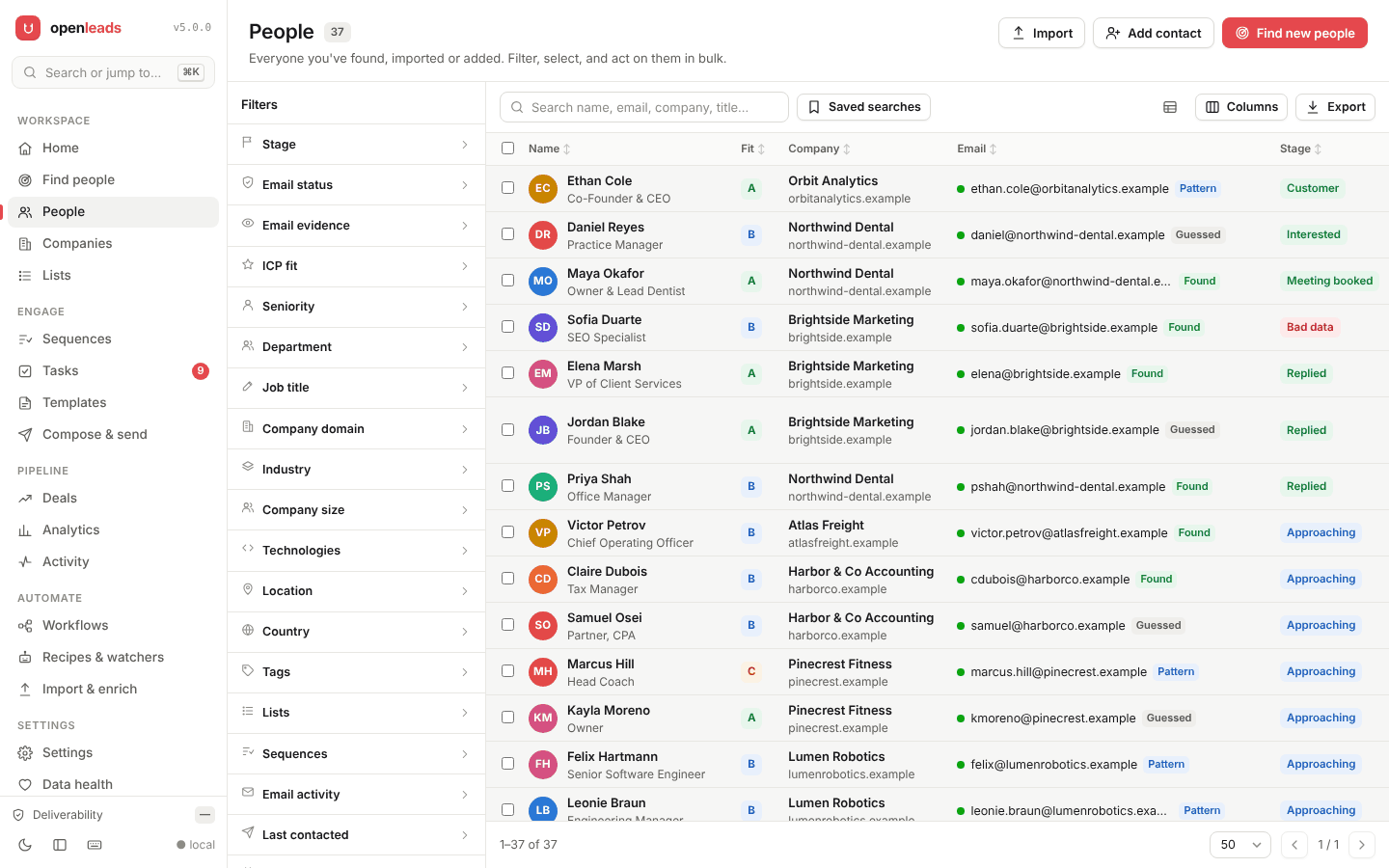
The local dashboard on the demo workspace (openleads demo, invented data).
Every email says how we know it
Most free finders call a first.last@ guess "valid". OpenLeads labels each address
with where it came from, then decides separately whether it is safe to send:
| Evidence | Meaning |
|---|---|
| found | Published on the company's site, in a public commit or security.txt, or confirmed by the mail server |
| pattern | Built from an address format already seen at that company |
| guessed | The most common format for that name. Nothing confirms it, and the label says so |
| Tier | What happens |
|---|---|
| safe | Sent by default |
| risky | Held for your review unless you opt in |
| bad | Dropped (no mail server, disposable, or it bounced) |
Seven checks decide the tier, and most of them work without port 25, which home internet providers block: two DNS-over-HTTPS resolvers that must agree on the mail server, SPF and DMARC, disposable/role/free-mail lists, Gravatar, published addresses, learned company patterns, and SMTP with catch-all detection when port 25 is open. How the scoring works.
Measured against live data every night
Unit tests can't tell you whether "dentists in Austin" returns dentists, so a GitHub
Action runs the same real searches against the live sources every night, asks for ten
leads each, and commits what came back to BENCHMARK.md, empty
nights included. Run it yourself with openleads bench.
What you can search
One sentence fans out across the sources that fit it. You never have to pick one,
but -s name pins a source.
| Ask for | Searched | Example |
|---|---|---|
| Local businesses, any city | OpenStreetMap (Overpass and Nominatim) | "accountants in Toronto" |
| Startup founders, companies hiring | Y Combinator, Hacker News | "AI startup founders" |
| Companies by industry | Wikidata, SEC EDGAR | "fintech companies" |
| Developers | GitHub | "rust developers in Berlin" |
| ML builders | Hugging Face | "ML engineers" |
| Researchers | OpenAlex | "machine learning researchers" |
| Everyone at one company | the company's own site | "emails at stripe.com" |
| US healthcare providers | NPI Registry | "pediatricians" |
Companies are turned into named people from their team and about pages. When a search comes back short, OpenLeads says which source failed or ran out of time and what to try next. Need a source we don't have? A source is one Python file.
Work your leads
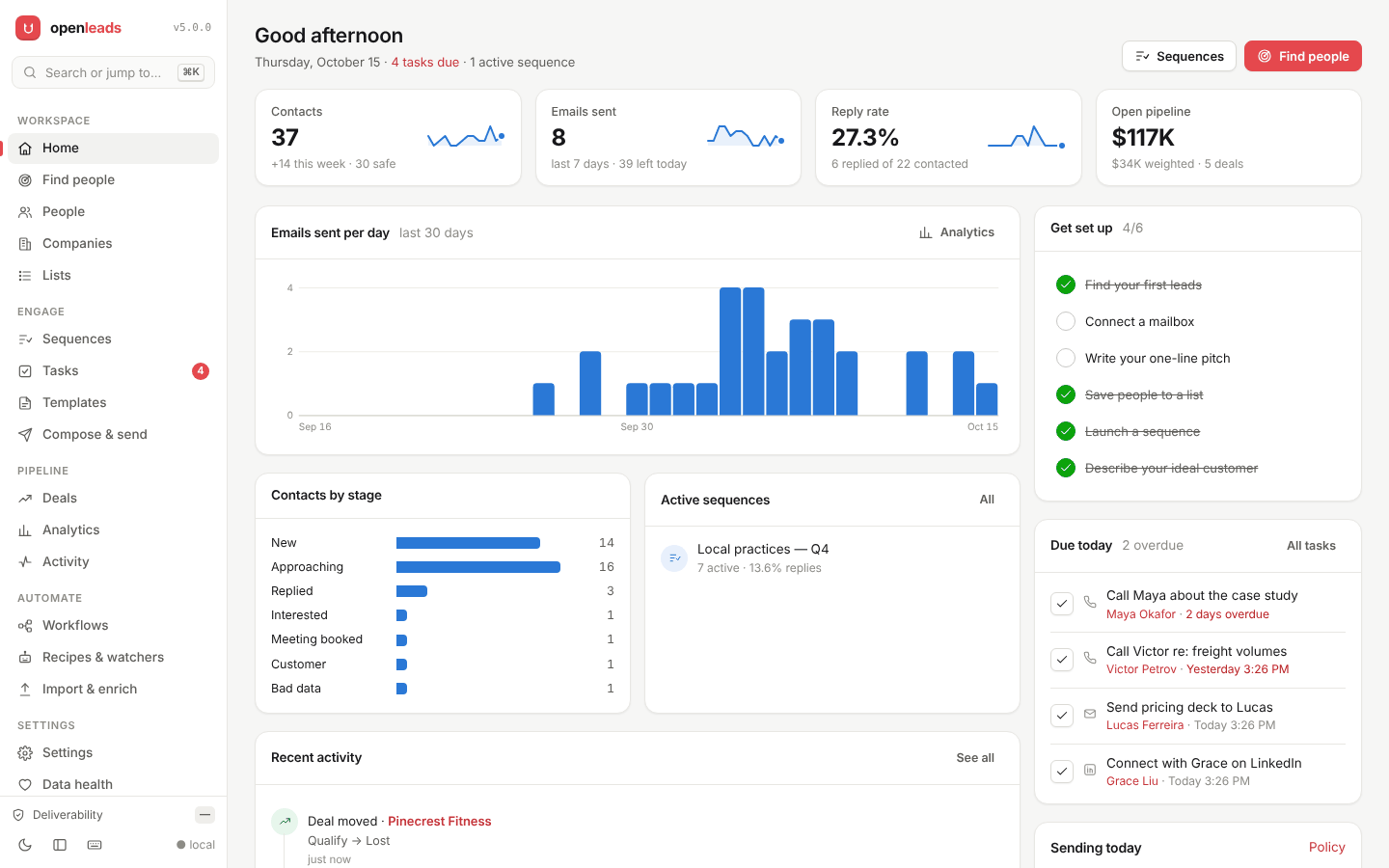
Everything you find lands in a local workspace: the same data in the dashboard, the terminal and your AI assistant.
 |
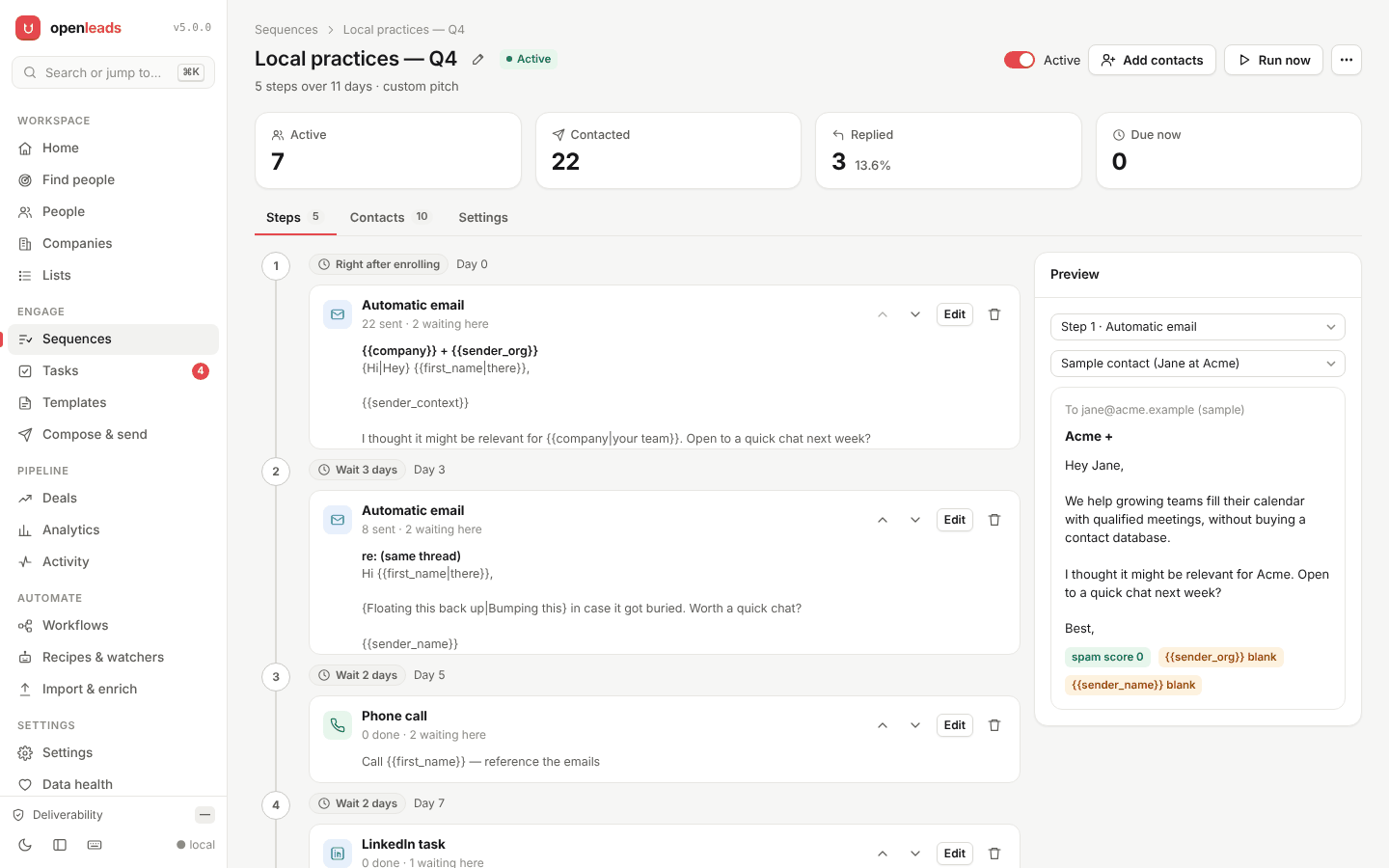 |
| Home. What is due today, how outreach is going, and the strongest leads you haven't contacted. | Sequences. Email, call, LinkedIn and task steps with A/B variants and same-thread follow-ups. People leave when they reply, bounce or unsubscribe. |
 |
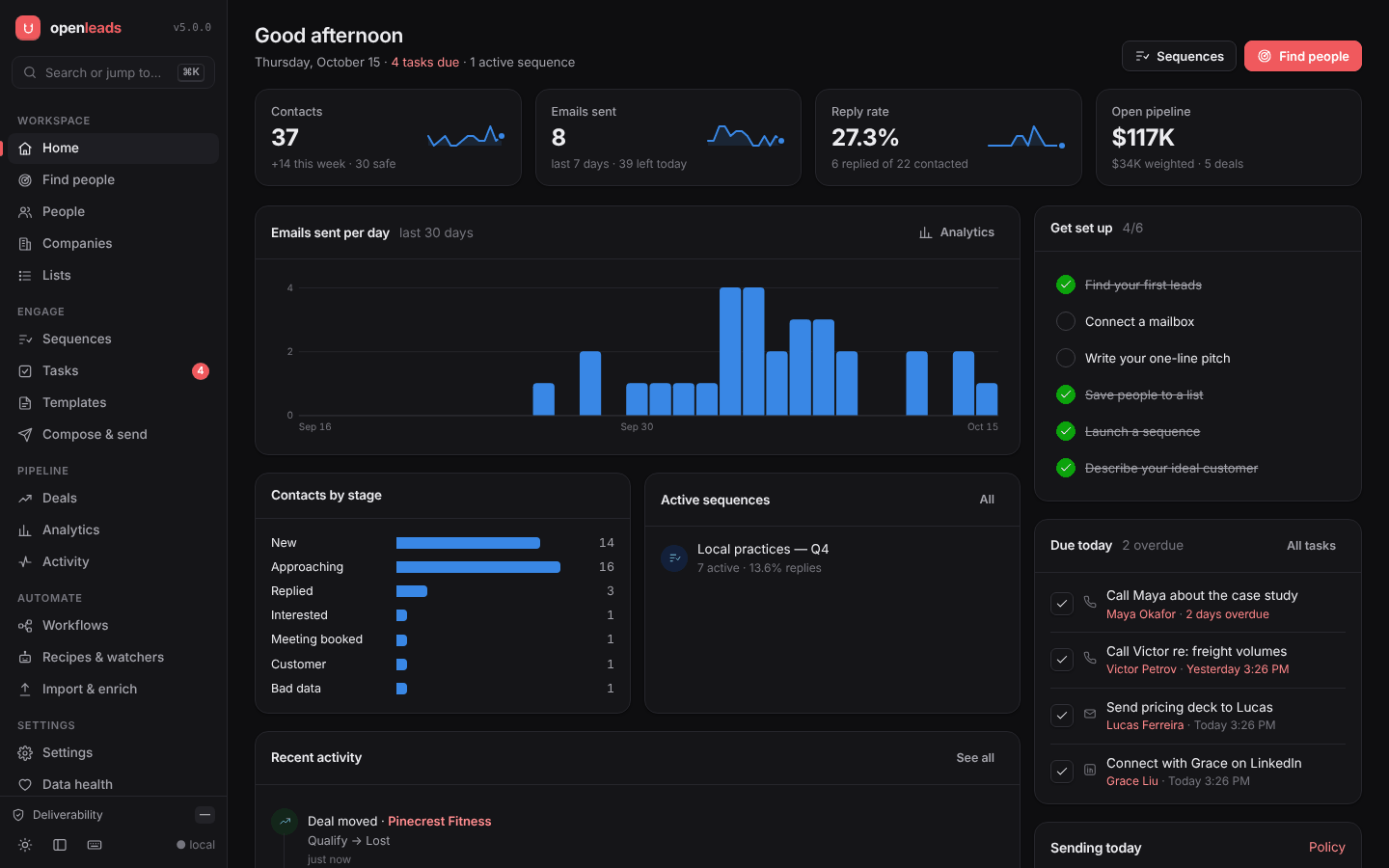 |
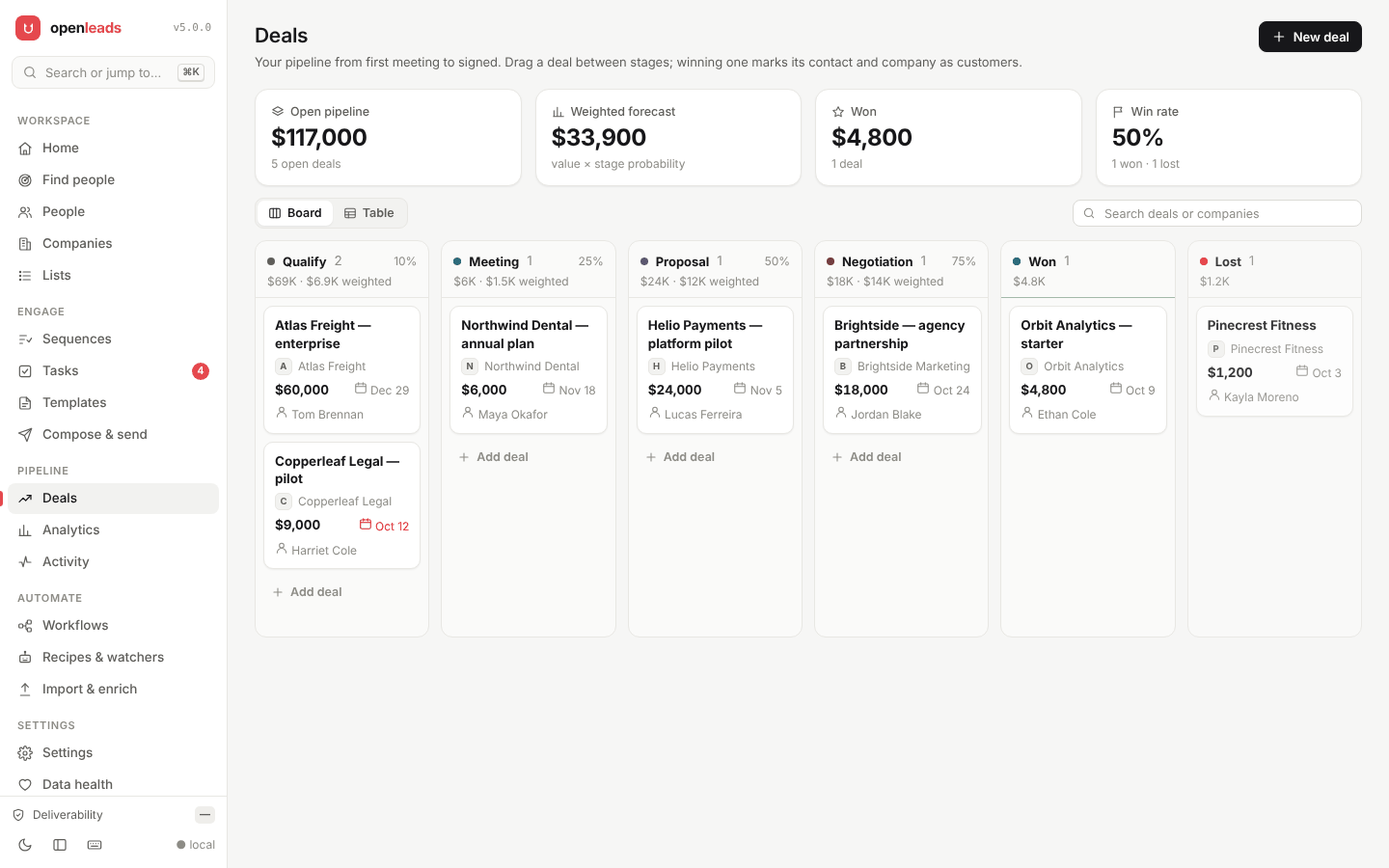
| Deals. A drag-and-drop pipeline with a weighted forecast. Winning a deal makes the contact a customer. | Everything else. People and companies with Apollo-style filters, lists, ICP fit from A to D, a task queue, templates, CSV import, duplicate merge and a ⌘K palette. |
openleads people --fit A --never-contacted                 # best untouched leads
openleads lists add "Q4 dentists" --where dental
openleads seq enroll "Q4 outbound" --list "Q4 dentists"
openleads tasks --bucket today
openleads import apollo-export.csv --list "Imported"
Workspace guide | Sequences guide | Moving from Apollo
Use it from Python
import openleads

leads = openleads.find("gyms in Sydney", count=20)
for lead in leads:
    print(lead.email, lead.evidence, lead.tier)
leads.write("gyms.csv")            # .csv, .json or .jsonl
print(leads.report.summary())      # which sources ran, what failed, why it stopped
Use it from Claude, Cursor or Claude Code
OpenLeads is an MCP server. Your assistant can find and verify leads mid-conversation, and work your lists, tasks and sequences:
claude mcp add openleads -- openleads mcp
{ "mcpServers": { "openleads": { "command": "openleads", "args": ["mcp"] } } }
"Find 10 law firms in London with emails we can actually send to, save them to a list called London law, and give me a call task for each partner."
The assistant can search and edit your workspace, but it never sends email itself.
Automate it
Workflows are n8n-style node graphs you draw in the dashboard: triggers (schedule, new leads, a reply), find, verify, filter and split by tier, write email, wait, send, add to a list or sequence, create tasks, and export. Test runs never send; every run shows what each node did. Sends stay inside your daily cap, warmup ramp and business hours, and stop for anyone who replies.
openleads workflow templates                       # 7 ready-made workflows
openleads workflow new dentists --from local-business-outreach   # arrives paused
openleads workflow run dentists      # a test run: finds and writes, never sends
openleads recipe add miami "marketing agencies in Miami" --every "weekdays 9am" --send
openleads watch add new-dentists "dentists in Austin"     # tell me only about new matches
openleads schedule on      # one agent: launchd, cron or Windows Task Scheduler
openleads runs             # what ran, what it found, what failed
Workflows | Writing emails | Timed runs. Exports go to CSV, Google Sheets, Notion, Airtable, HubSpot or any webhook. There is also a GitHub Action:
- uses: Samyrrrrrr990/[email protected]
  with: { query: "marketing agencies in Miami", count: 50 }
Install
pipx install "openleads[all]"     # recommended
pip install openleads             # minimal: the standard-library engine and CLI
npx openleads                     # Node: sets up a private Python environment on first run
openleads doctor    # checks your setup: DNS, port 25, mailbox
openleads demo      # the dashboard on an invented workspace
openleads           # chat: type what you want
Python 3.8 or newer on macOS, Linux or Windows. Full walkthrough: quickstart.
Commands
# find
openleads find "50 fintech founders, verified only" -o leads.csv
openleads find "accountants in Toronto" --explain     # the plan, each source's status, hints
openleads company stripe.com                           # tech stack, socials, phones, people
openleads enrich my-list.csv                           # your names and companies, emails labeled
openleads verify [email protected]

# reach out (a dry run unless you add --live)
openleads write "rust developers in Berlin" --variants 2 --explain   # drafts, scored, with the brief
openleads run "rust developers in Berlin"

# the workspace
openleads people | companies | lists | seq | tasks | deals
openleads import | export | dedupe | stats | backup

# set up and automate
openleads init | config | doctor | web | mcp | bench
openleads recipe | watch | schedule | runs
openleads --help lists every command by group.
How it works
flowchart LR
    Q["'dentists in Austin'"] --> P[Query parser]
    P --> F[Planner<br/>picks the sources]
    F --> S1[OpenStreetMap]
    F --> S2[YC, HN, GitHub, Hugging Face,<br/>OpenAlex, EDGAR, Wikidata, NPI]
    S1 & S2 --> D[People from team pages<br/>+ real-name check]
    D --> E[Email checks<br/>harvest, pattern, MX, SMTP, Gravatar]
    E --> L[Leads with evidence and tier]
    L --> W[Workspace, sequences, exports]
    E <--> DB[(Local SQLite<br/>learned patterns, workspace)]
The engine is Python standard library only. Requests that fail transiently are
retried, a search returns within its time budget with whatever finished, and every
run produces a report of which sources answered, which fell back and why. Your
leads, drafts, mailbox credentials, learned patterns and the whole workspace live in
~/.openleads. There is no hosted backend, no account and no telemetry.
Architecture.
Responsible use
OpenLeads is for legitimate prospecting, recruiting and research. You are responsible for anti-spam law (CAN-SPAM, GDPR, CASL) and each source's terms. It ships the guardrails: dry runs by default, a suppression list, one-click unsubscribe, warmup caps and no tracking pixels. Responsible use.
License
Open source under AGPL-3.0. Using OpenLeads is free, including at your company. If you embed it in a closed-source product, or run a modified version as a service without publishing your changes, you need a commercial license.
Contributing
The most useful contribution is a new source (guide); the next
is a query that openleads bench scores badly, with the fix. See
CONTRIBUTING.md. Thanks to everyone who has sent a pull
request, including @xmejl, @harrisonoconnorhover and @Shalinipks for 5.1.
Thanks
OpenStreetMap contributors,
OpenAlex, yc-oss/api,
Hugging Face, the NPI Registry,
SEC EDGAR, Wikidata, Gravatar, and the US Social Security Administration for its
given-name data. The dashboard and website use
Atkinson Hyperlegible by the Braille
Institute.