
Queena34/StudyPilot
Queena34/StudyPilot has 50 GitHub stars and 0 forks. GitHot measured 0 stars in 24 hours and 0 in 7 days. Last checked 2026-11-09 15:54 UTC. Last push 2026-09-04.
Bilingual AI study coach that answers only from your own course material, with citations
Measured star growth
- in 24h
- 0
- in 7 days
- 0
- in 15 days
- Update delayed
- in 1 month
- Update delayed
Net star changes over overlapping periods, not daily totals. Missing measurements are left blank. Stars measure attention, not software quality.
README.en.md
OriginalStudyPilot
A bilingual AI study coach for international graduate students. Upload your course material and StudyPilot explains concepts with citations, writes practice questions it can grade, marks them against a rubric criterion by criterion, and schedules revision from what you actually got wrong — all from that material alone.
The core constraint: it never fills a gap with general knowledge. If the material does not cover something, it says so rather than answering from memory.
Positioning, user scenarios, core flows, scope boundaries and acceptance criteria: Product requirements (PRD, in Chinese).
Screens
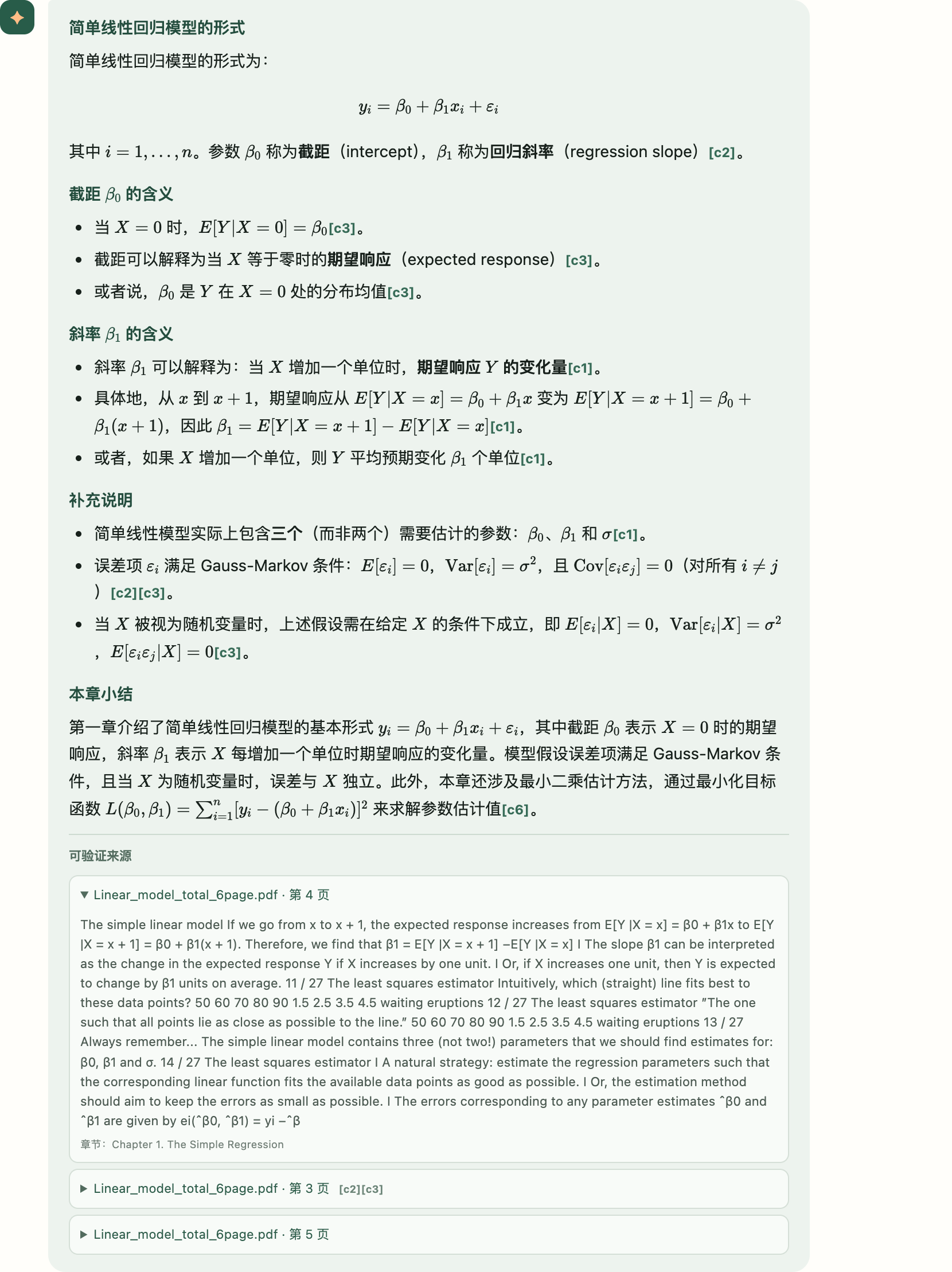
Grounded explanations — mathematics renders as LaTeX, inline [c1] markers point
at the sources below, and sources are grouped by page, expand to the passage the
model actually read, and link into the PDF at that page.
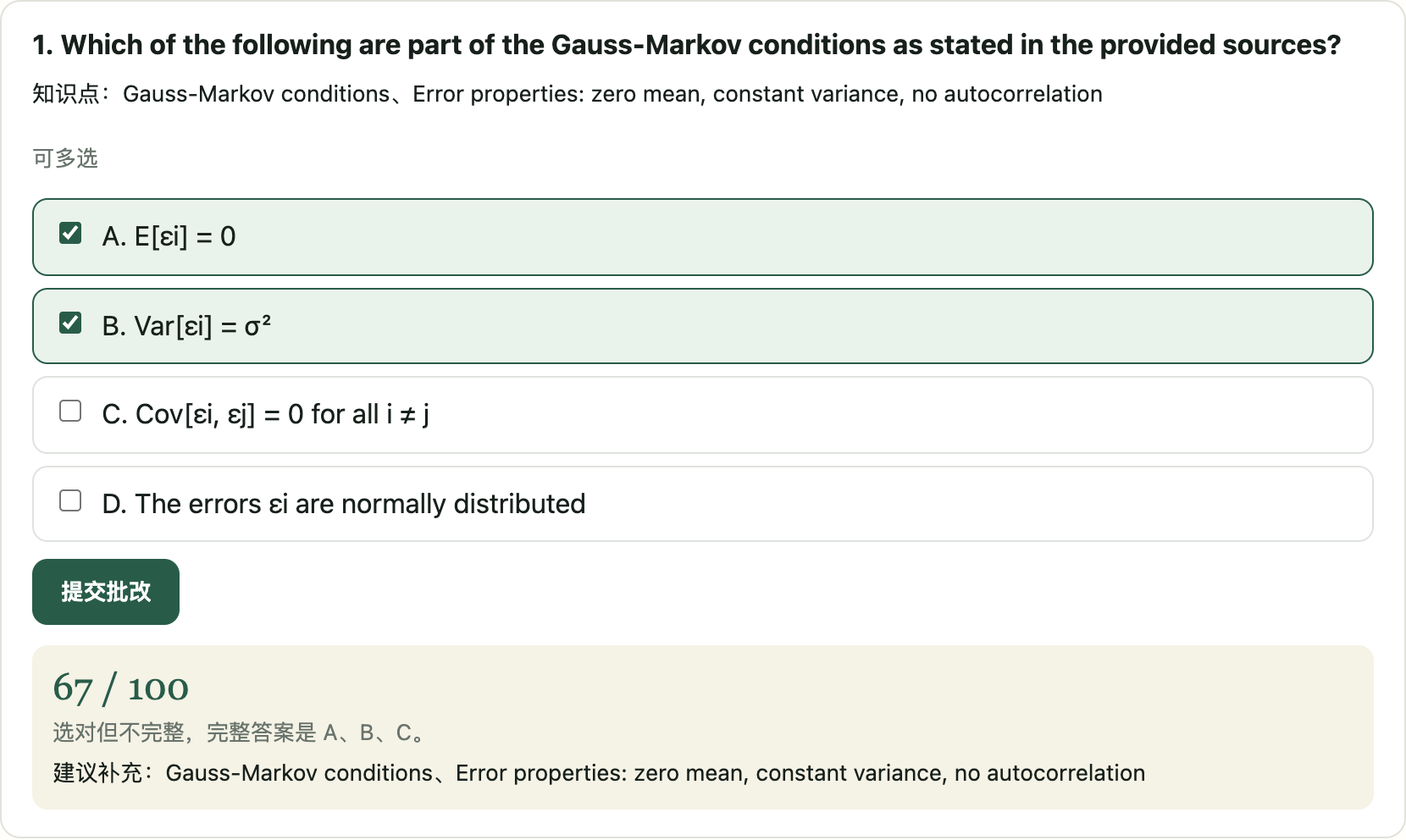
Practice and grading — single choice, multiple answers, short answer and concept
questions. Multi-answer questions earn (hits − misses) / answers, floored at zero.
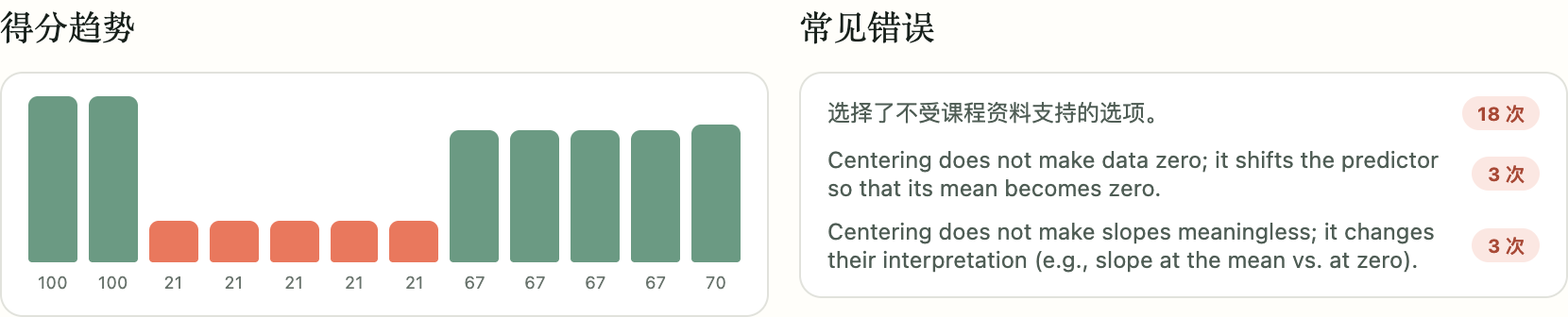
Progress — mastery, score trend and recurring mistakes, aggregated from every attempt.
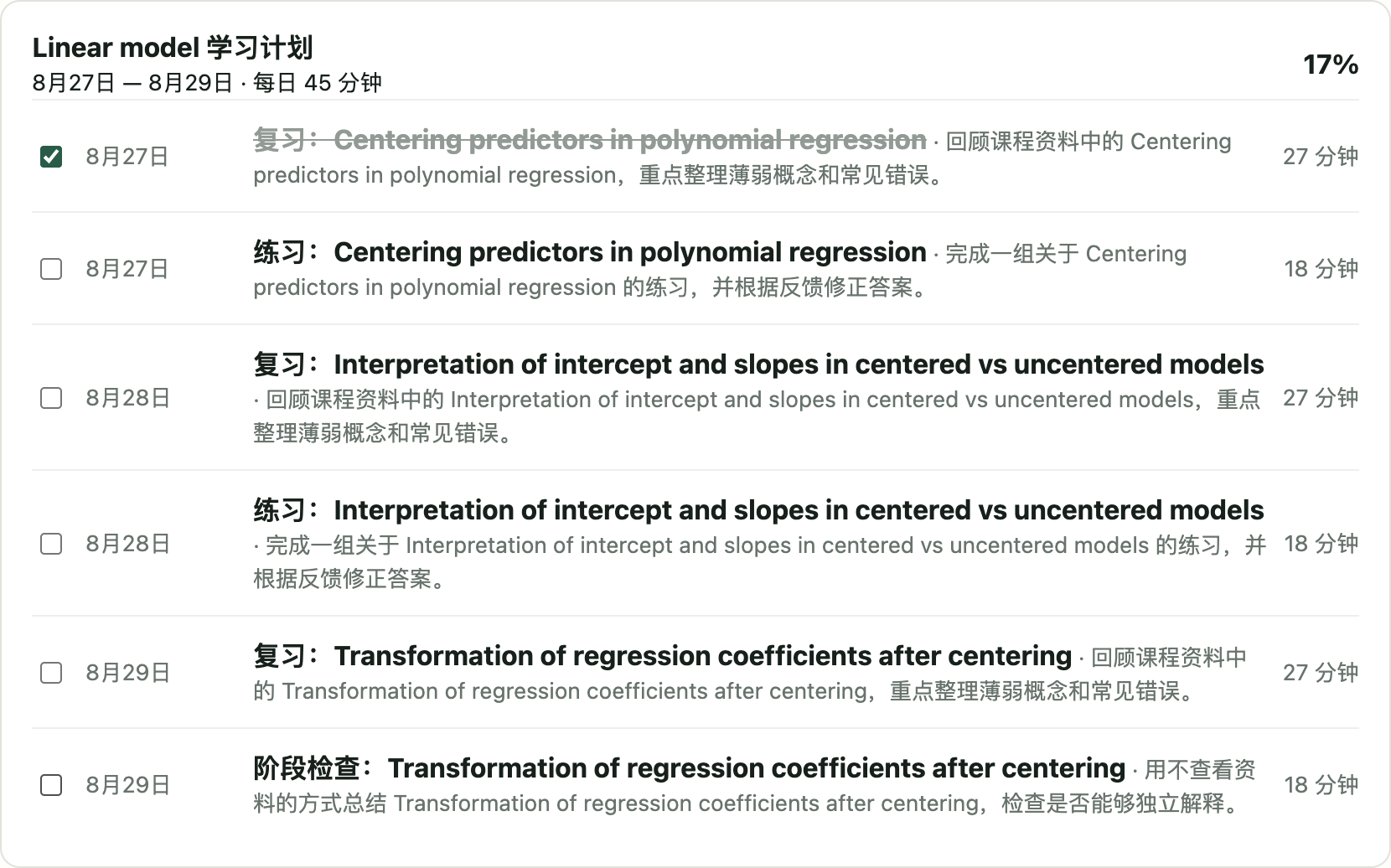
Study plan — daily tasks generated from weak topics and the exam date.
Quick start
cp .env.example .env        # add your model key
docker compose up -d --build
- Workspace: http://localhost:8000/
- API docs: http://localhost:8000/docs
Upload, parsing, retrieval and citation work without a model key — you get verifiable
retrieval results instead of generated prose. With a key configured you get full
explanations carrying [c1] citations:
STUDYPILOT_ANTHROPIC_API_KEY=your_api_key
STUDYPILOT_ANTHROPIC_MODEL=claude-3-5-sonnet-20241022
What it does
Material
- Create a course, set the exam date, upload PDF / Markdown / TXT.
- A background worker parses, chunks, embeds and indexes asynchronously, with visible progress.
- It detects how each document divides itself. Numbered chapters (
Chapter 3./第三章), slide handouts split by their title pages, and Markdown headings each get their own detector; when none applies the document is stated to have no structure rather than being given an invented one. A document that numbers its own chapters keeps those numbers — a textbook opening onChapter 0still answers "chapter one" withChapter 1.
Asking
- Retrieval is scoped by course, material type, named documents, page range and section, and understands references like "the first document" or "the second PDF".
- Every answer cites filename and page; a citation expands to the passage and links into the PDF.
- Ask in Chinese about English material: the question is translated into the material's language before retrieval, and the answer comes back in Chinese, English or both.
Practice and grading
- Questions carry their sources and a rubric. Question language is set separately from explanation language — students are often taught in one language and examined in another.
- Grading follows an immutable rubric and returns per-criterion scores, what was missed and what to do next. Choice questions are graded deterministically, without a model.
- Practice history, retry of missed questions, rubric and source display.
Study management
- Attempts aggregate into mastery levels and weak topics, which drive the study plan.
- Language and teaching-style preferences; individual weak topics can be inspected and removed.
Academic integrity
- Four deterministic levels. Ghost-writing an assignment and live-exam cheating get no answers, while legitimate study help continues — what is refused is doing the work, not learning from it.
Architecture
Single chat entry point
  ↓
Hybrid LearningIntentRouter        Rules first; the LLM is called only for low-confidence,
  ↓  RoutingDecision + QueryPlan   ambiguous and composite requests
Academic integrity guard           Four levels, before any agent runs
  ↓
LearningAgentOrchestrator          Dispatches by execution_mode, passes context when sequential
  ├─ TutorAgent      course Q&A and explanation
  ├─ QuizAgent       question generation
  ├─ EvaluatorAgent  rubric grading
  ├─ PlannerAgent    study plan reading and generation
  └─ Progress / Catalog / General
  ↓
TeachingToolManager                9 teaching tools; course ownership and document scope
  ↓                                are validated in one place
AgentResult + AgentTrace
Three constraints run through the whole system:
- A scope the learner chose explicitly is never overridden by a model. Course, documents, type, pages and section never enter the model's input, and the tool layer verifies the documents really belong to that course — anything else returns 403.
- Scope is parsed once. Intent and scope become a structured
QueryPlanin the router; every agent and service downstream consumes those fields rather than re-reading the message. Otherwise one phrase like "chapter one" gets three different readings in three different places. - Rules first. The most common unambiguous requests are resolved by deterministic rules at zero latency; measured over the routing suite, the LLM is called on about 40% of cases.
Retrieval: BAAI/bge-small-en-v1.5 embeddings (384-dim, ONNX inference, baked into
the image so nothing is downloaded at runtime), 1200/200 chunking, fused scoring
0.7 × vector + 0.3 × lexical. Cross-lingual retrieval does not rely on multilingual
embeddings — the question is translated into the material's language first. That costs
one small model call and buys a smaller, sharper English retrieval model; it also means
a bad translation is visible, whereas an embedding that fails to align is a black box.
Active stack: FastAPI + PostgreSQL + ChromaDB + Prometheus + Docker. Entry point app.main:app,
all routes under /api/v1; the front end is a vanilla HTML/CSS/JS workspace served by FastAPI.
PostgreSQL is the single authority for short-term context and background job state. The unused
Redis service was removed instead of adding cache invalidation and operational cost without a
measured need.
Observability: /api/v1/metrics exposes low-cardinality Prometheus metrics for HTTP success
and latency, routing sources, workflow completion and degradation, agent steps, teaching-tool
success and latency, RAG evidence outcomes, fallback reasons, and tutor tokens. Labels never
contain a user, course, document, question, or trace ID. Tutor responses return X-Trace-ID,
which identifies the full agent trace carried in the response body.
Testing and evaluation
Unit tests check that the code is correct. The offline evaluations under tests/evals/
check that model behaviour stays faithful to the material — the part of an LLM
application that actually breaks and that unit tests cannot see.
docker compose exec api python -m pytest tests/unit -q
Eleven versioned suites, each with a recorded baseline and an explicit merge gate. See tests/evals/README.md:
| Suite | Size | Baseline | Needs a model |
|---|---|---|---|
| Router v2 | 57 cases | 98.1% agent, 100% composite-step detection, 100% clarification, 100% scope preservation (86.5% intent; nearly all of the gap is same-agent label overlap) | partly |
| Integrity v1 | 61 cases | every metric perfect, 0% false positives | no |
| Orchestrator v1 | 30 cases | every metric 100% | no |
| Loop v1 | 5 stages | loop closes, 22.5s end to end | yes |
| RAG v1 | 30 questions | 100% citation validity, 100% scope adherence, 98% keyword coverage | yes |
| Quiz v1 | 30 scenarios | 96.7% expected-outcome success (including correct rejections); 27/28 requested generations succeeded | yes |
| Grading v1 | 10 × 3 bands × 3 runs | every metric 100% | yes |
| Faithfulness v2 | 30 human-reviewed | grounding and citation accuracy 100%, fabrication 0%, unsupported-query refusal 100% | human |
| Cross-lingual v1 | 14 questions × 2 languages | 100% parity, no unsupported citations | yes |
| Injection v1 | 10 attack classes | 100% resistance, 0% canary leakage | yes |
| Paraphrase v1 | 11 groups, 41 cases | 100% group consistency, 100% intent accuracy | partly |
Three suites call no model at all — free, seconds long, reproducible bit for bit, and suitable for CI:
docker compose exec api python -m tests.evals.run_router_eval --rules-only
docker compose exec api python -m tests.evals.run_integrity_eval
docker compose exec api python -m tests.evals.run_orchestrator_eval
Baselines record what the system actually does; no dataset was edited to make a number
look better. The metrics themselves have been corrected more than once — the injection
suite once scored "the model named the attack and refused to follow it" as a failure, and
a detector that punishes correct behaviour is worse than no detector. Those corrections
are written down in tests/evals/README.md.
Out of scope
StudyPilot answers only what the learner's own uploaded material covers. Mental-health crises and emotional support, professional medical, legal or financial advice, and factual questions outside the material are out of scope, and the system does not attempt to detect them. Those situations need trained people and human escalation, which this project does not have — so it declines the role rather than shipping an unreliable version of it.
Explore related projects
affaan-m/ECC
The agent harness performance optimization system. Skills, instincts, memory, security, and research-first development for Claude Code, Codex, Opencode, Cursor and beyond.
300,664 starsNousResearch/hermes-agent
The agent that grows with you
262,378 starsmultica-ai/andrej-karpathy-skills
A single CLAUDE.md file to improve Claude Code behavior, derived from Andrej Karpathy's observations on LLM coding pitfalls.
231,784 starsfirecrawl/firecrawl
Supercharge your AI agents with data from the web and beyond. Building the library for superintelligence. 🔥
200,178 stars