
OpenNHP/opennhp
OpenNHP/opennhp has 13,952 GitHub stars and 2,481 forks. GitHot measured -2 stars in 24 hours. Last checked 2026-11-05 19:09 UTC. Last push 2026-11-04.
Make your infrastructure invisible to attackers. OpenNHP implements the Network-infrastructure Hiding Protocol (NHP): authenticate before connection, cryptographically. IETF draft.
Measured star growth
- in 24h
- -2
- in 7 days
- Update delayed
- in 15 days
- Update delayed
- in 1 month
- Update delayed
Net star changes over overlapping periods, not daily totals. Missing measurements are left blank. Stars measure attention, not software quality.
README.md
Original


Make the Internet Invisible to Attackers





OpenNHP hides your servers, ports, and domains from the public internet. Nothing answers until a client proves who it is with a single encrypted packet, so scanners, bots, and AI-driven attackers find nothing to attack.
OpenNHP is a lightweight, cryptography-powered, open-source toolkit implementing Zero Trust security for infrastructure, applications, and data. It is the reference implementation of the Cloud Security Alliance (CSA) Network-infrastructure Hiding Protocol (NHP) specification, and features two core protocols:
- Network-infrastructure Hiding Protocol (NHP): Conceals server ports, IP addresses, and domain names to protect applications and infrastructure from unauthorized access.
- Data-content Hiding Protocol (DHP): Ensures data security and privacy via encryption and confidential computing, making data "usable but not visible."
Website · Vision · Live Demo · Documentation · Discord
Why OpenNHP
The modern internet is a dark forest. Attackers — increasingly backed by LLMs that scan, fingerprint, and exploit at machine speed via Autonomous Vulnerability Exploitation — treat every reachable service as a target. Gartner projects AI-driven cyberattacks will rise rapidly. Traditional defenses authenticate users after the network lets them in, leaving exposed ports, IPs, and domains as a permanent attack surface.
In the AI era, VISIBILITY = VULNERABILITY.
OpenNHP inverts that model: invisible until trusted. Every port, IP, and hostname sits behind a default-deny gate. Access is granted only after a cryptographically signed knock is authenticated and authorized out-of-band. Attackers can't exploit what they can't discover.
The third-generation network hiding protocol
NHP is the next step in a line of "hide the service first" designs:
| Generation | Protocol | Limitations |
|---|---|---|
| 1 | Port Knocking | Plaintext, replay-prone |
| 2 | Single Packet Authorization (SPA) | Shared secrets, one-way, typically hides ports only, typically C/C++ |
| 3 | NHP | Modern crypto, bi-directional with status, hides domain + IP + ports, stateless and horizontally scalable, memory-safe Go |
NHP slots in alongside existing IAM, DNS, FIDO, and Zero Trust policy engines rather than replacing them — it extends your stack instead of forking it.
Architecture
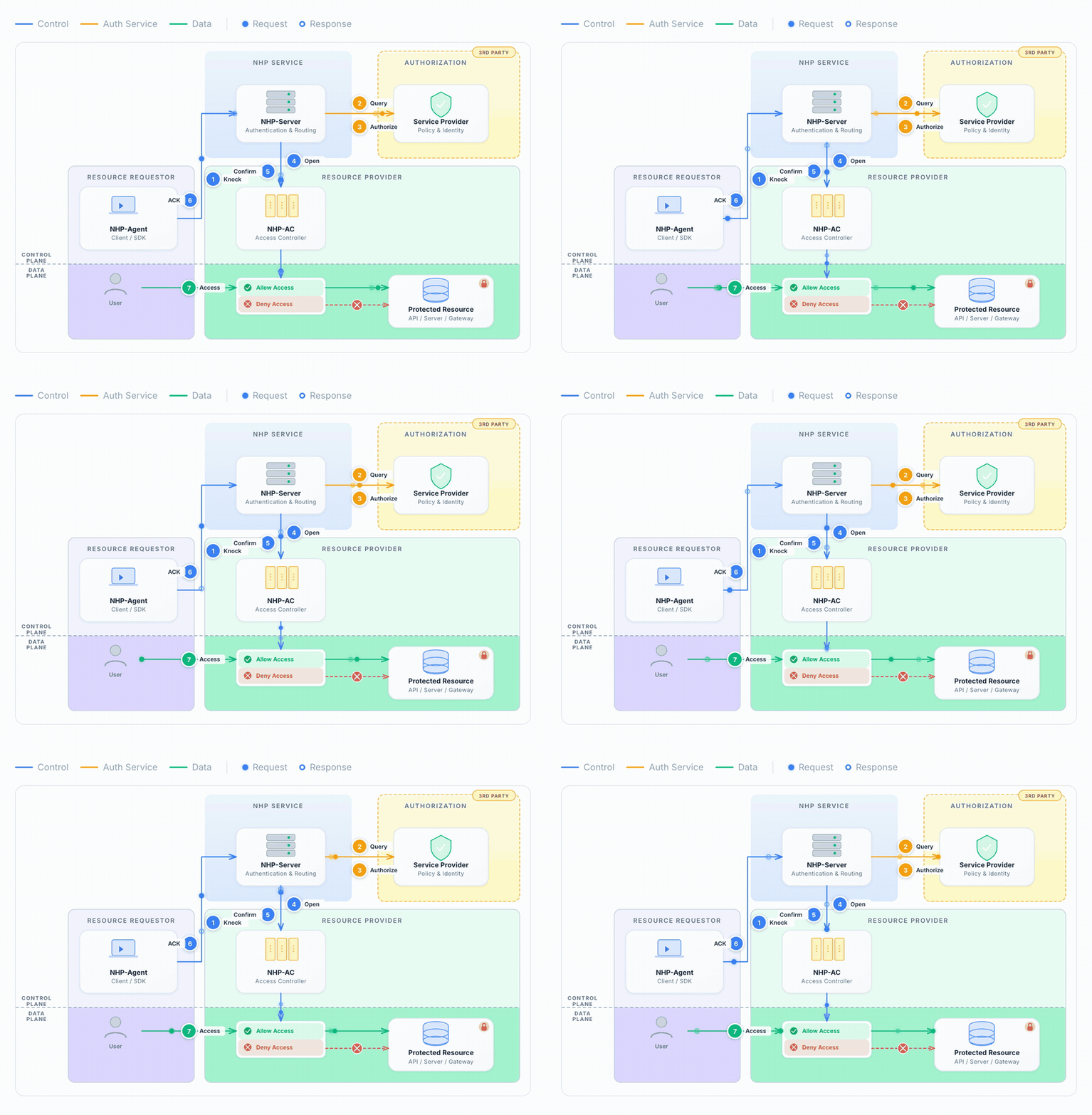
OpenNHP follows a modular design with three core components, inspired by the NIST Zero Trust Architecture:
| Core Component | Role |
|---|---|
| NHP-Agent | Client that sends encrypted knock requests to gain access |
| NHP-Server | Authenticates and authorizes requests; runs separately and is architecturally decoupled from the protected host |
| NHP-AC | Access controller that manages firewall rules on the protected server |
| Addon Component | Role |
|---|---|
| NHP-Relay | HTTP-to-UDP bridge enabling browser-based agents to send NHP knocks via HTTPS |
| NHP-KGC | Key Generation Center for Identity-Based Cryptography (IBC) |
Protocol flow
Registration (once per device). The agent generates its own key pair, then enrolls the public key:
- Agent requests a one-time password (
NHP_OTP); the Server's auth plugin delivers it to the user (e.g. by email). - Agent sends the OTP and its public key (
NHP_REG); the Server binds the key to the user and replies (NHP_RAK).
The private key never leaves the device.
Knock (every access).
- Agent sends an encrypted knock (
NHP_KNK) to the Server. - Server validates the knock and sends an operation request (
NHP_AOP) to the AC. - AC opens the firewall and replies (
NHP_ART) to the Server. - Server returns an acknowledgment (
NHP_ACK) with access info to the Agent. - Agent reaches the protected resource through the AC.
Browser agents, which cannot send raw UDP, reach the Server through NHP-Relay over HTTPS; the relay forwards each packet inside an authenticated NHP_RLY envelope.
Cryptography
OpenNHP ships with two interchangeable cipher suites:
CIPHER_SCHEME_CURVE— Curve25519 + AES-256-GCM + BLAKE2sCIPHER_SCHEME_GMSM— SM2 + SM4-GCM + SM3
Both are driven by the Noise Protocol Framework. An Identity-Based Cryptography (IBC) mode is available via the Key Generation Center (KGC).
For protocol details, deployment models, and cryptographic design, see the documentation.
Repository Structure
opennhp/
├── nhp/                # Core protocol library (Go module)
│   ├── core/           # Packet handling, cryptography, Noise Protocol, device management
│   ├── common/         # Shared types and message definitions
│   ├── keystore/       # Sealed (encrypted-at-rest) private key storage
│   ├── ebpf/           # eBPF/XDP programs (AC enforcement, Server ingress filter)
│   ├── plugins/        # Plugin handler interfaces
│   ├── utils/  log/  metrics/  audit/  etcd/
│   └── ...
├── endpoints/          # Daemons and SDKs (Go module, depends on nhp)
│   ├── agent/          # NHP-Agent daemon, plus the iOS/Android SDK (agent/iossdk)
│   ├── js-agent/       # JavaScript agent SDK for browsers (via NHP-Relay)
│   ├── server/         # NHP-Server daemon
│   ├── ac/             # NHP-AC (access controller) daemon
│   ├── relay/          # NHP-Relay daemon (HTTPS-to-UDP bridge)
│   ├── db/             # NHP-DB (Data Broker for DHP)
│   ├── kgc/            # NHP-KGC (Key Generation Center)
│   └── keystorecli/    # `seal` / `unseal` key subcommands shared by every daemon
├── examples/           # Server auth plugins and client SDK samples
├── demoapp/            # Example web app with NHP-protected login
├── docker/             # Docker Compose full-stack environment
└── docs/               # Documentation site (docs.opennhp.org)
Quick Start
Prerequisites
- Go 1.26+
make- Docker and Docker Compose (for the full-stack demo)
Build
# Build all components
make

# Build individual daemons
make agentd    # NHP-Agent
make serverd   # NHP-Server
make acd       # NHP-AC
make db        # NHP-DB
make relayd    # NHP-Relay
make kgc       # NHP-KGC
Test
cd nhp && go test ./...
cd endpoints && go test ./...
Run with Docker
cd docker && docker-compose up --build
Follow the Quick Start tutorial to simulate the full authentication workflow in a Docker environment.
Register an agent
Enroll a device key with a server through the OTP flow. The command prompts for anything you leave out:
./nhp-agentd register --email [email protected] --asp-id <auth-service-id> --res-id <resource-id>
The agent generates its key pair locally, asks the server to send a one-time password, then registers the public key once you enter the code. Use nhp-agentd seal to keep the private key encrypted at rest.
Clients, SDKs, and Live Demos
| Client | Where |
|---|---|
| Native agent daemon | nhp-agentd from make agentd |
| iOS / Android SDK | make iosagentsdk / make androidagentsdk |
| JavaScript (browser) SDK | endpoints/js-agent, sends knocks via NHP-Relay |
Try it in the browser:
- agent.opennhp.org: knock a hidden server with the JavaScript SDK
- reg.opennhp.org: walk through device registration (NHP-OTP → NHP-REG)
- demo.opennhp.org: a web app whose login is protected by OpenNHP
Contributing
We welcome contributions! Please read CONTRIBUTING.md before submitting pull requests.
Note: All commits must be signed with a verified GPG or SSH key.
git commit -S -m "your message"
Security
Found a vulnerability? Please follow the responsible-disclosure process in SECURITY.md rather than opening a public issue.
Sponsors



License
Released under the Apache 2.0 License.
Contact
- Email: [email protected]
- Discord: Join our Discord
- Website: https://opennhp.org
Explore related projects
trimstray/the-book-of-secret-knowledge
A collection of inspiring lists, manuals, cheatsheets, blogs, hacks, one-liners, cli/web tools and more.
256,325 starsHack-with-Github/Awesome-Hacking
A collection of various awesome lists for hackers, pentesters and security researchers
124,736 starsswisskyrepo/PayloadsAllTheThings
A list of useful payloads and bypass for Web Application Security and Pentest/CTF
82,418 starscaddyserver/caddy
Fast and extensible multi-platform HTTP/1-2-3 web server with automatic HTTPS
78,832 stars