
Nurkan1/Anatria-3D
Nurkan1/Anatria-3D has 61 GitHub stars and 19 forks. GitHot measured 0 stars in 24 hours and +1 in 7 days. Last checked 2026-11-25 03:15 UTC. Last push 2026-11-16.
Measured star growth
- in 24h
- 0
- in 7 days
- +1
- in 15 days
- Collecting history
- in 1 month
- Collecting history
Net star changes over overlapping periods, not daily totals. Missing measurements are left blank. Stars measure attention, not software quality.
About
Local-first 3D anatomy atlas with an AI tutor that drives the viewport. Male and female atlases, 3,697 structures, works offline. Free for study and teaching under BSL 1.1; Apache-2.0 from 2030.
Creative & MediaREADME.md
OriginalAnatria3D





Interactive anatomy and AI insights — a local-first desktop application.
An educational anatomy atlas whose AI assistant can drive the 3D viewport directly: ask it to show the left ventricle with hypertrophy and the scene responds, because the agent's tools are typed and validated against the meshes actually loaded.
Not a medical device. Anatria3D is for anatomical education and study. It does not diagnose, treat, or give advice about any individual. See Regulatory positioning.
Free to study with, licensed to deploy commercially. From v0.5.0 the application's code is under the Business Source License 1.1: free for students, teachers, academic research and non-commercial evaluation by healthcare professionals, and each version converts to Apache-2.0 four years after its release. Use in a clinic or any other revenue-generating setting needs a commercial licence — [email protected]. The anatomy keeps its own Creative Commons licences, which this does not touch. See Licensing.
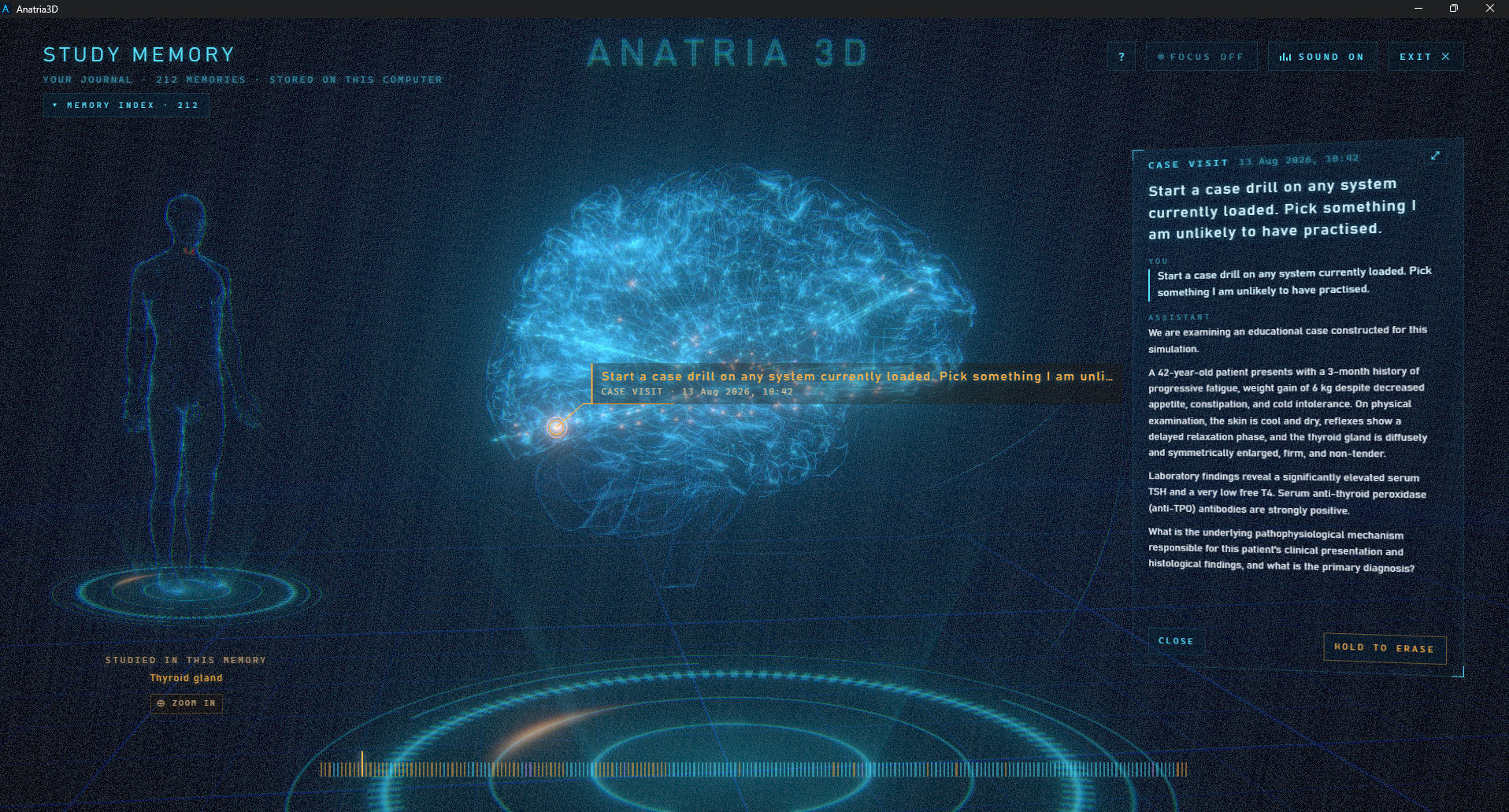
Your journal, as a map of memories. Everything you have studied is kept on this computer, and Study memory shows it as one sequence: a point of light per study session, case visit and note, laid on a brain in the order you made them. Open one and it is read beside the hologram, while the body on the left lights the structures that memory was about — here the thyroid gland, from a case drill about a patient who was invented for teaching. Nothing is fetched to draw any of it, and nothing leaves the machine.
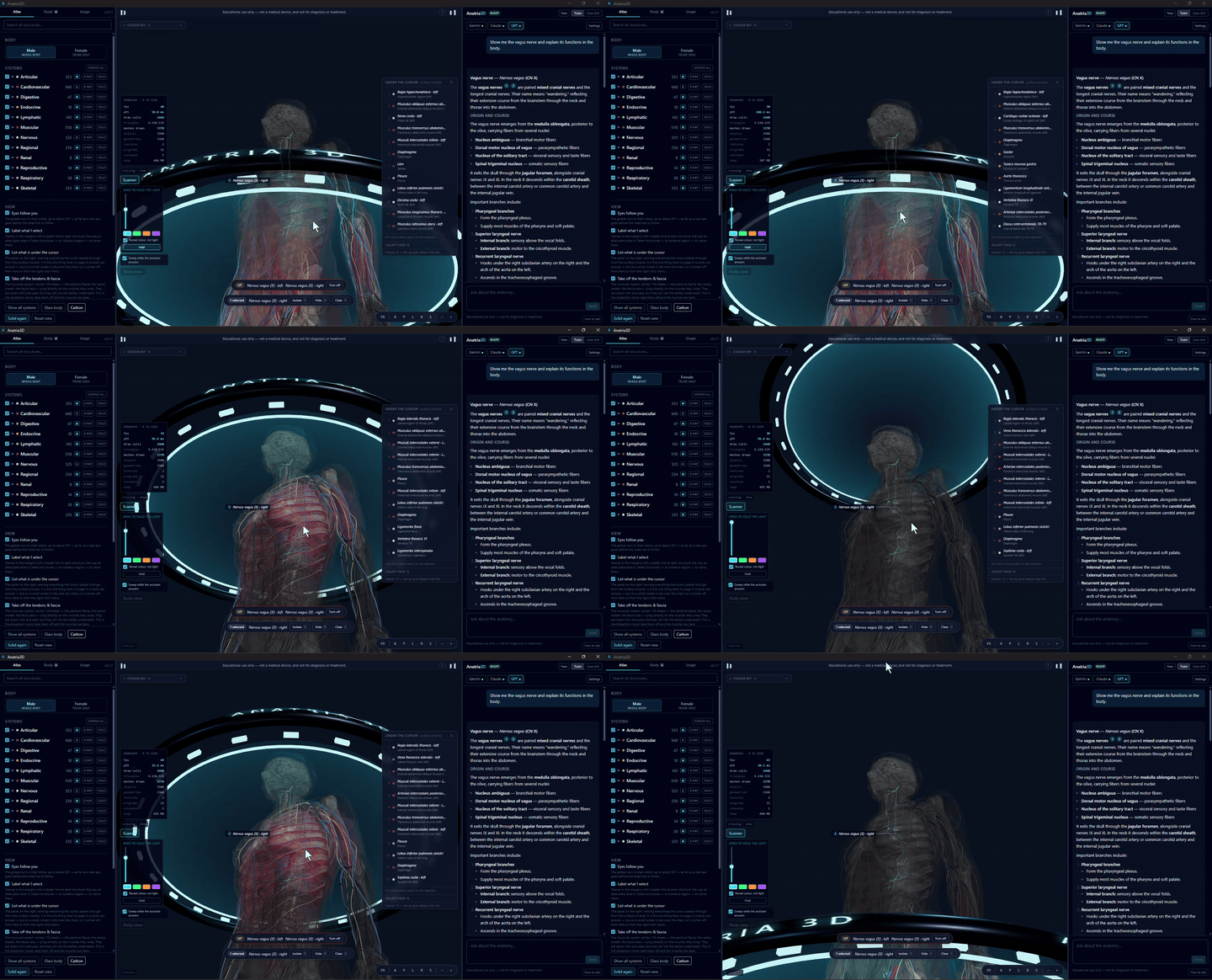
The scanner, running. A plane of light sweeps the body and lights each structure whole as it reaches it, naming what it crosses on the way — and on a carbon body it can give each one its own colour back instead of lighting it. There is a still of it further down, with the measured cost of drawing it.
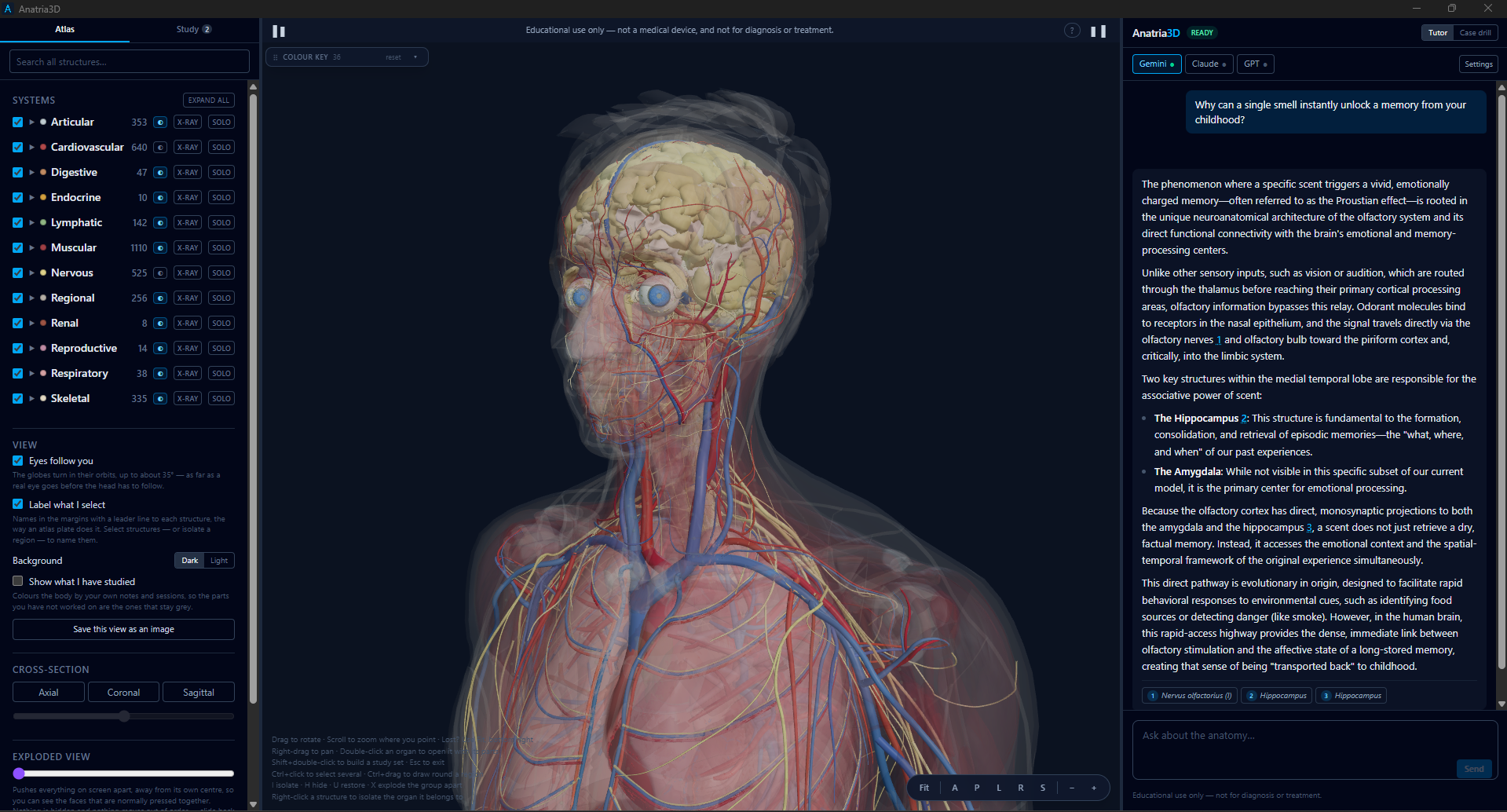
Ask, and the model answers with you. The assistant moves the camera, ghosts the layers in the way and marks what it is naming, so the explanation and the thing being explained are on screen together. Every structure it names carries a numbered pin: hover to highlight it, click to fly there.
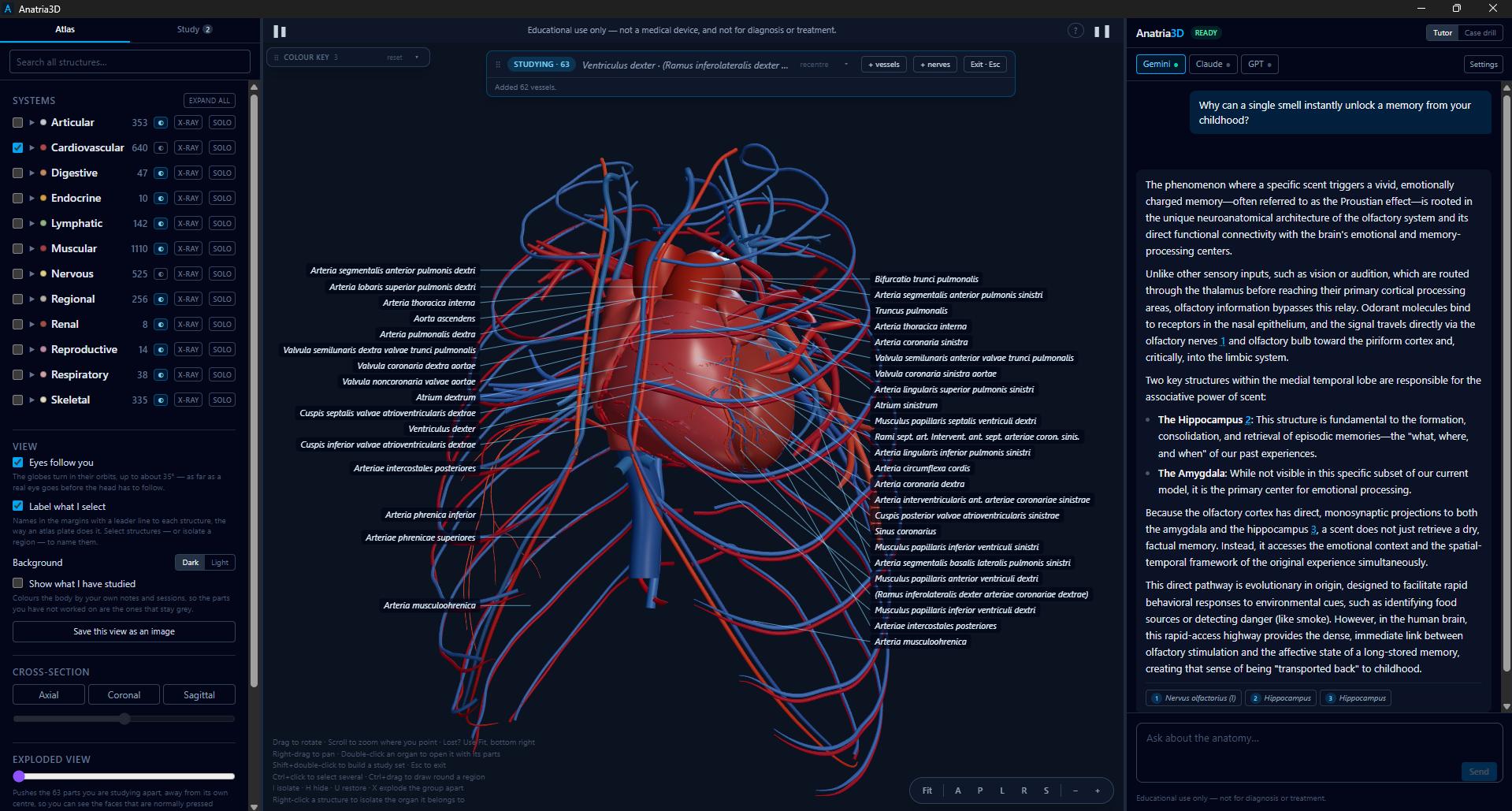
An organ is studied with its supply, or it is not studied. The atlas files structures by system, so isolating the heart leaves the coronary arteries behind under Systemic arteries. One button folds in every vessel that reaches what you are studying — here, sixty-two of them — and the labelled view turns it into a plate you can print.
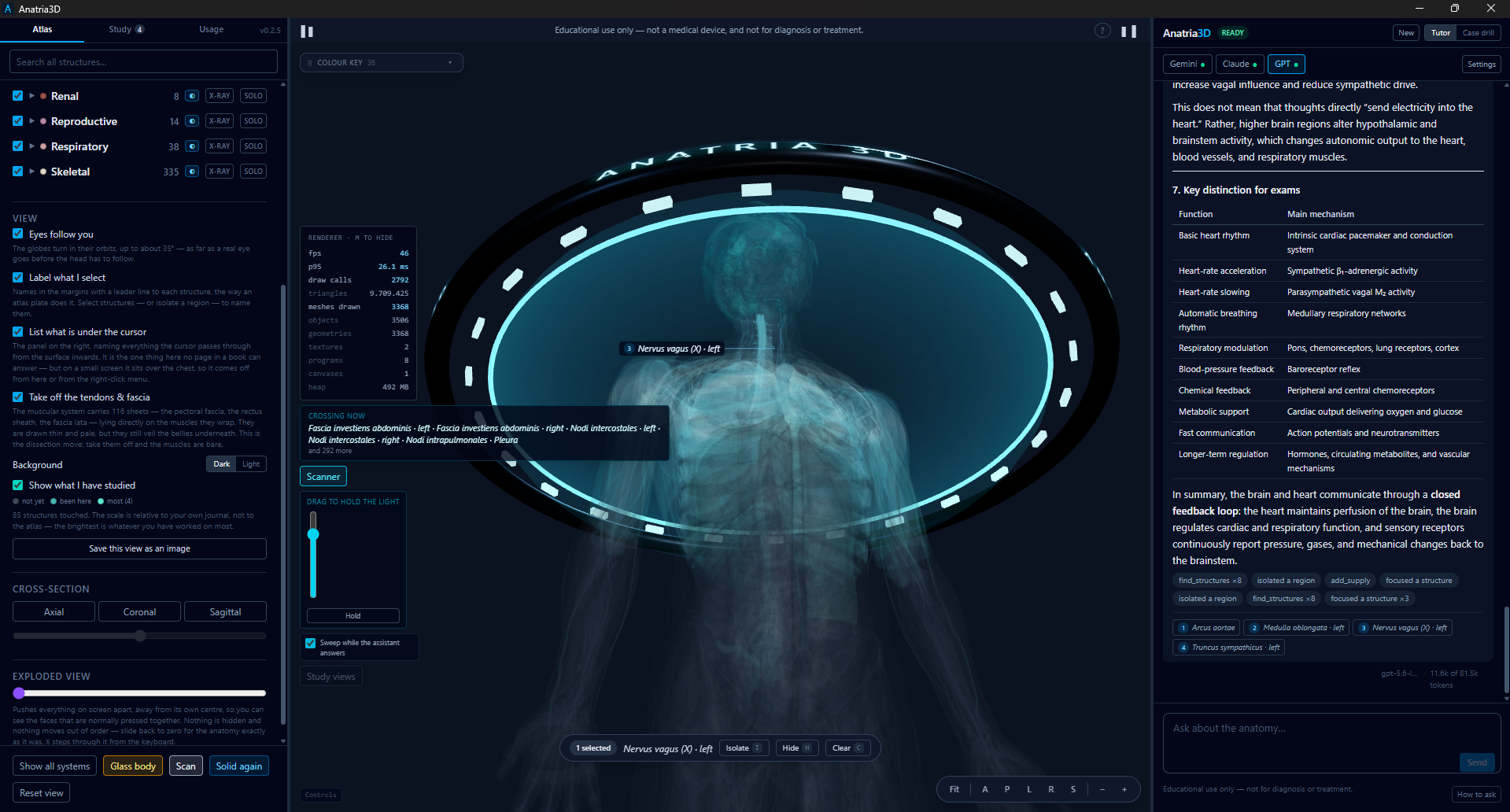
A plane of light that reads the body, and says what it finds. Press Scanner and a ring comes down onto the crown of the head, then travels to the feet and back. Every structure the plane reaches lights up whole while it passes — not the slice of it the plane happens to cut — and a panel names what is being crossed as it goes: the six largest, with the rest counted, because a plane through the chest passes two hundred structures and listing them all tells you nothing.
It is a way of reading rather than an effect. Structures you would never think to click on announce themselves on the way past, in the order they actually lie in the body — which is the one thing a list of names in a sidebar cannot show you. Drag the slider to hold the light where you want it, or press Hold to pin it there and look. It also runs by itself while the assistant is writing, which is the one moment you are waiting with nothing to look at.
What it costs, since the screenshot is showing you the counters anyway: no
extra draw calls, no extra triangles, one extra compiled shader program, and
0.6 ms on the 95th-percentile frame. Three and a half thousand materials share
that one program rather than compiling one each — three.js builds its program
cache key from the source of onBeforeCompile, so handing every material the
same module-level function is the whole trick, and the difference between a mode
that opens instantly and one that freezes the window for several seconds.
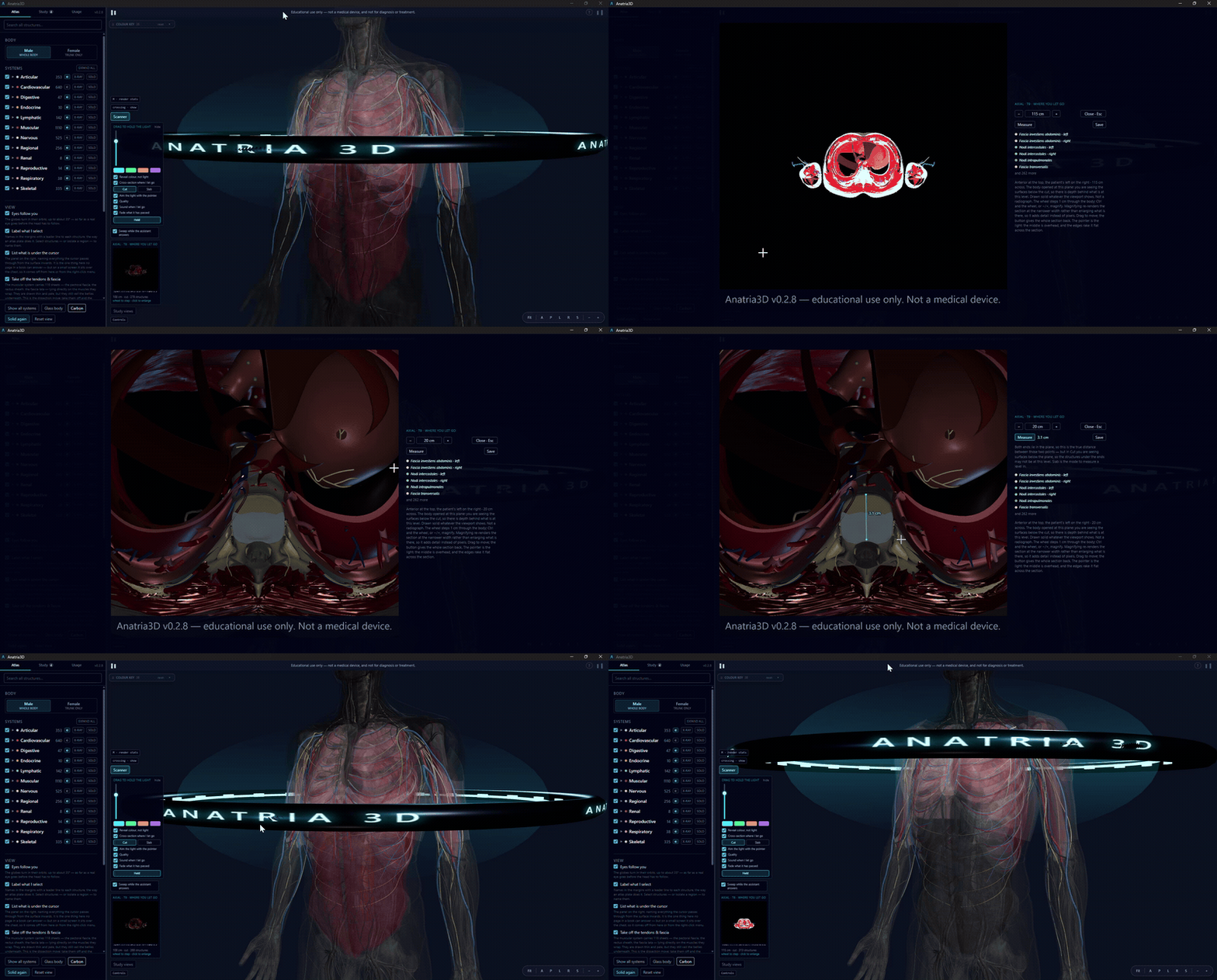
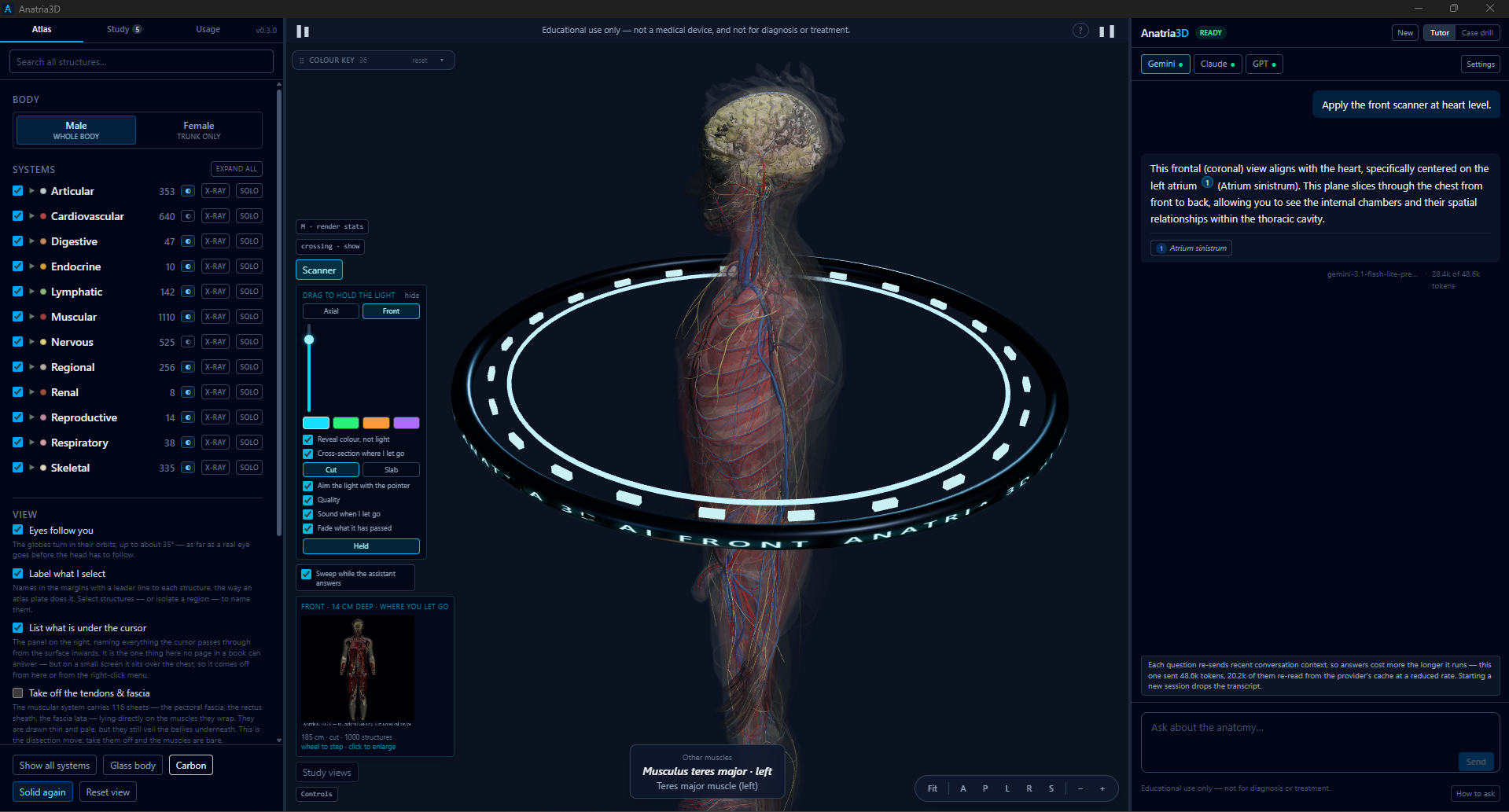
And it reads the body in section. Let go of the light and the body is drawn at that height the way an axial image is read — anterior at the top, the patient's left on your right — with the vertebral level named and the structures it crosses listed beside it. The wheel steps a centimetre at a time; magnifying renders the section again at the narrower width, so it adds detail rather than pixels; a caliper measures in the body's own coordinates and keeps each line on the level it was drawn on; and the assistant can put the plane at any structure you name. Switched to Front, the same instrument sections the body at a depth instead, seen from the front with the head at the top; and with the light held at a level and nothing selected, the assistant knows where it is, so "what is in this part?" needs no other words. A section is the atlas's geometry cut at a height or a depth, not a radiograph, and every picture it produces says so.
The heart, beating. Switch on Heartbeat and the atlas's heart contracts in the order of the cardiac cycle, with its heart sounds and a schematic ECG in time with it. Nineteen textbook patterns — conduction blocks, atrial and ventricular rhythms, valve murmurs, S3 and S4 — change the movement, the trace and the sound together; in a glass body each beat sends light along the arteries. The assistant can play the one it is explaining. They are illustrations for study and teaching at one representative rate, not a model of anyone's heart.
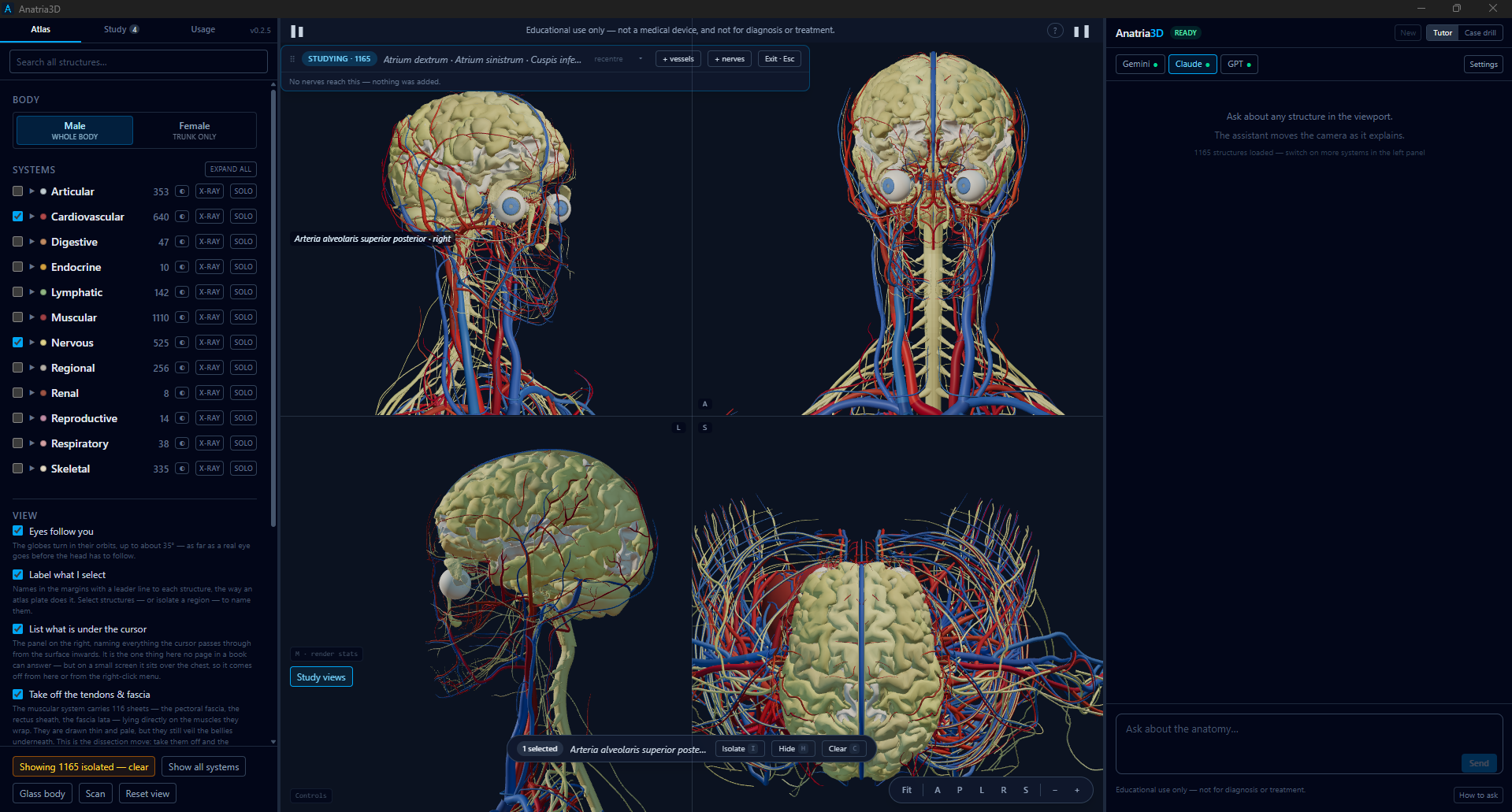
One structure, from four sides at once. An atlas plate shows a single view and leaves the rest to your imagination. Isolate something and the viewport splits: the panel you drive behaves exactly as it did — orbit, zoom, click, select — and three fixed anatomical views follow it, so all four agree about how big the thing is and where you are looking from. Click a letter to close a view; the ones left take the space.
It asks for something isolated first, and that is arithmetic rather than fussiness. Four views of the whole atlas is four passes over three and a half thousand structures; four views of one isolated structure cost four times almost nothing.
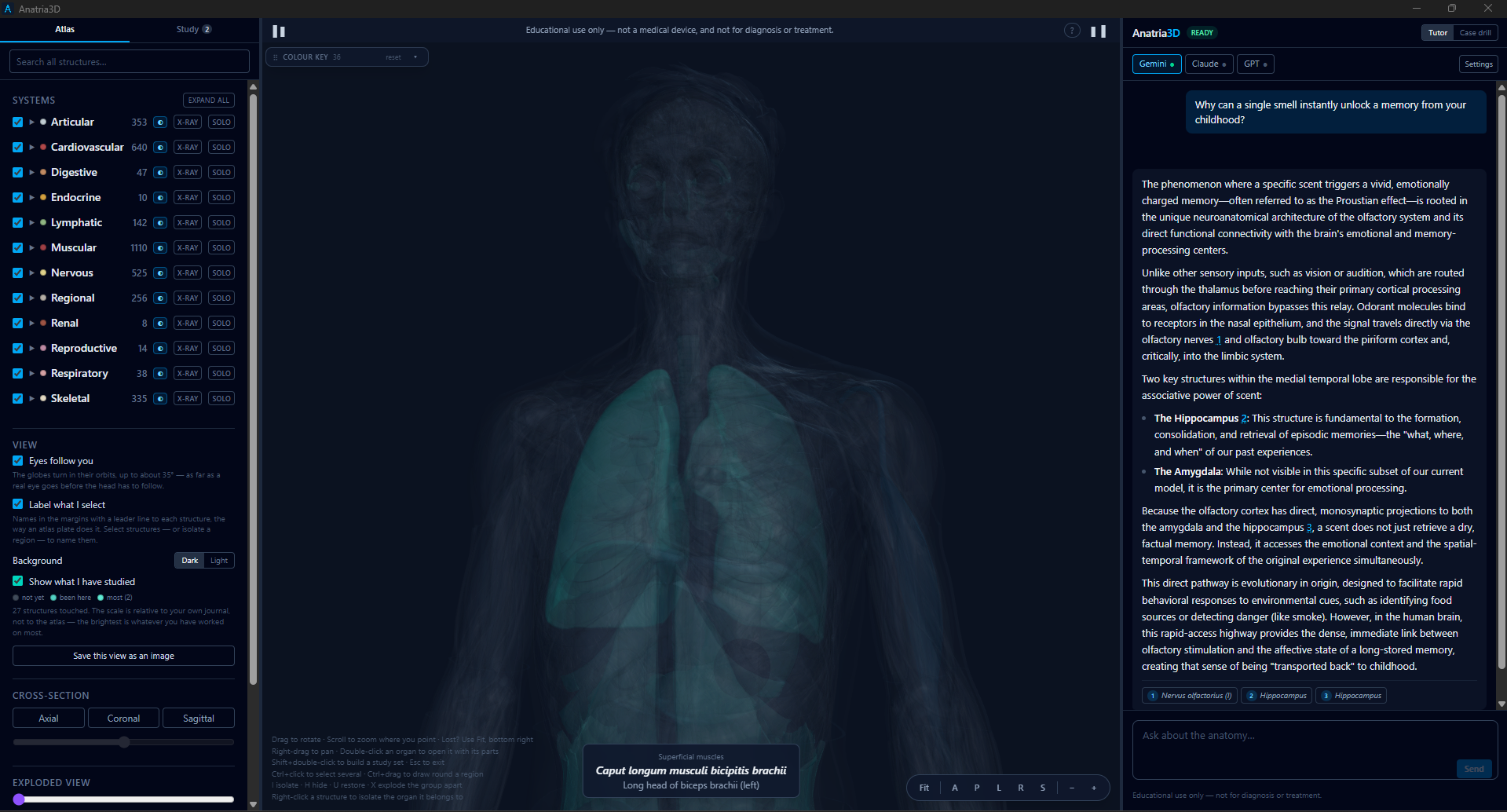
And it knows what you have already studied. Notes and sessions are filed locally against the structures they were about, so the atlas can be coloured by your own revision. Forty notes on the thorax and nothing on the pelvis is invisible in a list, and impossible to miss as a shape on a body.
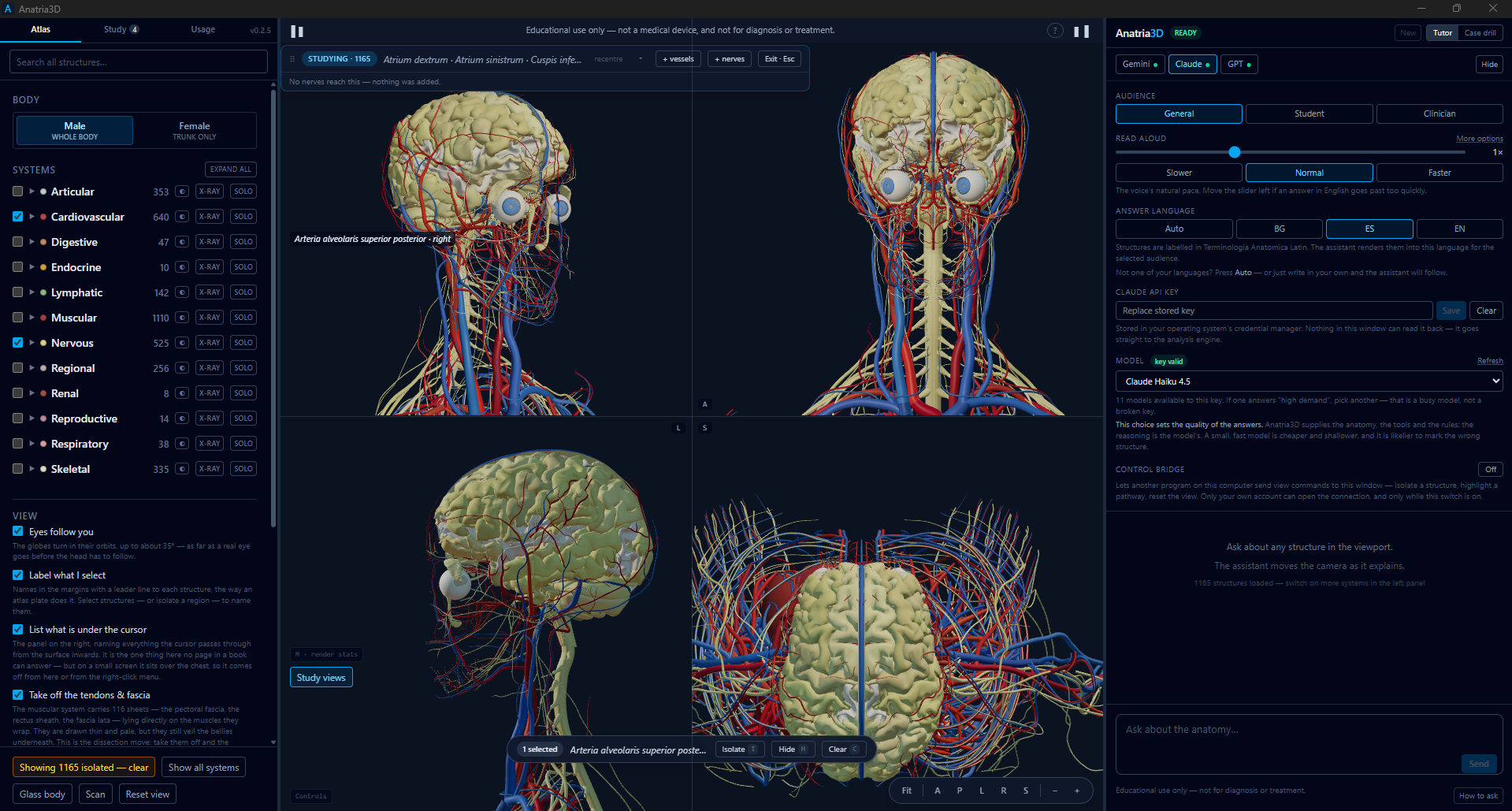
Your key, your provider, your machine. Three providers sit side by side and you switch between them mid-conversation — the application never picks for you. The key you paste goes into your operating system's credential manager, and nothing in this window can read it back: no command returns a key, so the interface can store one and ask whether one exists, and nothing more. The control bridge, which lets another program on this computer move the view, is off until you turn it on.
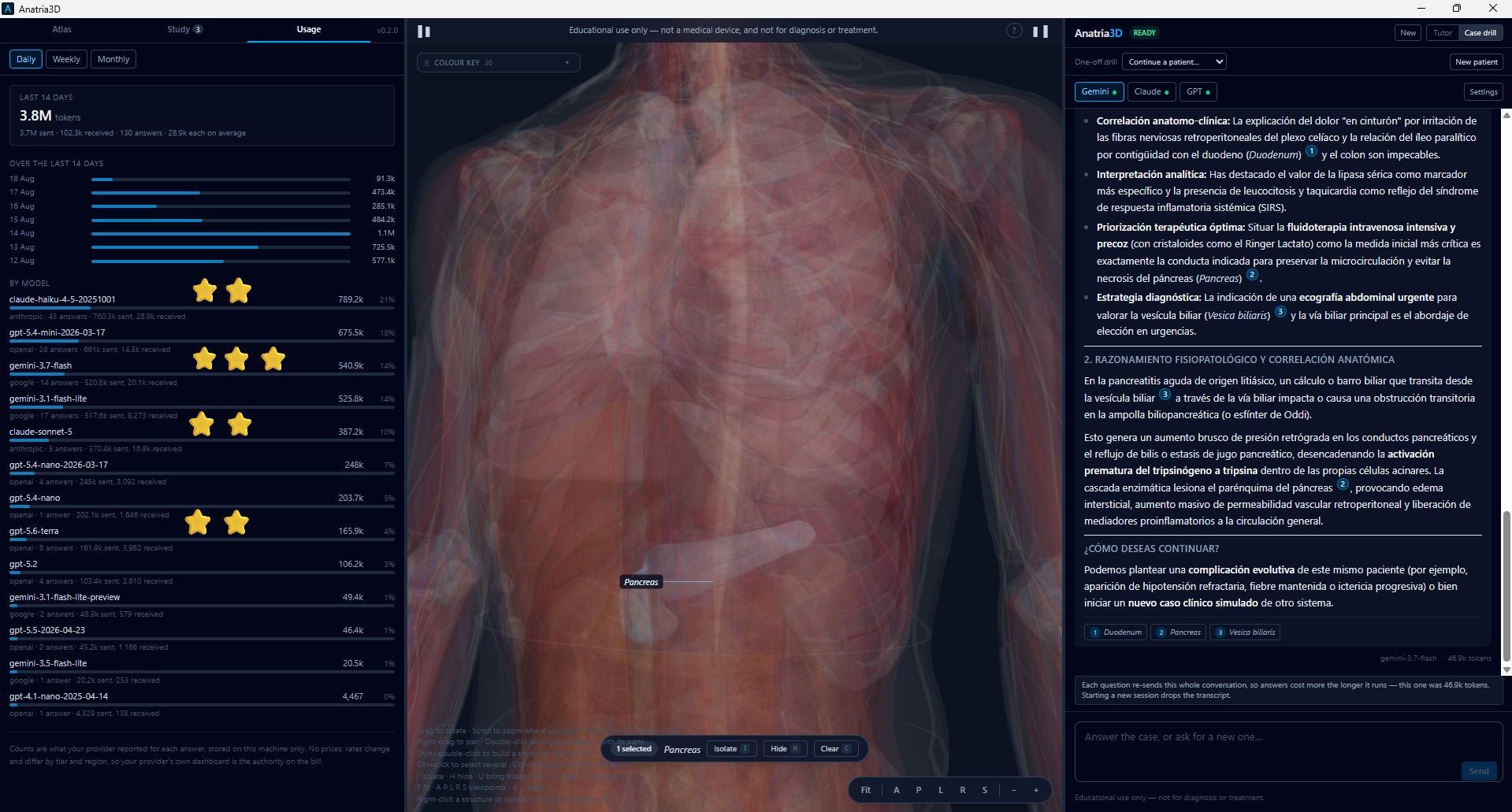
You can see what it costs, and you are not locked to one provider. Every answer's token count is recorded on your machine and totalled per day and per model. No prices are shown anywhere: rates change, and they differ by tier and region, so your provider's own dashboard is the authority on the bill. This panel answers the other question — where is it going?
The stars are annotations on this screenshot, not something the application shows. They are one maintainer's judgement after real use, and they rate balance rather than quality: speed, reliability at calling the scene tools, and precision when explaining — weighed against price.
- Three stars —
gemini-3.7-flash. The best balance today. Not the best model here: it is fast, it isolates the structure you asked for reliably, it explains accurately enough for study, and it costs a fraction of the others. - Two stars —
claude-haiku-4.5,claude-sonnet-5,gpt-5.6-terra. As good or better at the anatomy and the reasoning. The star they lose is price, nothing else.
The answer in the screenshot is in Spanish while every label around it is in English. That is the arrangement described under Status: the chrome is English by decision, and the assistant answers in the reader's own language.
This is a snapshot, not a benchmark. It reflects one person's use on one date, model versions move quickly, and the application never picks for you — the three providers sit side by side in the interface and you switch mid-conversation.
Download
Latest release — Windows and Linux, 64-bit. Four files, for four situations:
| File | Take this one if |
|---|---|
Anatria3D_<version>_x64-setup.exe |
Windows, on your own machine. |
Anatria3D_<version>_x64_en-US.msi |
Windows, deploying across a faculty or a lab through Group Policy or Intune. |
Anatria3D_<version>_amd64.deb |
Debian, Ubuntu, Mint, Kali. Installs to your applications menu. |
Anatria3D_<version>_amd64.AppImage |
Any Linux. No installation and no root — chmod +x and run it. |
The Linux packages are built on Ubuntu 22.04 deliberately, so they also run on newer distributions.
Windows installs without administrator rights. On a university laptop where you are not an administrator, you can still install it.
No account, no key and no internet are needed to start. All 3,742 structures — 3,478 in the male atlas, 264 in the female trunk — the labelling, cross-sections, exploded views and image export work offline the moment you install. Only the AI tutor needs an API key of your own — which also means your questions go straight to your provider, never through a server of ours. If you have Ollama and a model installed, Local gives you a conversation on your own computer with no key at all: it talks, but it cannot move the atlas, and its answers are less reliable.
Windows will warn you the first time. Anatria3D is not code-signed — a certificate costs money the project does not spend — so you will see "Windows protected your PC". Click More info, then Run anyway.
If you would rather check before trusting it, every release lists the SHA-256 of each file. Compare with
certutil -hashfile <file> SHA256. The source for that exact build is the tag it was cut from, and you can build it yourself.
There is no auto-updater, on purpose: the application never reaches the network by itself. New versions appear on the releases page, and nowhere else — Anatria3D is not distributed by email or on request. Because reinstalling is something you have to decide to do, CHANGELOG.md says what is different in each one.
Every installer is built by GitHub Actions from the tag it is named after, so the path from this source to that file is public and checkable. Releases are cut following RELEASING.md.
Status
| Phase | Scope | State |
|---|---|---|
| 1 | Tauri shell, IPC chain, OS-keyring credentials, Python sidecar | Done |
| 2 | 3D engine, Z-Anatomy asset pipeline, scene store | Done |
| 3 | Pydantic AI agent, scene-control tools, compliance guardrails | Done |
| 4 | Chat panel, model discovery, text↔model references, resizable shell | Done |
| 5 | Study journal, printing, exploded view, depth probe, revision map | Done |
Every panel is a production component and the quality gates are green across TypeScript, Rust and Python.
The interface is English only, by decision rather than omission. Translating the chrome would leave the anatomy untranslated beside it, which is the harder half and the one that must not be a frozen lookup table — rendering a structure for a layperson, a student and a clinician needs three different explanations per language. That is the assistant's job, done per turn with the reader's profile in hand, and it already answers in the reader's own language even when the interface does not offer it.
Open: the female head, thorax and limbs, and female musculature anywhere, which need a source that does not exist in the open — see There are two atlases, and the female one is a trunk.
Requirements
| Tool | Version | Notes |
|---|---|---|
| Node | 24+ | |
| pnpm | 9+ | |
| Python | 3.12+ | |
| Rust | 1.82+ | plus the platform toolchain Tauri v2 needs |
Setup
pnpm install
python -m venv .venv
.venv/Scripts/python -m pip install -e "engine[dev]"   # POSIX: .venv/bin/python
The MCP atlas server has a virtualenv of its own and must not be installed into this one — see Using the atlas from another agent for what that costs if it is.
Development
The Rust process launches the frozen Python engine, so the engine must be built before the app will start:
pnpm sidecar:build     # freezes engine/ -> engine/dist/anatria-engine/
pnpm tauri dev
Rebuild the sidecar after changing anything under engine/. Frontend changes
hot-reload as usual; only Python needs the re-freeze. Note that pnpm tauri build does not do it for you — beforeBuildCommand is only tsc and Vite,
so a forgotten re-freeze pairs a new window with whatever engine was last
frozen. The app says so in the assistant panel when a frame arrives that it
cannot read, which is what that mismatch looks like from the inside.
Test the frozen build, not just the interpreter. Two failure modes only
appear after PyInstaller: distributions that read their own version through
importlib.metadata need --copy-metadata or raise PackageNotFoundError
from deep inside pydantic-ai's imports, and symbols re-exported through a module
__getattr__ resolve under a normal interpreter but not in the bundle.
Checks
pnpm typecheck                                    # TypeScript
pnpm test                                         # includes the IPC contract test

cd engine && .venv/Scripts/python -m pytest -q    # POSIX: .venv/bin/python
cd engine && .venv/Scripts/python -m ruff check .

cd src-tauri && cargo test
cd src-tauri && cargo clippy --all-targets -- -D warnings
tests/protocol-contract.test.ts spawns the project virtualenv to compare the
Zod and Pydantic definitions of the wire format. It needs the venv to exist.
Architecture
React (webview)          Rust (native)              Python (sidecar)
─────────────────        ──────────────             ─────────────────
invoke('ask_agent')  ──► reads key from OS      ──► Pydantic AI agent
  (no api_key)           keyring, writes             tools validated against
                         NDJSON to stdin             the loaded manifest
                                                          │
sceneStore  ◄── emit ◄── reads stdout lines  ◄──── NDJSON events
  │                                                 (text deltas +
  └─► R3F scene reacts                               scene commands)
Three properties this buys, each deliberate:
The API key never enters JavaScript. Rust reads it from the OS credential store and injects it into the sidecar's stdin. No Tauri command returns a key — the webview can store one and ask whether one exists, nothing more.
Engine state is asked for, not awaited. ready is emitted once, and Rust
spawns the sidecar in setup() — before the window has run a line of
JavaScript. A frontend that only listens is betting on winning that race, and
losing it leaves the composer disabled with no way back. EngineHandle
therefore remembers both the readiness and the reason it is absent, and
engine_status answers whatever already happened; the event carries whatever
happens next. A failed spawn is the sharper case — reported from setup(), it
is always lost, so a missing engine binary would otherwise read as an
unexplained "offline".
No network surface. The engine speaks NDJSON over stdio rather than serving HTTP on localhost, which any other process on the machine could reach. This process holds the user's API keys; it has no port.
The AI cannot invent anatomy. Every scene-control tool validates its
organ_id against the manifest actually loaded, and raises ModelRetry on a
miss. A hallucinated identifier never reaches the viewport.
The app ships with no shell permission at all — the engine is spawned from
Rust with std::process::Command, so the webview has no path to executing
anything. See src-tauri/src/sidecar.rs for why
that is also what makes PyInstaller --onedir workable.
Found a hole in any of that? SECURITY.md says where to send it
— privately, not as a public issue.
Layout
src/            React 19 + TypeScript + Tailwind v4
  lib/schemas.ts    Zod wire format — one of two protocol owners
src-tauri/      Rust: process ownership, credentials, event forwarding
  src/study_db.rs   SQLite study journal — notes, sessions, case grades
engine/         Python: NDJSON transport, agent, report compiler
  anatria_engine/protocol.py   Pydantic wire format — the other owner
public/anatomy/ Meshes and labels — two atlases, two licences (see NOTICE)
tests/          Cross-language contract test
tools/          Asset pipeline, and the MCP atlas server (own virtualenv)
Protocol ownership
The wire format is defined twice — Zod in src/lib/schemas.ts and Pydantic in
engine/anatria_engine/protocol.py — and nothing in either type system connects
them. tests/protocol-contract.test.ts is that connection: it derives a
normalised surface from each and asserts they match. Change one side, run the
tests. Rust deliberately models only the two fields it needs (provider,
request_id) so the protocol has two owners, not three.
How the assistant drives the viewport
Asking "how does the heart pump blood?" produces a guided tour, not a wall of
text. The agent calls focus_organ on each structure as it reaches it, and the
camera moves while the explanation is still streaming.
That interleaving is structural, not a timing trick. A tool writes its scene command to stdout the instant the model calls it, inside the tool body — the commands are not collected and flushed at the end of the turn. Text deltas ride the same stream, so the two interleave naturally on the way to the viewport.
The tools
| Tool | Effect |
|---|---|
focus_organ |
Move the camera to a structure and select it |
isolate_structures |
Show only these, hide the rest |
show_all_structures |
Clear isolation and section |
set_layer_visibility |
Switch a whole system on or off |
apply_pathology_overlay |
Tint a structure by severity (0–1) |
clear_pathology_overlays |
Remove every overlay |
set_cross_section |
Cut the model on a plane to reveal the inside |
The chat panel carries conversation history across turns, so a follow-up like "and why?" reaches the model with the thread attached. Only completed non-empty turns are replayed — feeding back a failed or half-streamed answer would teach the model that broken turns are normal. Tool calls from earlier turns are not replayed either: the viewport has moved on, and stale scene context invites reasoning about a scene the user is no longer looking at.
Every tool validates against the structures actually loaded and raises
ModelRetry on a miss, naming close matches. A hallucinated organ_id never
becomes a scene command — it is turned back at the tool boundary and the model
tries again with the real inventory in hand. test_scene_tools.py asserts this
directly; it is the property the whole design exists to guarantee.
Linking the answer to the model
Where the assistant names a loaded structure it appends [[organ_id]]. The
panel turns each marker into a numbered pin: hovering highlights that mesh,
clicking flies the camera to it, and a legend under the answer lists every
structure it pointed at. A long explanation stays anchored to what is on screen
instead of asking the reader to find it themselves.
Markers resolve against the structures actually loaded. Nothing validates ids the model merely writes in prose — only the ones it passes to tools — so an invented id is stripped rather than left as literal brackets mid-sentence. Copy strips the markers too, along with the space in front of them, so pasted text is clean.
Pins write to the same sceneStore the assistant's tools do, so clicking a pin
and the model calling focus_organ leave the viewport in identical states.
Choosing a model
The settings drawer lists the models a stored key can actually reach, fetched from the provider. That call is also the key check: the request that fills the picker is the one that proves the credential works, so there is no separate "test key" button that could pass while real questions fail.
This matters in practice because a busy model answers HTTP 503, which is not a
broken key and not our bug. service_unavailable is its own error code for
exactly that reason — the user's move is to retry or pick another model, and
"internal error" would leave them with neither. Defaults avoid preview models
for the same reason: those are the ones that saturate.
Instruction layers
Composed in this order every turn, safety first so nothing later can argue past it:
- Safety — the MDR boundary. Not tunable, asserted by
test_prompts.pyacross all nine profile × language combinations. - Scene — the assistant is expected to show, not only tell.
- Case — only in drill mode: present a scenario, withhold the answer, then grade the attempt. Composed below safety, never in place of it.
- Profile — depth and register for layperson / student / clinician.
- Language — the output language, plus how to render Latin nomenclature for this particular reader.
- Inventory — the structures currently loaded, in
organ_id — Latin (English)form.
The study journal
Notes, conversations and case grades are kept in a local SQLite file in the application's data directory. Nothing about it is remote and nothing about it is optional to the rest of the app.
It lives in Rust, not in the Python sidecar, although Python has sqlite3
built in. The sidecar is the process that holds API keys and talks to a model
provider, and it is the one killed and respawned on a crash. A student's own
notes want neither property. rusqlite's bundled feature compiles SQLite into
the binary, so there is no system library to locate on any of the three targets.
Opening the journal cannot fail the application. A database that will not open
is remembered as unavailable and reported per call, so the atlas, the viewport
and the assistant all keep working — a locked file costs the student their
history, never their lesson. studyStore swallows its own write failures for
the same reason: saving runs from an engine-event handler, and a rejection
escaping there would take the answer down with it.
Conversations are filed as they happen, one row per finished turn, indexed by the structures that were selected when the question was asked. That index is what makes "what have I already studied about the left ventricle?" a lookup rather than a search.
An answer that moved the model files what it did, beside what it said. A question can isolate a region, take the body to glass and light ten structures, and the paragraphs afterwards describe that arrangement — so a transcript keeping only the words was a description of something the reader could no longer see. The recording is read back through the same schema the live commands pass, and one this build cannot read is dropped whole rather than restored in part: a view rebuilt from half an answer would be read as the whole of it.
The journal travels. It is the one thing in the app that cannot be recomputed — an answer can always be asked again, a year of somebody's own notes cannot — so it exports to a single JSON file and imports on another machine.
JSON rather than a copy of the .db: a file copy cannot be merged into an
existing journal, breaks the moment two machines are on different schema
versions, and is opaque to anyone deciding whether to hand it to a class.
Import merges, never replaces, and is idempotent — someone will double-click
the file twice. Sessions key on their id, which was a UUID from the start; notes
key on a uuid added in schema v2 and backfilled with SQLite's own randomblob,
because a rowid is not an identity once it leaves the machine that issued it.
Conflicts resolve to the later edit, and a transcript is only replaced by a
longer one — a conversation only grows, which makes message count a better
signal than a timestamp that also moves when a case is graded.
Rust opens the file dialog, not the webview. A command taking a path would hand the renderer a general write-anywhere capability, which is the thing this design has avoided everywhere else.
Case drills are ordinary sessions with kind = 'case' and a score. The
score comes from a tool the agent can only call in drill mode — see
engine/anatria_engine/case_tools.py — and is validated at that boundary
(0–100, with a written justification long enough to still mean something weeks
later). It is a number rather than prose because it is the part the journal can
average and chart, and that cannot be recovered from a paragraph afterwards.
Why nomenclature is not localised
The manifest carries Terminologia Anatomica Latin and clinical English only. Rendering Ventriculus sinister for a layperson, a student and a clinician needs three different explanations, in each of three languages — that is not a lookup, it is teaching. A frozen translation table would serve all three audiences the same words and leave a pile of unreviewed medical terms in the repo. The agent does it per turn with the profile in hand.
The vendored term list has defects, and they are corrected on the way in
Both atlases take their Latin from one file, tools/asset-pipeline/vendor/TA2.csv,
which ships with Z-Anatomy. It is not a clean copy of the standard. An audit of
every label against Terminologia Anatomica found 61 terms that were
misspelled, truncated, or naming a different structure from the English beside
them — 114 structures in the male atlas and 2 in the female. Four kinds:
| Defect | Example | Correct |
|---|---|---|
| French diacritics from the neighbouring column | Nodi sacrales latérales |
Nodi sacrales laterales |
| The row's synonym run into the main term | Arteria transversa colli arteria transversa cervicis |
Arteria transversa colli |
| Letters dropped or misread | Venae pudendales extemae |
Venae pudendales externae |
| The identifying word lost | Arteria pancreaticoduodenalis |
Arteria pancreaticoduodenalis inferior |
The last kind is the dangerous one: what remains is a real term for something else, so it reads as correct. The worst single case had the articular capsules of the metatarsophalangeal joints carrying the glenohumeral capsule's Latin — a label in the foot naming a joint in the shoulder.
The vendored file is never edited. It arrives from upstream, and editing a
vendored standard makes every future update a merge conflict while hiding the
defect from whoever inherits the repo. Corrections are applied on read, in
tools/asset-pipeline/ta2.mjs, where each one carries its evidence. The bar is a
defect provable from the file's own neighbouring rows rather than from an
outside citation. Row 4420's Ramus fontale is settled by row 4433, which spells
the frontal branch of the middle meningeal artery Ramus frontalis: that fixes
both the dropped letter and the ending, since ramus is masculine. Evidence of
that shape is checkable by the next reader without leaving the repository.
Corrections to rows the vendored file added past the end of the standard are kept in a separate table. There is nothing to check those against, so the replacement is our own composition following the file's sound rows; merging the two lists would let a composition of ours be read as a citation of TA2. Defects in that block that would need a ruling on Latin grammar are recorded and left alone rather than guessed at.
Two tests hold the line: no shipped Latin term may carry a diacritic, and none may repeat a word back to back. Those are the signatures every defect in this batch left behind — and the first three were found by reading a printed plate, not by any build.
Using the atlas from another agent
The manifest is also served over the Model Context Protocol, so an agent that is not this application's — Claude Code, Codex, Gemini CLI — can look structures up directly. No running application, no API key, no network.
| Tool | Answers |
|---|---|
search_structures |
"what is the id for the left atrium?" |
describe_structure |
the record, plus the muscle's origin and insertion areas |
list_systems |
each system's size and where in the tree it sits |
browse_hierarchy |
one level of the atlas tree at a time, paged |
atlas_info |
version, structure count, licence, credit |
tools/anatria_mcp/README.md has the setup for
each client and the limits in full. Three of them decide whether an answer from
this server is trustworthy: the index is TA2 Latin, English and identifiers
only, so a query in any other language returns nothing and that is not
evidence of absence; the manifest records no relationships, so nothing here
says what supplies, innervates or borders a structure; and the two atlases are
separate works under different licences, so atlas_info is the only correct
place to read one from.
Why, when the application already has an assistant. Because the atlas is reference data and useful with no viewport at all — and because a reader who pays for a coding subscription already has an agent. An API key bought to ask the same questions inside this application is a second purchase for the same model, which is a reason to reach for MCP that has nothing to do with the anatomy.
It can also drive the application, once you pair it. Fifteen further tools appear — the same fifteen the built-in assistant has, isolating, illuminating, ghosting, sectioning and tracing — and they act on the window you have open. That is the point rather than a bonus: an agent reaching the atlas from outside should be able to do what the assistant inside can do.
Setting it up is "ANATRIA3D_BRIDGE": "1" in the client's configuration and a
switch in the settings drawer. Nothing is copied between the two: the pipe is
named for the account that created it, and the server runs as that account, so
it finds the window by itself. Without that variable the fifteen tools are
not registered at all, so a client that was not asked to drive is never
offered them.
The switch is the consent, and it is where consent belongs — a thing the reader
can see, with a bridge badge in the header for as long as it is on, and
turning it off takes the pipe with it. The transport is a named pipe whose
permissions admit your account and no other, and it carries scene commands and
nothing else: the frame type is checked, so nothing arriving over it can
impersonate part of a conversation.
There is no token. There was, and it cost a copy-and-restart every session while buying nothing the pipe's own permissions did not already give — any program running as you could read the journal and the case files long before it could move a viewport.
It moves the model and records nothing. This is the one thing to understand before choosing between the two paths, and it is a design decision rather than an omission. The bridge carries scene commands and nothing else, so a session driven over MCP leaves no trace here: no saved conversation, no note, no case, no coverage, no token accounting. The conversation lives in the other program's window and stays there.
Everything that makes Anatria3D a study tool rather than a viewer — the journal, the case files, what you have covered and what you have not — is built by the assistant inside this window, on your own API key. If you are here to study, use the key. The bridge is for driving the atlas from an agent you already have, and it is worth exactly that.
Neither half can read the study journal, the case files or the keys. There is no tool for any of them.
The reason it is worth the two steps: a scene command from the bridge takes the same path as one from the built-in assistant — the same event, the same schema, the same store — so there is no second way of drawing the scene that could drift from what the window shows.
Its virtualenv is load-bearing
Never install the MCP SDK into the repository's .venv.
engine/build_sidecar.py freezes the engine with --collect-all=pydantic_ai,
and pydantic-ai-slim declares an mcp extra whose module already sits inside
that package. Install the SDK beside it and PyInstaller follows the import:
73 MB of cryptography, starlette, pywin32 and opentelemetry land in
the shipped sidecar, for a feature the sidecar does not use. The same mechanism
took the sidecar from 97 MB to 434 MB once already, in an experiment where the
size was the finding. Isolation is the fix, and it only holds while nobody
installs the SDK in the root.
The seam between the two environments is
engine/anatria_engine/atlas_search.py,
standard library only for that reason — a dependency there would have to be
satisfied twice. It is also the reason the search ranking cannot drift between
the two: engine/tests/test_atlas_search.py passes the engine's own structure
type straight into the shared function and asserts the order.
Regulatory positioning
Anatria3D is positioned as an educational tool and is built to stay outside the scope of EU MDR 2017/745. Under Rule 11, software intended to inform diagnostic or therapeutic decisions is a regulated medical device. Accordingly:
- The AI is instructed, in every language and every user profile, to decline advice about a specific person and to redirect to a healthcare professional.
- There is no field for a real person anywhere in the application. A case drill holds a sex, an age, a height and a weight, and every one of them is invented by the reader for teaching — the composer says so where they are typed, and says that the file is sent to the reader's own AI provider with each turn.
- Generated documents are titled Educational Summary, never Clinical Report.
- The disclaimer layer is not a preference and cannot be dismissed.
- The first-run guide opens on what the tool is not for, before it explains a single control. A reader who learns the boundary before they learn to rotate the model never has to unlearn anything.
The clinician profile still goes to full academic depth — pathophysiology, differentials as study material. It just never addresses a real patient.
A printed page says when a model wrote part of it, and where that knowledge stops. A PDF containing assistant answers, or a case the assistant graded, carries a disclosure at the foot of every page. It appears only when something on the page was recorded as generated — a notebook of the reader's own notes carries nothing, because there is nothing to disclose.
The notice has two halves and they print together. The second says Anatria3D does not record where a note's text came from, and it is what makes the first honest: alone, "parts of this were generated by AI" quietly certifies that the remainder was not, which is a claim the application cannot support. It knows a model wrote an answer because it recorded the model id at the time; about text typed into a note it knows nothing, and cannot — a paragraph pasted out of a chatbot and one copied from a textbook arrive through the same keystroke. For a supervisor relying on the footer, a certification we cannot back is worse than no footer.
Two mechanisms that appear to close that gap are refused, and the reasons sit in the source beside the notice so nobody adds them later in good faith. Classifying prose as machine-written is unreliable in general and systematically wrong on writers working outside their first language, which is most of this atlas's readers; a study aid that accuses a student on a coin toss has no business doing so. Recording that a paragraph was pasted answers a different question — pasting is evidence of a textbook or a lecture slide, not of a model — and printing it would turn a notebook into surveillance.
Under the EU AI Act this is not a deployer obligation: Article 50(4) reaches text published to inform the public on matters of public interest, which a student's own study record is not, and the machine-readable marking of Article 50(2) falls on the provider of the generative system. The disclosure is here because a page outlives the app that printed it, not because a regulator asked for it.
Exports carry the build that made them. The version is on the footer of every printed page and every exported plate. Two plates of the same structure can legitimately disagree — this release corrected 61 Latin terms — and without the build on the image there is no way to tell a corrected plate from a stale one.
Case drills are the same boundary, not an exception to it. A drill reasons
about a patient, so it is the feature most easily mistaken for clinical use. The
instructions therefore require the assistant to state in its opening line that
the patient is invented for teaching, and to abandon the drill outright the
moment the user describes a real person — themselves, a relative, someone in
their care. test_prompts.py asserts that the safety block is composed into
every drill, in every profile and language, and that it precedes the case rules
rather than following them. The journal stores the student's own answers and the
grades they earned; there is no field anywhere for a real person's data.
These constraints are load-bearing. Removing them changes the product's regulatory classification.
Assets and licensing
Geometry and nomenclature come from real anatomical atlases — no placeholder or
synthesised shapes — and public/anatomy/ holds two of them under two
different licences:
manifest.jsonand*_male.glbare CC BY-SA 4.0, adapted from Z-Anatomy, which derives from BodyParts3D (DBCLS, CC BY-SA 2.1 JP).manifest_female.jsonand*_female.glbare CC BY 4.0, from the NIH Human Reference Atlas, derived from the Visible Human Female (NLM).
Neither share-alike nor attribution extends to this application's source code,
which aggregates rather than adapts them. The two must not be merged into one
file — that would impose share-alike on material whose authors chose attribution
alone. Full attribution in public/anatomy/NOTICE and
the file-by-file breakdown in
public/anatomy/LICENSE.
There are two atlases, and the female one is a trunk
The Body switch above the systems list changes over between them.
| Male | Female | |
|---|---|---|
| Source | Z-Anatomy → BodyParts3D | NIH Human Reference Atlas → Visible Human Female |
| Coverage | Whole body, every system | Spine, abdomen, pelvis and breast |
| Structures | 3,478 | 264 |
| Licence | CC BY-SA 4.0 | CC BY 4.0 |
The female atlas is not a female body, and the application says so where you choose it. It holds the vertebral column from C1 to the coccyx, the pelvic girdle, the uterus with its cervix and walls, both uterine tubes down to the fimbriae, the ovaries, the vagina, sixteen ligaments and peritoneal folds, the bladder and ureters, both kidneys, the liver with its impressions and ligaments, the biliary tract, the pancreas, the spleen, the small and large intestine, sixty vessels — the pelvis, the coeliac trunk, the mesenteric tree and the whole portal system — and the breast, which exists nowhere on the male atlas, and is filed under the integumentary system where Terminologia Anatomica files it.
What it lacks, it lacks in the source: no skull, no ribcage, no limbs, and no skeletal muscle or peripheral nerve at all. The HRA models organs, not a body.
Where it is better than the male atlas is worth saying too, because the structure count invites the opposite assumption. Where the two overlap, the female viscera are modelled far more finely:
| System | Male | Female |
|---|---|---|
| Renal | 8 | 58 |
| Reproductive | 14 | 36 |
| Digestive | 47 | 50 |
| Cardiovascular (abdomen and pelvis) | — | 60 |
| Integumentary (the breast) | 0 | 16 |
A kidney there opens into capsule, hilum, cortex, columns and every pyramid with its papilla; on the male side a kidney is one mesh.
This atlas is one woman, not an average, and the interface says so. The male atlas is an idealised composite; this is a 59-year-old subject, frozen and sectioned supine. Two differences from the textbook are measurable in the shipped geometry, and both are surfaced where the reader chooses the body and again in the assistant's instructions — which are told to give the classical teaching value first and describe this body second:
- Six lumbar vertebrae, L1 to L6, where most people have five. A real variant, in roughly one person in twenty.
- The kidneys span L1 to L5, against the vertebrae shipped beside them, where the classical description is T12 to L3 — and the left is 2.7 cm longer than the right. Cadaveric position and the loss of muscle tone account for much of the descent; renal ptosis is commoner in older women. The capsule was checked against the outer cortex to rule out perirenal fat inflating the measurement: they co-extend to within a millimetre.
Neither is corrected. The geometry is the published NIH data, unaltered — a student who is not told, however, would measure the renal level here and be marked wrong for it.
That is a real limit and it is stated rather than worked around, because the alternative is worse: a Male/Female toggle that promises a body and delivers a trunk reads as a failed download, and takes the credibility of everything else on screen with it.
The two are separate atlases rather than one model with a switch, and that is not an implementation detail. They are two different people — a Japanese male MRI subject and the Visible Human Female — so no organ of one is positioned to sit inside the other. Switching reloads the scene because it genuinely is a different body.
Why Z-Anatomy alone could not do it
Z-Anatomy publishes exactly one body and
describes it as "Human
male model". A request for a female model has been open upstream
since December 2023 with no
reply. The Female genital system' collection exists in the source blend and is
empty — as is Male genital system'; the male organs arrive through a different
branch of the tree.
The expensive part was never the geometry. The manifest is derived from
Z-Anatomy's collection names crossed with TA2.csv, which is what produces
organ_id, the TA2 Latin, the clinical English, the system and the anatomical
hierarchy — everything the right-click menu, region isolation and the agent's
scene tools depend on. A mesh dump without that labelling would give none of it.
The HRA needed that labelling built by hand; see below.
It is not fixable from upstream, and here is the check
The obvious hope is that the geometry exists further up the chain — Z-Anatomy derives from BodyParts3D, which is indexed by FMA identifiers, so a script could map them across. That hope does not survive contact with the data.
BodyParts3D publishes the index of every organ it holds a mesh for. Both trees together are 4,273 entries, and they contain no female reproductive structure at all — no uterus, ovary, vagina, vulva, clitoris, uterine tube, endometrium, cervix or broad ligament. The male ones are there with their mesh ids, which is what proves the search rather than the spelling:
FMA7210   BP8579   testis
FMA9600   BP8469   prostate
FMA18247  BP8793   glans penis
FMA18255  BP8142   epididymis
FMA19386  BP8531   seminal vesicle
Checkable in a browser:
isa_parts_list_e.txt
and
partof_parts_list_e.txt.
The trap is that FMA is an ontology, not a mesh library. It carries a
concept id for the uterus whether or not anybody ever modelled one, so a
documentation search finds the identifiers and reports success. Z-Anatomy fell
into the same gap from the other side: its blend declares twelve female
collections — Uterus', Ovary', Vagina', Vulva', Clitoris',
Uterine tube', Broad ligament of uterus, Uterovaginal plexus,
Uterine artery', Ovarian artery', Vaginal artery' — and every one of them
holds zero objects. They built the taxonomy from the concepts and had nothing to
put in it.
So the limitation is not a gap in this pipeline. BodyParts3D was built from a male body, and everything downstream of it inherits that.
What unblocked it
A different source. The test was deliberately narrow, because it is the conjunction that matters and every near-miss passes one half of it: a model must carry uterus, ovaries, uterine tubes and cervix as separate named meshes, and be available under CC0, CC BY or CC BY-SA — no non-commercial clause, no agreement to sign, no fee.
| Candidate | Has the organs | Licence | Verdict |
|---|---|---|---|
| Human Reference Atlas, HuBMAP / NIH | Yes — as separate named meshes, with UBERON/FMA ids | CC BY 4.0 | Passes. This is what ships |
| Ella, IT'IS Virtual Population | Yes — fully segmented | Signed agreement, non-commercial, paid commercial tiers | Fails on licence |
| Maastricht pelvis, AnatomyTOOL | Yes, but pelvis only | CC BY-NC-SA 4.0 | Fails on licence and scope |
| Visible Human Female, NLM | No meshes — 40 GB of cryosections | Open terms | Research source, not integrable |
| Denver lower extremity | Lower limb only, 129 GB | CC BY 4.0 | Wrong region |
The misreading to head off, because it is the common one. "Anatria3D is given away, so a non-commercial source is fine" — it is not. NC does not restrict what you charge; it restricts what you may grant onward. The male atlas is published under CC BY-SA 4.0, which permits commercial use, and that permission cannot be granted over material that withholds it. The conflict is between the two licences, not between the licence and a price.
Worth recording from the same search: IT'IS require the face and the genitals to be pixelated in published images of Ella. People who work with models derived from real individuals treat re-identification as binding, and anyone reaching for medical imaging as a shortcut — segmenting a CT and shipping the result — inherits that obligation along with the geometry.
What the HRA cost to use
Its meshes were ready; its names were not. The HRA is built for mapping cell types, so it labels structures with UBERON and FMA terms, and those labels are unusable as they stand for teaching:
- They are not unique. 888 structures carry 508 distinct labels. Six pelvic
meshes are labelled
compact bone tissueand sixtrabecular bone tissue— the tissue, not the bone. Joining on the label would merge the ilium with the ischium. - They word structures differently from TA2.
uterine cervixis TA2's Cervix of uterus;trigone of urinary bladderis Trigone of bladder; every pelvic vessel TA2 calls anorectal, the HRA calls rectal. A naive match resolved 32 of 70. - A few are wrong. One vein carries the label and ontology id of the corresponding artery.
So every structure was matched by hand to a TA2 term in
hra-selection.mjs, and the build
fails if any term is absent from TA2.csv. Eleven structures in the source are
deliberately not shipped — the uterine horn, a cervicovaginal junction the
source declines to label, the duodenal ampulla, an inferior pancreaticoduodenal
vein, two segmental hepatic arteries and five placental structures — because
TA2 does not list them,
and coining plausible Latin for an anatomy atlas is worse than leaving a
structure out. The reasons are recorded beside the table, and a test asserts
every shipped term exists.
Three more are left out by judgement rather than by the standard, and they are recorded in a separate list so a decision cannot borrow the standard's authority: TA2 names the umbilical artery and vein, but nothing else of the placenta — not the basal or chorionic plate, not the amnion, not the cord, all of which are Terminologia Embryologica terms. Three vessels floating where a placenta should be would teach nothing.
One laterality was read off the geometry rather than guessed: the source ships a single unlateralised triangular ligament of the liver where TA2 has only a right and a left. It sits entirely at positive x, and the paired structures in this body put the left side at positive x, so it is the left one.
Provenance for all 264 — original node name, UBERON or FMA id, source label,
polygon count — is committed in tools/asset-pipeline/vendor/reports-female/.
The extraction stays inside glTF rather than round-tripping through Blender, so
the node names are byte-identical to the published digital object and any
structure here can be checked against the HRA portal.
The rule that shaped it
A female reproductive module is not a female model — dropping a uterus into a male pelvis produces wrong relations, and spatial relations are what this application is for.
That is why nothing was dropped into anything. The female atlas ships its own pelvic girdle, its own bladder, its own rectum and its own vessels, all from the same body, and the male atlas is untouched. What you are looking at when you switch is one person's pelvis, internally consistent, not a graft.
The same rule applies to the licences. CC BY material may lawfully be folded into a CC BY-SA work, but the result must then be share-alike — imposing a condition the HRA's authors chose not to. So the two atlases are separate files, which keeps this a mere aggregation, and a test asserts they never share a mesh file.
What else is missing, and what is complete
Audited against the source blend, not from memory. Everything below is absent from Z-Anatomy itself — none of it was lost in our pipeline, and none of it can be recovered without different source data.
Gaps a student will notice
- The gut has a hole in it. Duodenum and jejunum are here, then it jumps straight to the colon: no ileum, caecum, rectum or anal canal.
- No meninges — no dura, arachnoid or pia.
- No skin. There is no
Cutisand no integument. What reads as a body surface is the 256 named regions in theregionalsystem — "mammary region", "angle of mouth" — which are territories, not an organ. - No thoracic duct, no vocal folds.
- No bronchopulmonary lung segments, although all twenty-seven segmental bronchi are present with their BI–BX numbering.
Present only as their parts. No single mesh exists for the skull, the larynx, the lung (lobes only), the small intestine, the peritoneum, the lumbar and sacral plexuses, or the semicircular canals. Z-Anatomy names each of these with a zero-geometry marker — the same reason there is no mesh called "Heart" — so the right-click ancestry menu reaches them wherever the atlas defines a collection, and nothing does where it does not.
Complete, checked against a 130-structure list of what a general atlas owes: the arterial and venous trees to the periphery, the whole musculature, the urinary and endocrine organs, every bone individually, all twelve cranial nerves, the lymph nodes in unusual detail, and the eight hepatic segments of Couinaud.
Why the pipeline drops 1,616 objects, and why that is correct
5,520  geometry objects in the blend
1,616  skipped: no evaluated geometry
3,904  real meshes
4,349  bucket placements (a structure can belong to two systems)
3,478  unique manifest entries
The 1,616 are Z-Anatomy's .j and .i objects: named markers carrying zero
polygons, used to place a label for a concept whose geometry lives in its
parts — Aorta.j, Colon.j, Digestive system.j, Ankle joint.j. The split
is unambiguous: .l and .r objects reach the manifest at 95%, .j and .i
at 4%. That is a category, not attrition.
integumentary used to be a dead branch here — a valid value in both protocol
schemas, with a colour and a label in palette.ts, that no structure claimed.
The female atlas fills it: the breast is filed under it, where Terminologia
Anatomica files it, and it is the only system in either atlas that the male one
does not populate.
Licensing
The application source code is under the Business Source License 1.1
(LICENSE, NOTICE), with Nurdzhan Kerimov (Digital
Rose) as licensor. It is source-available rather than open source in the OSI
sense, and it is time-limited: each version converts to Apache-2.0 on its
own Change Date, four years after that version's release. The date is stated
once, in the version's LICENSE, and the Apache text is already in
the repository at LICENSES/Apache-2.0.txt.
| Use | Cost |
|---|---|
| Students, teachers, universities, schools, academic research | Free |
| A healthcare professional evaluating it, non-commercially | Free |
| Reading, modifying and redistributing the source, non-production | Free |
| A clinic, a hospital or any revenue-generating setting | Commercial licence |
| Re-branding, or shipping it inside a paid product or service | Commercial licence |
Commercial licensing, pilots and institutional deployments: [email protected].
Versions up to and including v0.4.0 were published under Apache-2.0, and that grant is irrevocable: those releases stay Apache-2.0 forever. The BSL applies from v0.5.0 onwards.
The licences do not merge, and the code's licence does not reach the
anatomy. The meshes and nomenclature in public/anatomy/ are third-party
work under CC BY-SA 4.0 (male atlas) and CC BY 4.0 (female atlas). Those
licences permit commercial use by anyone, and nothing here restricts them —
doing so would breach them and end the right to ship the data at all.
THIRD-PARTY-NOTICES.txt is the reader-facing
summary, and it is what the installer shows.
Building the installer
pnpm sidecar:build && pnpm tauri build --bundles nsis
Produces src-tauri/target/release/bundle/nsis/Anatria3D_<version>_x64-setup.exe
(~54 MB). It installs per user, with no administrator rights — a student on
a locked-down university laptop can run it. pnpm sidecar:build must come
first: the Python engine is bundled as a resource from engine/dist/, and a
stale build there ships a stale engine.
Regenerating the assets
Two one-off downloads, neither committed:
| Input | Where it goes |
|---|---|
Z-Anatomy.zip (87 MB) — extract Startup.blend |
tools/asset-pipeline/vendor/Z-Anatomy/ |
| TA2.csv (1.5 MB) | tools/asset-pipeline/vendor/ |
Plus Blender 4.2+ (the portable zip is enough — no installer).
blender --background tools/asset-pipeline/vendor/Z-Anatomy/Startup.blend \n  --python tools/asset-pipeline/blender_export.py -- \n  --collection "Bonus collection/Cardiovascular system/Heart" \n  --out public/anatomy/cardiovascular_male.glb \n  --report tools/asset-pipeline/vendor/export-report.json

node tools/asset-pipeline/build-manifest.mjs
blender_inspect.py dumps the atlas's 1,944 collections and 4,569 objects to
JSON if you need to find another collection path.
Install Blender at a short path. Its glTF add-on fails to import with a
misleading cannot import name … (unknown location) when its own files sit
past Windows' 260-character MAX_PATH — the add-on looks broken when the path
is the problem.
Why the pipeline looks the way it does
Selection is by collection, not by object name. Z-Anatomy's hierarchy is the anatomical hierarchy; a hand-written list of object names would duplicate it and then drift from it.
The manifest join is automatic. Z-Anatomy names its objects with the exact
English term from Terminologia Anatomica, which is also the English column of
TA2.csv — so the glTF node name pulls in Latin and Spanish with no mapping table
to maintain.
Curves are geometry. Z-Anatomy models the whole vascular tree — aorta, venae
cavae, coronary arteries — as bevelled curves, not meshes. Gathering only
type == "MESH" silently drops every blood vessel and leaves the heart chambers
floating alone.
Export runs through a clean staging scene. Exporting straight out of the
Z-Anatomy scene dies with an IndexError inside the glTF gatherer: that scene
carries driver networks, a dependency cycle, and elaborate material trees the
exporter has to walk. Baking each object to a plain evaluated mesh in an empty
scene removes all of it, and drops materials — which is what we want anyway,
since the viewer shades organs itself.
Node names are sanitised on load. three's GLTFLoader runs every name
through PropertyBinding.sanitizeNodeName, turning Right atrium into
Right_atrium. The viewer looks up both forms; a raw lookup misses every organ.
Draco is self-hosted in public/draco/, copied from three/examples. drei
defaults to a Google CDN, which a local-first app must not depend on and which
the CSP blocks.
Scale, and what it costs
The male atlas ships as thirteen per-system .glb files — 3,478 structures,
8.6M polygons, 37 MB; the female trunk adds seven more at 264 structures,
5.3 MB. Only cardiovascular loads at startup; the rest download when their
system is switched on, so opening the heart never pulls the skeleton, and
switching sex loads only the other atlas's files.
Two things had to change to make that survivable:
The prompt cannot carry the atlas. Listing every structure is ~53,000 tokens
on every turn — roughly $0.16 a question on a mid-tier model, and past the
context window of the cheaper ones. Above INLINE_INVENTORY_LIMIT (120) the
prompt switches to a per-system summary and the agent uses find_structures to
look up ids on demand. The frontend also sends only the loaded systems'
structures, not the whole manifest.
The tree cannot render the atlas. A system with 800+ structures freezes the panel on mount, so systems above 60 structures start collapsed.
Roughly 9% of exported objects (404 of 4,349) carry names Terminologia Anatomica
does not list — parenthesised anatomical variants, plus a little scratch
geometry. They are excluded rather than shipped without nomenclature; the build
prints the count and the first of them on every run, so the number is checkable
rather than quoted. Getting the match rate up from 72% came down to Z-Anatomy's
dotted suffixes: .l/.r are sides, but .t, .s, .g, .st and .j are
its own structural markers and they stack.
Some structures genuinely belong to two systems — a tooth is both digestive and skeletal, and Blender puts one mesh in both collections. The manifest lists such a structure once, under the first system that claims it.
Two constraints worth knowing
- Z-Anatomy ships a male model only, so everything in this section describes the male atlas alone. The female one comes from a different source, is built by a different pipeline, and is documented in There are two atlases.
- TA2.csv has no Bulgarian. It carries English, Latin, French, Spanish,
Portuguese, Italian and Parsi. Bulgarian lives in
tools/asset-pipeline/translations/bg.json, written by hand, with a per-termreviewedflag that starts false. Unreviewed labels are marked in the interface — machine-adjacent medical terminology must not be presented as authoritative. Terms with no Bulgarian at all fall back to Latin.
Explore related projects
Loading…