
Novotarskyi/ivan-bohun
Novotarskyi/ivan-bohun has 41 GitHub stars and 4 forks. GitHot measured 0 stars in 24 hours and 0 in 7 days. Last checked 2026-11-11 22:12 UTC. Last push 2026-10-23.
A personal website served from six ESP32-S3 microcontrollers: elected load balancer, virtual-MAC failover, OTA with rollback. No cloud, no CDN, no Pi.
Measured star growth
- in 24h
- 0
- in 7 days
- 0
- in 15 days
- Collecting history
- in 1 month
- Collecting history
Net star changes over overlapping periods, not daily totals. Missing measurements are left blank. Stars measure attention, not software quality.
README.md
Original
A personal website served from six £12 microcontrollers on a shelf in a London flat. No cloud. No CDN. No Raspberry Pi. No reverse-proxy box.




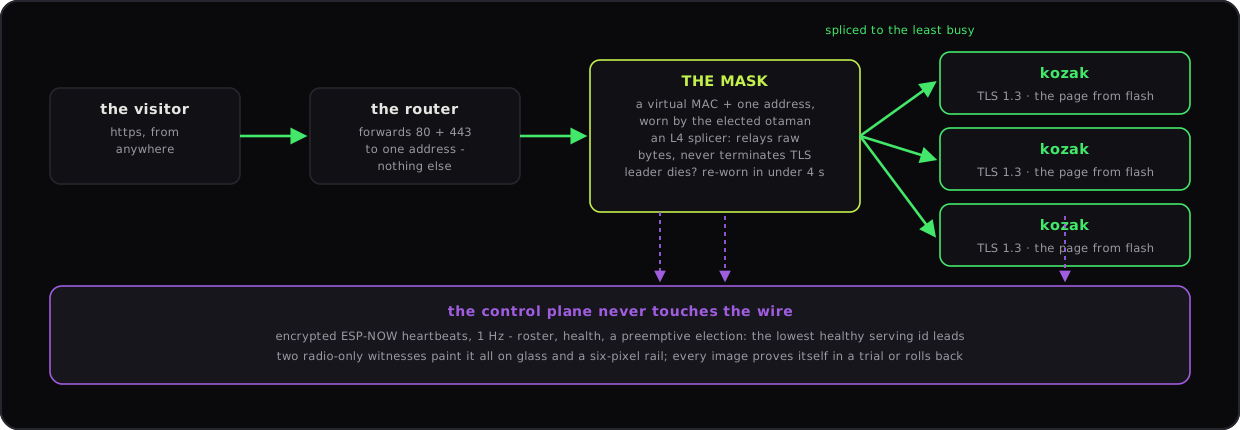
Four ESP32-S3 blades with wired Ethernet hold an election over encrypted radio. The winner puts on the mask - a virtual MAC address no factory ever issued, plus the one LAN address the router forwards - and becomes a layer-4 TCP splicer: it accepts your connection and relays the raw bytes to whichever other blade is least busy. That blade terminates TLS 1.3 and serves the page out of its own flash.
Kill the leader, and another blade wears the mask in under four seconds - same MAC, same address, same certificate, different silicon. Kill everything but one, and the survivor splices to itself over loopback and keeps serving. Two more boards - a 2.8" roster screen (the pysar) and a 4.3" touch panel (the kobzar) - hear every heartbeat and paint the fleet on glass and on a six-pixel LED rail, one pixel per member.
Named after the Cossack colonel Ivan Bohun, who broke his sabre rather than swear the oath at Pereiaslav - the right patron for a website that refuses to be hosted by anyone.
Why it is interesting
- Load balancing is an elected role, not a box. Every blade carries both programs. The splicer's backend set is rebuilt every second from radio gossip; no configuration file names a backend.
- The election never rides the wire it protects. Heartbeats travel over encrypted ESP-NOW at 1 Hz, so a switch or cable failure cannot split the brain. The election is preemptive arithmetic - the lowest healthy, serving id leads - with nothing to wedge and nothing to time out.
- Health is proven twice, from both sides. Every blade TCP-connects to its own public port every 7 seconds and stands down from the election when it fails; the splicer independently benches backends by the bytes that actually come back, because a self-reported flag can lie.
- Releases cannot brick the fleet. One key-gated, variant-guarded OTA door for all six members. Deploys roll followers first, leader last, and a fresh image must survive a 60-second serving trial or the bootloader rolls it back. The radio-only displays update through a touch-opened OTA window under the same rollback contract.
- No reboot goes unexplained. Every node keeps a 4096-record blackbox ring and a coredump partition in flash; the heartbeat carries every boot's cause, and the kobzar's chronicle names it on glass.
Measured on the machine itself: fresh TLS connections at 2.9-3.0/s with nothing dropped (a ~650 ms P-256 handshake is 99% of the toll), warm keep-alive requests in ~40-60 ms at ~40-50 req/s fleet-wide, the splicer's own wire the limit past ~100 req/s - and the site stays up through any single power plug being pulled.
The full architecture, with every diagram:
docs/SYSTEM_DESIGN.md. How it came to be,
cascade of failures included: STORY.md.
🇺🇦 Donate to Ukraine's defenders
Everything above is, in the end, a plug for this section.
Or place your trust in me directly by donating in support of the Ukrainian Medical Corps with best-in-class hemostatic agents, procured at manufacturing source and shipped straight to the front-line hotspots where the need is most critical. $50 saves a life - literally. $150,000+ deployed, 2250+ Celox Haemostatics delivered so far. Full nomenclature is and always will be publicly available here.
Firmware
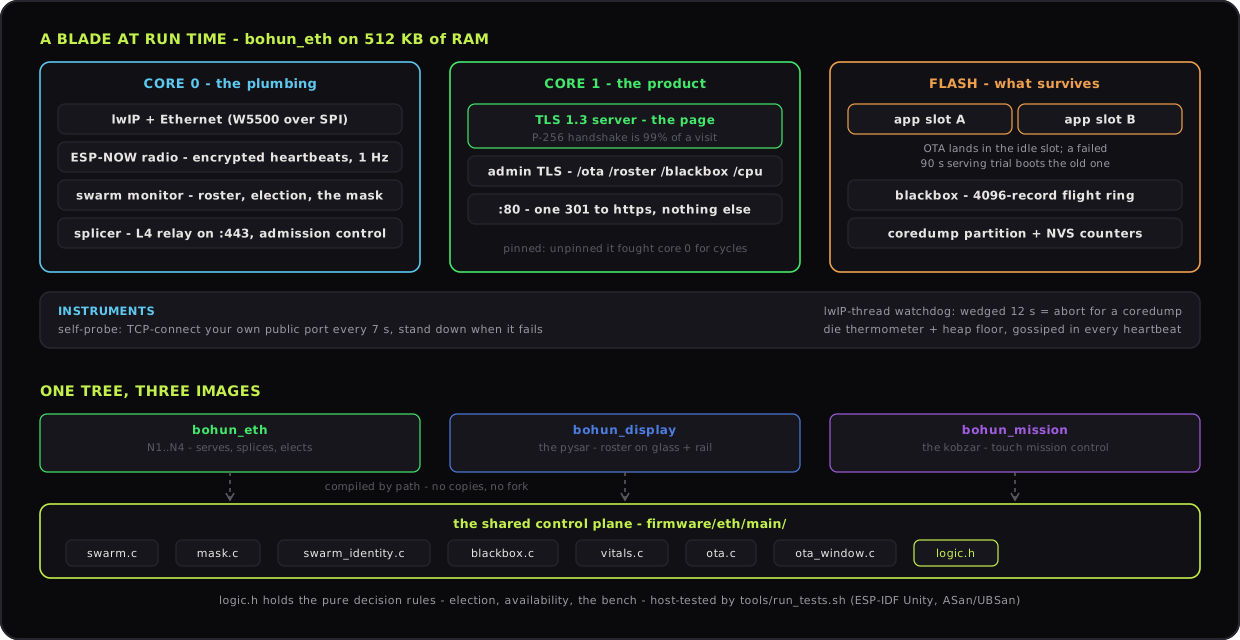
Three images from one tree. bohun_eth is the blade: a TLS server pinned
to its own core (a P-256 handshake is 99% of the cost of a visit), the
radio, lwIP and the splicer sharing the other, and a key-gated admin plane
that never leaves the LAN. bohun_display and bohun_mission are the
witnesses - and they compile the blades' control-plane sources straight
from firmware/eth/main/ by path, so a display can never drift out of
protocol with the blades it listens to.
The firmware assumes it will fail, and instruments every way it ever has: each blade TCP-connects its own public port every 7 seconds and stands down from the election when that fails, a watchdog aborts to a coredump if the lwIP thread wedges, and a 4096-record blackbox ring in flash survives reboot, OTA and panic - when a blade dies, it leaves a note saying why.
The rules the fleet lives by - who leads, what availability means, when
the balancer benches a blade - are pure functions in one header,
logic.h, proven on the host by
tools/run_tests.sh with ESP-IDF's own Unity
(69 tests, ASan/UBSan). The serving path proves itself on the machine
instead: a fresh image must survive a 60-second public serving trial or
the bootloader rolls it back. Module-by-module detail:
docs/2_firmware/.
Hardware
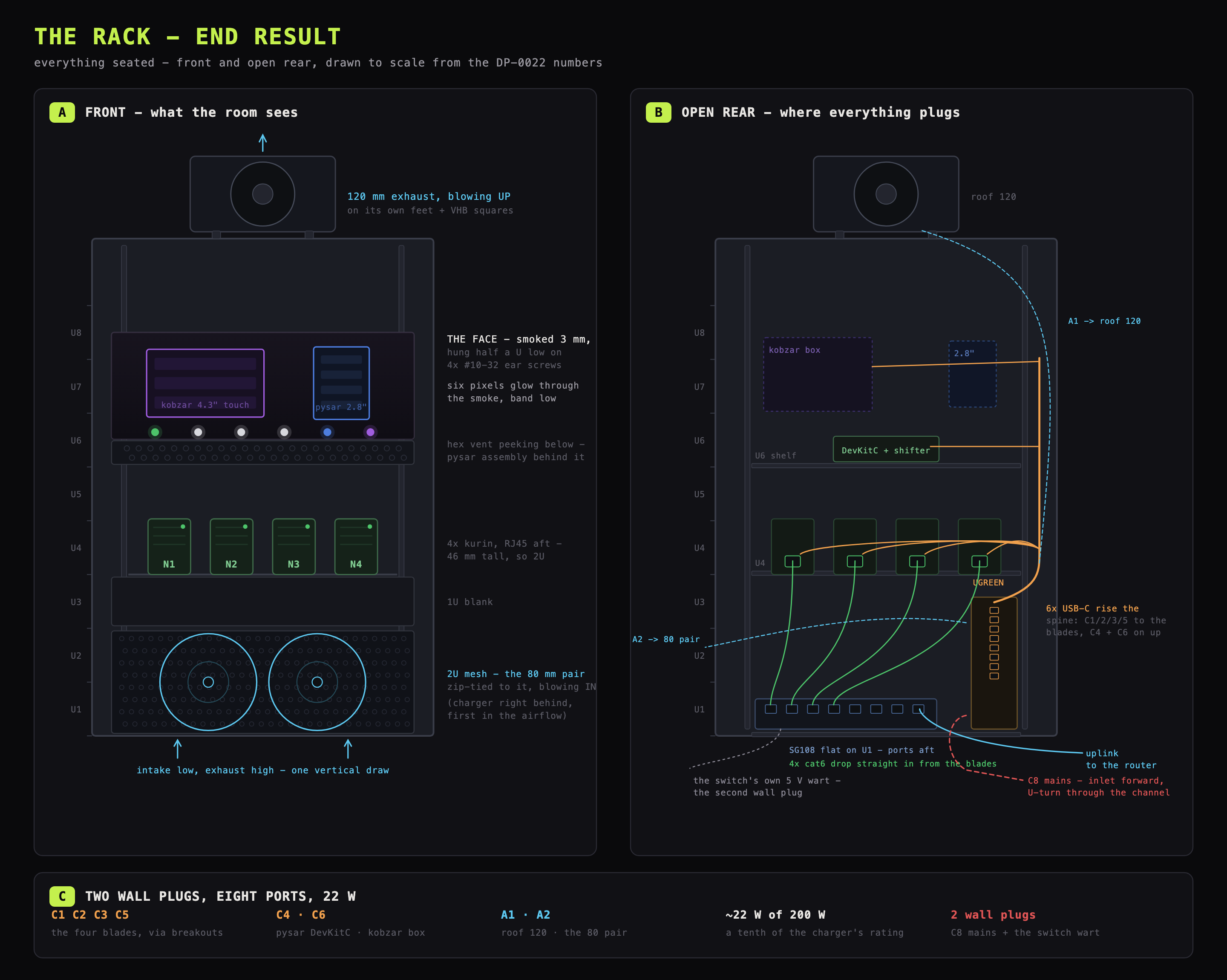
A 10-inch, 8U desktop rack: four blades in 3D-printed cases, both screens
behind a smoked-acrylic face with the LED rail glowing through it, one
Ethernet switch, one USB charger, three fans - about 22 W for the whole
machine. The build is documented to be repeatable, from the first solder
joint to the last cage screw: docs/1_hardware/.
Build your own
You need:
- 2+ LILYGO T-ETH-Lite ESP32-S3 boards - one serves with no failover; this fleet runs four plus two spares.
- An Ethernet switch, USB-C power, a router you can port-forward on, a static public IP, a domain.
- A computer with ESP-IDF v6.0.2 exported in the shell.
- Optional: the two display boards + an SK6812 strip
(
docs/1_hardware/), a 10" rack and the printed cases (docs/1_hardware/16_rack.md,hardware/).
Then, in order:
Mint your secrets (once):
tools/gen_secrets.shWrites the OTA key and the ESP-NOW PMK/LMK into
firmware/eth/main/secrets.h- gitignored, never committed, baked into every binary (which is why build directories are gitignored too). Then fill in the deployment fields by hand:BOHUN_MASK_IP(the mask's reserved LAN address, outside your DHCP pool),BOHUN_MASK_GW(your gateway), and - if you build the displays -BOHUN_WIFI_SSID/_PASSfor their OTA window.secrets.h.exampleshows the shape. Keep a copy: losing it means USB reflashes to rejoin, and rotating keys is a flag day for all nodes at once.Get a TLS certificate for your domain (Let's Encrypt via DNS-01 works while the fleet is still LAN-only) and drop the pair into
firmware/eth/main/certs/asservercert.pem(full chain) andprvtkey.pem. Both gitignored.Teach the fleet its members - edit
firmware/eth/main/swarm_identity.c: each board's eFuse MAC, id, name, shortname, eligibility. Blades are eligible; displays are witnesses. (idf.py monitorprints a board's MAC on boot if you need it.)Make it your site - replace
assets/personal.html(one self-contained file, no external requests), then refresh the compressed copies the firmware embeds:gzip -9 -n -c assets/personal.html > firmware/eth/main/personal.html.gz brotli -f -q 11 assets/personal.html -o firmware/eth/main/personal.html.brRun the tests - seconds, on your machine, no board:
tools/run_tests.sh65 checks over the fleet's decision rules (election, availability, the balancer's bench), compiled against ESP-IDF's Unity with sanitizers on. Run them again after any change to
firmware/eth/main/logic.h.First flash of each blade over USB (every later update goes over the air):
cd firmware/eth
idf.py -B build.lilygo -D SDKCONFIG=build.lilygo/sdkconfig \
       -D SDKCONFIG_DEFAULTS="sdkconfig.defaults;boards/lilygo.defaults" \
       build flash
The per-board defaults matter: they carry 240 MHz, PSRAM and the TLS session-ticket config - a plain
idf.py buildproduces a slower image with a different TLS stack shape.Displays, if you built them - plain
idf.py build flashinfirmware/displayandfirmware/mission. Later display releases go over the air: hold the touch surface for 4 s to open the OTA window, thentools/deploy_observer.sh(docs/2_firmware/26_ota_deployments.md).Open the doors - forward TCP/80 + TCP/443 to your mask address and point your domain's A record at your public IP. Never forward the backend or admin ports.
Prove it:
tools/fleet_check.shEvery blade must PASS: page 200, OTA closed on the public port, admin open on the LAN, identical content hashes fleet-wide, plus the live roster from the mask holder.
Every later release goes over the air:
export BOHUN_OTA_KEY=$(grep BOHUN_OTA_KEY firmware/eth/main/secrets.h | cut -d'"' -f2)
tools/deploy.sh
Followers first, leader last, four gates per node including the 60-second rollback trial. Re-running is idempotent - blades already on the target image are skipped.
Map
| Where | What |
|---|---|
docs/SYSTEM_DESIGN.md |
the architecture - read this first |
STORY.md |
the build story - how six microcontrollers ended up serving a website |
docs/1_hardware/ |
building the fleet: soldering, power, data wiring, the LED rail, blade cases, the rack |
docs/2_firmware/ |
the firmware: intake, the serving blade, the swarm control plane, both displays, OTA and deploys |
firmware/ |
the code: eth (blades), display (pysar), mission (kobzar) - the displays compile the blades' swarm sources by path, no copies |
hardware/ |
OpenSCAD + STLs for the printed blade cases |
assets/ |
the site: one self-contained personal.html |
firmware/tests/ |
host tests for the decision kernels - tools/run_tests.sh runs them in seconds |
tools/ |
gen_secrets.sh · deploy.sh · deploy_observer.sh · fleet_check.sh · fleet_discover.sh · run_tests.sh |
License
MIT.
Explore related projects
awesome-selfhosted/awesome-selfhosted
A list of Free Software network services and web applications which can be hosted on your own servers
336,159 starsimmich-app/immich
High performance self-hosted photo and video management solution.
118,850 starsStirling-Tools/Stirling-PDF
#1 PDF Application on GitHub that lets you edit PDFs on any device anywhere
96,278 starslouislam/uptime-kuma
A fancy self-hosted monitoring tool
93,514 stars