
NEUIR/Uncode
NEUIR/Uncode has 46 GitHub stars and 2 forks. GitHot measured 0 stars in 24 hours. Last checked 2026-11-15 02:28 UTC. Last push 2026-10-24.
What you can do
- 🚀 >7% average gain over the strongest decoding baseline - 🧩 3 × 7 MDM backbones × reasoning & planning benchmarks
- ⚖️ 44.7 ≈ 45.3 — LLaDA-1.5 + UNCODE rivals autoregressive Qwen-2.5-7B - 🔌 0 extra training — plug-and-play, decoding-side only
Measured star growth
- in 24h
- 0
- in 7 days
- Collecting history
- in 15 days
- Collecting history
- in 1 month
- Collecting history
Net star changes over overlapping periods, not daily totals. Missing measurements are left blank. Stars measure attention, not software quality.
About
[ACL '26] UNCODE (a.k.a. PC-Sampler): training-free decoding calibration for masked diffusion LLMs. Code for "Empirical Analysis of Decoding Biases in Masked Diffusion Models"
AIREADME.md
OriginalUNCODE: Empirical Analysis of Decoding Biases in Masked Diffusion Models
Pengcheng Huang, Tianming Liu, Zhenghao Liu, Yukun Yan, Shuo Wang, Tong Xiao, Zulong Chen, Maosong Sun


A training-free decoding-calibration framework that fixes two systematic biases
in Masked Diffusion Models — improving reasoning & planning by 7%+ across 3 MDMs and 7 benchmarks.
📖 Introduction • 🎉 News • ⚙️ Setup • 📃 Evaluation • 📈 Trajectory • 💻 Algorithm • 📌 Citation • 📧 Contact
📖 Introduction
UNCODE (UNmasking Calibration for DecOding DEbiasing) is a training-free decoding-calibration method for masked diffusion language models (MDMs) such as LLaDA and Dream: it fixes the rigid boundary bias and trivial token bias of uncertainty-based samplers and improves reasoning and planning by 7%+ across 3 MDMs and 7 benchmarks (e.g., LLaDA-8B-Instruct average 33.6 → 42.7), by unifying global trajectory planning with content-aware informativeness maximization.
Also known as PC-Sampler. UNCODE was previously released as PC-Sampler ("PC-Sampler: Position-Aware Calibration of Decoding Bias in Masked Diffusion Models", arXiv 2508.13021 v1). The ACL 2026 version is the same line of work under its final name; please cite the ACL 2026 version below.
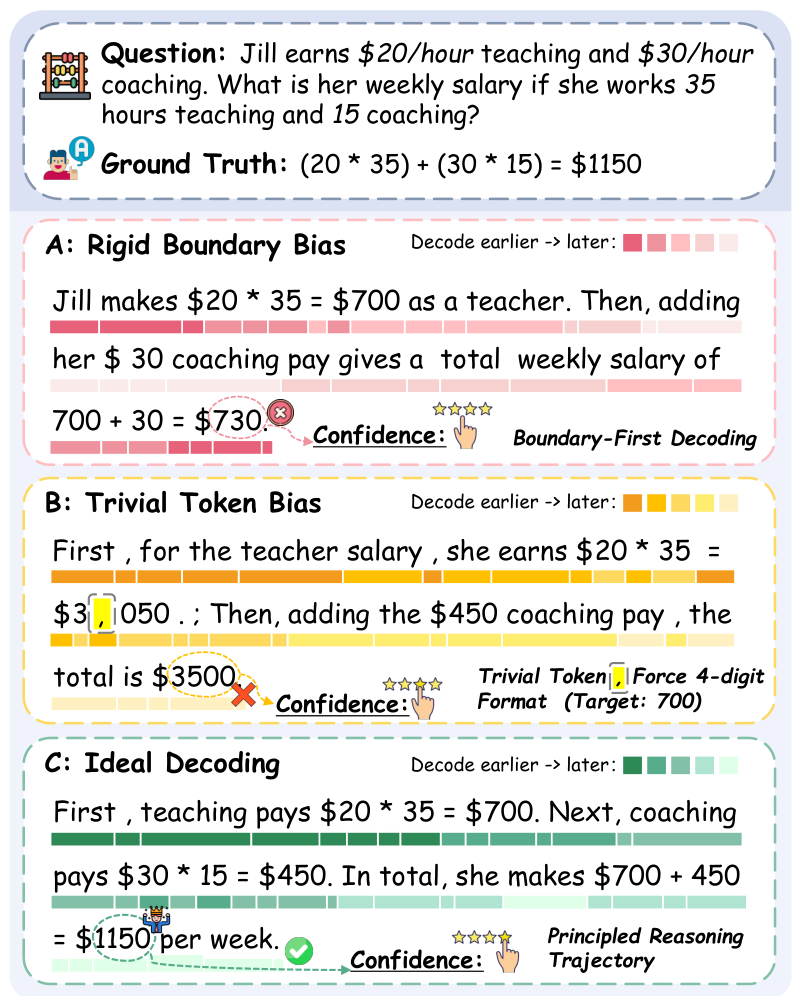
Uncertainty-based samplers, when applied to MDMs, suffer from two systematic decoding biases:
- 🔴 Rigid Boundary Bias — boundary tokens (BOS/EOS, sentence edges) are decoded first, collapsing decoding into a fixed U-shaped trajectory and committing to an answer before the reasoning is built.
- 🟡 Trivial Token Bias — high-frequency, low-information tokens (punctuation, spaces, fillers) get over-prioritized, spending the decoding budget on surface structure instead of reasoning content.
UNCODE fixes both with a position-aware weighting mechanism and a calibrated, frequency-aware confidence score, guiding the decoding path and suppressing premature selection of unimportant tokens — with no fine-tuning and no architecture change.
📄 Paper: arXiv:2508.13021 · 🌐 Project page: passionate11.github.io/Uncode-project-page
🎉 News
- 2026-04-07: Our paper has been accepted to ACL 2026 (Main Conference)! 🎉
- 2025-09-12: Release adds enhanced LLaDA decoding support, integrating recent semi- and non-autoregressive sampling strategies: ReMDM, Fast-dLLM, Semi-AR, Margin-, Entropy- and Confidence-based samplers.
- 2025-08-19: Released our paper on arXiv and code on GitHub.
✨ Highlights
| 🚀 >7% average gain over the strongest decoding baseline | 🧩 3 × 7 MDM backbones × reasoning & planning benchmarks |
| ⚖️ 44.7 ≈ 45.3 — LLaDA-1.5 + UNCODE rivals autoregressive Qwen-2.5-7B | 🔌 0 extra training — plug-and-play, decoding-side only |
⚙️ Setup
git clone https://github.com/NEUIR/Uncode.git
cd Uncode
conda create --name uncode python==3.10
conda activate uncode
pip install -r requirements.txt
📃 Evaluation
UNCODE and all baseline methods can be evaluated across mathematical reasoning, code generation, and question-answering datasets: HumanEval, MBPP, GSM8K, MATH-500, GPQA, Countdown, and Sudoku. Results are saved to the results/ folder.
Example — HumanEval with UNCODE
Change --task and --mode to evaluate on other datasets / decoding methods.
cd scripts
python eval.py \
    --task 'humaneval' \
    --model_name 'GSAI-ML/LLaDA-8B-Instruct' \
    --device 'cuda:0' \
    --gen_length 256 \
    --steps 256 \
    --block_length 256 \
    --mode pc_sampler \
    --lambd 0.25 \
    --alpha 10 \
    --data_path ../data/humaneval.jsonl \
    --result_path results/humaneval_pc_sampler
Baseline decoding methods
| Decoding Method | Command | Decoding Method | Command |
|---|---|---|---|
| Semi-Autoregressive | bash eval_semi_ar.sh |
Entropy | bash eval_entropy.sh |
| EB-Sampler | bash eval_eb_sampler.sh |
Fast-dLLM | bash eval_fast_dllm.sh |
| Margin | bash eval_margin.sh |
PC-Sampler | bash eval_pc_sampler.sh |
| ReMDM | bash eval_remdm.sh |
Linear-Position | bash eval_linear_position.sh |
All scripts live in
scripts/. Run them from inside that folder (cd scripts).
Evaluation tools & consistency
- GSM8K and GPQA are evaluated with
lm-eval; the remaining datasets usescripts/eval.py. - All methods share the same evaluation scripts to ensure consistent, comparable assessment.
Painting heatmaps
Generate decoding-trajectory heatmaps for different methods:
cd scripts
bash heatmap.sh
Heatmap outputs are saved to the heatmap_results/ folder.
📈 Decoding Trajectory
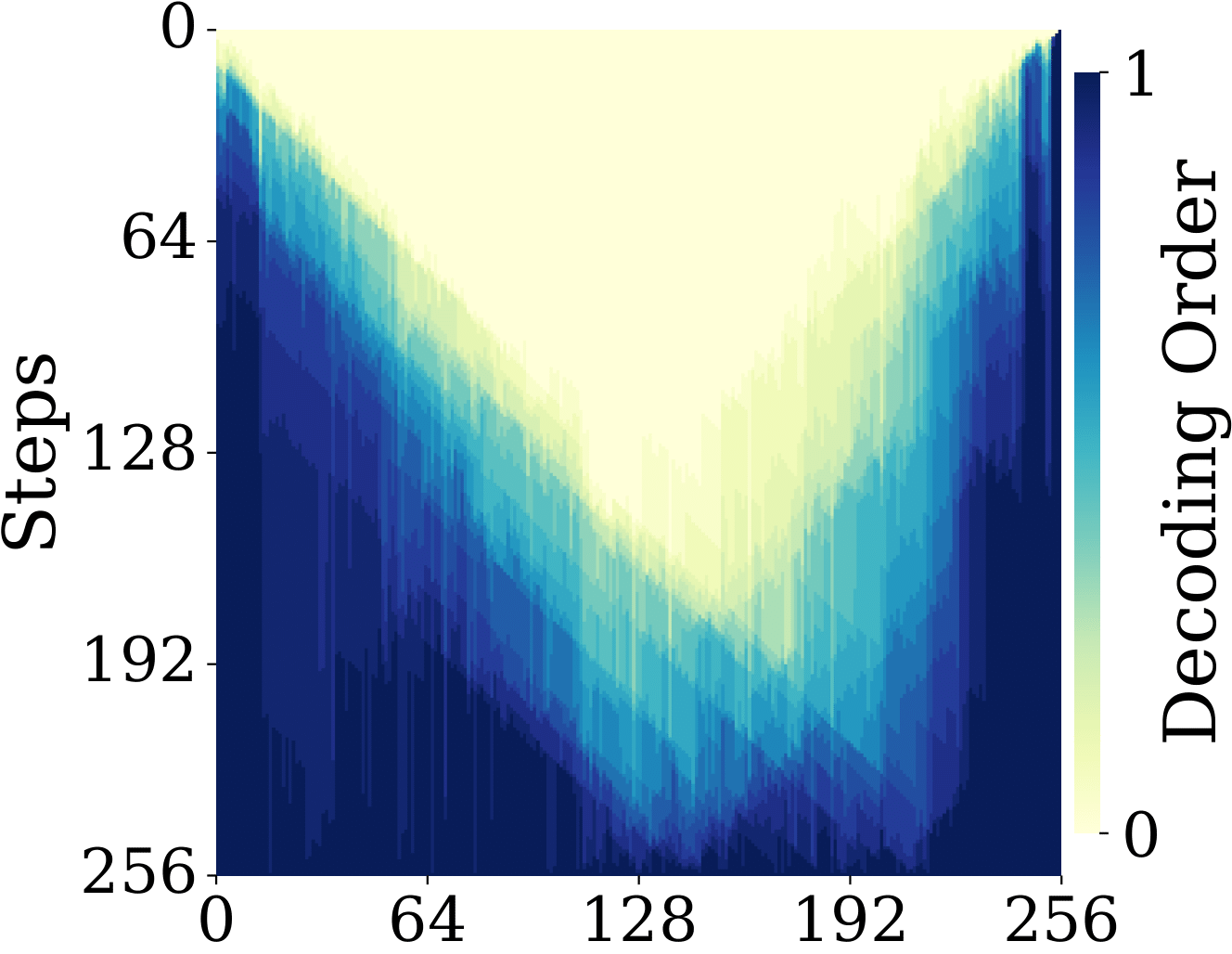
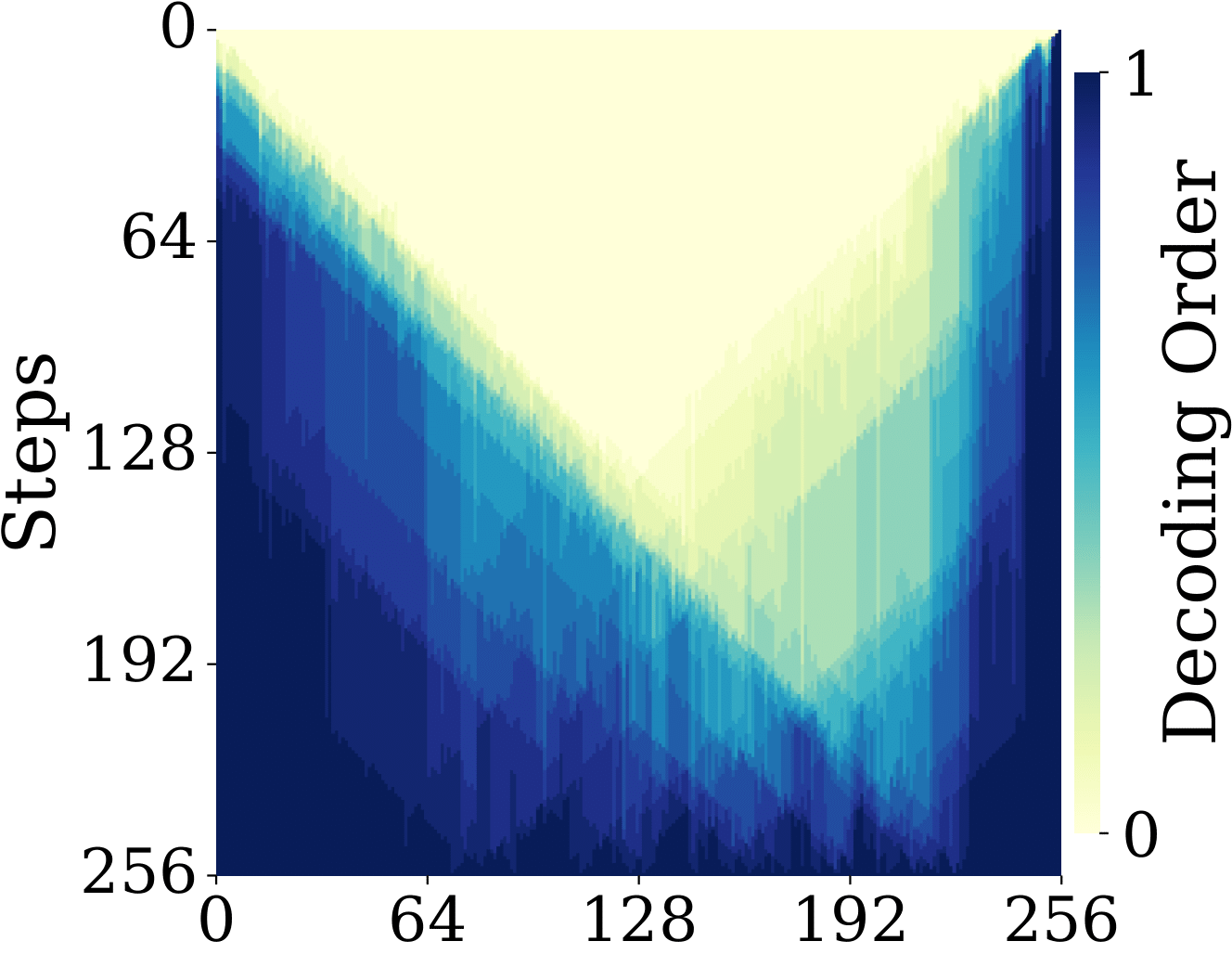
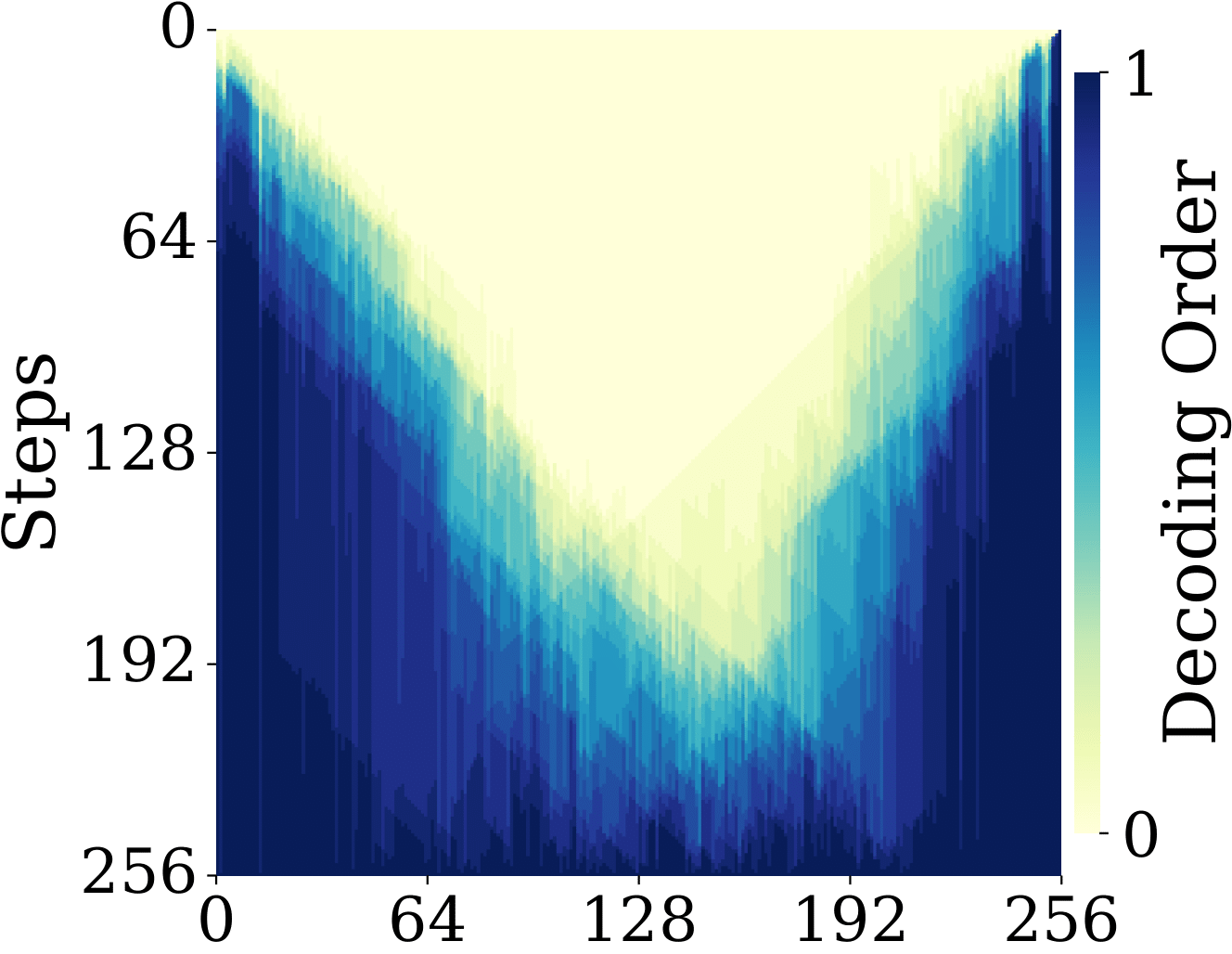
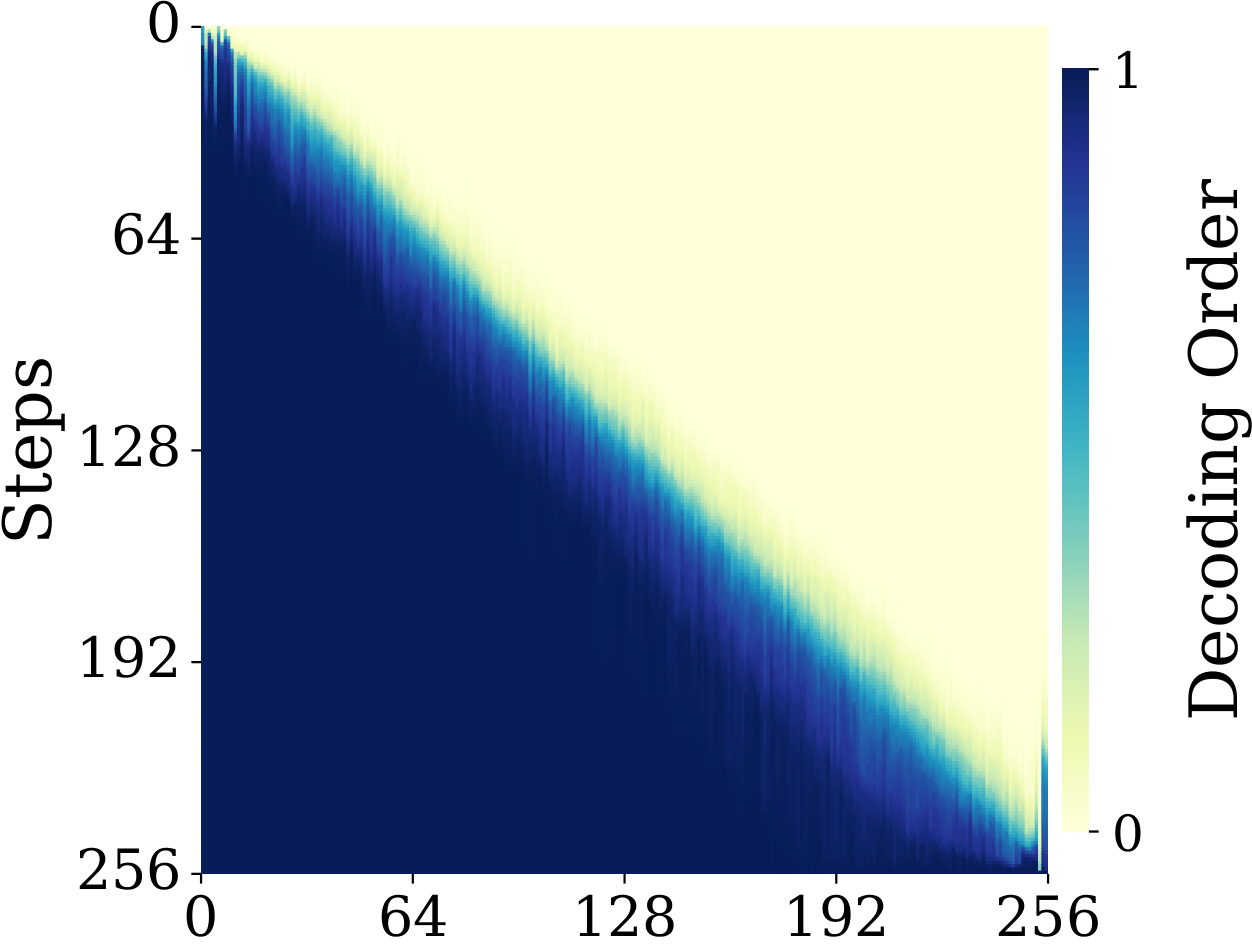
The decoding strategy strongly shapes the generation order of MDMs. Existing uncertainty-based methods exhibit a U-shaped trajectory (the rigid boundary bias): boundary tokens (BOS/EOS) are unmasked early because the attention mechanism's local positional bias inflates their confidence, after which decoding converges inward.
UNCODE instead introduces explicit trajectory control via position-aware weighting, yielding an adaptive generation order tailored to each task. Trajectories on GSM8K for four representative samplers:
| Confidence-based | Entropy-based | Margin-based | UNCODE |
|---|---|---|---|
 |
 |
 |
 |
🔑 Key Observations
- Rigid Boundary Bias — confidence/entropy/margin samplers consistently show the U-shaped pattern, decoding both sequence boundaries first. This limits their ability to capture the global dependencies needed for complex reasoning.
- Trivial Token Bias — uncertainty-based samplers over-prioritize semantically trivial, high-frequency tokens (newlines, spaces,
the,.,!), leading to suboptimal reasoning paths. - Debiasing with UNCODE — exponential positional weighting removes the U-shape, producing a natural progression aligned with the logical flow of reasoning.
This adaptive trajectory control directly drives UNCODE's strong 82.2% GSM8K accuracy, well above uncertainty-based alternatives.
💻 Algorithm
UNCODE addresses the limitations of uncertainty-based sampling through two core components:
- Position-Aware Weighting — an exponential decay over position regulates the decoding path, giving flexible control over generation order to match task structure.
- Calibrated Confidence Score — a frequency-based adjustment from a reference corpus suppresses premature selection of trivial tokens, promoting semantically rich content.
Across seven benchmarks, UNCODE consistently outperforms existing MDM decoding strategies, narrowing the gap to state-of-the-art autoregressive models.
Workflow
Require: Predictor $p_\theta$, prompt $p_0$, answer length $L$, steps $T$, hyperparameters $\lambda, \alpha$; reference corpus $\mathcal{D}'$
- $p_{\mathcal{D}'} \gets \text{FreqDist}(\mathcal{D}')$
- $x \gets \text{Concat}(p_0, \text{[MASK]} \times L)$
- for $t = 1$ to $T$ do
- $\mathcal{M}_t \gets {i \mid x^i = \text{[MASK]}}$
// mask indices - if $\mathcal{M}_t = \emptyset$ then break
- $\hat{x}0, \hat{p}^i \gets p{\theta}(\cdot \mid x)$
- for each position $i \in \mathcal{M}_t$ do
- $\mathcal{C}^{(i)} \gets \hat{p}^i \cdot \log p_{\mathcal{D}'}(x^i)$
- $\mathcal{C}^{(i)} \gets \min(\mathcal{C}^{(i)}, \alpha)$
// clip salience - $w^{(i)} \gets e^{-\lambda \cdot (i - |p_0|)}$
- $\text{score}^{(i)} \gets w^{(i)} \cdot \mathcal{C}^{(i)}$
- $n_k \gets \text{NumToReveal}(k, N, |\mathcal{M}_k|)$
- $\mathcal{S}_t \gets \text{TopK}(\text{score}, n_k)$
// select best tokens - for each index $j \in \mathcal{S}_t$ do $x^j \gets \hat{x}_0^j$
// reveal
- $\mathcal{M}_t \gets {i \mid x^i = \text{[MASK]}}$
- return $x$
Hyperparameters
| Param | Meaning | Recommended |
|---|---|---|
$\lambda$ (--lambd) |
Positional bias strength: 0 = no bias, larger = stronger left-to-right |
0 (Sudoku), 0.25 (most tasks), 0.5 (Countdown) |
$\alpha$ (--alpha) |
Clipping threshold for the salience score | 10 (stable across tasks) |
| $p_{\mathcal{D}'}$ | Background frequency distribution from a reference corpus | see data/baseline |
📌 Citation
If you find UNCODE useful, please cite:
@inproceedings{huang-etal-2026-empirical,
    title     = "Empirical Analysis of Decoding Biases in Masked Diffusion Models",
    author    = "Huang, Pengcheng and Liu, Tianming and Liu, Zhenghao and Yan, Yukun and Wang, Shuo and Xiao, Tong and Chen, Zulong and Sun, Maosong",
    booktitle = "Proceedings of the 64th Annual Meeting of the Association for Computational Linguistics (Volume 1: Long Papers)",
    year      = "2026",
    publisher = "Association for Computational Linguistics",
    url       = "https://aclanthology.org/2026.acl-long.311/",
    doi       = "10.18653/v1/2026.acl-long.311",
    pages     = "6853--6876",
}
📧 Contact
Questions, suggestions, or bug reports are welcome — please open an issue or email [email protected].