
Log2n-io/Typhon
Log2n-io/Typhon has 253 GitHub stars and 21 forks. GitHot measured 0 stars in 24 hours. Last checked 2026-11-15 23:18 UTC. Last push 2026-11-14.
Measured star growth
- in 24h
- 0
- in 7 days
- Collecting history
- in 15 days
- Collecting history
- in 1 month
- Collecting history
Net star changes over overlapping periods, not daily totals. Missing measurements are left blank. Stars measure attention, not software quality.
About
A microsecond-latency ACID database engine with a native Entity-Component-System data model, built for real-time systems.
DataREADME.md
OriginalTyphon






Server ·



Clients ·




📣 10 slides, 5 minutes to understand what it is about ➡️ Typhon intro.
Want to learn more, read the pitch.
It makes the case for Typhon — the problem it solves, what's actually built and measured today, and where it's headed — before you dive into the technical docs below.
⚠️ Alpha — 1.0.0-alpha.1 is out. ⚠️
The features are in; what remains is polish, user feedback and stabilizing. Not yet production-ready, but ready for POC & early adopters.
The engine, the CLI + Workbench, ASP.NET Core hosting and the Subscriptions client SDKs — .NET & Unity, TypeScript and C — all ship at one version; see every package. Full reference documentation is live. The line runs alpha → beta (public API and wire protocol frozen) → rc → 1.0.0, prerelease-only until then. Open an issue or go to the discussions for help, questions, or feedback.
A real-time world engine: an ACID, larger-than-RAM ECS store, a parallel tick runtime, spatial partitioning with realms, and interest-managed replication to .NET/Unity, TypeScript and native C clients — one process, one data model, from disk to screen.
Typhon started as an embedded ECS database and grew upward, one layer at a time. Each layer runs inside the engine, on the same entities, transactions and snapshots as the one below it: the runtime doesn't sit on top of the database — it runs inside it — and replication streams what the tick just wrote, with no second data model in between.
┌──────────────────────────────────────────────────────────────────────────┐
│ Clients       .NET & Unity  ·  TypeScript  ·  C / FFI                    │
└──────────────────────────────────────────────────────────────────────────┘
                    ▲  TCP / WebSocket, typhon.3 wire
┌──────────────────────────────────────────────────────────────────────────┐
│ Replication   what each archetype exposes, who sees what,                │
│               commands & events, per-session budgets                     │
│ World         spatial partitioning (per-realm cell grid) · realms        │
│ Runtime       tick loop · DAG scheduler · parallel systems               │
│ Store         ECS archetypes · MVCC ACID transactions · indexes, queries │
│               WAL & crash recovery · paged, larger than RAM              │
└──────────────────────────────────────────────────────────────────────────┘
      one process · one data model · the same entities, transactions
      and snapshots at every layer
📖 Start here:
- 📚 doc.typhondb.io — the new documentation site: guide, in-depth overview, feature catalog, and full API reference, all in one browsable, searchable place.
- User Guide — learn the key concepts hands-on, backed by a small runnable sample project (
doc/guide/example). - In-Depth Overview — dig into how every subsystem works, and the reasoning behind it.
- Packages — every NuGet, npm and native package, what each is for, and which ones you need.
- Demos — Asteroid Field (a Unity 6 client on the netstandard2.1 SDK) and AntHill (a persistent world larger than RAM).
🗺️ Curious what's next? Current priorities, in-progress work, and the roadmap are tracked live on the GitHub Project.
Key Features
📚 This is a curated highlight reel — see the full Feature Catalog for every capability, categorized and cross-linked to source and tests.
🗄️ Store — an ACID ECS database
- Microsecond Operations — Optimized for µs-level latency with pinned memory, SIMD, and lock-free reads
- ACID Transactions — Full transactional semantics with optimistic concurrency control
- MVCC Snapshot Isolation — Readers never block writers; each transaction sees a consistent snapshot
- ECS Archetype System — Entities are typed by archetype; components are blittable structs with source-generated accessors and archetype inheritance
- Entity Clusters — SoA batched storage co-locating up to 64 entities per cluster, with cluster-native SIMD predicate evaluation (AVX-512 / AVX2 / scalar dispatch), zone-map pruning, and k-way sorted merge
- Three Storage Modes — Versioned (full MVCC + WAL), SingleVersion (last-writer-wins; per-tx TickFence or Committed durability discipline — atomic, zero-loss, no revision chain), Transient (heap-only, no persistence)
- Larger-Than-RAM Storage — The database is a paged file on disk, virtualized through the engine's own native page cache that holds only the hot working set — so resident memory is bounded by the cache, not the database. Manipulate a 100 GiB store on a machine with a fraction of that RAM; component data, indexes, and the entity map all page to/from disk on demand (in-memory ECS frameworks, by contrast, must fit the entire world in RAM)
- Entity Relationships — Typed
EntityLink<T>references for 1:1, 1:N, and N:M relationships, with declarative cascade delete and reactive FK-joined queries - Schema Versioning — Component/field-level revisions with migration functions, compatible-evolution support, and audit history; automatic archetype layout-drift detection at database open is still landing
- Bulk Load Session — Opt-in exclusive write path for fast dataset ingestion, batching writes through a recycled Transaction and committing the whole load atomically behind a checkpoint barrier
🔎 Queries & Indexes
- Query Engine — Typed queries with
Where,With/Withoutfilters, polymorphic iteration, OR logic, navigation joins, and a cluster execution path that routes filtered scans through SIMD gather-compare on cluster SoA columns - Views & Change Tracking — Incremental entity-set monitoring (added/removed/modified detection) via ring-buffer delta streaming for indexed queries — opaque/unindexed predicates still work but fall back to a full re-scan per refresh; SingleVersion/Transient view support is still being validated end-to-end
- B+Tree Indexes — Cache-aligned 256-byte nodes with optimistic lock coupling and specialized key-size variants
💾 Durability & Integrity
- Write-Ahead Logging — WAL (v2, always on) with configurable durability modes (Deferred, GroupCommit, Immediate) and coalesced tick-boundary snapshots via
TickFence/ClusterTickFencechunks for the runtime tick loop - Configurable Durability — Choose per-UnitOfWork whether data is deferred, group-committed, or immediately fsynced
- Page Integrity — CRC32C checksums, suspect-page detection, and crash-recovery rebuild (index + EntityMap); full-page images were retired in favor of a rebuild-based torn-page net. Recovery runs only after an unclean close, and works on databases larger than the page cache
- Integrity Check & Repair —
typhon checkreads a database as bytes, with no engine — so it diagnoses one that will not open — runs every cross-structure check, reports as text or JSON and carries the verdict in its exit code;typhon repair --plan/--applyrebuilds derived structures, reclaims leaked pages and restores A/B page pairs, and asks before anything that would lose data
⚙️ Runtime — the simulation
- Tick-Based Parallel Runtime — Tick-based micro-task
DagSchedulerwith any-worker parallel dispatch, per-system change filters, parallel chunks that write Versioned data and spawn/destroy entities (ctx.Commands), typed MPSC event queues, side-transactions, cluster dormancy with staggered heartbeat wake, checkerboard Red/Black dispatch, and a growing overload response ladder (system throttling, tick-rate modulation up to 6x, a last-resort player-shedding callback) — still evolving, with finer-grained escalation designed but not a current priority
🌍 World — space and realms
- Spatial Indexing — A declarative
[SpatialIndex]on any component field, answered by one index: a sparse 2D/3D cell grid per realm locates the cells, a per-cell cluster broadphase answers AABB / Radius / Ray / Frustum / kNN queries (SIMD narrowphase, category masks), with multi-resolutionSimTierdispatch for near/far/coarse simulation budgets - Realms — Several isolated worlds (planets, interiors, space, instanced dungeons) hosted by one engine: each realm owns its grid and cell size, is queried and replicated on its own, and can sleep or run at a reduced rate while nobody watches it
📡 Replication — the bridge to clients
- Subscriptions (push replication) — Engine-owned replication to remote clients: declare what each archetype exposes (
[Replicated],[Motion],[Owner]…) and the engine does change detection, quantized encoding, motion segments, per-session visibility (sphere / region / distance bands, groups, visibility tags), typed commands, best-effort or reliable events, session resume and per-session byte budgets — in parallel on the worker pool, over TCP or WebSocket (ASP.NET Core), on the catalog-driventyphon.3wire - Client SDKs — .NET (
Typhon.Client, also netstandard2.1 for Unity), TypeScript (@typhondb/client, browser + Node) and C (a C ABI with a CMake package, for native clients and FFI bindings): a columnar world store, motion extrapolation, commands, groups, events and reconnection, all decoding against the server's catalog
🧰 Tooling
- Workbench Dev UI — 📣Demo video #1📣 A local, browser-based companion (ASP.NET Core + React/Vite) — DataGrip for Typhon, not just a profiler. Open a recorded
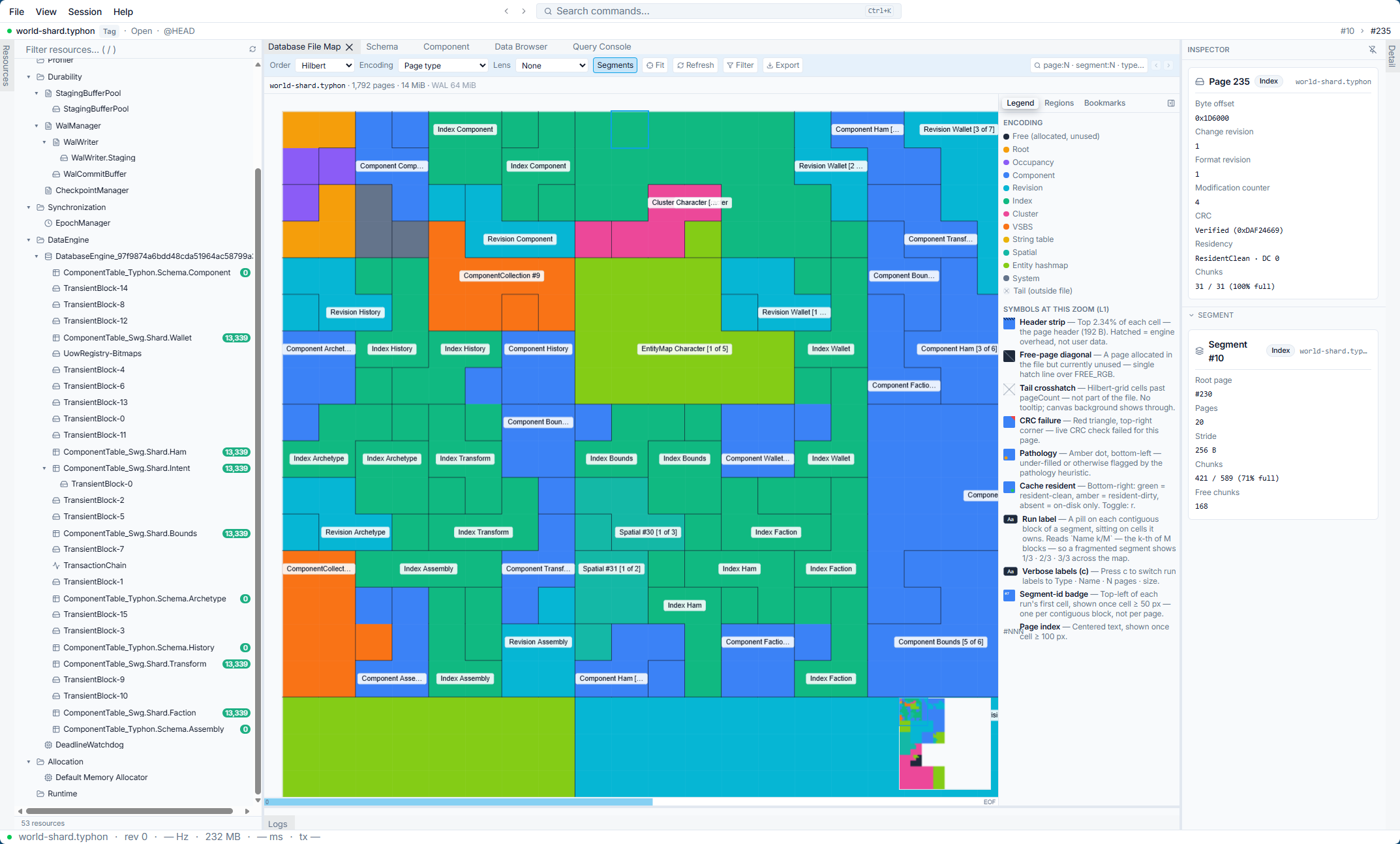
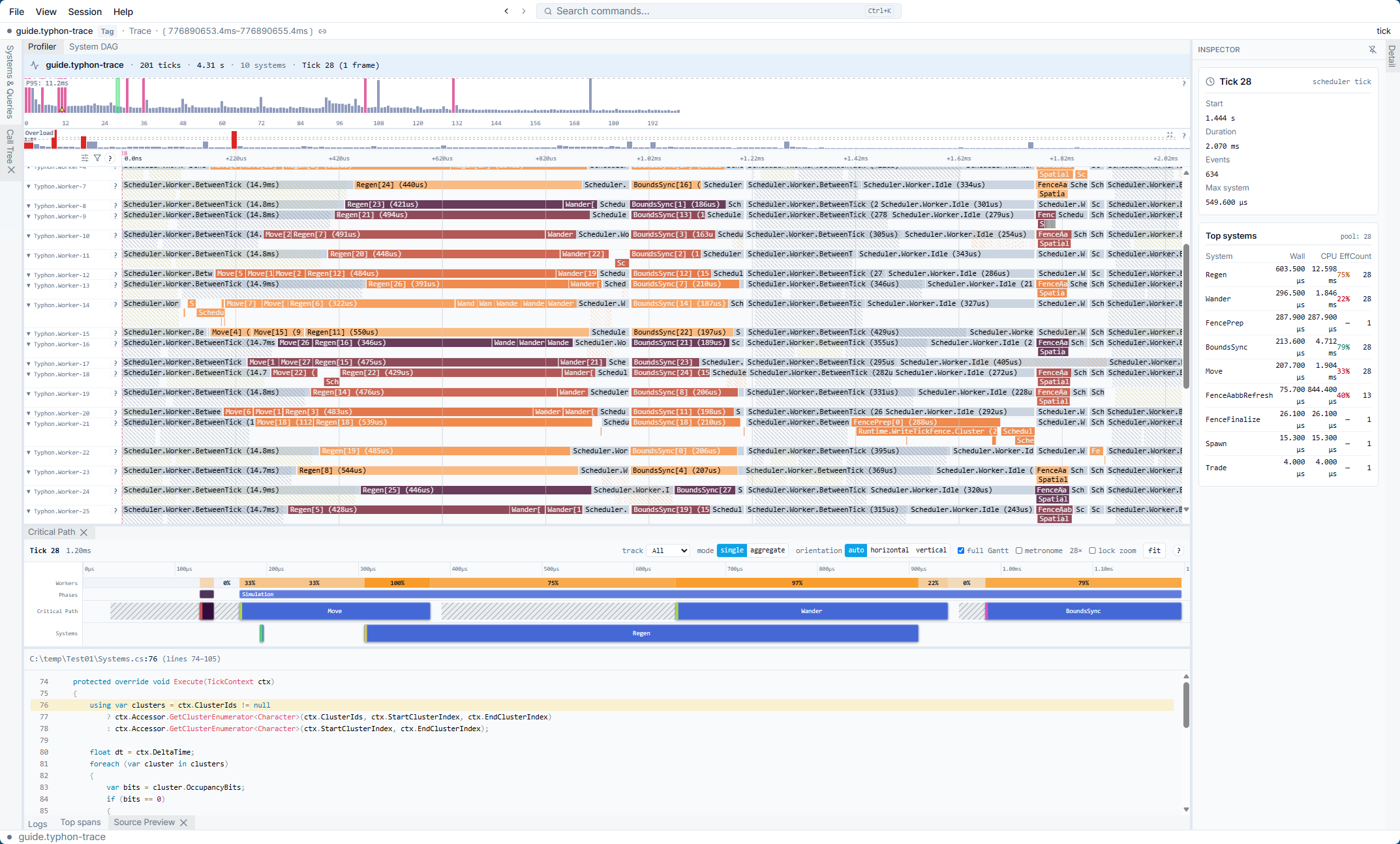
.typhon-trace, attach to a live engine over TCP, or open a.typhondatabase file directly. Performance: per-tick profiler timeline with CPU-sample + off-CPU overlays, Top Spans, Call Tree, Critical Path, System DAG. Data & schema: component/archetype browsers, Schema Inspector, a zoomable Hilbert-curve Database File Map, live Resource Tree. Queries: catalog, plan tree, per-execution inspector — all in a dockable, persisted workspace - Deep-Trace Profiler — Per-tick Gantt and flame-graph visualization via a
.typhon-tracebinary format, live TCP streaming to a React/Vite viewer, and optionaldotnet-traceCPU sampling correlation for full managed-stack profiles - Observability — Runtime telemetry, metrics, and diagnostics with zero-cost JIT-eliminated toggles
- CLI (
typhon) — Database REPL and.tshscript runner,typhon newproject scaffolding,check/repair, and the launcher for the Workbench (typhon ui) - Public/Internal API split — Two namespaces per assembly (
Typhon.Engine/Typhon.Engine.Internals), each subsystem folder split intopublic/+internals/, enforced at compile time by theTYPHON008Roslyn analyzer - Roslyn Analyzers — Custom analyzers detecting undisposed engine resources at compile time + the
TYPHON008internal-API leak detector
Quick Start
A taste — declare a component and an archetype, spawn an entity, read it back:
// A component is a plain struct; an archetype is the fixed set of components an entity has.
[Component("Game.Health", 1, StorageMode = StorageMode.Versioned)]
public struct Health { public int Current, Max; }

[Archetype(1)]
public sealed partial class Unit : Archetype<Unit>
{
    public static readonly Comp<Health> Health = Register<Health>();
}

// ...build the engine + register the schema (see the Guide), then:
using var tx = dbe.CreateQuickTransaction();
var id = tx.Spawn<Unit>(Unit.Health.Set(new Health { Current = 100, Max = 100 }));
var hp = tx.Open(id).Read(Unit.Health);   // hp.Current == 100
tx.Commit();
Illustrative — engine build + schema registration are elided. The User Guide has the full, runnable version (
doc/guide/example).
A 5 minutes round-trip
Install the Typhon.Cli NuGet package and follow the instructions to create a sample app, run it, profile it, open the database and the profiled session in the workbench.
Workbench Database
Workbench Profile viewer
Status
Typhon is in alpha (1.0.0-alpha.1): the features are in, stabilization is under way. What changed in each version is in the
releases; what's next is on the GitHub Project.
Not yet:
- Backup and restore — point-in-time incremental backup is designed, not built
- TLS and WebSocket in the native client SDK — it speaks plain TCP today
- Spreading one world across several machines — one engine runs in one process; realms divide worlds inside it