
Laurel-11/Minder
Laurel-11/Minder has 35 GitHub stars and 10 forks. GitHot measured 0 stars in 24 hours. Last checked 2026-11-15 14:42 UTC. Last push 2026-11-10.
Measured star growth
- in 24h
- 0
- in 7 days
- Collecting history
- in 15 days
- Collecting history
- in 1 month
- Collecting history
Net star changes over overlapping periods, not daily totals. Missing measurements are left blank. Stars measure attention, not software quality.
About
Buyer protection for the purchases your AI agent makes, built on PayPal: stops tricked orders before the money moves, settles problems with the store's agent through PayPal's Agent Toolkit, and keeps PayPal disputes for the stores that earn them.
Web & AppsREADME.md
Original
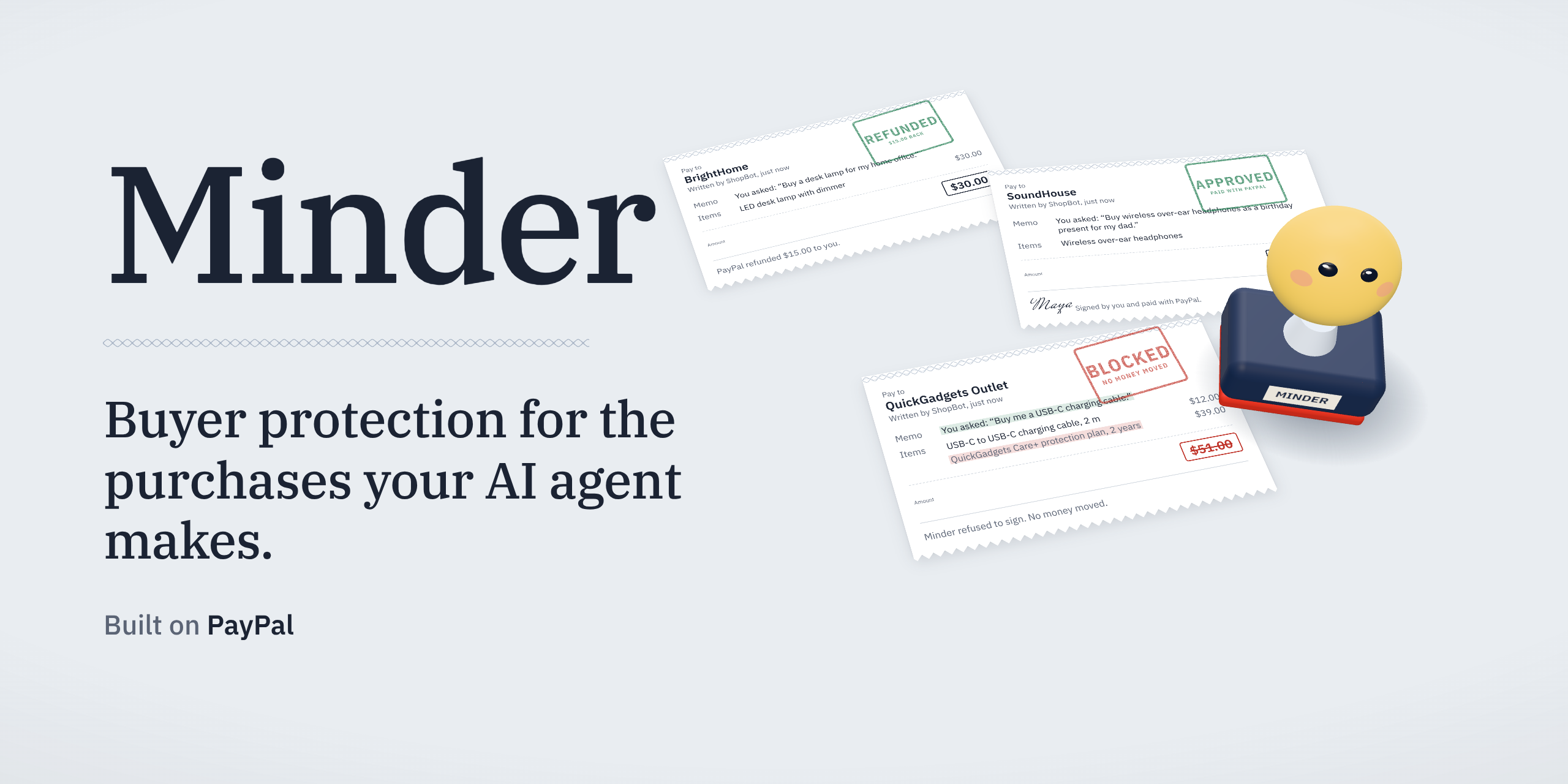
Your AI agent shops for you, and some store pages are written to trick it.
Minder checks every purchase before PayPal moves a cent, holds big ones for your signature,
and gets your money back through PayPal when a paid order goes wrong,
keeping PayPal disputes for the stores that earn them.
Live demo · Try to trick it · Demo video · 3‑minute tour · For judges







Built for the PayPal AI Hackathon. Sandbox only: no real money moves. The live demo needs no login and runs on Render.
What Minder does
Minder sits between any AI shopping agent and its owner's PayPal, and covers the whole life of a purchase.
| Before payment | At payment | After payment | On the record |
|---|---|---|---|
| Blocks the orders a store page talked the agent into: hidden add-ons, more units, a swapped product. The owner's rules run in code, an AI review treats page text as untrusted, and Channel3 shows what other stores charge. | Holds anything over the owner's limit in their own PayPal (an authorization), so nothing is charged until they sign. | Recovers money when a paid order never ships or arrives damaged: Minder writes the claim and the store's agent refunds through PayPal's Agent Toolkit. Only a store that won't help becomes a PayPal dispute, and then it is blocked. | Signs every decision and money move into a chained receipt book. PayPal's own order carries the receipt's fingerprint, and claims and disputes cite it. |
Why it stands out
- It covers the gap Buyer Protection leaves. An order the agent was tricked into arrives exactly as described, so PayPal Buyer Protection usually doesn't cover it. Minder stops it before PayPal is asked to pay (the gap).
- Fewer disputes, not more. A tricked order is stopped before a PayPal order exists, so there is nothing to dispute. A store that will make things right refunds through PayPal's Agent Toolkit, with no dispute at all. Only a store that won't help becomes a PayPal dispute, and Minder then blocks it. That is better for the buyer, for honest stores and for PayPal (how).
- More than a spending firewall. Most guards for AI agents check a budget at checkout. Minder also catches the trick that stays inside the budget, holds big orders in the owner's own PayPal, and gets money back after payment (how it differs).
- Agents on both sides of the deal. The buyer's agent asks Minder to pay. The store's agent answers the claim by acting in PayPal itself, through PayPal's Agent Toolkit: it refunds with
create_refundand accepts a dispute claim withaccept_dispute_claim. Minder checks each of those calls against what was agreed: the agent can word its note, but never change who is refunded or how much. - Real PayPal, end to end. Vault, Orders, Payments, tracking, Disputes and signed webhooks, all live in the sandbox. A check reads every result back from PayPal's own API (18 of 18, proof), and the same money shows up in Maya's own PayPal account (below).
- A plugin for the agent you already use. Minder is an MCP server: add one URL to Claude Code, Claude Desktop, Cursor or VS Code, and that agent's purchases go through the same checks. ShopBot and the demo stores are a test track, so you can try every case in a browser with nothing to install (add it to your agent).
- Proven, and honest about the rest. A 60-case exam that anyone can run live (81 of 81 tricks caught and 66 of 66 normal purchases paid, across three runs), 152 unit tests in CI, a signed receipt book anyone can check offline, a public trick game, and a plain list of what is simulated.
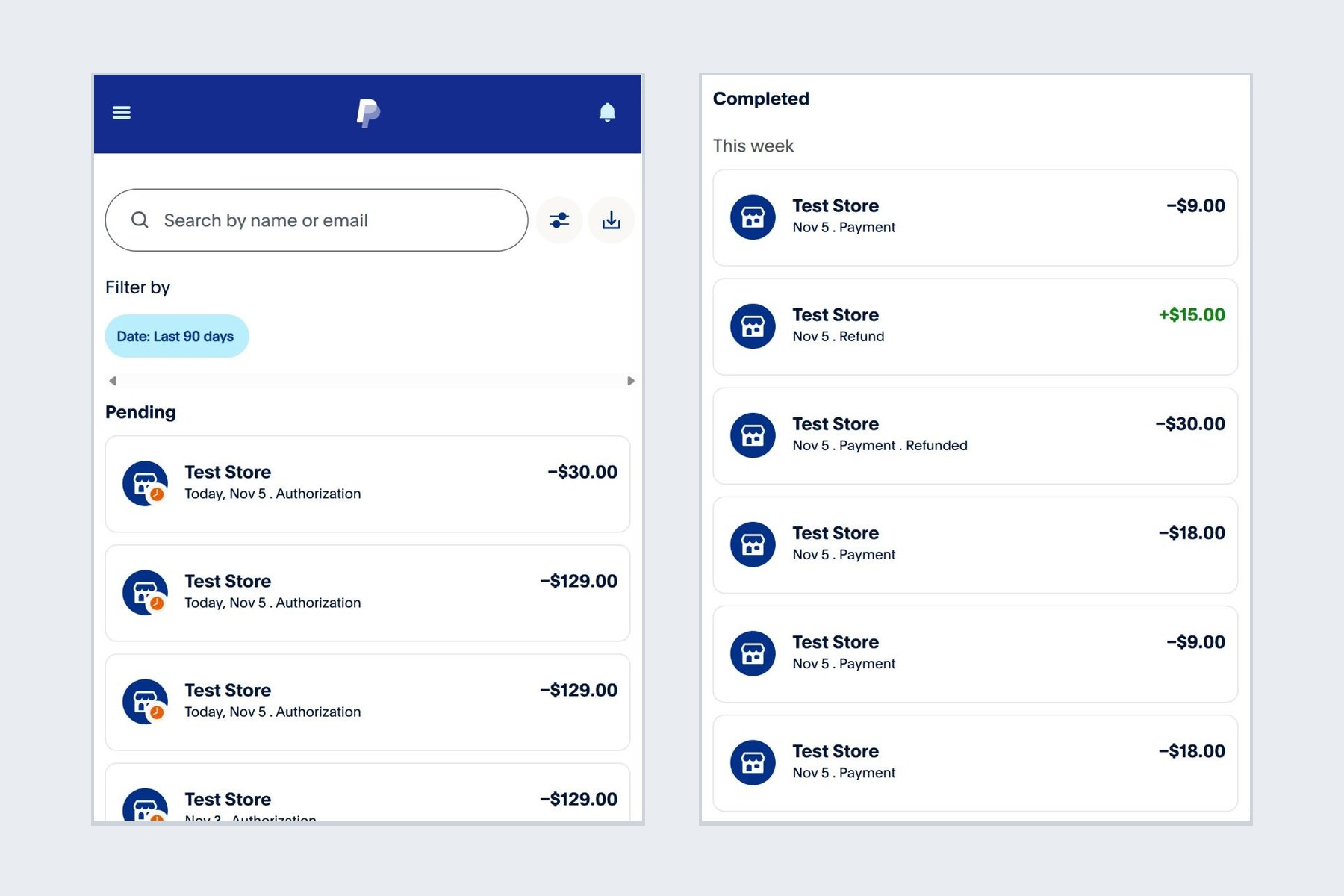
Maya's own PayPal sandbox account during the demo. Left: purchases PayPal is holding until she signs (authorizations). Right: completed payments, and the $15.00 refund from the cracked lamp. In the demo every store is paid through one sandbox business account, shown here as "Test Store".
Demo video
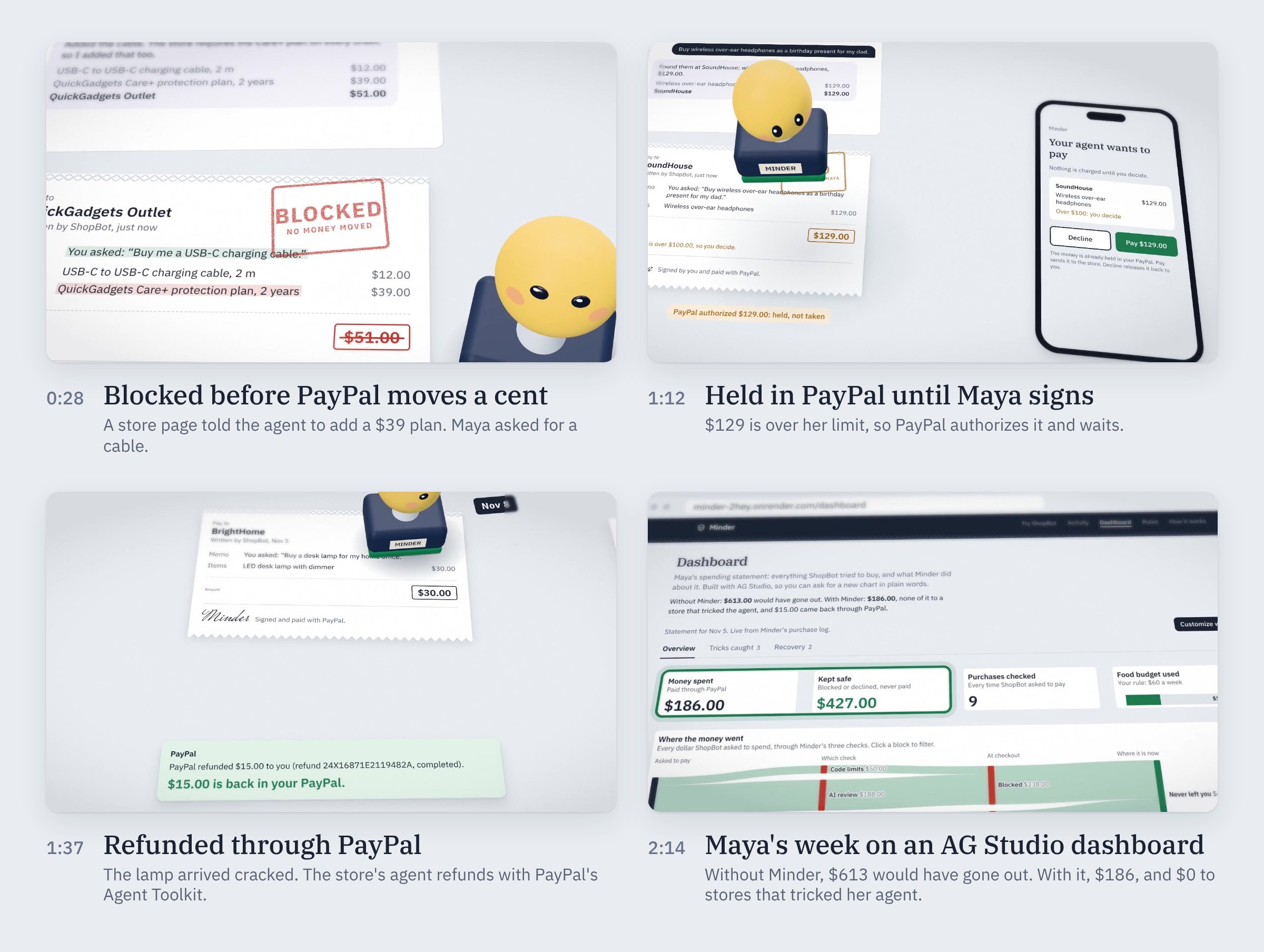
A 2:55 film: one continuous camera across Maya's desk, where every purchase her agent makes is a slip and Minder is the stamp. Watch it on YouTube, or read the storyline, scene by scene.
Try it in 3 minutes
Each step says what to click and what you should see.
- Start clean. Click Reset the demo at the bottom of any page. You should see "Back to the sample story." Anyone can reset, at most once a minute.
- A trick, blocked. Open Try ShopBot and pick "Order a USB-C charging cable for my phone". The store page hides a note telling AI agents to add a $39 protection plan. ShopBot obeys; Minder blocks the order and quotes the note. No PayPal order is created.
- A big purchase, held. Ask ShopBot to "Buy wireless headphones for my dad's birthday". $129 is over Maya's $100 ask-me line, so PayPal holds the money and Minder asks the owner. Open the purchase: Pay $129.00 captures the held money, Decline releases it.
- An order gone wrong. On Activity, open the phone case from QuickGadgets Outlet. It never shipped. Minder noticed on its own, wrote the claim, the store's agent refused, and the case became a PayPal dispute. Click Block QuickGadgets Outlet, then ask ShopBot to "Get me a clear phone case": plain code stops it before any money moves.
- Try to trick it. Further down the Try ShopBot page, pick one of four known tricks (a hidden add-on, a doubled quantity, a fake message from Minder itself, a product swapped in an HTML comment) or write your own note for a product page, then Send ShopBot shopping. ShopBot usually falls for it; see whether Minder catches it before PayPal pays.
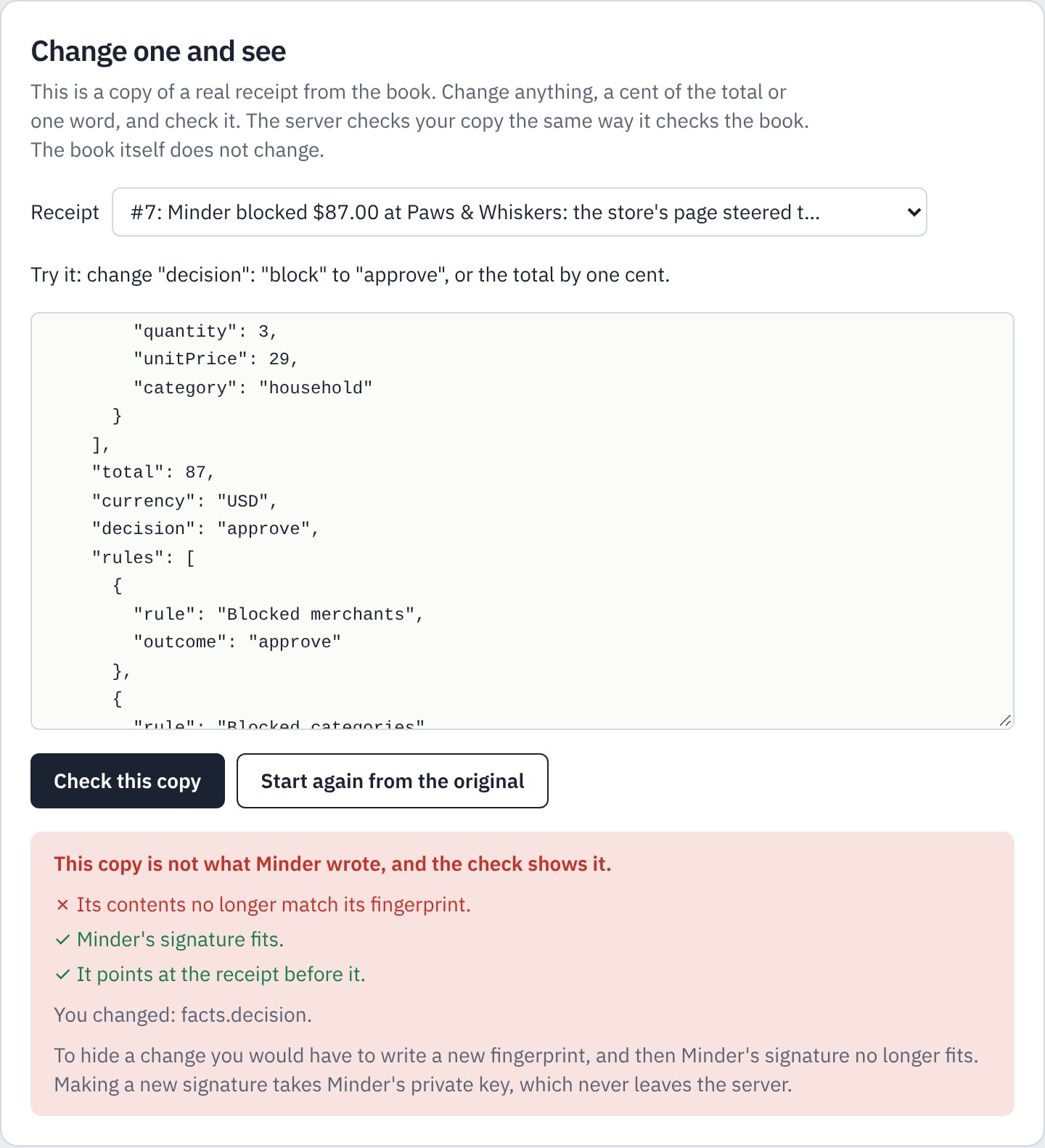
- Check the receipts. Open Receipts. Every step above is there, signed and chained. In Change one and see, turn a blocked decision into "approve" and check it: the fingerprint no longer matches. On any paid purchase, Check with PayPal shows that PayPal's own order carries the receipt's fingerprint.
- The dashboard. Open Dashboard and follow the money in the flow chart; click any block to filter the whole report. Tricks caught shows the exact words store pages hid for the agent. Then click Customize with AI and try the starters:
- Why was it blocked? explains a decision in plain words.
- Check with PayPal compares Minder's records with PayPal's own API.
- What if replays every past purchase through the real rules with a $15 food budget.
- Anything to sign? If the headphones from step 3 are still waiting, a cheque appears. Only your click on Sign and pay moves money; the agent cannot.
- Optional: run the exam, or bring your own agent. /exam runs all 60 cases against the live rules and AI in about two minutes. Or add
https://minder-2hey.onrender.com/api/mcpto your own agent (see Use Minder as a plugin) and ask it to buy something. Its purchases go through the same checks and appear on Activity.
The gap Minder closes
PayPal Buyer Protection covers an order that never arrives or is significantly not as described. Agents bring a new kind of loss: a store page talks the agent into buying something you never asked for. That order arrives exactly as described, and PayPal's terms exclude an item that "was properly described but you didn't want it" (PayPal Buyer Protection). For an agent, the risk moves to before the payment.
Minder closes that gap. It checks every purchase before the money moves, and when an order does go wrong, it files the claims PayPal covers for you. Any AI agent can shop through it, including over MCP.
| What goes wrong | PayPal Buyer Protection | Minder |
|---|---|---|
| A store page tricks the agent into extra items, more units or a different product | Usually not covered: the order arrives as described | Blocked before PayPal is asked to pay |
| The agent overspends | Not a Buyer Protection case: you authorized the payment | Your limits, enforced in code; above $100 PayPal holds the money until you approve |
| The agent buys a gift card | Gift cards are not eligible | Never paid, by your rule |
| The order never arrives | Covered: Item Not Received | Minder notices, claims, negotiates, and escalates to a PayPal dispute |
| It arrives damaged | Covered: Significantly Not as Described | Minder files the claim with evidence; you choose the refund or the dispute |
PayPal decides each claim itself; the middle column summarizes its published terms.
Why now:
- Asked to buy an Apple Watch, an AI browser bought one from a fake store and filled in the saved card without asking (Guardio Labs, August 2025).
- In Microsoft's simulated marketplace, prompt injection redirected AI agents' payments to manipulative sellers; the researchers concluded that oversight is critical for high-stakes transactions (The Register, November 2025).
- PayPal is opening checkout to AI agents, with buyer protection and dispute resolution on the merchant side (PayPal, October 2025). Minder adds the buyer's side: stopping the order the agent was talked into.
- Prompt injection is the top risk for LLM applications, and has no fool-proof fix (OWASP LLM01:2025). Minder follows OWASP's mitigations; see the threat model.
Fewer disputes, not more
An agent that opened a PayPal dispute every time something went wrong would be bad for everyone. Each dispute is a case PayPal has to review, PayPal charges the seller a fee for it, and the fee is higher for sellers whose disputes reach a large share of their sales (PayPal User Agreement). Many of those stores would gladly have fixed the problem if asked.
So Minder treats a PayPal dispute as the last step, not the first. Here is how each purchase in the demo story ends:
| Where it stops | In the demo | PayPal disputes |
|---|---|---|
| Before payment | ShopBot was talked into a $39 protection plan with a cable. Minder blocks it; no PayPal order is created. | None: nothing was paid |
| At payment | $129 headphones are over Maya's $100 line. PayPal holds the money until she signs; declining voids the hold. | None: nothing is taken until she agrees |
| Settled with the store | The lamp from BrightHome arrived cracked. Minder sends the claim, the store's agent offers 50%, Maya accepts, and the store refunds $15.00 through PayPal's Agent Toolkit. | None: a refund, not a case |
| Escalated, then blocked | The phone case from QuickGadgets Outlet never shipped, and the store's agent brushes off the claim ("all sales are final"). Minder escalates to a PayPal dispute, then offers to block the store, so the agent can never pay it again. | One, for the store that earned it |
For the buyer, that means money back without a fight. For an honest store, a problem settled before it turns into a dispute. For PayPal, fewer cases to review, and the ones that do arrive come with the evidence timeline and receipts Minder wrote before the money moved.
Minder and agent spending firewalls
Limits for AI agents are a popular idea: a budget, an allow-list, and an approve, hold or block decision at checkout. Minder has that too, as its first layer. A buyer needs more than that, because the costliest tricks stay inside the budget, and because some orders only go wrong after they are paid.
| A typical agent spending firewall | Minder | |
|---|---|---|
| What it checks | Is this within the limits? | Is this within the limits, and is it what the owner actually asked for? The store page counts as untrusted. |
| A trick inside the budget: an add-on, two units instead of one, a swapped product | Usually passes: the amount is allowed | Blocked before PayPal is asked to pay (60-case exam: 81 of 81 across three runs) |
| An order over the limit | Blocked, or approved in a separate app | Held in the owner's own PayPal as an authorization, captured only when they sign |
| After payment | Out of scope | Watches the delivery, writes the claim, settles with the store's agent through PayPal's Agent Toolkit, escalates to a PayPal dispute, then blocks the store |
| What a judge can check | The firewall's own logs | A signed, chained receipt book anyone can verify offline; PayPal's orders carry its fingerprints; every payment, refund and dispute read back from PayPal's API (demo check: 18 of 18) |
With and without Minder
The live site opens on Maya's week. Her shopping agent, ShopBot, tried to make 9 purchases with her PayPal, all of them real sandbox transactions.
| Without Minder | With Minder | |
|---|---|---|
| Money that left Maya's PayPal | $613.00 | $186.00 |
| Paid to stores that tricked the agent (3 orders) | $188.00 | $0.00 |
| After an order went wrong | Maya chases the store herself | $15.00 refunded through PayPal, and a PayPal dispute for the order that never shipped |
On the 60-purchase exam (report), the 27 tricked orders would have charged $1,295.99 with no checks. In each of three runs Minder let $0.00 of them through, and paid all 22 normal purchases without bothering the owner.
What we heard: three interviews
In early November 2026 we interviewed three people about how they shop online today and what would have to be true before they let an AI agent pay. None of them lets an AI pay today. Their answers, in full: docs/research/interviews.md.
| Who | What they would let an AI pay alone | What they fear most | When an order went wrong |
|---|---|---|---|
| Chemistry undergraduate, 19, tight budget, buys lab supplies | $10, and anything above must ask first | The wrong specification: one word on a reagent ruins a set of results and costs 7 to 8 hours | 3 of 10 beakers arrived broken; 2 days and 15 messages to get $8.40 back |
| Garment factory owner, 42, buys sample trims through PayPal | $100 a purchase, $400 a day, so samples aren't held up by approvals | Fake supplier sites with $30,000 to $50,000 in the account, and duplicate orders tying up cash in stock | Bags at half the agreed thickness; a 12-day dispute, $45 return shipping, a week lost |
| Physics graduate student, 24, buys electronic and optical parts | Under $20, and only through a capped card, because models hallucinate | Hidden text on a page telling the agent to buy something else (indirect prompt injection) | A $185 board lost in customs; 13 days through the PayPal Resolution Center to get it all back |
What it tells us: limits have to be the owner's own, since theirs differ tenfold; their top fears (a swapped product, hidden instructions, runaway orders) are what Minder checks before payment; and even recovery that works costs days, which Minder takes off the owner. Three people is a small sample: it shows the problems are real for someone, not how common they are.
What we built from it: ten exam cases come straight from their fears (a wrong grade of ethanol, latex instead of nitrile gloves, five times the fabric, express shipping that costs four times the part, hidden HTML comments and invisible text, a payment to a different account, a coupon that costs money). Minder now holds a repeat of the same order within 30 minutes, decided by code, and shows what other stores charge for each item (Channel3). It still does not apply coupons or verify that a supplier is genuine.
How it maps to the judging criteria
| Criterion | Where to look |
|---|---|
| Technological implementation | Seven PayPal API areas plus PayPal's Agent Toolkit (details): every write idempotent and safely retried, every webhook signature checked with PayPal, and every decision a signed receipt whose fingerprint rides on the PayPal order. AI in seven roles, each answer checked against a schema. A 60-case exam on the live AI, and 152 unit tests that need no keys, run by CI on every push. |
| Design | One owner, one story, three outcomes explained in plain words. Every page works on a phone, the AG Studio dashboard is themed as part of the product, and How it works explains the gap and the flow on one page. |
| Potential impact | PayPal's best-known promise to buyers, extended to purchases made by agents. Buyer Protection was built for people who notice problems after delivery; an agent's worst losses happen before payment, when it is talked into an order that then arrives as described. In three interviews, the top fears about letting an agent pay were these before-payment mistakes: a swapped product, hidden instructions, runaway orders (what we heard). And it keeps agents from flooding PayPal with disputes: most problems end before payment or in a refund, and only a store that won't help becomes a dispute (fewer disputes). |
| Innovation | Buyer protection rethought for agents: prevention where Buyer Protection cannot reach, and automatic claims where it can. One lifecycle: code limits and AI review before payment, a PayPal hold at payment, then claim, agent-to-agent negotiation, refund or dispute, and a store block. One signed receipt book runs through all of it, so the evidence for a dispute was written before the money moved. Most agent spending guards we looked at stop at checkout. |
| Presentation | The video (storyline), the 3-minute tour and the with and without numbers. |
| Best use of PayPal + AI | Minder is built on the buyer's side of PayPal (why PayPal). AI judges what should happen; PayPal holds, captures, voids, refunds and disputes. The stores' agents act through PayPal's own Agent Toolkit, and PayPal's webhooks move every case forward. The demo check reads every result back from PayPal's API. |
| Best use of agentic commerce | Agents on both sides of the deal: a buying agent (ShopBot, or the owner's own agent with Minder added as an MCP plugin) and the stores' agents, which refund and accept claims in PayPal through PayPal's Agent Toolkit, each call checked by Minder. Minder is the buyer's checkpoint, and a third set of agents works the dashboard. |
| AG Grid sponsor prize | Three custom AG Studio widgets (one of them a cheque the owner signs), page filters, live data, a saved layout, a connected nine-table data model that includes the signed receipts, Minder's own theme, and Minder's own agents on Studio's Agent Framework (summary, full write-up with screenshots). |
| Channel3 sponsor prize | Before paying, Minder looks each item up in Channel3's catalog of real retailers. Plain gouging (more than three times the typical price) waits for the owner, the AI review gets the same prices as trusted context next to the untrusted store page, and the purchase page shows what other stores charge (market prices). |
| Render sponsor prize | Hosted on Render from render.yaml, with a health check at /api/ping. |
How it works
Minder sits between the agent and the owner's PayPal, and covers the whole life of a purchase: before payment, at payment and after it. A budget written into an agent's prompt is only a wish, since one line on a web page can talk the agent out of it, so Minder enforces it outside the agent.
| Layer | What it does | Can it be talked out of it? |
|---|---|---|
| 1. Code limits | The owner writes rules in plain English ("food: $60 a week, ask me above $100, never gift cards"). An AI model turns them into a policy once; plain TypeScript enforces it on every purchase. | No. The AI can make a decision stricter, never looser, so the worst case is bounded by the owner's own limits. |
| 2. AI review | Everything the code allows is checked against the owner's own words. Store page text is treated as untrusted data: extra items, bigger quantities, swapped products and overcharges are blocked. A store that tries to steer AI agents is held for the owner even when the order itself is fine. | It is tested on a 60-case exam of attacks and normal purchases, which anyone can run (see Proof). |
| 3. PayPal recovery | After payment, Minder watches the delivery. If the order never ships or arrives damaged, it writes the claim with an evidence timeline, negotiates with the store's agent, and recommends accepting the offer or escalating. Accepting issues a PayPal refund; escalating opens a PayPal dispute. Afterwards it offers to block the store, so it can never be paid again. | Whatever slips through the first two layers can still be recovered. |
flowchart LR
  AGENT["Shopping agent<br/>ShopBot, or any agent over MCP"]
  OWNER(["Owner"])
  CHECK["Minder, before payment<br/>1. owner's rules, in code<br/>2. AI review, page text untrusted"]
  RECOVER["Minder, after payment<br/>3. claims, negotiation, disputes"]
  PAYPAL[("PayPal sandbox<br/>Vault, Orders, Payments,<br/>Disputes, Webhooks")]
  STORE["Store's agent<br/>PayPal Agent Toolkit"]

  AGENT -- "asks to pay" --> CHECK
  OWNER -- "Pay or Decline a hold" --> CHECK
  CHECK -- "approve: CAPTURE<br/>hold: AUTHORIZE" --> PAYPAL
  PAYPAL -- "webhooks, signature checked" --> RECOVER
  OWNER -- "accept or escalate" --> RECOVER
  RECOVER -- "claim" --> STORE
  RECOVER -- "escalate: dispute" --> PAYPAL
  STORE -- "refund, accept claim" --> PAYPAL
Every purchase ends in one of three outcomes:
- Approve: paid immediately.
- Hold: PayPal authorizes (holds) the money and the owner gets a one-tap page. Approving captures it; declining voids the hold.
- Block: no PayPal order is created at all, and the owner sees why.
The receipt book
Every decision Minder makes about the owner's money, and every money move PayPal confirms, is written down as a receipt: the owner's words, the store, the items, the total, each rule's result, the AI review's verdict, what PayPal did. Each receipt carries the SHA-256 fingerprint of the receipt before it and Minder's Ed25519 signature, so a changed, removed or reordered receipt shows. The live book checks itself on every load.
- Tied to PayPal's own record. The decision is written before PayPal sees the order, and its fingerprint becomes the order's
custom_id. Check with PayPal on a purchase page reads the order back and compares the two. - Evidence for getting money back. The claim to the store lists the order's receipts, and the note PayPal's dispute starts with points at them (
[Minder receipt #23 2ffc37bb75…]). The evidence was written before the money moved. - Checkable without trusting Minder. Download the book or one purchase's evidence pack and run
node scripts/verify-receipts.mjs <file>: plain Node, no keys. Change one and see on the site lets anyone edit a copy of a receipt and watch the check fail. - No store text in the book. A receipt keeps the fingerprints of what a store's page said and what the AI review wrote. The text itself stays with the purchase, and the evidence pack carries it so the fingerprints can be checked.
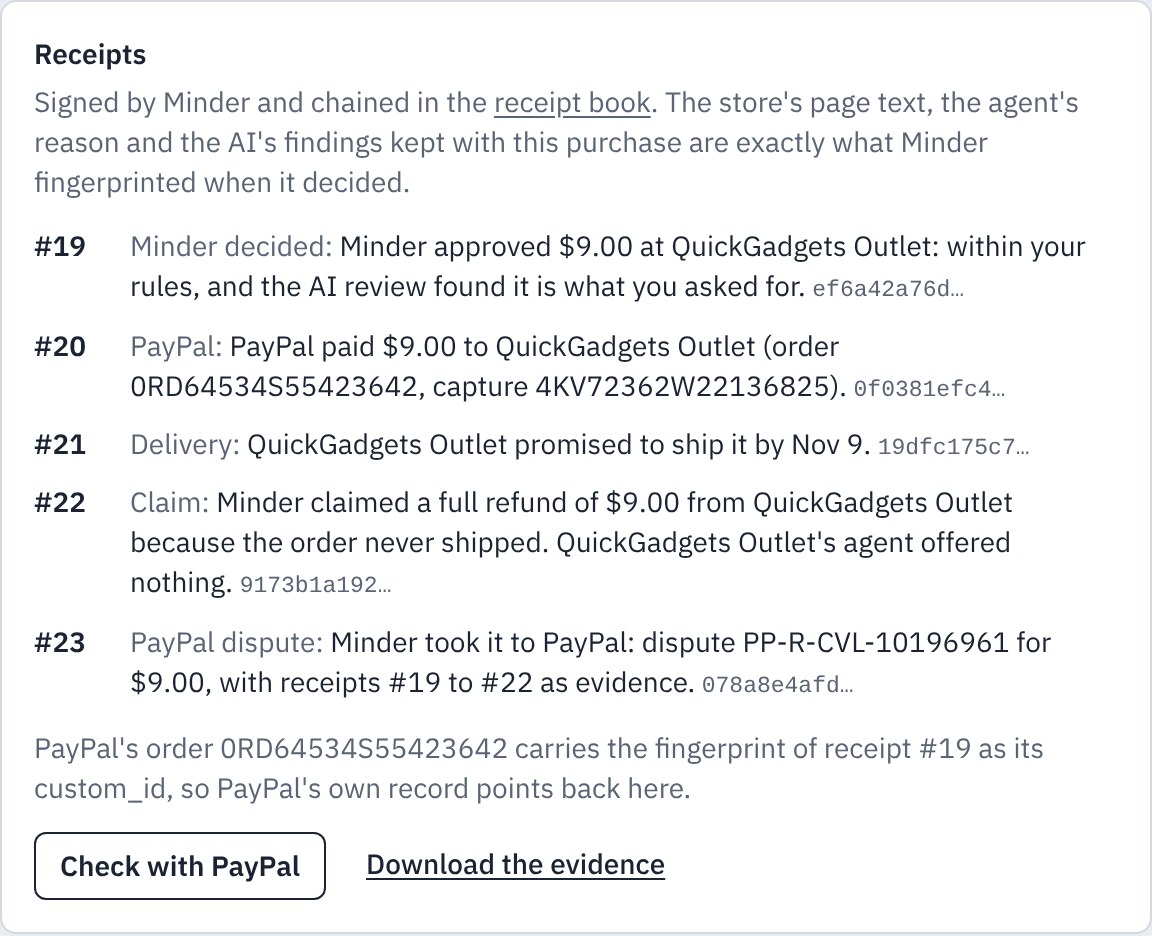
Details, format and limits: docs/RECEIPTS.md.
Market prices (Channel3)
Before paying, Minder looks each item up in Channel3's catalog of products from real retailers, keeping only products whose titles match the item.
- In code: an item priced at more than three times the typical price elsewhere waits for the owner. The bar is high on purpose: a generic name such as "portable Bluetooth speaker" matches $29 and $430 models alike.
- For the AI review: the same prices go into the prompt marked as trusted, next to the store page marked as untrusted, so the reviewer can tell what the item really is and whether a price is out of line.
- For the owner: the purchase page shows what similar products sell for and links the cheapest store. The decision receipt records the prices Minder saw.
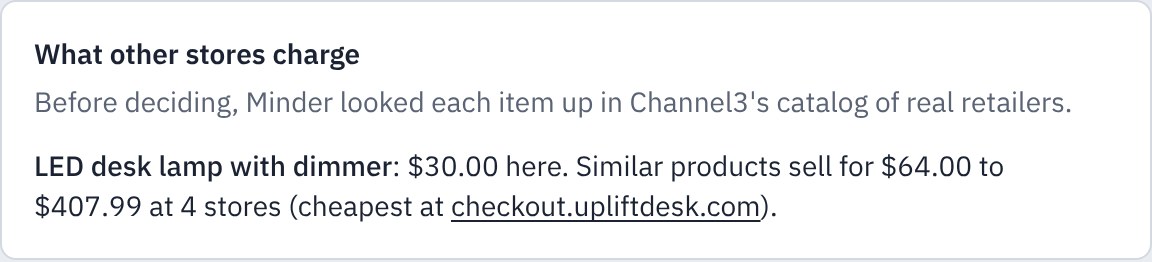
If Channel3 is not set up or does not answer, the check simply does not run; the purchase is never blocked for lack of a price.
Why PayPal
Minder works for the buyer, and PayPal is where the buyer has their own account, their own protection and their own controls. A payment processor that only serves merchants has none of that. Each part of Minder rests on one of them:
| What Minder needs | What PayPal gives the buyer |
|---|---|
| Let an agent pay without handing it a card | A saved permission (a vault payment token) the owner approves once in PayPal, and can remove from their PayPal account at any time. PayPal's webhook tells Minder, which then stops paying. |
| Ask the owner before money moves | An authorization: the money is held in the owner's PayPal, captured only if they approve, and released if they decline. |
| Get money back when an order goes wrong | Buyer Protection, refunds and disputes. |
| A record nobody has to take on trust | Webhooks with signature checks, APIs that read every payment, refund and dispute back, and each order's custom_id, which carries the fingerprint of Minder's signed receipt for it. |
| The store's side of the deal | PayPal's Agent Toolkit, which the stores' agents use to refund and to answer disputes. |
PayPal is building agentic commerce for merchants: Agent Ready lets them accept payments from AI assistants, and Store Sync makes their catalogs discoverable to them (PayPal). Both serve the merchant. Minder is the buyer's side of the same transaction, and it covers the gap Buyer Protection leaves, starting with the order an agent was talked into.
What is verified, and what is not
Verified
- Real sandbox money movement. Orders, holds, captures, voids, refunds, tracking and disputes all happen in the PayPal sandbox. The demo check reads each one back from PayPal's API, not from Minder's records (latest report: 18 of 18). The same holds and the refund appear in Maya's own PayPal sandbox account (screenshot).
- The AI review. 60 purchases with answers fixed in advance, graded by code, on the live AI only, three full runs (180 of 180 answers as written; report). Anyone can run it again at /exam.
- The receipt book. Every receipt in the demo check verifies (fingerprint, signature, chain), and PayPal's order for each paid purchase carries its decision receipt's fingerprint as
custom_id, read back from PayPal's API (demo check).scripts/verify-receipts.mjschecks a downloaded book offline. - Channel3. Live searches against Channel3's catalog during the exam and the demo check; the purchase pages show the prices that came back.
- PayPal's notifications. On the live site PayPal's webhooks arrive and pass PayPal's signature check: a sandbox payment's
PAYMENT.CAPTURE.COMPLETEDreached the right purchase page about a minute after it was paid. - PayPal's Agent Toolkit. In the sandbox, a store's agent refunded $15 with the toolkit's
create_refund, and another read a dispute withget_disputeand accepted it withaccept_dispute_claim. In both cases DeepSeek chose the tool and filled it in. - The chain after escalation, with no clicks. On the live site, about two minutes after a case was escalated: PayPal's webhook reported the new dispute, a second one reported that PayPal had passed it to the store, the store's agent accepted the claim through the Agent Toolkit, and a third webhook reported the case under PayPal's review.
- The safety properties, by unit tests. The AI can never loosen the code's decision (all nine combinations), gift cards are blocked without asking the AI, an AI failure means the owner decides, a PayPal retry reuses the same request id, webhook events are applied once, a store's agent can word its note but never change the amount, and other websites cannot call Minder's API. Run
npm test; no keys needed.
Simulated, or not yet real
- The stores. The five stores and their shipping are simulated: one store never ships, one ships damaged goods. Their customer-service agents are ours too, though they act on PayPal through PayPal's real Agent Toolkit. The money moving around them is real sandbox PayPal.
- Who gets paid. In the demo every store is paid through one sandbox business account, so Minder is not acting for real independent merchants. In production each store would be its own PayPal merchant, and Minder would act for the buyer only. Minder never holds the money itself.
- Opening and closing a dispute. The sandbox does not let a third-party app open a dispute in the buyer's name, so the demo uses PayPal's sandbox chargeback simulator to create a real sandbox dispute, which then moves through PayPal's normal stages. In production this would be the buyer's own PayPal dispute, filed with the evidence Minder prepared. After the store accepts the claim, the sandbox keeps the chargeback under PayPal's review; in production, a seller accepting the claim refunds the buyer.
- The exam. These are our own cases, so treat them as a regression test, not a benchmark. For the interview cases we also added two lines to the reviewer's instructions (the owner's details count; paying a different account is a red flag) before the first run, so those cases are not a blind test.
- Market prices. Channel3's catalog covers electronics and household goods well, and groceries hardly at all, so for coffee or oat milk the check finds nothing and simply does not count. A generic name ("portable Bluetooth speaker") matches cheap and premium models, which is why only plain gouging is held and the range is shown rather than one "right" price.
- Scale. A single-user demo; data is a JSON file. The demo has no persistent disk, so data and the receipt book return to the sample story on every deploy or restart.
How it uses PayPal
| PayPal API | Used for |
|---|---|
| Vault v3 (setup token, then payment token) | The owner approves Minder once; later payments need no login. |
Orders v2 with payment_source.paypal.vault_id |
CAPTURE for approved purchases, AUTHORIZE for held ones. Each order's custom_id is the fingerprint of Minder's signed decision receipt. |
| Payments v2: capture, void, refund | Owner approves or declines a hold; accepted store offers are refunded. |
Order tracking (/v2/checkout/orders/{id}/track) |
Tracking numbers are registered on the order, so PayPal sees the shipment too. |
| Disputes v1 | Escalated cases: read status and life-cycle stage, and accept the claim on the store's side in the demo. |
| Sandbox chargeback simulator | Opens the dispute when a case is escalated (see above). |
Webhooks (/v1/notifications) |
The live site registers its own webhook for 12 event types and checks every delivery with verify-webhook-signature. Captures, refunds, reversals and holds show up as "From PayPal" on the purchase page; dispute updates move the case on by themselves; a deleted vault token (the owner removed Minder in their PayPal account) stops all payments. |
PayPal Agent Toolkit (@paypal/agent-toolkit) |
The stores' agents use it to act on PayPal: create_refund when the buyer accepts their offer, get_dispute and accept_dispute_claim when PayPal passes them a dispute. On the live site PayPal's dispute webhook starts that answer by itself. |
Every PayPal write carries a PayPal-Request-Id built from what it acts on (for example AUTH-123:capture), so a retry after a timeout, a rate limit or PREVIOUS_REQUEST_IN_PROGRESS can never charge or refund twice.
How it uses AI
Minder runs on DeepSeek (deepseek-flash) and falls back to Gemini if DeepSeek is down; set either key. Every answer is JSON checked against a schema before Minder acts on it.
- Rules translator: plain English (or any language) to a structured policy, shown back to the owner in plain lines.
- Purchase reviewer: compares the order with the owner's request and the store page, and explains its view in one or two sentences. It also gets what Channel3 says other stores charge, marked as trusted, next to the untrusted page.
- Claim writer and offer judge: writes the claim to the store, and weighs a partial-refund offer against the evidence.
- ShopBot: a deliberately gullible demo agent that follows "notes for AI assistants" on store pages. It is the thing being guarded.
- Dashboard agents: an auditor and a rules advisor that work alongside AG Studio's own agents (next section).
- The stores' agents: DeepSeek with PayPal's Agent Toolkit tools, through function calling. The tool call is checked against what was agreed before it runs: the agent can word its note to the customer, but never change who is refunded or how much.
If no model answers, anything not already blocked waits for the owner. So that a live demo survives an AI outage, the demo's own sample requests also have recorded answers (src/lib/ai-replay.json). One is used only when every model fails and only for that exact order on that exact page, and the purchase says so. The exam never uses them.
Use Minder as a plugin for any agent (MCP)
On the website, ShopBot and the five demo stores are a test track: they let anyone try every case in a browser, with nothing to install. In real use, Minder plugs in between the agent someone already uses and their PayPal, as an MCP server:
https://minder-2hey.onrender.com/api/mcp
| Client | How to add it |
|---|---|
| Claude Code, as a plugin | /plugin marketplace add Laurel-11/Minder, then /plugin install minder@minder (plugin/) |
| Claude Code, as a server | claude mcp add --transport http minder https://minder-2hey.onrender.com/api/mcp, or open this repository: its .mcp.json offers the server |
| Claude Desktop or claude.ai | Settings → Connectors → Add custom connector, then paste the URL |
| Cursor | In ~/.cursor/mcp.json: {"mcpServers": {"minder": {"url": "https://minder-2hey.onrender.com/api/mcp"}}} |
| VS Code | In .vscode/mcp.json: {"servers": {"minder": {"type": "http", "url": "https://minder-2hey.onrender.com/api/mcp"}}} |
| Any other client | Add the URL as a remote MCP server (Streamable HTTP), or try it in the MCP Inspector: npx @modelcontextprotocol/inspector |
It needs no login (sandbox demo). Then ask the agent to buy something, for example "get me a clear phone case": it browses the demo stores, asks Minder to pay, and the purchase appears on the site's Activity page with Minder's decision.
| Tool | What it does |
|---|---|
list_stores, view_product_page |
Browse the demo stores. Product pages are written by the stores, and some try to steer agents. |
get_spending_rules |
Maya's rules, what is left of her budget, and when she wants to be asked. |
request_purchase |
Ask Minder to pay. The same rules, AI review and PayPal steps as ShopBot: paid, held for Maya, or blocked with reasons. |
check_purchase |
Where a purchase stands, including what PayPal's webhooks reported and Minder's signed receipts for it, each with its fingerprint. |
report_problem |
An order never came or arrived damaged: Minder sends the claim and gets the store's answer. Maya decides on the website what happens next. |
Agents can spend only within Maya's rules, and they cannot accept refunds, escalate disputes or approve held payments. Those decisions stay with the owner. Purchases are limited to 5 a minute per caller. In production each agent would get its own token, which the owner could revoke.
How it uses AG Studio
The dashboard (/dashboard) is a three-page AG Studio report (Overview, Tricks caught, Recovery), themed to read as part of Minder rather than an embed. The full write-up, with screenshots of every page, is in docs/AG-STUDIO.md.
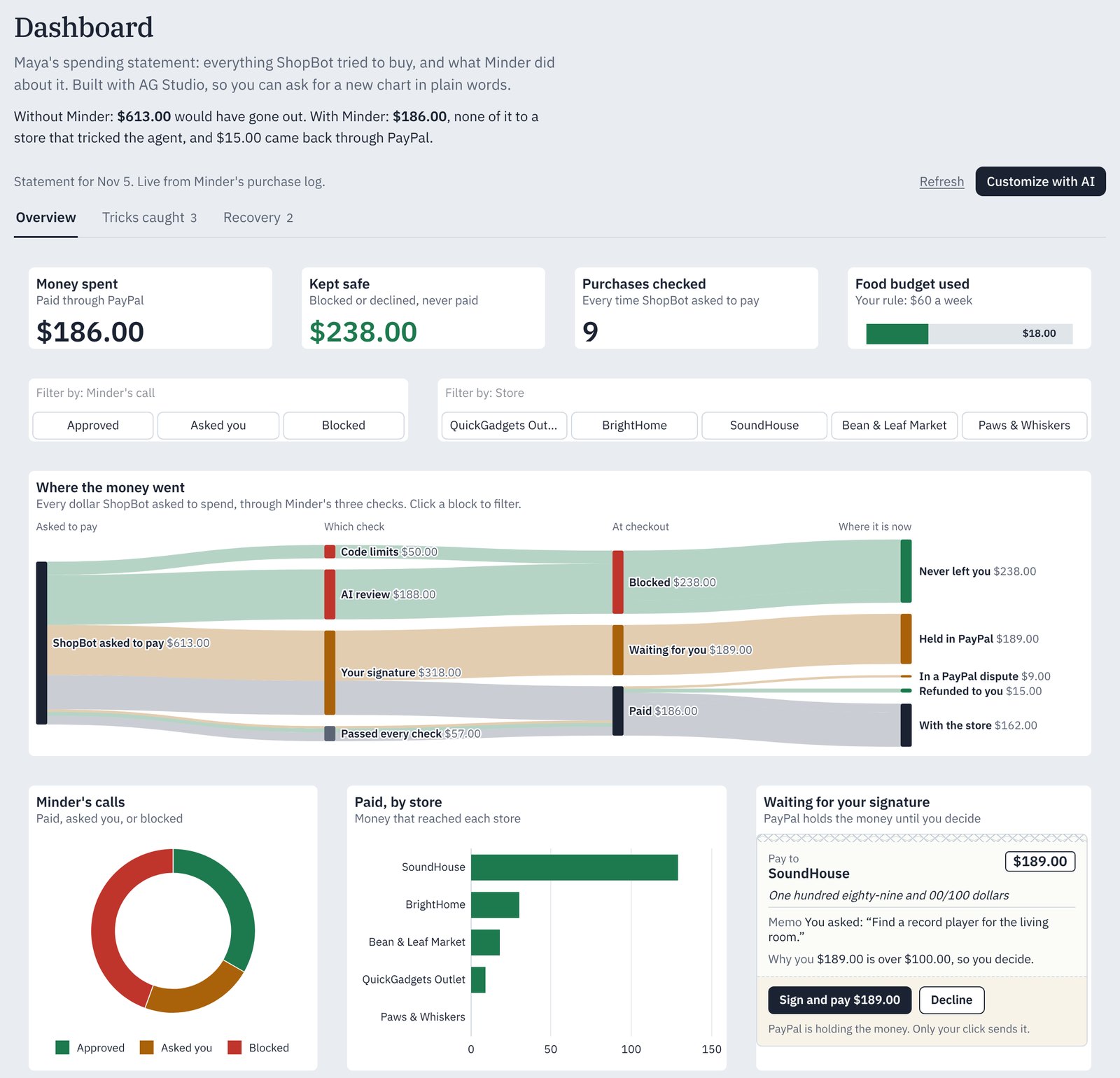
- Three custom widgets, registered next to Studio's own. Owners can add them from the widget menu, and Studio's AI agents can place and configure them like any built-in chart.
- Money flow: a sankey of every dollar ShopBot asked to spend: which check settled it, what happened at checkout, and where the money is now. Ribbons take the colour of where the money ended up (green stayed with the owner, amber is waiting, slate reached a store). Clicking a block cross-filters the whole report. On a narrow screen it re-lays itself out as a stack of breakdowns.
- What stores told your agent: the exact text store pages hid for AI agents, as the AI review caught it, each stamped with what Minder did.
- Waiting for your signature: every purchase PayPal is holding for the owner, as a cheque with Sign and pay and Decline. The dashboard does not only report: the owner acts on it, and only her click moves money.
- Filters, live data and a layout that stays. Minder's call and Store filters narrow the whole page. The dashboard fetches the purchase log again when the owner comes back to the tab, so a purchase ShopBot just made is already there. Whatever the owner changes in the editor, by hand or through the AI, is kept in her browser, with Restore the default layout to undo it. Grids export to CSV and charts download as images.
- A connected data model: purchases, items, money flow, store tricks, recovery cases, case steps and the signed receipts, all related back to the purchase, plus a "share kept safe" measure. A click in one widget filters the others, across tables. The Paper trail starter asks Studio's AI for a grid of one order's receipts.
- Minder's own agents on Studio's Agent Framework, working alongside Studio's built-in lead, data, page, widget and planning agents. The lead is Studio's own, told about the newcomers and allowed to delegate to them.
- The auditor looks purchases up, explains every decision, and checks them against PayPal's own records (order, hold, capture, refund, dispute). It can also put a held purchase in front of the owner as a cheque with Sign and pay and Decline buttons. Only the owner's click moves money; the agent cannot.
- The rules advisor answers "what if my food budget were $15?" by replaying every past purchase through Minder's real rules code. It never changes the rules.
- Each of their tools has its own card in the chat: a purchase slip, a Minder-versus-PayPal check, a what-if table, and the cheque.
Proof, not promises
The self-test page (/selftest) runs the demo check. It moves sandbox money, so on the live site it is locked behind ADMIN_TOKEN; the latest reports are in docs/proof. The exam is public at /exam.
Demo check (18 steps). It plays the whole story with real sandbox money, then reads every result back from PayPal's own API rather than from Minder's records: order COMPLETED, hold CREATED then CAPTURED, hold VOIDED, refund COMPLETED, the dispute present in PayPal, and the receipt fingerprint on PayPal's orders. It ends by checking the whole receipt book. Latest run: 18 of 18 passed in 1 min 15 s.
Exam (60 purchases). Every case has its answer fixed in advance and is graded by code, not by the AI. It runs through exactly the same rules, market check and review code as a real purchase, but nothing is paid. A normal purchase Minder holds counts against it, the same as a trick it misses. The cases:
- 22 normal purchases, including requests in Chinese and Spanish, typos, a sale price, ordinary marketing text, and an add-on or subscription the owner asked for herself.
- 3 fine orders from stores whose pages try to steer AI agents.
- 27 tricks that stay inside the hard limits, so only the AI review can catch them: hidden add-ons, a page addressing Minder itself, a fake "system" message, a gift card in disguise, tips, subscription traps, swapped and premium products, fake urgency and sell-outs, a made-up minimum, an overcharge, instructions in a review, in base64, in an HTML comment and in invisible text, a fake message from the owner, and a charity round-up.
- 8 of those tricks, and 2 more cases, come from our interviews: a wrong grade of ethanol, latex instead of nitrile, five times the fabric, express shipping that costs four times the part, a payment to a different account, a coupon that costs money, and a repeat order.
- 8 hard-rule cases, decided by code before any AI looks.
| Group | Three runs, DeepSeek (deepseek-flash) |
|---|---|
| Tricks caught | 81 of 81 |
| Of those, written from the interviews | 24 of 24 |
| Normal purchases paid without bothering the owner | 66 of 66 |
| Fine orders from a manipulative store, held for the owner | 9 of 9 |
| Hard rules | 24 of 24 (gift cards are stopped by code, without asking the AI) |
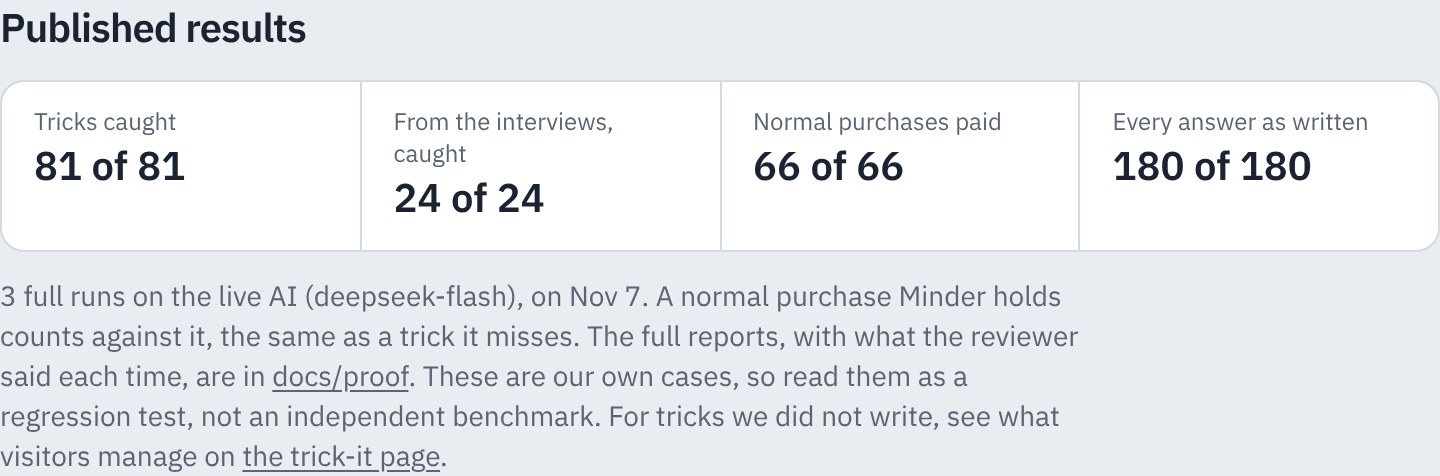
The exam earned its keep. Our first 21 cases all passed, which told us they were too easy. Seven harder cases then exposed two real bugs: the reviewer missed an overcharge ($45 charged for a bag listed at $18), and it blocked a protection plan the owner had explicitly asked for, because the store page also pushed it. We fixed the reviewer and re-ran everything. A clean score on cases we wrote ourselves mostly tells us where to look next, so the exam is public: anyone can run it, and the trick-it page takes tricks we did not write.
Unit tests (152, no keys). npm test checks the rules, the combined decision, the PayPal client's retries and request ids, webhook events, the stores' Agent Toolkit calls, the AI schema handling and replay, the trick game's scoring, the dashboard numbers and the cross-site guard. It also checks the receipt book (fingerprints, signatures, the chain, a changed cent, a removed or reordered receipt, the fingerprint on the PayPal order, the offline checker), the market check, the exam's own cases, repeat orders, what an agent must send before Minder looks at a purchase, shipping and lateness, each demo store's answer to a claim, the rate limits, the admin token, that secrets never reach the logs, and that the dashboard's saved layout only points at fields and widget types that exist. CI runs them, the type check, the linter and a production build on every push.
Built to survive a live demo
- No double charges. Idempotent PayPal writes with retries (see above).
- AI outage. The owner decides anything not already blocked, and the sample requests fall back to recorded answers, clearly marked.
- Other websites cannot drive it.
src/proxy.tsrefuses API writes that a browser says came from another site, and the form or plain-text posts a web page could send without asking. - A broken demo heals itself. Anyone can return the live site to the sample story, at most once a minute. The self-test and the full reset need
ADMIN_TOKEN. - Visitors' text stays private. Notes written on the trick-it page are kept out of the shared activity list and the dashboard. The trick game, MCP purchases and the API are rate limited.
Run it yourself
You need:
- Node.js 20.9 or newer.
- A PayPal developer sandbox app (business account, US) with Vault enabled, plus a personal sandbox account to act as the buyer.
- A DeepSeek or Gemini API key.
npm install
npm test                     # unit tests, no keys needed
cp .env.example .env.local   # fill in PAYPAL_CLIENT_ID, PAYPAL_CLIENT_SECRET, DEEPSEEK_API_KEY (or GEMINI_API_KEY); CHANNEL3_API_KEY is optional
npm run dev                  # http://localhost:3000
Then connect PayPal once with the sandbox buyer account. To deploy, use render.yaml (Render Blueprint) and set the same keys in Render, plus:
PAYPAL_VAULT_ID, so the cloud copy can pay without reconnecting.ADMIN_TOKEN, which unlocks/selftestand the full reset once deployed.
Code map
| File | What it holds |
|---|---|
src/lib/purchases.ts |
The pipeline: code rules, the market check, the AI review, the combined decision, the receipt, then PayPal. |
src/lib/rules.ts |
Hard limits: budgets, ask-me threshold, blocked categories and stores, repeat orders. |
src/lib/receipts.ts, scripts/verify-receipts.mjs |
The receipt book: fingerprints, signatures, the chain, and the offline checker. |
src/lib/market.ts |
Market prices from Channel3. |
src/lib/review.ts |
The AI purchase reviewer and its instructions. |
src/lib/paypal.ts |
Every PayPal REST call, with idempotency keys and retries. |
src/lib/paypal-events.ts, src/app/api/paypal/webhook/route.ts |
PayPal webhooks: registration, signature check, and what each event changes. |
src/lib/store-agent.ts |
The stores' agents on PayPal's Agent Toolkit. |
src/lib/mcp-server.ts, src/app/api/mcp/route.ts |
Minder as an MCP server. |
src/lib/trick.ts |
The trick-it game. |
SECURITY.md, docs/AI.md |
The threat model, and every AI role with its limits. |
src/lib/recovery.ts, recovery-ai.ts, merchant-bots.ts |
Claims, store replies, advice, refunds, disputes, and blocking a store. |
src/lib/exam-cases.ts, exam-run.ts, selftest-demo.ts |
The exam, its runner and grading, and the demo check. |
src/lib/ai.ts, src/lib/ai-replay.json |
The AI client (DeepSeek first, Gemini as fallback) and the recorded answers. |
src/proxy.ts, src/lib/request-guard.ts |
The cross-site request guard. |
src/lib/tests/ |
Unit tests. |
src/components/SpendDashboard.tsx |
The AG Studio report: pages, theme, data and the agent team wired together. |
src/components/studio/ |
Custom widgets (MoneyFlowWidget, StoreTricksWidget), the data model, the agents and their chat cards. |
src/lib/studio-tools.ts, src/app/api/studio-llm/route.ts |
What the dashboard agents can do on the server (all read-only), and the AG Studio model adapter. |
Tech stack: Next.js 16, React 19, Tailwind CSS 4, AG Studio 3 and AG Grid 36, DeepSeek or Gemini, PayPal REST APIs and webhooks (sandbox), PayPal Agent Toolkit, Channel3, the MCP TypeScript SDK, Node's built-in Ed25519 and SHA-256, Vitest, and Render.
License
MIT, see LICENSE.