
Lakonik/LakonLab
Lakonik/LakonLab has 477 GitHub stars and 27 forks. GitHot measured 0 stars in 24 hours and 0 in 7 days. Last checked 2026-11-09 02:28 UTC. Last push 2026-10-29.
Official implementation of AsymFlow, pi-Flow, GMFlow
Measured star growth
- in 24h
- 0
- in 7 days
- 0
- in 15 days
- Update delayed
- in 1 month
- Update delayed
Net star changes over overlapping periods, not daily totals. Missing measurements are left blank. Stars measure attention, not software quality.
README.md
OriginalLakonLab: Official Codebase for AsymFlow, pi-Flow, and GMFlow
Official PyTorch implementation of the papers:
Asymmetric Flow Models [README]
In NeurIPS 2026
[Hansheng Chen](https://lakonik.github.io/), [Jan Ackermann](https://janackermann.info/), [Minseo Kim](https://soniaminseokim.github.io/), [Gordon Wetzstein](http://web.stanford.edu/~gordonwz/), [Leonidas Guibas](https://geometry.stanford.edu/?member=guibas)
Stanford University
[Project Page](https://hanshengchen.com/asymflow) | [arXiv](https://arxiv.org/abs/2605.12964) | [ComfyUI](https://github.com/Lakonik/ComfyUI-piFlow) | [AsymFLUX.2 klein Demo🤗](https://huggingface.co/spaces/Lakonik/AsymFLUX.2-klein)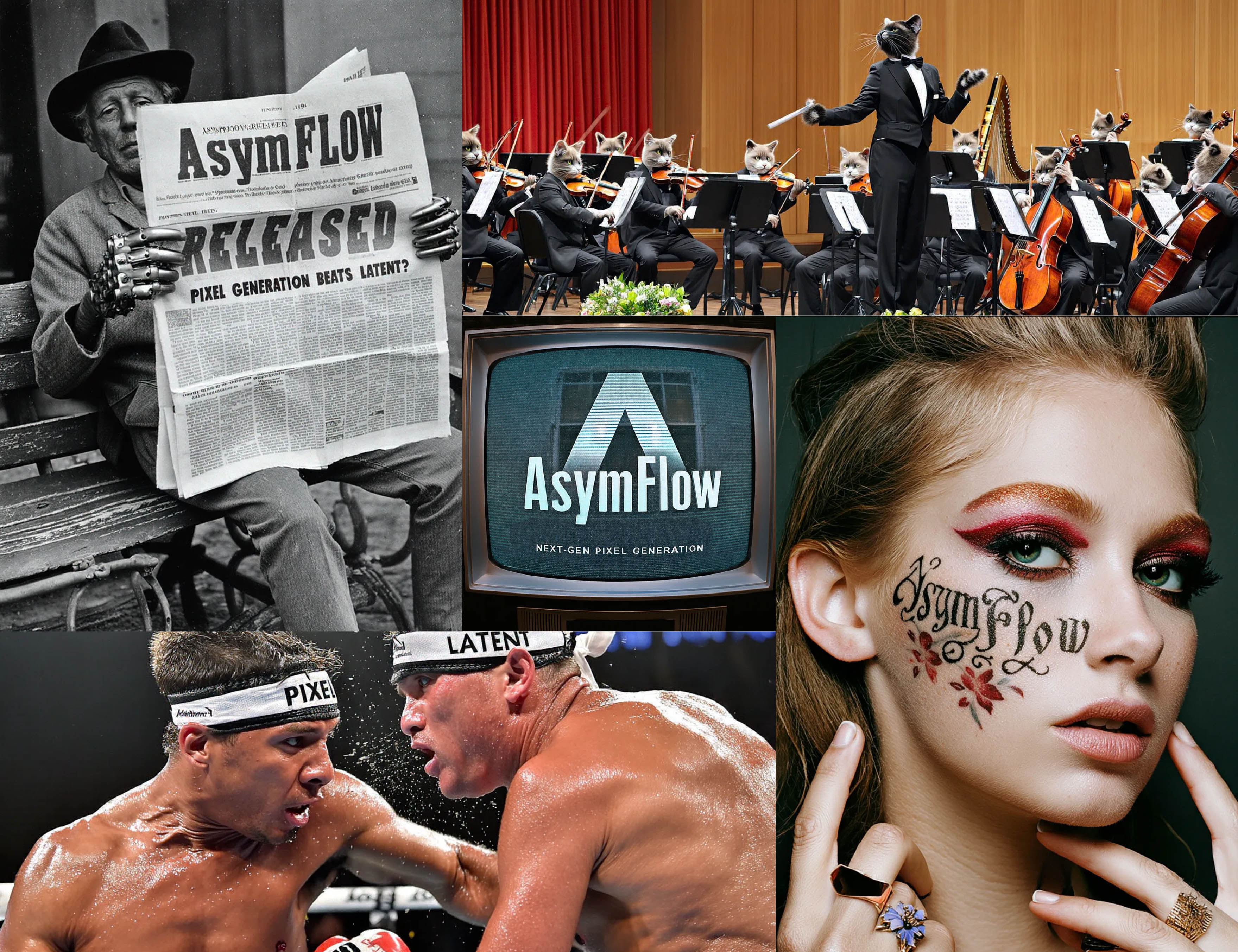
pi-Flow: Policy-Based Few-Step Generation via Imitation Distillation [README]
In ICLR 2026
[Hansheng Chen](https://lakonik.github.io/)1, [Kai Zhang](https://kai-46.github.io/website/)2, [Hao Tan](https://research.adobe.com/person/hao-tan/)2, [Leonidas Guibas](https://geometry.stanford.edu/?member=guibas)1, [Gordon Wetzstein](http://web.stanford.edu/~gordonwz/)1, [Sai Bi](https://sai-bi.github.io/)2
1Stanford University, 2Adobe Research
[arXiv](https://arxiv.org/abs/2510.14974) | [ComfyUI](https://github.com/Lakonik/ComfyUI-piFlow) | [pi-Qwen Demo🤗](https://huggingface.co/spaces/Lakonik/pi-Qwen) | [pi-FLUX Demo🤗](https://huggingface.co/spaces/Lakonik/pi-FLUX.1) | [pi-FLUX.2 Demo🤗](https://huggingface.co/spaces/Lakonik/pi-FLUX.2)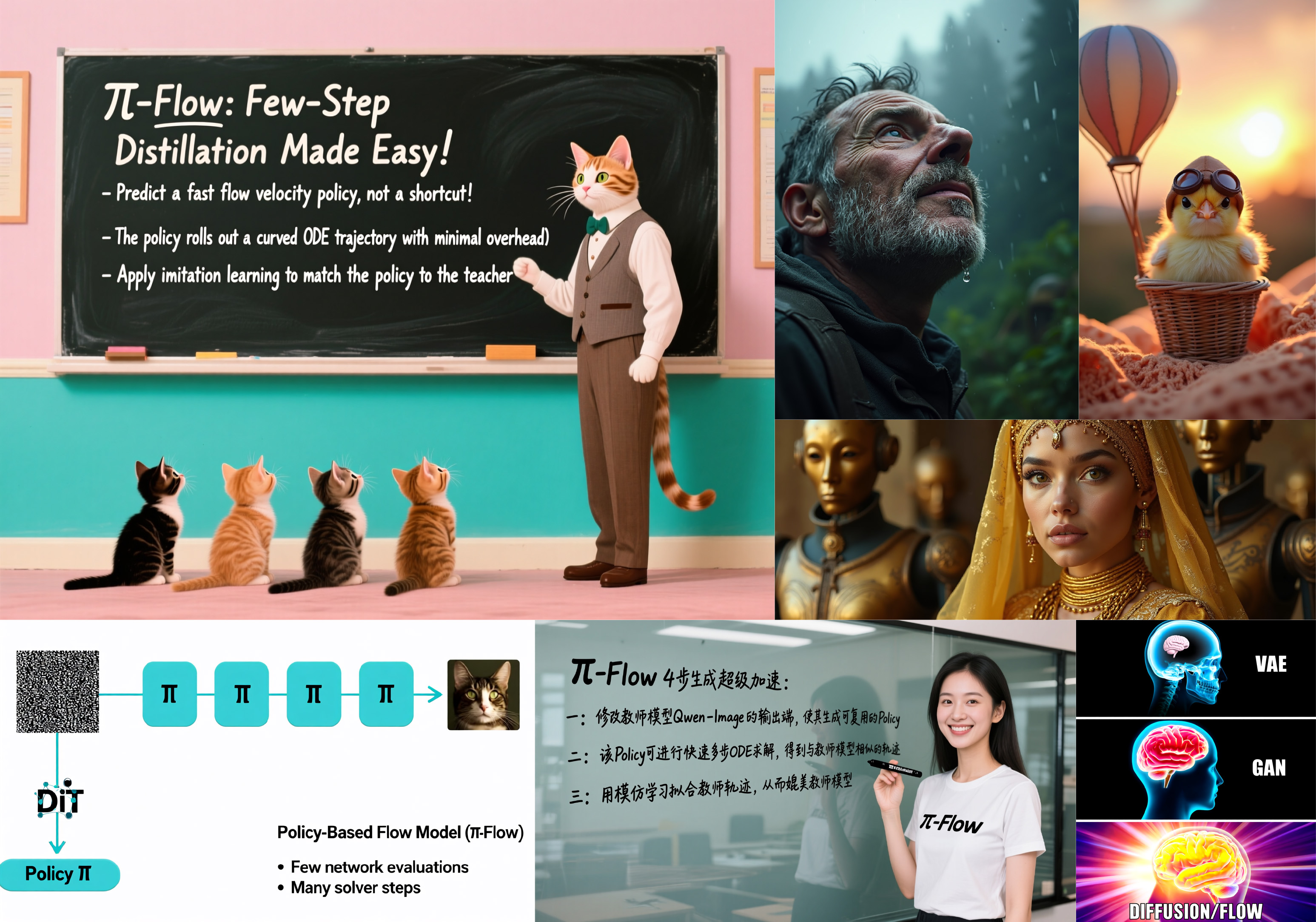
Gaussian Mixture Flow Matching Models [README]
In ICML 2025
[Hansheng Chen](https://lakonik.github.io/)1, [Kai Zhang](https://kai-46.github.io/website/)2, [Hao Tan](https://research.adobe.com/person/hao-tan/)2, [Zexiang Xu](https://zexiangxu.github.io/)3, [Fujun Luan](https://research.adobe.com/person/fujun/)2, [Leonidas Guibas](https://geometry.stanford.edu/?member=guibas)1, [Gordon Wetzstein](http://web.stanford.edu/~gordonwz/)1, [Sai Bi](https://sai-bi.github.io/)2
1Stanford University, 2Adobe Research, 3Hillbot
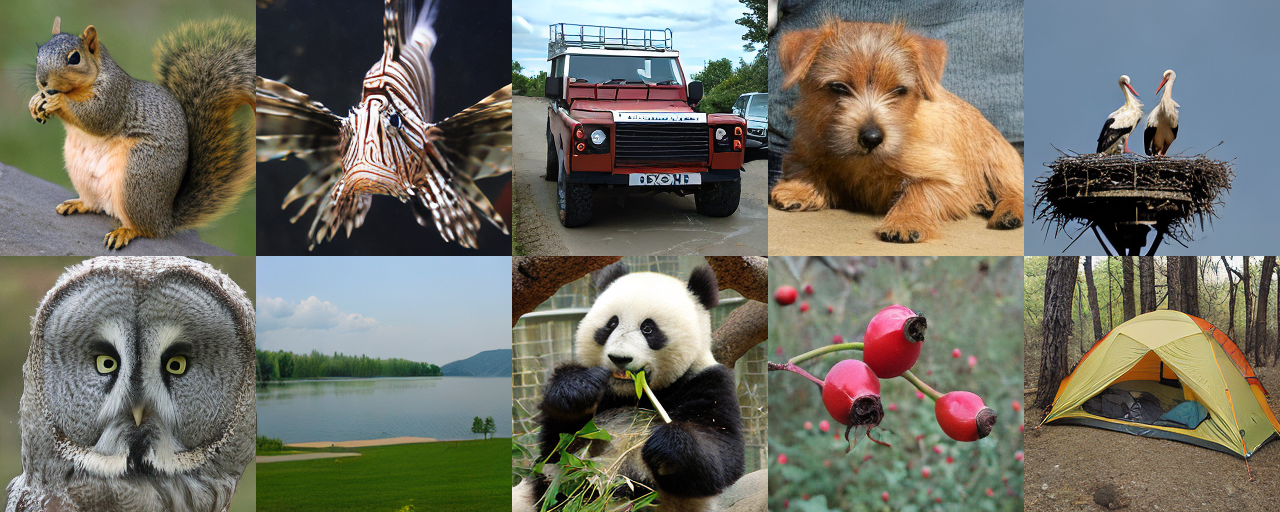
[arXiv](https://arxiv.org/abs/2504.05304)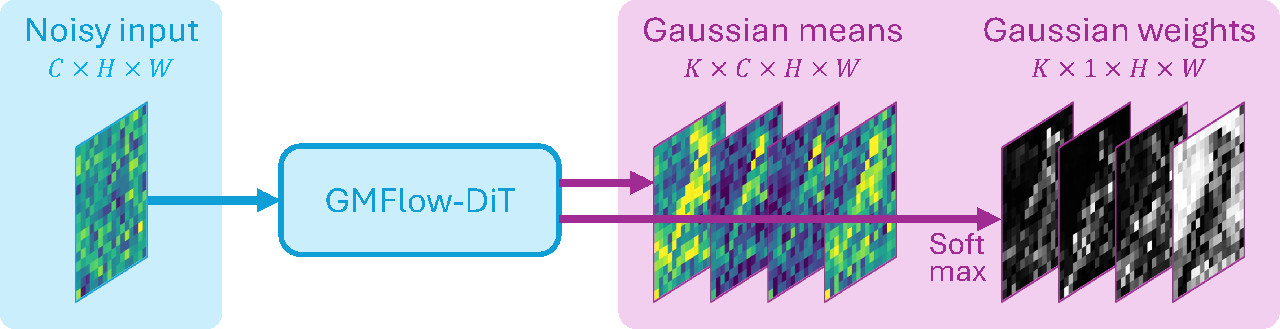
🔥News
[May 20, 2026] AsymFlow is now supported in our ComfyUI extension.
[May 14, 2026] AsymFlow is released.
[Dec 12, 2025] pi-FLUX.2 is now available for 4-step image generation and editing. Check out the pi-FLUX.2 Demo🤗. Please re-install the latest version of LakonLab (this repository) to use pi-FLUX.2.
[Nov 7, 2025] ComfyUI-piFlow is now available. Supports 4-step sampling of Qwen-Image and Flux.1 dev using 8-bit models on a single consumer-grade GPU, powered by ComfyUI.
Installation
The code has been tested in the following environment:
- Linux (tested on Ubuntu 20 and above)
- PyTorch 2.6+
With the above prerequisites, run pip install -e . --no-build-isolation from the repository root to install the LakonLab codebase and its dependencies.
An example of installation commands is shown below:
# Move to this repository (the folder with setup.py) after cloning
cd <PATH_TO_YOUR_LOCAL_REPO>

# Create uv environment
uv venv --python 3.10
source .venv/bin/activate

# Install Pytorch. Goto https://pytorch.org/get-started/previous-versions/ to select the appropriate version
uv pip install torch==2.10.0 torchvision==0.25.0 --index-url https://download.pytorch.org/whl/cu128

# Install LakonLab in editable mode
uv pip install -e . --no-build-isolation
Additional notes:
To access FLUX models, please accept the FLUX.2 klein Base 9B conditions and FLUX.1 dev conditions, and then run hf auth login to login with your HuggingFace account.
Codebase

LakonLab is a high-performance codebase for experimenting with large diffusion models. Key features of LakonLab include:
Performance optimizations: Seamless switching between DDP, FSDP, and FSDP2, all supporting gradient accumulation and mixed precision.
Weight tying: For LoRA fine-tuning, the base weights of the teacher, student, and EMA models are tied, sharing the same underlying memory. This is compatible with DDP and FSDP.
Advanced flow solvers:
- FlowSDEScheduler: Generic flow SDE solver with an adjustable diffusion coefficient.
h=0corresponds to a flow ODE;h=1corresponds to a standard flow SDE;h='inf'corresponds to the re-noising sampler in the original consistency models. Powers the GM-SDE solver in GMFlow. - FlowMapSDEScheduler: Generic flow SDE solver for few-step flow map models, similar to above.
- FlowSDEScheduler: Generic flow SDE solver with an adjustable diffusion coefficient.
Storage backends: Most I/O operations (e.g., dataloaders, checkpoint I/O) support both local filesystems and AWS S3. In addition, model checkpoints can be loaded from HuggingFace (link format
huggingface://<HF_REPO_NAME>/<PATH_TO_MODEL>) and HTTP/HTTPS URLs directly.Streamlined training and evaluation: Supports online evaluation using common metrics, including FID, KID, IS, Precision, Recall, CLIP similarity, VQAScore, HPSv2, and HPSv3. Supports exporting results to offline evaluators, including HPSv3 Benchmark, DPG-Bench and GenEval.
3rd-party model inference reproduction:
ImageNet 256x256 models with ADM evaluation:
Model FID (reproduced) FID (official) SiT-XL/2 2.05 2.06 JiT-H/16 1.90 - DiT-XL RAE (unguided) 1.50 1.51 REPA-XL/2 1.38 1.42 REPA-E-XL VAVAE 1.12 1.12 Note:
We use BF16 inference for all models except RAE.
Original JiT paper uses its own evaluation protocol that differs from ADM evaluation.Text-to-image models:
See examples in configs/misc and lakonlab/models/architectures/diffusers.
LakonLab uses the configuration system and code structure from MMCV.
Citation
@article{asymflow,
  title={Asymmetric Flow Models},
  author={Hansheng Chen and Jan Ackermann and Minseo Kim and Gordon Wetzstein and Leonidas Guibas},
  url={https://arxiv.org/abs/2605.12964},
  journal={arXiv preprint arXiv:2605.12964},
  year={2026},
}

@article{piflow,
  title={pi-Flow: Policy-Based Few-Step Generation via Imitation Distillation},
  author={Hansheng Chen and Kai Zhang and Hao Tan and Leonidas Guibas and Gordon Wetzstein and Sai Bi},
  url={https://arxiv.org/abs/2510.14974},
  journal={arXiv preprint arXiv:2510.14974},
  year={2025},
}

@article{gmflow,
  title={Gaussian Mixture Flow Matching Models},
  author={Hansheng Chen and Kai Zhang and Hao Tan and Zexiang Xu and Fujun Luan and Leonidas Guibas and Gordon Wetzstein and Sai Bi},
  url={https://arxiv.org/abs/2504.05304},
  journal={arXiv preprint arXiv:2504.05304},
  year={2025},
}
Explore related projects
affaan-m/ECC
The agent harness performance optimization system. Skills, instincts, memory, security, and research-first development for Claude Code, Codex, Opencode, Cursor and beyond.
300,253 starsNousResearch/hermes-agent
The agent that grows with you
262,082 starsmultica-ai/andrej-karpathy-skills
A single CLAUDE.md file to improve Claude Code behavior, derived from Andrej Karpathy's observations on LLM coding pitfalls.
231,373 starsfirecrawl/firecrawl
Supercharge your AI agents with data from the web and beyond. Building the library for superintelligence. 🔥
199,847 stars