
Internet-Architecture-and-Security/PacketScope
Internet-Architecture-and-Security/PacketScope has 1,457 GitHub stars and 61 forks. GitHot measured 0 stars in 24 hours. Last checked 2026-11-08 05:23 UTC. Last push 2026-09-04.
🎯 A general-purpose protocol stack analysis and debugging tool based on eBPF 🧰
What you can do
- 🧠 Intelligent Engine: Combines eBPF with LLMs for low-level network behavior observation and intelligent security defense
- 📊 Multidimensional Analysis: Real-time tracking of network paths, statistics on latency, packet loss, interaction frequency
- 🌐 Global Network Visualization: Maps global paths and latency, presented on a topology graph
- 🔐 Protocol Stack Defense: Detects and intercepts low-level abnormal traffic, covering the blind spots of traditional WAF/IDS
Measured star growth
- in 24h
- 0
- in 7 days
- Update delayed
- in 15 days
- Update delayed
- in 1 month
- Update delayed
Net star changes over overlapping periods, not daily totals. Missing measurements are left blank. Stars measure attention, not software quality.
README.md
Original
中文 · English


PacketScope: "Smart Armor" for Server-Side Defense

What's New: Analyzer module fully rewritten in Go + cilium/ebpf, replacing the original Python + BCC implementation. Lightweight redesign removes BCC runtime dependency, uses CO-RE (bpf2go) for pre-compiled eBPF, and adds MCP skill integration for each module.
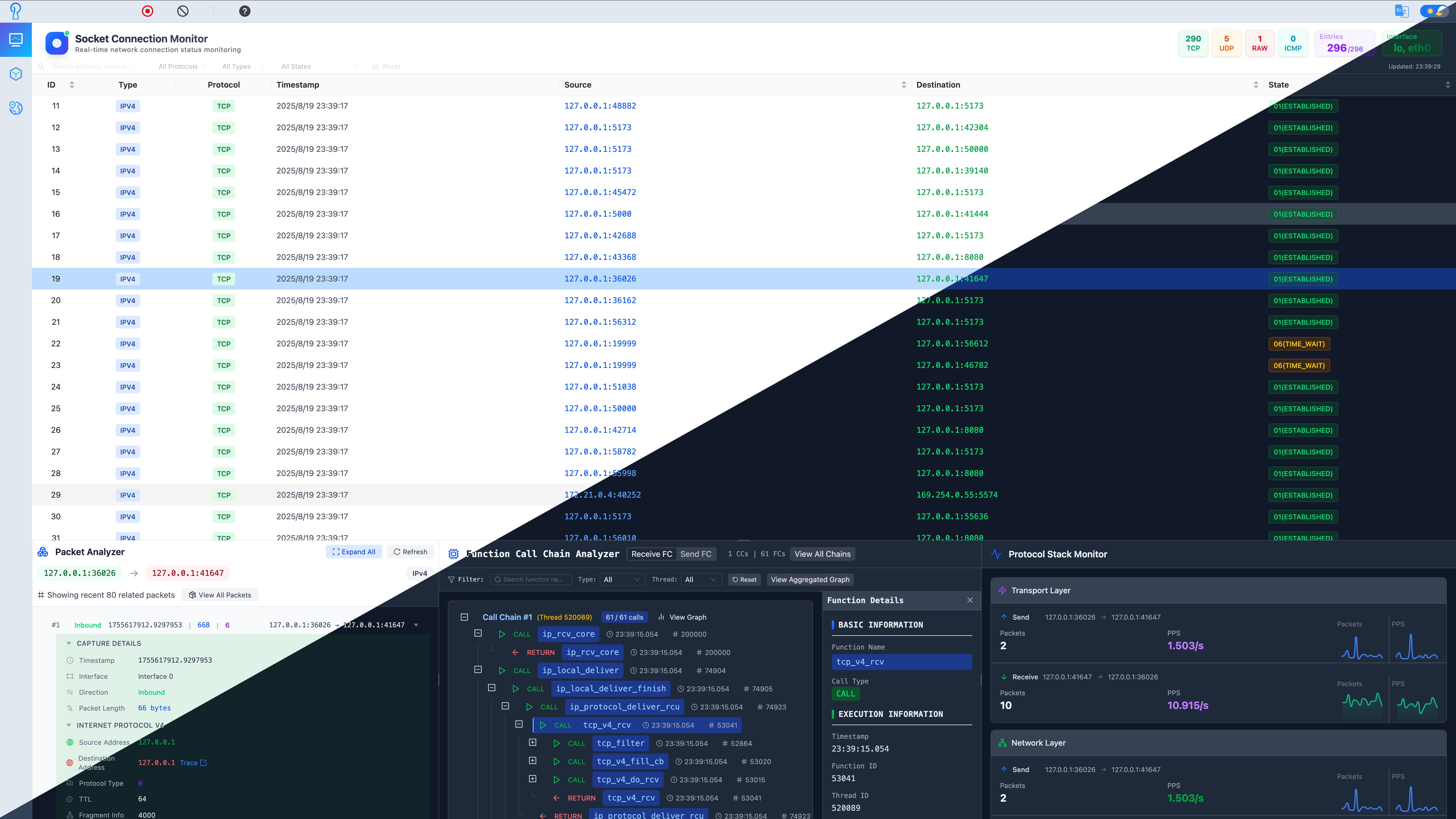
PacketScope is a general-purpose protocol stack analysis and debugging tool based on eBPF. It integrates performance optimization, anomaly diagnosis, and security defense. It aims to implement fine-grained tracing and intelligent analysis of network packets at the protocol stack level on the server side. By solving three major pain points—difficult diagnosis of performance bottlenecks, unclear transmission paths, and hard-to-detect low-level attacks—PacketScope provides visualized, intelligent endpoint-side security analysis and defense capabilities.
Background
With the proliferation of social platforms, online banking, large-scale AI models, logistics, and travel services, open servers have become key execution environments. These must balance performance and security under the condition of being openly accessible. Traditional WAFs and IDS tools have blind spots in protocol stack-level defense, which PacketScope addresses:
🚨 Three Core Pain Points:
- Unclear packet paths through the protocol stack make bottlenecks and faults hard to diagnose
- Lack of fine-grained cross-domain transmission data makes routing risks invisible
- Low-level protocol stack attacks are stealthy and difficult to detect with traditional tools
Through protocol tracing, path visualization, and intelligent analysis, PacketScope builds "smart armor" for the server.
🚀 Core Capabilities
- 🧠 Intelligent Engine: Combines eBPF with LLMs for low-level network behavior observation and intelligent security defense
- 📊 Multidimensional Analysis: Real-time tracking of network paths, statistics on latency, packet loss, interaction frequency
- 🌐 Global Network Visualization: Maps global paths and latency, presented on a topology graph
- 🔐 Protocol Stack Defense: Detects and intercepts low-level abnormal traffic, covering the blind spots of traditional WAF/IDS
- 🤖 MCP Skill Integration: Each module provides an MCP server for LLM agent integration (Trae, Cline, etc.)
- 🖥️ User-Friendly Interface: GUI designed for easy use by security engineers and operators
⚡ Getting Started
Prerequisites
- Docker: Version 20.10 or higher
- Docker Compose: Version 2.0 or higher
docker --version
docker compose version
One-Click Deployment
International users:
git clone https://github.com/Internet-Architecture-and-Security/PacketScope.git
cd PacketScope
sudo bash starter.sh
China mainland VPS users (with mirror acceleration):
git clone https://github.com/Internet-Architecture-and-Security/PacketScope.git
cd PacketScope
bash install-cn.sh
The script will automatically install Docker (if needed), configure mirror acceleration, build all containers, and start services. Only port 80 needs to be open in your firewall/security group.
Access the Application
Open your browser: http://localhost
All services are served through a single nginx reverse proxy on port 80 — no need to open multiple ports.
Service Endpoints
Backend APIs are proxied through nginx at the following path prefixes:
| Prefix | Backend | Description |
|---|---|---|
/ |
nginx (frontend) | React SPA dashboard |
/api/guarder/ |
Guarder | Security & filtering API |
/api/tracer/ |
Tracer | Route tracing API |
/api/monitor/ |
Analyzer-Monitor | Packet capture & function call API |
/api/analyzer/ |
Analyzer-Calculator | Cross-layer metrics (REST + WebSocket) |
Managing Services
sudo docker compose -f docker-compose.yml ps              # View status
sudo docker compose -f docker-compose.yml logs -f         # View logs
sudo docker compose -f docker-compose.yml down            # Stop all
sudo docker compose -f docker-compose.yml restart <name>  # Restart a service
📁 Project Structure
PacketScope/
├── modules/                    # Backend service modules
│   ├── Analyzer/              # Protocol stack analysis (Go)
│   │   ├── Monitor/           # Packet capture & function call monitor (Go + eBPF)
│   │   ├── Calculator/        # Cross-layer metrics calculator (Go + eBPF)
│   │   ├── README.md          # English docs
│   │   └── README-zh.md       # Chinese docs
│   ├── Guarder/               # Security defense (Go + eBPF/XDP)
│   └── Tracer/                # Route tracing & risk analysis (Python + MCP)
├── nginx/                      # Nginx reverse proxy configuration
├── skills/                     # MCP skill packages for LLM agents
│   ├── monitor/               # Monitor MCP server & client
│   ├── tracer/                # Tracer MCP server & client
│   └── guarder/               # Guarder MCP client
├── src/                        # Frontend source (React + TypeScript)
├── docker-compose.yml          # Docker Compose (6 services)
├── Dockerfile                  # Multi-stage: node build → nginx serve
├── starter.sh                  # One-click deployment script
├── install-cn.sh               # China-friendly deployment (with mirrors)
├── README.md                   # This file
└── README-zh_CN.md             # Chinese docs
✨ Functional Modules
Analyzer — Protocol Stack Analysis
The Analyzer module has been fully rewritten in Go + cilium/ebpf, replacing the original Python + BCC implementation. This lightweight redesign removes BCC runtime dependency, uses CO-RE (bpf2go) for pre-compiled eBPF, and significantly improves deployment portability.
Monitor captures packets and tracks kernel function calls:
| Component | Technology | Port | Description |
|---|---|---|---|
| kbatch | eBPF fentry/kprobe | - | Kernel function call monitoring |
| tcxprober | eBPF TC | - | Network packet capture (ingress/egress) |
| server | Go HTTP | 8010 | RESTful API query service |
Calculator computes real-time cross-layer metrics:
| Metric | Description |
|---|---|
| PPS | Per-layer packet rate (link, network, transport) |
| LAT | Cross-layer latency (link↔network, network↔transport, link↔transport) |
| DROP | TCP packet loss rate |
Communication via WebSocket (port 8020), metrics pushed every second.
See Analyzer/README.md for details.
Tracer — Route Tracing & Risk Analysis
Maps network paths from the host to any global IP with geographic/ASN enrichment, anomaly detection, and Spamhaus-based risk scoring.
| Feature | Description |
|---|---|
| traceroute | Real-time with ICMP/TCP, per-hop streaming |
| GeoIP | City and ASN enrichment via MaxMind GeoLite2 |
| Anomaly detection | Historical path comparison, path deviation alerts |
| Risk scoring | Malicious IP detection against Spamhaus DROP/EDROP |
HTTP API on port 8000, MCP server for LLM agent integration.
See Tracer/README.md for details.
Guarder — Security Defense
eBPF/XDP-based network security module with AI-powered filter generation.
| Feature | Description |
|---|---|
| Connection tracking | TCP/UDP/ICMP monitoring via eBPF/XDP |
| Packet filtering | Kernel-space rules (IP, port, protocol, TCP flags, ICMP type) |
| AI filter generation | LLM-powered analysis and automatic rule creation |
| PCAP analysis | Upload PCAP files for AI-driven security inspection |
HTTP API on port 8080, supports OpenAI-compatible and Anthropic-compatible endpoints.
See Guarder/README-zh.md for details.
🤖 MCP Skills
Each backend module provides an MCP (Model Context Protocol) server, enabling LLM agents to directly invoke module capabilities:
| Skill | MCP Tools | Transport |
|---|---|---|
| monitor | get_recent_packets, query_packets, get_recent_map, get_func_table, query_func_send, query_func_recv, get_socket_list, health_check |
SSE / stdio |
| tracer | trace_target, analyze_target, get_history, compare_routes, health_check, server_capabilities |
SSE / stdio |
| guarder | get_connections, get_stats, create_filter, ai_analyze, ai_generate, list_filters |
HTTP client |
Quick Start with MCP
{
  "mcpServers": {
    "packetscope-monitor": {
      "transport": "sse",
      "url": "http://localhost:8012/sse"
    },
    "packetscope-tracer": {
      "transport": "sse",
      "url": "http://localhost:8013/sse"
    }
  }
}
See skills/ for each skill's configuration and usage.
🏗️ Technology Stack
| Module | Language | eBPF Loading | Communication | Data Storage |
|---|---|---|---|---|
| nginx | — | — | HTTP (80, unified entry) | — |
| Analyzer-Monitor | Go | cilium/ebpf (bpf2go, CO-RE) | HTTP REST (8010, internal) | PostgreSQL |
| Analyzer-Calculator | Go | cilium/ebpf (bpf2go, CO-RE) | WebSocket (8020, internal) | BPF map aggregation |
| Guarder | Go | cilium/ebpf + XDP | HTTP REST (8080, internal) | In-kernel maps |
| Tracer | Python | nexttrace (external) | HTTP REST (8000, internal) | File-based cache |
| PostgreSQL | — | — | 5432 (internal) | Persistent volumes |
Deployment highlights:
- Single port: nginx reverse proxy on port 80 — all APIs proxied via path prefixes
- Multi-stage builds: Docker images use alpine runtime (~7 MB) — total image footprint ~1 GB (vs ~13 GB before)
- Separated PostgreSQL: dedicated
postgres:16-alpinecontainer instead of embedded in Monitor
🧰 Use Cases
- Network Protocol Stack Performance Optimization: Identify bottlenecks and improve transmission efficiency
- Threat Detection and Security Defense: Detect and block potential attacks such as DDoS and ARP spoofing
- Fault Diagnosis: Diagnose issues caused by latency, packet loss, or abnormal cross-layer behavior
- Topology Analysis: Analyze path latency and routing performance in cross-regional deployments
- Industrial Internet Security: Monitor industrial control systems in real time to ensure safety and integrity
❤️ Contributing
We welcome issues and pull requests! If you find bugs or have suggestions, open an issue or PR. Please refer to CONTRIBUTING for contribution guidelines.
License
This project is licensed under the MIT License. See LICENSE for details.
Explore related projects
codecrafters-io/build-your-own-x
Master programming by recreating your favorite technologies from scratch.
561,067 starspublic-apis/public-apis
A collective list of free APIs
497,309 starsmorluto/rea
Reverse engineer anything with agents, from app behavior down to native binaries.
443,567 starsopenclaw/openclaw
The AI that really does things. Any OS. Any Platform. The lobster way. 🦞
394,215 stars