
IceWhaleTech/ToolFS
About
🗂 ToolFS: A FUSE virtual filesystem for AI Agents, integrating memory, RAG & local data access with flexible MCP/tool chaining and a scalable plugin system
AIWhat you can do
- Unified Namespace: A single entry point (/toolfs) for files, session-bounded memory, vector-based RAG queries, and autonomous skills.
- Unified Skill API: Register and execute WASM-based or native skills with context-aware documentation that helps agents understand when and how to use them.
- Session-Bounded Security: Fine-grained path-based permissions and isolated environments for multi-tenant agent deployments.
- Atomic Snapshots: Create instant, copy-on-write snapshots of the entire agent environment for rollback, debugging, and perfect reproducibility.
Measured star growth
- in 24h
- 0
- in 7 days
- Collecting history
- in 15 days
- Collecting history
- in 1 month
- Collecting history
Net star changes over overlapping periods, not daily totals. Missing measurements are left blank. Stars measure attention, not software quality.
README.md
OriginalToolFS is a specialized virtual filesystem framework designed for Large Language Model (LLM) agents. It unifies disparate interfaces—files, persistent memory, semantic search (RAG), and code execution (WASM skills)—into a single, POSIX-compliant /toolfs namespace.
By mapping complex state and capabilities to filesystem operations, ToolFS leverages the LLM's inherent understanding of path structures and file manipulation, significantly reducing the complexity of tool integration.
💡 Why ToolFS?
Current AI agent architectures often suffer from "tool bloat," where managing dozens of disparate APIs becomes a bottleneck. ToolFS solves this by providing:
- Natural Abstraction: LLMs inherently understand files and directories. Mapping tools to paths simplifies intent recognition.
- Unified State: Session history, knowledge bases, and local files share a single lifecycle.
- Agentic Autonomy: Context-aware skill documentation allows agents to discover and chain tools without hardcoded logic.
🎯 Key Capabilities
- Unified Namespace: A single entry point (
/toolfs) for files, session-bounded memory, vector-based RAG queries, and autonomous skills. - Unified Skill API: Register and execute WASM-based or native skills with context-aware documentation that helps agents understand when and how to use them.
- Session-Bounded Security: Fine-grained path-based permissions and isolated environments for multi-tenant agent deployments.
- Atomic Snapshots: Create instant, copy-on-write snapshots of the entire agent environment for rollback, debugging, and perfect reproducibility.
- Audit-Ready: Transparent JSON-based audit logging for every operation, ensuring compliance and observability.
🛠 Architecture
ToolFS acts as an abstraction layer between the Agent and its environment:
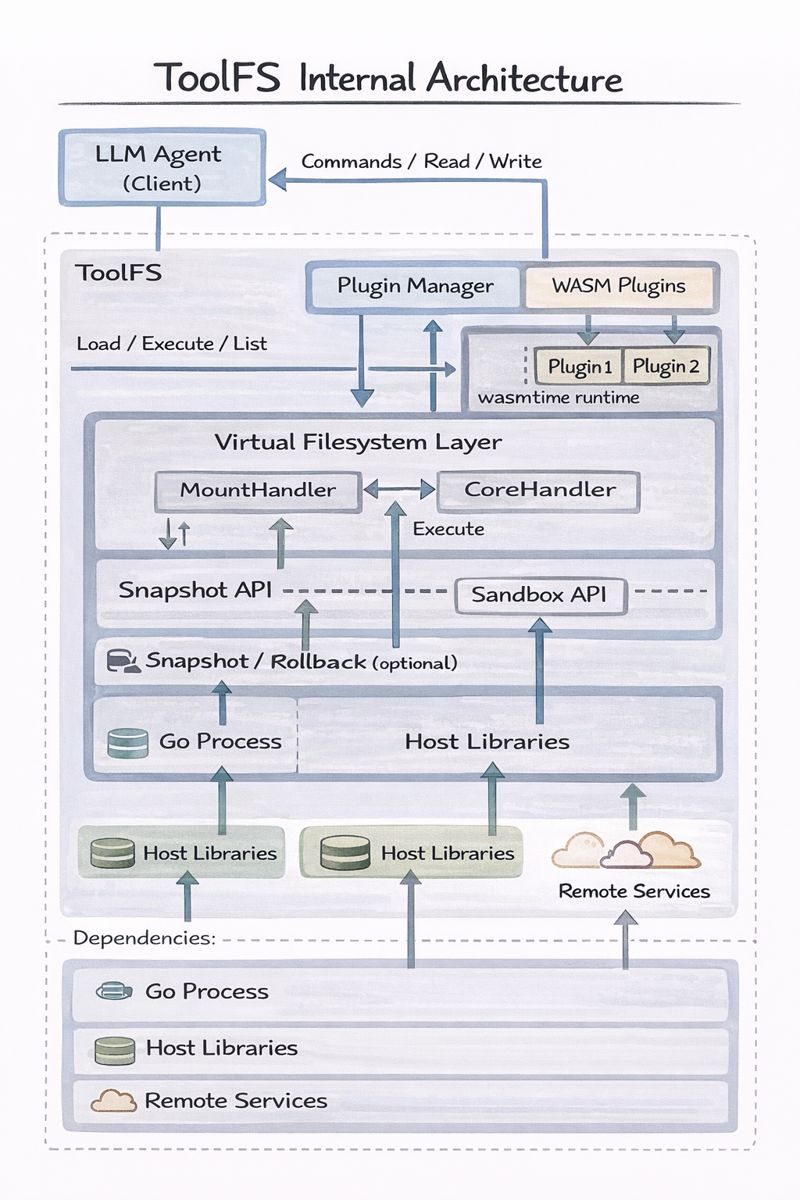
ToolFS Internal Architecture
[ Agent ] <──> [ /toolfs Virtual Path ] <──> [ ToolFS Core ]
                                                     │
               ┌──────────────┬──────────────┬───────┴──────┬──────────────┐
               ▼              ▼              ▼              ▼              ▼
         [ Local FS ]   [ Memory KV ]   [ RAG Store ]   [ WASM Skills ] [ Snapshots ]
🚀 Quick Start
1. Installation
go get github.com/IceWhaleTech/toolfs
2. Integration Example
Combine memory, RAG, and file access in a few lines:
package main

import (
    "github.com/IceWhaleTech/toolfs"
)

func main() {
    // Initialize with a root mount point
    fs := toolfs.NewToolFS("/toolfs")

    // Isolated session with path-level permissions
    session, _ := fs.NewSession("agent-007", []string{"/toolfs/data", "/toolfs/memory", "/toolfs/rag"})

    // Persistent Context (Memory)
    fs.WriteFileWithSession("/toolfs/memory/last_query", []byte("How to build an agent?"), session)

    // Semantic Retrieval (RAG)
    // Simply read a virtual path!
    results, _ := fs.ReadFileWithSession("/toolfs/rag/query?text=agent+design&top_k=3", session)

    // Skill Execution
    // Chains multiple operations: search memory -> execute skill -> save result
    ops := []toolfs.Operation{
        {Type: "search_memory", Query: "preferences"},
        {Type: "execute_code_skill", SkillPath: "/toolfs/skills/processor"},
    }
    fs.ChainOperations(ops, session)
}
⚡ Performance
Optimized for high-frequency agent loops. Tested on Apple M4 Pro.
| Operation | Throughput | Latency | Overhead |
|---|---|---|---|
| Memory Access | 1,200,000+ ops/s | <1 μs | 0 allocations |
| Path Resolution | 35,000,000+ ops/s | <30 ns | Cache-driven |
| RAG Search | 170,000+ ops/s | ~6 μs | Highly efficient |
| File I/O (Small) | 110,000+ ops/s | ~9 μs | Local-first |
🧩 ToolFS vs. AgentFS
While both focus on agent state, they serve different primary roles:
| Feature | ToolFS | AgentFS |
|---|---|---|
| Primary Goal | Unified Tool/Storage Abstraction | Structured State & Audit Trails |
| Storage Engine | Virtual Layer (File, Memory, RAG) | SQLite-backed |
| Tool Execution | Native & WASM Skills (Unified API) | Focus on CRUD of state |
| Audit Model | Per-path/Per-session logs | Transactional SQL logs |
Intersection: Both can be used together—AgentFS for deep structured memory, and ToolFS for providing a standard filesystem-like API to that memory alongside other tools.
🙏 Inspirations
ToolFS is inspired by the pattern of using filesystems as the primary interface for autonomous agents:
- How to Build Agents with Filesystems and Bash: Demonstrates 75% cost reduction by replacing custom tools with standard FS patterns.
- FUSE is All You Need: Exploring virtual filesystems for agent tool access.
- We Removed 80% of our Agents' Tools: Case study on radical simplification via filesystem-based tool design.
📚 Documentation
- Unified Skill System: Deep dive into the "Skill is Skill" architecture.
- RAG Implementation Guide: Building custom semantic search skills.
- Go API Reference: Detailed package documentation.
Built for the future of Autonomous Agents.
Explore related projects
Loading…