
HarshTomar1234/Tennis-Vision
HarshTomar1234/Tennis-Vision has 89 GitHub stars and 15 forks. GitHot measured 0 stars in 24 hours. Last checked 2026-11-15 12:41 UTC. Last push 2026-09-30.
Measured star growth
- in 24h
- 0
- in 7 days
- Collecting history
- in 15 days
- Collecting history
- in 1 month
- Collecting history
Net star changes over overlapping periods, not daily totals. Missing measurements are left blank. Stars measure attention, not software quality.
About
Tennis Detection and Visualization System An advanced computer vision system for tennis match analysis that tracks players and ball movement with high precision. The system uses YOLOv8 and custom-trained models to detect players and the ball, visualizing their movements on both the actual court and a simplified mini-court representation.
Machine LearningREADME.md
OriginalTennis-Vision


An evidence-driven tennis computer-vision pipeline from a single broadcast camera.
Players. Ball. Court geometry. Events. Rally reasoning. 3-D reconstruction.
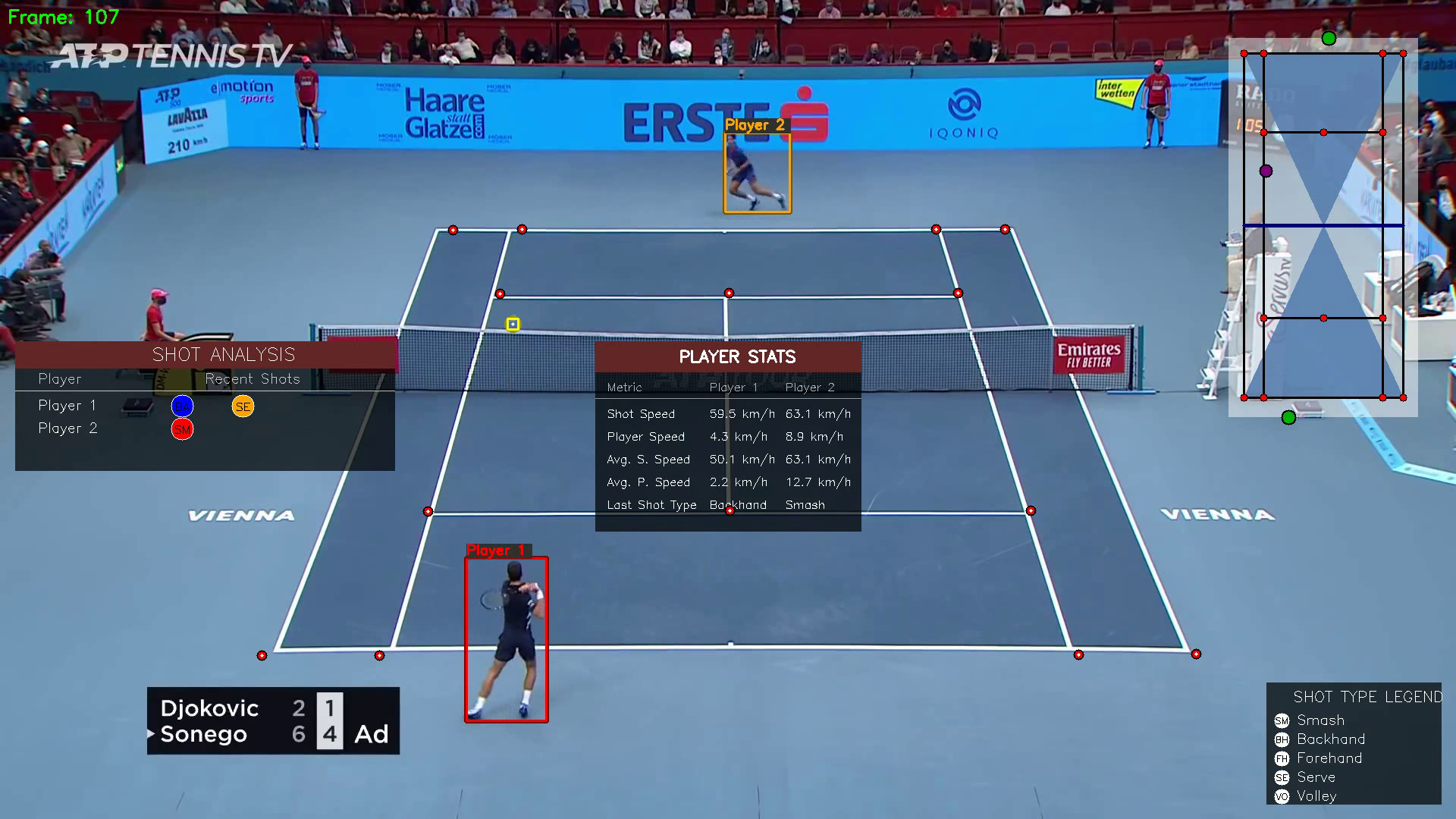
Every number this project reports carries the evidence for it, or it is not reported.
The system is built around a simple rule: a plausible-looking measurement from an unsupported input is worse than an explicit refusal. Court evidence gates real-world geometry, event evidence gates shot measurements, and every output carries the reason it was accepted, downgraded, withheld or rejected.
Three findings that shaped the system
These are experimental findings, not product KPIs. Each one changed what the pipeline is willing to claim.
| Finding | What the measurement says |
|---|---|
| Ball 88.6% detection rate 42.5% of visible-ball frames within 5 px |
A position being output is not the same as accurate localization. Both numbers are needed to understand the detector. |
| Pose 85.5% MediaPipe 66.4% SAM 3D Body |
More landmark coverage did not produce better forehand/backhand task performance. Coverage and task accuracy are separate measurements. |
| End to end 89.3% / 0.600 F1 86.4% / 0.824 F1 |
The best offline hit/bounce classifier was the worse product model. The shipped feature set was chosen on behaviour with real detections, not benchmark accuracy alone. |
Every published figure names the script and dataset behind it. The full tables, caveats and rejected approaches remain below.
From broadcast pixels to a 3-D flight
The same pipeline that detects the court, players and ball also reconstructs floor-anchored flight segments between detected events. The viewer exposes the reconstructed geometry together with the evidence behind each segment.
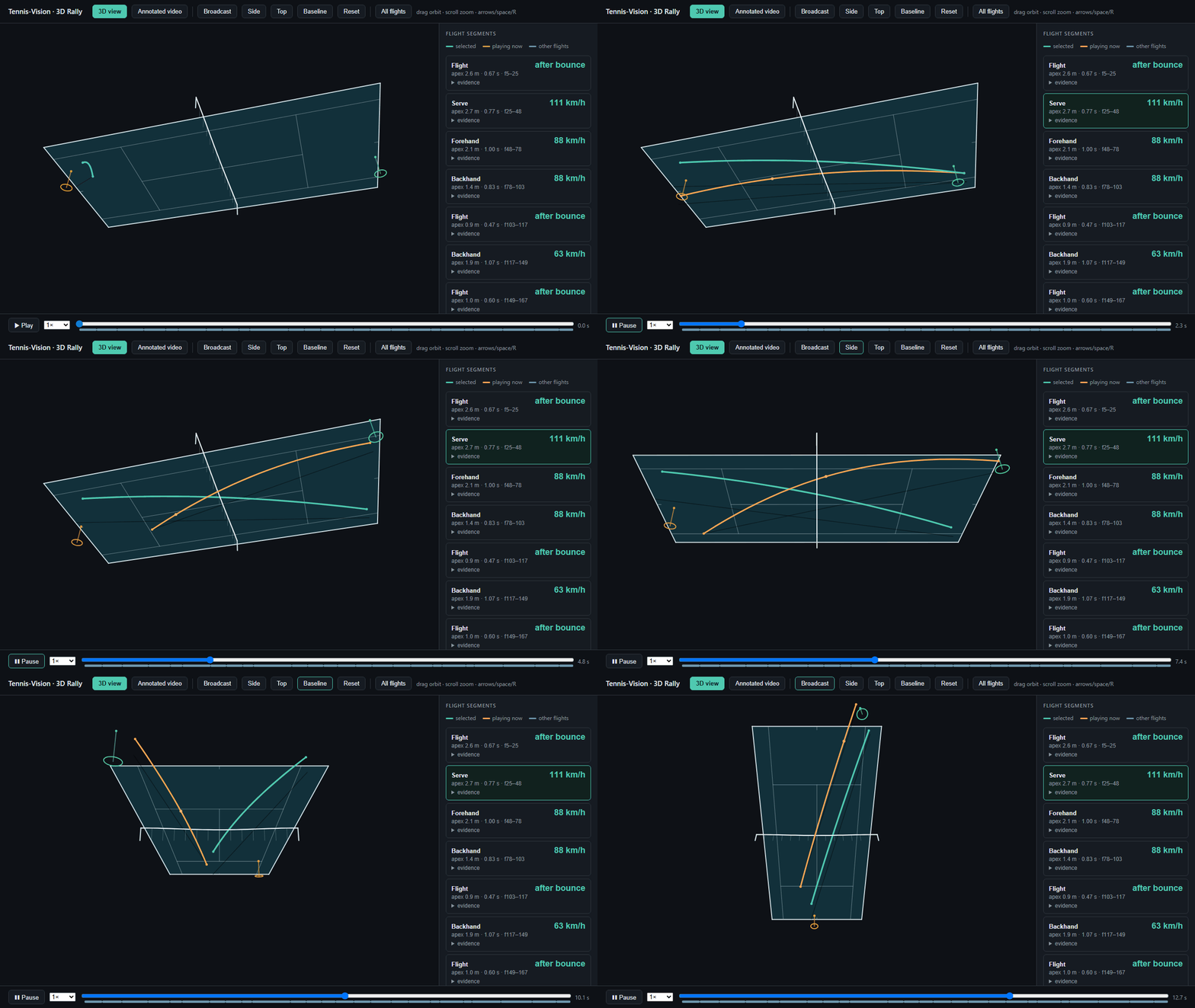
Physics-constrained 3-D reconstruction from broadcast video. Preview captured from the generated viewer; rally speeds are not ground-truth validated.
Open the self-contained interactive 3-D viewer · View a static viewer screenshot
The HTML viewer runs without a server, external assets or a CDN. It supports orbiting the scene, top/side/baseline/broadcast views, timeline playback, segment selection, evidence inspection and an annotated-video mode when the local demo video is present. The public artifact contains the 3-D scene and evidence; the source broadcast video is not bundled.
The pipeline as a system
flowchart LR
    V[Broadcast video]

    subgraph D[DETECTION]
      F[FPS support]
      P[Players + ball]
      C[Court keypoints]
      E[Event candidates]
    end

    subgraph G[EVIDENCE / REFUSAL]
      CV[Court validity gate]
      PS[Player selection gate]
      R[Rally decoding]
      PV[Physics validation]
    end

    subgraph M[MEASUREMENT]
      H[Homography]
      S[Serve and event measurements]
      T[3-D flight reconstruction]
      O[Reports + interactive viewer]
    end

    V --> F --> P
    V --> C --> CV
    P --> PS
    P --> E --> R
    CV --> H
    PS --> H
    H --> S --> PV --> T --> O
    R --> S
When the evidence is insufficient
- Court fit fails: real-world measurements are withheld because the homography is not trusted.
- Serve landing is not observed: serve speed is refused instead of extrapolated from an unknown endpoint.
- The clip contains a camera cut or unsupported view: the clip is refused with a reason and usable-frame count.
The system is designed to fail explicitly rather than turn unsupported inputs into plausible-looking numbers.
Quickstart
git clone https://github.com/HarshTomar1234/Tennis-Vision.git
cd Tennis-Vision

Place a permitted tennis video at `input_videos/input_video_2.mp4` before running the analysis command.

python -m venv venv
source venv/bin/activate            # Windows: venv\Scripts\activate
pip install -e .

tennis-vision download-models       # about 140 MB
tennis-vision analyze input_videos/input_video_2.mp4 -o output/demo.avi
download-models prints one manual step. The TrackNet ball weights belong to their
original author and their licence is unstated, so they are fetched from that project
rather than rehosted here. Everything else downloads automatically.
Add --max-frames 60 for a fast check before committing to a full run.
Outputs land in output/: an annotated video, a per-frame stats CSV, a run summary JSON,
and an interactive 3-D viewer as a single self-contained HTML file with no external
dependencies.
Technical pipeline
Ball tracking. TrackNet, with the position taken from the largest connected heatmap response rather than the mean of all responding pixels. Ball positions map to the court through the floor homography only at floor level, meaning at a bounce or a racket contact. While the ball is airborne the floor homography does not apply to it, so those frames interpolate between floor-valid anchors instead of being projected as though the ball were on the ground.
Court geometry. ResNet-50 keypoint regression, 14 points, re-detected per frame so
camera pan and tilt are handled, then a real perspective homography via
cv2.findHomography.
Court validity gate. The keypoint model is a plain regression head with no way to say "this camera angle is outside my training distribution". On unfamiliar footage it returns a tidy quadrilateral that is simply not on the court, and every real-world measurement downstream is then computed from it and reported with full confidence. That failure is worse than a crash because the output looks plausible. The gate samples along every predicted line and asks whether those pixels are actually brighter than the surface a few pixels to either side. A predicted line lying on the crowd fails; one lying on paint passes.
Player tracking. YOLOv8x with ByteTrack, then a six-criteria selection aggregated across the whole clip. Frame-zero selection was the original approach and it failed on real footage: on one eval clip the true player is a track id that does not exist at frame zero.
Event detection. Three candidate generators feed a union, because each is blind to a different event shape. y-reversal and x-velocity are hit-shaped by construction, and a dedicated bounce generator covers what they miss. A trained trajectory classifier then splits contacts from bounces.
Serve detection and speed. A serve is the only shot that is simultaneously struck above the player's head and from the baseline or behind it. Both conditions must hold, each is independently measurable, and a rejection reports which one failed. Speed comes from the contact and the landing, both floor-valid, and is not reported at all when the landing is never observed inside the service box.
3-D reconstruction. Between two known contacts the ball follows a parabola whose curvature is gravity and whose endpoints are known heights, so there are no free parameters. Height is modelled from those anchors rather than measured from the image, because at broadcast camera angles raising the ball and pushing it further away move it in almost the same image direction. A free ballistic fit can match the picture to a pixel while being metres wrong in space.
Shot classification. Serve comes from physical evidence. Volley and Smash are tested against physical evidence and, when none is found, downgraded to "Groundstroke" rather than reported: across 9 clips and 81 shots that layer evidences 1 and rejects 20, so it is a validation filter and is described as one. Forehand and backhand come from a pose-based body-geometry test via MediaPipe, measured at 54% against ground truth and documented under Limitations as unreliable.
The pose test is body-relative: whether the hitting arm crosses the shoulder midline horizontally, which makes it independent of handedness, facing, and which side of the court the player is on. That is the right idea and it is not sufficient, because a volley is played with the body square to the net and the arm never crosses the midline at all.
Optional: SAM 3D Body pose backend
MediaPipe drops the racket arm on 44-58% of backhands (see Limitations). SAM 3D Body
predicts a whole-body mesh and infers occluded joints instead of dropping them. On the
exact frames MediaPipe could not complete, it returned keypoints on 6 of 6
(eval/sam3d_occluded_arm_test.py), and on a full backhand clip it completed 100% of
frames against MediaPipe's 88%.
It runs on contact frames only, roughly 15 per clip. At about 1.6s per frame a per-frame pass would take half an hour on a mid-range GPU; 30 inferences takes under a minute.
# 1. request access, then create a read token, then put HF_TOKEN in .env
python scripts/download_sam3d_body.py

# 2. the inference code is a separate repository
git clone https://github.com/facebookresearch/sam-3d-body.git
export SAM3D_BODY_CODE=/path/to/sam-3d-body

# 3. enable it
#    configs/config.yaml -> pipeline.use_sam3d_pose: true
Off by default. If it is switched on and the weights are absent the pipeline uses MediaPipe and says so, rather than falling through in silence: the two backends measure 85.5% and 66.4% balanced on identical clips, so a run that quietly used the other one is not the run that was asked for.
On licensing. The weights are under Meta's SAM License, not MIT. That licence grants free use, modification and derivative works, and requires anyone redistributing the materials to pass the same terms along. This project therefore does not bundle them: doing so would have an MIT licence make a promise about Meta's weights it has no standing to make. You fetch them under terms you accept directly, which is the same arrangement already used for the TrackNet weights.
Verified working on a GTX 1050 Ti (4.3 GB) in float32. Do not wrap inference in
torch.autocast: the MHR head is a TorchScript module and raises NotImplementedError
inside one. Casting the weights fails in both directions as well.
Deep evaluation
The sections below contain the complete measurement record, including negative results, unsupported inputs and the numbers that limit how the system should be used.
Measured results
Scripts marked (dataset) need a third-party dataset that is over 7 GB and not
redistributable. See datasets/README.md for sources. Everything else runs against what
ships in this repository plus the downloadable weights.
Ball localization
Against the original TrackNet dataset's own hand-labelled coordinates, 16 clips.
| Metric | Result | Script |
|---|---|---|
| Detection rate (a position was output, not an accuracy) | 88.6% | eval/ball_localization_accuracy.py (dataset) |
| Localization error vs ground truth | median 5.4px, 90th percentile 18.0px, at 360x640 | same |
| Located within 5px of the labelled centre | 46.8% of outputs, 42.5% of visible-ball frames | same |
Detection rate and accuracy are not the same measurement, and the gap here is large. The detector reliably finds roughly where the ball is and is not pixel-precise. That is adequate for trajectory shape, bounce timing and speed across a flight. It is marginal for exact landing coordinates.
It is worth being precise about what this does and does not cost. It bounds the accuracy of speeds, 3-D reconstruction and landing positions. It does not cost event recall: the funnel below shows every labelled contact has a detected ball near it, so nothing is missed for want of a detection.
Contact and bounce event detection
Two questions with very different answers. Both are published, because the gap between them is the honest cost of detection noise.
Given perfect ball positions, feeding the dataset's labelled coordinates straight into the candidate generators. This isolates the generators and is an upper bound, not shipped behaviour. 91 clips.
| Configuration | Recall | Precision | Script |
|---|---|---|---|
| y-reversal only | 75.8% | 88.9% | eval/retest_union_candidates_full_pipeline.py (dataset) |
| y-reversal + x-velocity union | 87.6% | 90.3% | same |
Running real detection end to end, which is what the pipeline does. 10 clips, 76 labelled contacts, trajectory classifier only.
| Configuration | Recall | Precision | F1 | Mean offset |
|---|---|---|---|---|
| mean of all heatmap pixels, chained clustering | 48.7% | 92.5% | 0.638 | 3.6 frames |
| largest connected component, chained clustering | 51.3% | 92.9% | 0.661 | 3.2 frames |
| largest connected component, bounded clustering (shipped) | 68.4% | 92.9% | 0.788 | 2.4 frames |
Script: eval/event_detection_on_real_detections.py (dataset). Rows above are the same 10
clips throughout so the comparison is controlled.
On a wider 25-clip sample, 164 labelled contacts:
| Metric | Result |
|---|---|
| Recall | 72.0% |
| Precision | 95.9% |
| F1 | 0.822 |
| Mean offset | 2.4 frames |
| Per-clip recall | min 50%, median 71%, max 100% |
| Clips below 40% recall | 0 of 25 |
The per-clip row matters more than the aggregate. A 72% mean could hide clips that fail completely, and it does not: the worst clip in the sample still recovers half its contacts, and none scores zero.
Where the remaining misses go, attributed by eval/event_recall_funnel.py across 12 clips
and 91 labelled contacts:
| Stage | Share of all contacts |
|---|---|
| reported | 68.1% |
| ball never detected nearby | 0.0% |
| no candidate proposed | 15.4% |
| lost in candidate merging | 16.5% |
| rejected by the classifier | 0.0% |
Detection reaches every labelled contact and the classifier discards none. Everything still missing is lost in candidate generation or in merging, which is the opposite of what this project assumed before the funnel existed.
Hit versus bounce classification
Trajectory-only logistic regression on ball height, vertical and horizontal velocity change, and whether the ball reversed horizontally. No player position needed. Trained on 820 events, tested on 214 held out, split by clip rather than by event so camera, lighting and player correlations cannot leak.
86.4% held-out accuracy. See eval/train_hit_bounce_classifier.py.
The feature set was chosen on end-to-end F1, not on this accuracy, and the two disagree:
| Features | Held-out accuracy | End-to-end shot F1 |
|---|---|---|
| height, vertical, horizontal | 84.1% | 0.737 |
| plus raw signed velocities | 89.3% | 0.600 |
| plus horizontal reversal (shipped) | 86.4% | 0.824 |
The most accurate model on the benchmark is the worst in the product. The cause is a train and serve mismatch: the dataset's velocities come from hand-annotated positions, while the pipeline computes them from real detections with interpolated gaps. Raw signed velocities took the largest weights and did not survive contact with real data.
Court keypoints
Held-out validation split of the TennisCourtDetector dataset, 2,211 images.
| Metric | Base weights | Fine-tuned (shipped) | Script |
|---|---|---|---|
| Median keypoint error | 4.03px | 2.90px | eval/court_keypoint_accuracy.py (dataset) |
| Images with all 14 keypoints within 25px | 96.8% | 98.3% | same |
| Real clips passing the court-validity gate | 4/9 | 8/9 | eval/court_validity_calibration.py (dataset) |
Fine-tuned with geometric augmentation only: translation, scale, perspective and flip. Per-surface error is near-identical (hard 3.90px, clay 4.58px, grass 4.65px), so surface is not the weakness. Camera framing is. Validated on Wimbledon grass the model had never seen.
The validity gate was calibrated by measurement, and one obvious approach was discarded: homography reprojection error is useless for this. Across 9 clips it ranged 1.40 to 1.88px on correct fits and 2.13px on a visibly wrong one, with 14 of 14 RANSAC inliers every time. It measures whether the 14 points are self-consistent, and a tidy quadrilateral on the stands is perfectly self-consistent.
Shot type physics
utils/shot_physics.py tests Volley, Smash and Lob against physical facts rather than
court position: a smash is struck above the head and not from a baseline, a volley has no
bounce between it and the previous contact, a lob's 3-D apex is far above net height.
Across the 9 evaluation clips, 81 shots (eval/physics_evidence_rate.py):
| Outcome | Shots | Share |
|---|---|---|
| Positively evidenced as Volley, Smash or Lob | 1 | 1.2% |
| Downgraded to "Groundstroke" for lack of evidence | 20 | 24.7% |
Serves evidenced separately by utils/serve_detector.py |
14 | 17.3% |
The layer rejects twenty labels for every one it evidences, which makes it a validation filter rather than a classifier, and it is described as one throughout. That is not a failure: a quarter of all shots would otherwise carry a confident Volley or Smash label with nothing behind it. Serve detection is the contrast and does fire positively, because serves are common and smashes are not.
Two of the nine clips saw the layer do nothing at all: no evidence and no rejections.
Serve speed
Validated against broadcast radar, which is third-party ground truth rather than a self-generated reference.
| Clip | Pipeline | Broadcast radar |
|---|---|---|
| 1 | 213.4 km/h | 214.0 km/h |
| 2 | 164.1 km/h | 177.0 km/h |
Mean ratio 0.96, always at or below radar, which is what aerodynamic drag predicts given
that radar reads at racket contact. Reproduce with eval/serve_speed_accuracy.py.
Rally coherence
A rally has orderings that cannot happen: a player cannot hit twice in succession, and a ball cannot bounce twice with play continuing. Where the reported sequence contains one, an event is provably missing, and that is checkable with no ground truth at all. So this is measured on every clip rather than only the labelled one.
The hit/bounce classifier labels each event alone, so its errors compound into impossible
rallies. utils/rally_decode.py re-labels the sequence as a whole, keeping the most likely
labelling the rules permit, and discarding candidates that have no legal place in it.
| Metric | Without decoding | With decoding | Script |
|---|---|---|---|
| Events the ordering proves are missing (9 clips) | 83 | 35 | eval/rally_coherence.py |
| Clips improved | 10 of 10, none worse | same | |
| Contact recall, 40 labelled clips | 75.9% | 75.9% | eval/event_detection_on_real_detections.py |
| Shot recall on the labelled clip | 100% | 100% | eval/shot_frame_accuracy.py |
| Shot false positives on the labelled clip | 7 | 8 | same |
The coherence number alone would be trivially gamed by discarding every candidate, so it is only quoted next to the recall it cost. Discarding does cost recall as it gets more aggressive, monotonically, which is why the shipped setting is the smallest one that gets the full coherence benefit rather than the one with the best coherence score.
What it costs: one extra false-positive shot on the reference clip. That clip has 7 labelled shots, so a single event is inside its noise, and the dataset-scale recall it is traded against is unchanged. The cost is listed rather than left out.
It cannot recover an event that was never detected: a missing contact stays missing, and the audit still reports it.
Held-out benchmark
Everything above this line is measured on data that influenced the system: the nine evaluation clips calibrated the court threshold, swept the rally deletion prior, and produced the frame-rate and physics figures. Numbers from them describe performance on data the system was fitted to.
This section is different. Fourteen clips were cut from a region of source video that has
never influenced any threshold, model choice or feature selection, and the manifest was
frozen before a single clip was viewed. The selection rule is arithmetic and stated in
datasets/heldout/manifest.json, so the set cannot have been curated. Nothing was dropped
afterwards for looking bad.
Its limits, first. One match, one surface, one broadcast production, two players, 25 fps throughout. It measures generalization within broadcast tennis, not across domains, and it cannot exercise the frame-rate gate. There is no handheld, phone, clay or hard-court footage in it, and none was fabricated to fill the table. It has no frame-level ground truth, so it produces no precision or recall figures and none are claimed.
Part A - arbitrary 15-second broadcast windows
| Result | |
|---|---|
| Clips analysed | 14 |
| Reported numbers | 0 |
| Refused | 14 |
| Crashes | 0 |
Valid summary.json written |
14 / 14 |
| Fabricated positions | 0 |
| Silent algorithm fallbacks | 0 |
Every clip was refused, and that is the correct outcome. A fixed-length window cut from a broadcast is not one rally: it routinely contains the end of a point, a crowd shot, a replay and the next serve, and this pipeline assumes a single continuous camera take. Scoring court line support frame by frame shows it plainly:
development clip   0.44 0.48 0.53 0.56 0.57 0.61 0.65 0.65 0.62 0.69 0.73 0.59   12/12
held-out H00       0.05 0.06 0.05 | 0.60 0.58 0.59 0.57 0.47 | 0.01 0.03 0.00 0.04  5/12
held-out H13       0.12 0.14 0.14 0.06 0.13 0.14 0.16 0.08 0.14 0.15 0.06 0.06     0/12
Seven of the fourteen windows contain a real court segment with cuts either side. Seven never show a playable court at all.
The apparent four-way failure (ball 100%, court 93%, players 71%) collapses to that one cause. Ball coverage on H00 is 27% across the whole window and 59% on its court segment alone, against 73% on a development clip, so roughly two thirds of the ball failure was downstream of the cuts rather than a detector problem.
What Part A actually demonstrates is the refusal architecture under adversarial input. Fourteen clips the system could not handle produced zero fabricated numbers, zero crashes, and a specific reason each time. Since this run, a failed court fit also says which kind of failure it is, because "5 of 12 frames do show a valid court, trim the clip" and "no part of this clip shows a court" need different things from the user.
Reproduce with eval/heldout_benchmark.py; the per-clip record is committed in
datasets/heldout/results.json.
Part B - the tennis inside those windows
The same frozen clips, with the court-valid segment located and analysed. Reported separately because "does it survive camera cuts" and "does it analyse tennis" are different questions, and merging them would hide both answers. Only measurements downstream of the court gate are reported, so the segment selection cannot flatter them.
Five of the fourteen clips contain a court-valid segment of at least four seconds.
| Clip | Segment | Court | Players | Ball | Shots | Serves | 3-D segs | Shot speed |
|---|---|---|---|---|---|---|---|---|
| H00 | 6.0 s | 0.558 | ok | 57% | 3 | 1 | 1 | 172 km/h |
| H04 | 4.8 s | 0.458 | ok | 41% | 1 | 0 | 0 | unavailable |
| H05 | 8.4 s | 0.482 | ok | 72% | 3 | 1 | 1 | 70 km/h |
| H07 | 4.8 s | 0.502 | ok | 62% | 4 | 1 | 3 | 108-141 km/h |
| H10 | 5.4 s | 0.542 | ok | 76% | 5 | 2 | 3 | 87-112 km/h |
| Metric | Result |
|---|---|
| Court calibrated | 5 / 5 |
Player selection ok |
5 / 5 (no failures, no degraded) |
| Ball coverage | median 62%, range 41-76% |
| Shots reported | 16 across 5 segments |
| Serves evidenced | 5 |
On footage never used for tuning, and given a continuous view of play, the court gate and the player gate both pass everywhere. Ball coverage runs about 11 points below the development clip's 73%, which is a real grass-domain gap and the honest cost of never having tuned on this footage.
Reproduce with eval/heldout_segments.py.
Reference clip, end to end
One clip with 7 hand-labelled shots. Listed because it is the reproducible demo, not because 7 events settle anything. The dataset-scale numbers above are the ones to trust, and on precision they disagree with this clip.
| Metric | Result | Script |
|---|---|---|
| Shot-frame recall | 7/7 found, mean offset 7.9 frames | eval/shot_frame_accuracy.py |
| Shot-frame precision | 46.7%, 8 false positives in 15 reported, F1 0.636 | same |
| Ball speed plausibility (a range check, not accuracy) | 21/21 within physical bounds | eval/speed_accuracy.py |
Runtime
Measured, on the hardware this project is developed on. No real-time claim is made and none is close.
Reference clip: input_video_2.mp4, 570 frames, 1280x720, 30 fps, 19.0 s of video.
Hardware: NVIDIA GTX 1050 Ti (4 GB), CUDA, PyTorch 2.13, Python 3.12.
| Run | Wall clock | vs real time |
|---|---|---|
Full analysis, fresh detection (--no-stubs, the default) |
5 m 51 s | 18.5x slower |
Re-analysis with cached detections (-c configs/dev.yaml) |
1 m 04 s | 3.4x slower |
Where the time goes on a fresh run: YOLOv8x player detection 2 m 35 s, TrackNet plus per-frame court keypoints 2 m 35 s, everything else including rendering about 40 s. The two detectors are essentially the whole cost, and both scale linearly with frame count, so a 2-minute clip is roughly 35 minutes on this card.
A modern GPU will be considerably faster and is not measured here, because publishing a
number from hardware nobody ran would be the sort of estimate this README exists to avoid.
Use --max-frames 60 for a quick check before committing to a full clip.
Caching is off by default on purpose: a stub holds one video's detections, and loading it
while analysing a different clip produces confident nonsense. configs/dev.yaml turns it
on for repeated runs against the same clip.
Test suite
412 unit and integration tests (pytest tests/), covering ball-state classification,
Kalman and RTS smoothing including the physical speed-plausibility gate, mini-court
coordinate mapping, trajectory drawing, pose-based shot classification, the hit and bounce
classifier and its feature contract, the rally grammar and its decoder, the no-ground-truth
rally audit, TrackNet postprocessing geometry, detection-cache keying, and packaging
integrity.
The end-to-end smoke test runs genuine fresh detection and depends on no cached artefacts, so it fails for everyone if the pipeline breaks.
What we tried that did not work
Published because negative results are expensive to produce and cheap to reuse. Each of these was implemented, measured, and rejected on the number.
Homography reprojection error as a court-validity signal. Cannot distinguish a court fitted to the court from one fitted to the stands, for the reason given above.
Raising the ball detector's heatmap threshold, and changing its minimum cluster size. Thresholds from 0 to 128 and cluster sizes from 3 to 10 all land within noise of each other. The shipped configuration is already at its optimum for this postprocess. The remaining error is in the network's output, not in how it is thresholded.
A larger or newer YOLO for player detection. Detection is already saturated: on the reference clip YOLOv8x finds 11 to 14 people per frame and the pipeline needs 2. The hard problem is selecting which two are the players, which is our own logic, not the detector's.
RTS forward-backward smoothing of the ball trajectory. Buys complete coverage and about 1.5 points of recall for 4% worse median error. Two useful findings came out of it. Smoothing across a contact is measurably worse than smoothing between contacts, because a racket hit changes velocity discontinuously and a constant-velocity smoother run through one blends the incoming and outgoing velocities. And even applied per flight span it does not improve median error, because TrackNet's error is not Gaussian: a 5.4px median against an 18.0px 90th percentile is a heavy tail of gross mislocalizations, and a Kalman smoother spreads those into neighbouring good frames instead of rejecting them. Shipped as a tested utility, off by default.
A chi-square outlier gate in front of that smoother. Catastrophic on real data, taking median error from 6.3px to 29.4px, and to 207.9px at tight tuning. It diverges: the constant-velocity prediction is too poor to serve as a reference, so the gate rejects correct measurements and coasts on a wrong track. Gating is the right idea for choosing among several candidate detections per frame, which is a different job. Our postprocess emits exactly one position, so a gate can only discard.
The ratio of outgoing to incoming vertical speed as a bounce signal. The physics is sound, since a floor bounce can only lose vertical speed while a racket adds it, and the medians do separate: 2.04 for hits against 0.98 for bounces. But it reaches only 65.7% accuracy on 1,034 labelled events, because at broadcast camera angles vertical pixel speed is substantially measuring depth rather than energy.
Replacing MediaPipe with SAM 3D Body for forehand/backhand. SAM 3D Body recovers the occluded racket arm that MediaPipe drops on 44-58% of backhands, taking usable clips from 171 to 200 and from a 55/45 class skew to a perfect 100/100 balance. It also made the classifier substantially worse:
| configuration | balanced | forehand | backhand |
|---|---|---|---|
| MediaPipe, shared clips only | 85.5% | 83.5% | 87.4% |
| SAM 3D, shared clips only | 66.4% | 71.6% | 61.3% |
Measured on identical clips, so this is not about the extra data. The landmark mapping was verified against MediaPipe on frames where both succeed and agrees within 1-3 pixels, so it is not an integration error either.
The damage is confined to position, not motion:
| feature subset | MediaPipe | SAM 3D |
|---|---|---|
| wrist side only | 78.6% | 51.8% (chance) |
| speed and reach only | 63.1% | 65.8% |
On frames where the arm is occluded, MediaPipe declines and SAM 3D infers the arm from a body prior. That inference is anatomically plausible and it is still a guess about where the racket is, and it destroys exactly the signal that decides forehand from backhand.
The lesson is one this project already claims to hold: MediaPipe's refusal was a quality filter, not only a loss. A model that always answers is not better than one that knows when to stay quiet. The optional backend remains in the tree for its coverage, meshes and camera estimates, and is off by default.
A trained forehand/backhand classifier on pose features. Scores 76.3% balanced on THETIS with subject-grouped splits and repeated cross-validation, against 54% for the hand-crafted geometry it was built to replace. On real broadcast images it scores 53.6%, statistically the same as the rule, with the bias flipped rather than removed. Everything about the training was methodologically sound and it would still have been a regression in production. Kept, measured, not wired in.
"The first shot in a sequence is a serve." This was the original serve rule. It only holds if a clip begins exactly at the start of a point, and ours are cut from mid-match, so every "Serve" the pipeline ever reported was this heuristic firing rather than a serve being recognised.
Limitations
Wrong or unvalidated today:
Rally and groundstroke speeds are unvalidated. 3-D reconstruction produces 62 to 153 km/h with a mean of 92 on the reference clip, and the physics is verified, but no ground truth exists for non-serve shots. Serve speed is validated; rally speed is not.
The dominant uncertainty is not the one you would expect.
trajectory_3d.pyused to list drag, spin and contact height as its honest limits, and all three are smaller than event timing, which the list omitted. Speed is distance over flight time, flight time comes from event frames, and the measured mean event offset is 2.4 frames:source of error mean median worst event timing (±2.4 frames) 12.5% 12.2% 28.0% contact height (±0.20 m) 0.7% 0.2% 3.5% ball localization (±0.09 m) 0.1% 0.1% 0.7% Measured on 25 real segments by
eval/speed_timing_sensitivity.py. Sensitivity scales as 1/T, so flights under 0.5 s average 23.9% and flights over 1.0 s average 6.5%. A reconstructed speed is about as accurate as the event detector is punctual, which is why adding drag or Magnus terms would be modelling the small terms first.Not every reconstructed segment is a shot, and the report says which. A rally alternates contact, bounce, contact, so only a segment that begins at a racket contact is a ball leaving a racket. On the reference clip 25 segments reconstruct, of which 13 are shots, 11 are post-bounce legs travelling to the receiver, and 1 is flagged as an outlier (struck and landing on the striker's own side without crossing the net, which breaks the free-flight assumption). Averaging all 25 into one figure is what previously put an 18 km/h reading next to a 170 km/h one and called both "shot speed".
Roughly a quarter to a third of contacts in a rally are missed (72.0% recall on real detections, 95.9% precision). Reported events are overwhelmingly real, so the shot count is an under-count rather than noise.
Forehand versus backhand is unreliable, and measured as such. Against THETIS ground truth (120 clips, 8 classes, balanced by construction) the pose geometry scores 54%, which is barely above chance on a two-class problem, and it predicts forehand 89% of the time. It is accurate on forehands (87-100%) and fails on backhands (0-47%).
Two separate causes, both measured with
eval/forehand_backhand_on_thetis.py. Choosing which wrist is the hitting hand accounts for about 24 points. The side projection itself accounts for the rest: even given the correct hand it tops out at 78%, and on volleys it reaches only 27%, because a volley is blocked with the body square to the net and the wrist never crosses the shoulder midline the test depends on.A trained classifier was built to replace it and did not survive the transfer test. On THETIS it scores 76.3% balanced with subject-grouped splits, fixing the asymmetry (forehand 78.9%, backhand 73.7%). On real broadcast images it scores 53.6%, which is the same as the rule, and the bias flips direction rather than merely weakening (forehand 39.1%, backhand 68.0%). See
eval/validate_on_broadcast_images.py.That test is handicapped: 8 of the 20 features describe motion and a still image has none, so it is a lower bound rather than a like-for-like comparison. But it is the only broadcast evidence that exists, and it does not support shipping the classifier. It is trained, measured and committed, and deliberately not wired into the pipeline.
The common cause of both failures is upstream, and it is more specific than "pose fails". MediaPipe finds the player on 100% of frames and then omits the landmarks of the occluded arm. On a backhand that is the racket arm:
class frames no pose most-missing landmarks backhand_volley 117 0 right elbow 68%, right wrist 58% backhand 142 0 right elbow 47%, right wrist 44% forehand_volley 120 0 left elbow 9%, left wrist 5% forehand_flat 146 0 left elbow 25%, left wrist 23% Forehand versus backhand is decided by where that arm is, so both classifiers are reading a hand that is often not there. That is why a stronger pose model is the fix rather than a better classifier on the same landmarks, and it is measured by
eval/pose_availability_at_contacts.py.Volley and smash are not classified, they are filtered.
utils/shot_physics.pywas built to replace the position-guessed Volley and Smash labels with physically evidenced ones. Measured across the 9 evaluation clips, 81 shots, it evidences 1 and rejects 20, a 20-to-1 ratio (eval/physics_evidence_rate.py). On broadcast rallies almost nothing is a volley or a smash, so what it actually does is downgrade a quarter of all shots to "Groundstroke" for lack of evidence. That is worth having and it is a validation filter, not a classifier, and this README calls it one.Serve is the contrast: genuine positive physical evidence, firing 14 times across the same 81 shots. The difference is not that physics works for one and not the other, it is that serves are common and smashes are not.
The learned temporal shot classifier is not wired into the pipeline. It scores 73.4% on unseen subjects across 6 classes, but it is trained on THETIS indoor demonstration footage and its transfer to broadcast video is unmeasured.
Player detection has no ground-truth eval. Precision, recall, IDF1 and ID switches need labelled boxes that do not exist for this footage. What does exist is a sanity check that needs no labels, because singles is played across the net: two selected tracks on the same half cannot both be players. Across the 9 evaluation clips (
eval/player_selection_sanity.py), 6 of 9 pass every check:Clip Court gate Player selection 3, 5, 7, 8, 9, 10 pass pass 4 pass (0.476) degraded, 26-frame gaps 6 fail (0.071) fail 11 pass (0.327) fail, both tracks one side of the net Clip 11 is the interesting one and it is why the pipeline gained a second gate. Its court fits fine, so nothing stopped the run, and it still selected two tracks on the same half with one of them present for 40% of frames. Player-selection quality is now assessed on every run and reported in
summary.json, the same way court validity is.Ball height is modelled, not measured, and cannot be otherwise from this camera geometry. It is anchored at known contact heights and interpolated by gravity, so it degrades whenever a contact is missed.
Out of scope right now:
- Ground-level cameras fail. Validated on broadcast and elevated fixed-camera footage only. The validity gate flags these rather than reporting wrong numbers.
- Doubles and amateur footage are untested. Every evaluation clip is broadcast singles.
- Frame rates outside 23 to 31 fps are not supported. See below.
- A clip containing a camera cut is refused whole. There is no shot-boundary detection, and the court gate judges the clip by its median frame. On the held-out benchmark that refused 14 of 14 arbitrary broadcast windows. Trim to one rally and it analyses; the refusal message says how many frames were usable.
- Ball coverage on unseen footage runs lower than on the development clips. Median 62% across the held-out segments against 73% on a development clip and 88.6% on the labelled dataset. The three numbers measure different things and the lowest one is the one a new user should expect.
Supported inputs
One continuous take, one rally
The pipeline assumes the clip is a single uninterrupted view of play. It has no shot-boundary detection, so a clip spanning a camera cut is refused as a whole even when part of it is a perfectly good court view.
This is not a theoretical limit. The held-out benchmark cut fourteen fixed-length windows from a broadcast and every one was refused, because a broadcast window routinely contains the end of a point, a crowd reaction, a replay and the next serve. Trimmed to the rally inside them, five of five had a valid court and valid player selection.
| Input | Status |
|---|---|
| One rally, continuous camera, court in view | Supported |
| A clip containing a camera cut, replay or crowd shot | Refused, with the reason and how many frames were usable |
| A full match | Unsupported. No point segmentation, and 18.5x real time makes it impractical |
If a clip is refused for this reason the output says so specifically, including how many of the sampled frames did show a valid court, so trimming is an obvious next step rather than a guess.
Frame rate
Every threshold in the event-detection path is counted in frames, and the two largest weights in the hit/bounce classifier are velocities in pixels per frame. None of it is normalised by frame rate, so the same tennis sampled at a different rate produces a different event set. Every evaluation clip here runs between 23.57 and 29.82 fps and both input videos are 30.0, so the entire measured record sits inside one narrow band.
| Frame rate | Status | What to expect |
|---|---|---|
| 23 to 31 fps | Supported | The range every number on this page was measured on |
| 18 to 23, 31 to 50 fps | Partially supported | Runs, and event counts are wrong in a known direction |
| below 18 or above 50 fps | Unsupported | Event counts should not be treated as measurements |
Measured by resampling the reference clip's ball track and running the real generators and the real classifier over it. Events per second is the comparison that means something, since the rally contains the same contacts however fast it was sampled:
| fps | events/s | vs 30 fps | contact:bounce |
|---|---|---|---|
| 15 | 0.84 | -43% | 10:6 |
| 18 | 1.05 | -29% | 9:11 |
| 24 | 1.37 | -7% | 15:11 |
| 30 | 1.47 | baseline | 14:14 |
| 36 | 1.79 | +21% | 14:20 |
| 50 | 2.21 | +50% | 15:27 |
| 60 | 2.42 | +64% | 11:35 |
Two failures in opposite directions. Too slow and real events are never proposed. Too fast and the generators fire more often while the per-frame velocities shrink, so the classifier calls almost everything a bounce: 11 contacts to 35 bounces on a rally with roughly 14 of each. 60 fps is ordinary footage and it is genuinely not supported today.
One caveat on the method, in the direction that matters: below 30 fps the resampling discards information, which is what a slower camera does. Above 30 fps it invents intermediate points a real fast camera would have measured independently, and cannot model sharper motion or reduced blur. The high-rate rows are a lower bound on the disruption, not an estimate of it.
The pipeline still analyses an out-of-band clip rather than refusing it, and stamps the
rendered video, the log and summary.json with what it cannot vouch for. Normalising the
event path to seconds and metres and retraining is the real fix; it is post-launch work,
because it would invalidate every number above in the process.
Also unsupported: doubles, ground-level cameras, and any clip whose court fit fails the validity gate. All three are reported rather than guessed at.
Roadmap
Ordered by measured value, not by interest.
Labelled broadcast video for shot types, before any more modelling. Three approaches have now been measured on forehand/backhand and none is trustworthy: the geometric rule (54%), a trained classifier (76.3% indoors, 53.6% on broadcast), and swapping in a stronger pose model (66.4%, worse than MediaPipe on identical clips). Each was chosen on reasoning and rejected on measurement. What is missing is not a better model, it is ground truth on the footage this actually runs on, which
tools/label_shots.pyproduces.A stronger pose model used as a supplement, not a replacement. SAM 3D Body gives 100% landmark coverage, body meshes and camera parameters. Used naively it is worse than MediaPipe (above), but its camera estimate is an independent check on the homography, which is currently validated only by image evidence.
A smarter merge decision. A fixed frame window is the wrong instrument: it still loses 16.5% of contacts, which are real events genuinely closer together than the window. Two candidates should merge because the trajectory says they describe one physical event, not because they are near each other in time. This is the largest remaining bucket.
Candidate generation. A further 15.4% of contacts are never proposed by any of the three generators, so they are blind to some event shape. Finding out which is a labelling exercise, not a modelling one.
Ball localization. Median 5.4px, 18.0px tail. Demoted from first place, because the funnel shows it costs zero recall: every labelled contact has a detected ball nearby. It still bounds the accuracy of speeds, 3-D reconstruction and landing positions, which is why it stays on the list.
Audio impact detection. A racket strike and a floor bounce are sharp broadband transients that a broadcast mix carries clearly. Audio cannot say where the ball is, but it says precisely when it was struck, including while the ball is hidden behind a player or the net. It is the most promising route to the contacts no generator proposes.
Player-height-normalised contact distance. The current threshold is a raw pixel constant, which is wrong at different resolutions and at different depths within a single frame. Dividing by the player's own pixel height converts pixels to metres at that player's depth without needing to know the ball's height.
Geometric court detection. The four cross-court lines have a projective-invariant cross-ratio that is identical under any camera view, so a court can be found by searching for that signature rather than by a learned model. This would remove the per-surface fine-tuning dependency entirely.
Broadcast ground truth for shot types, so the temporal classifier can be validated and wired in, or dropped.
Reproducing the numbers
pip install -e ".[dev]"
pytest tests/                                       # 412 tests, needs the weights
pytest tests/ -m "not slow"                         # 411, what CI runs, no weights

python eval/shot_frame_accuracy.py                  # reference clip, ships with repo
python eval/speed_accuracy.py                       # reference clip, ships with repo
python eval/rally_coherence.py                      # any clips, needs no ground truth
python eval/speed_timing_sensitivity.py             # reads a run's own 3-D output
python eval/player_selection_sanity.py              # no ground truth needed
python eval/physics_evidence_rate.py                # runs the real pipeline per clip

python eval/heldout_benchmark.py                    # frozen held-out set, needs the clips
python eval/heldout_segments.py                     # the rallies inside them

python eval/ball_localization_accuracy.py --clips 16          # needs dataset
python eval/event_detection_on_real_detections.py --compare   # needs dataset
python eval/train_hit_bounce_classifier.py                    # needs dataset
python eval/court_keypoint_accuracy.py                        # needs dataset
Repository layout
configs/              config.yaml, every tunable parameter
constants/            court dimensions, physical plausibility bounds
court_line_detector/  ResNet-50 court keypoint regression
eval/                 every number in this README traces to a script here
mini_visual_court/    mini-court mapping and trajectory drawing
models/               small trained weights (committed); large weights fetched by script
notes/                CV concept write-ups
scripts/              download_models.py, build_clip_suite.py, public media tooling
docs/public/media/    3-D preview, self-contained viewer and static viewer screenshot
tests/                412 unit and integration tests
tools/                label_shots.py, keyboard-driven contact and bounce labelling
trackers/             tracknet_ball_tracker.py, player_tracker.py
training/             court keypoint and shot classifier training
utils/                ball_state, court_validity, hit_bounce_classifier, kalman_smoother,
                      serve_detector, serve_landing, trajectory_3d, viewer_3d, and more
main.py               pipeline entry point
cli.py                tennis-vision command
How it works
docs/public/TECHNICAL_OVERVIEW.md walks the whole
pipeline stage by stage. Every stage states what it does, why it exists, the algorithm,
the key assumption and the failure mode, because the failure modes are the part worth
reading.
Notes on the CV concepts
Written while building, in notes/:
01_homography_basics.md, court coordinate transformation02_kalman_filter.md, ball trajectory smoothing03_temporal_smoothing.md, keypoint jitter reduction04_sort_tracker.md, multi-object tracking05_deepsort_reid.md, re-identification06_shot_detection.md, shot classification methodology
Credits
- TrackNet (yastrebksv/TrackNet), ball detection weights and the labelled dataset behind every event-detection number here
- TennisCourtDetector, the court keypoint dataset behind the fine-tuned model
- Ultralytics YOLOv8, player detection
- MediaPipe, pose estimation
- THETIS, shot type dataset
- PyTorch, OpenCV, NumPy, pandas
The court keypoint model published at Coddieharsh/tennis-court-keypoints is a derivative fine-tune, with a model card recording provenance and per-surface accuracy.
Contributing
See CONTRIBUTING.md. The one rule specific to this project: a new number
needs a script in eval/ that produces it, and that script goes in the same commit.
License
MIT. See LICENSE.