
Haosen-Zhang/MRI-Anatomy-Physics-Lab
Haosen-Zhang/MRI-Anatomy-Physics-Lab has 14 GitHub stars and 0 forks. GitHot measured 0 stars in 24 hours. Last checked 2026-11-11 08:14 UTC. Last push 2026-11-04.
Interactive 3D MRI anatomy teardown and physics lab: 21 procedural components, real clipping sections, gradients, RF, GRE and k-space in Three.js.
Measured star growth
- in 24h
- 0
- in 7 days
- Update delayed
- in 15 days
- Update delayed
- in 1 month
- Update delayed
Net star changes over overlapping periods, not daily totals. Missing measurements are left blank. Stars measure attention, not software quality.
README.md
Original
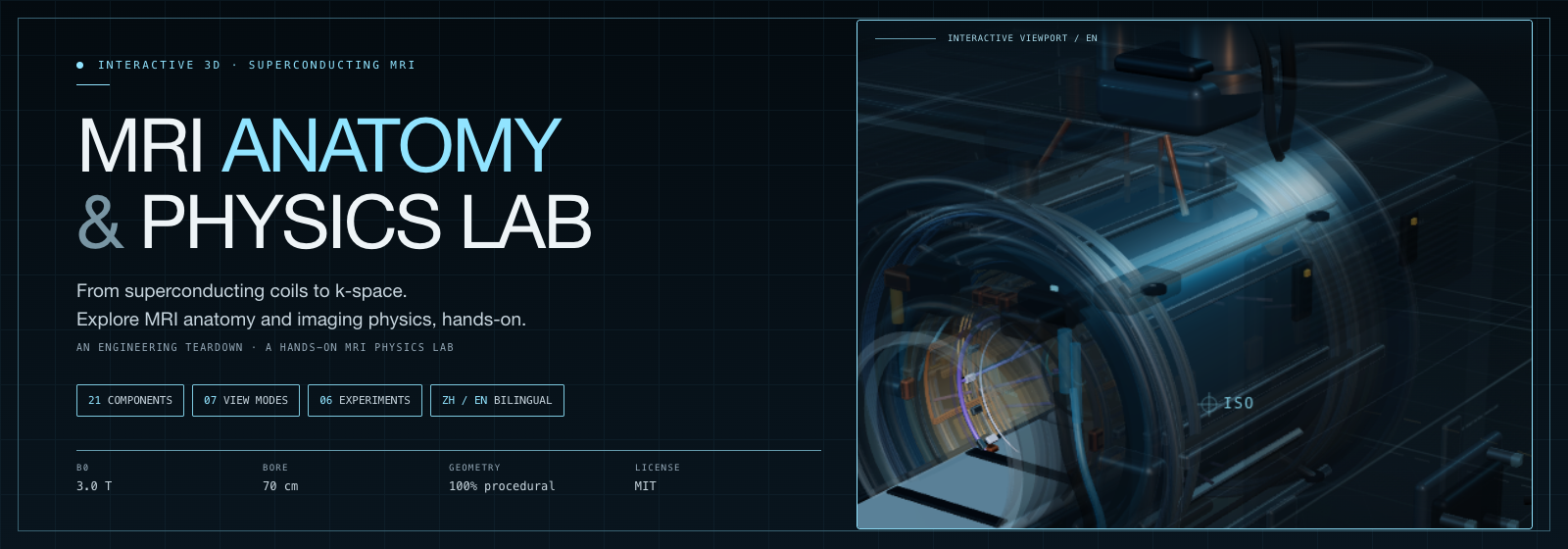
MRI Anatomy & Physics Lab
An interactive system-level teardown of a superconducting MRI — and a hands-on MRI physics laboratory.
21 procedural components · 7 viewing modes · 6 physics experiments · bilingual · offline-ready


中文 | English

Build with DeepSeek-V4.1-Flash1017. · open-source prompt
From the outer cover to k-space. Explore a generic 3.0 T superconducting MRI as 21 engineering components, cut real geometry with clipping planes, isolate subsystems, and connect the hardware to the physics that forms an image.
What is inside
🧩 Complete anatomy21 components across patient interface, superconducting magnet and cryogenics, gradients, shims, RF transmit/receive and the electronics room. Every component has its own technical dossier: structure, principle, typical materials, specifications, system relationships, imaging impact, safety notes and sources. |
🔬 Real sections & interactionsLongitudinal and transverse sections use actual Three.js clipping planes, paired with clearly marked schematic section caps and a layer legend. Seven viewing states, staged disassembly, subsystem explode, isolate/hide, 3D callouts, focus, camera presets and perspective/orthographic cameras. |
⚡ Six MRI experimentsB₀, Larmor precession, ideal RF excitation, spatial gradient encoding, GRE timing and Cartesian k-space reconstruction. Each experiment includes 3D overlays, live readouts, controls, teaching assumptions and sources. |
🎓 Built for learningChinese / English UI, Level A/B/C confidence labels, in-page glossary, safety boundaries and an explicit distinction between documented physics, typical engineering and schematic teaching aids. No vendor CAD, patient data, pre-rendered video or external 3D assets. |
Gallery
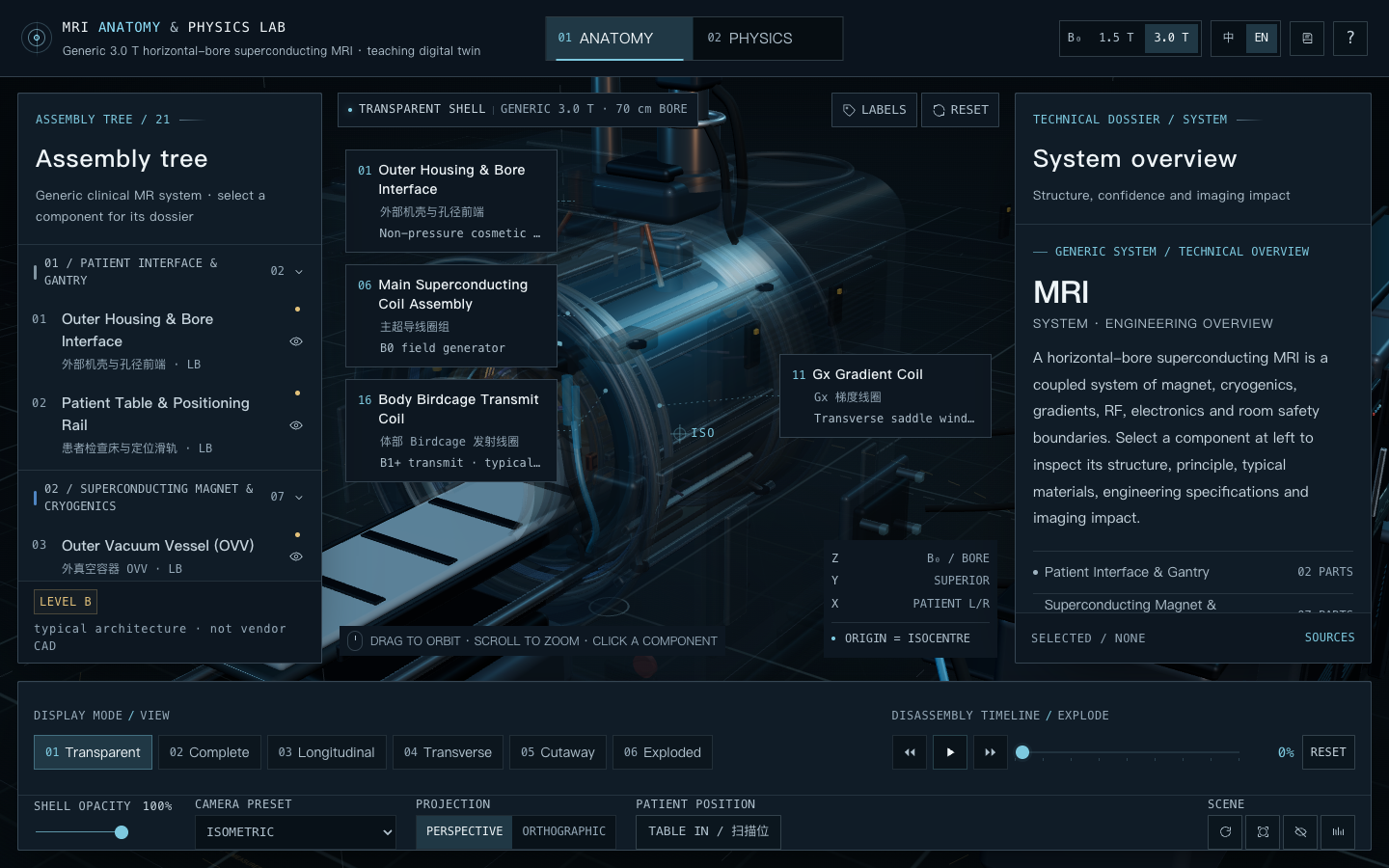
Transparent-shell view · assembly tree · technical dossier · 3D callouts · disassembly timeline

Complete assembly: outer housing, 70 cm bore, patient table, cold head and service turret.
 Transverse section · z = 0 real clipping + layer caps |
 100% exploded component callouts |
 Larmor precession B₀ out-of-plane + M(t) |
 GRE sequence RF / gradients / ADC |
 K-space & reconstruction real 2D FFT + aliasing |
📱 Fully usable on mobile
The assembly tree, technical dossier and experiment controls become drawers and a horizontally scrollable control deck. You can still orbit, zoom, select components, change sections and run experiments by touch.
A low-performance pixel-ratio mode is included for classroom projectors and phones.

390 × 844 · drawers / adaptive console / touch controls
Quick start
Open the live demo → MRI Anatomy & Physics Lab
The site is deployed with GitHub Pages. It also works offline; the repository includes a prebuilt bundle. To view locally:
git clone https://github.com/Haosen-Zhang/MRI-Anatomy-Physics-Lab.git
cd MRI-Anatomy-Physics-Lab
open index.html
No install or server is required. To run with a local server:
npm install
npm run dev        # http://localhost:4174
To rebuild after editing:
npm install
npm run build
The esbuild step bundles Three.js and the native ES modules into a classic IIFE that also works from file://.
Experiment summary
| # | Experiment | What changes | What it teaches |
|---|---|---|---|
| 01 | B₀ | 1.5 T / 3.0 T | Static field, spin polarisation; B₀ does not encode position |
| 02 | Larmor | Field, visual speed, play/pause | f₀ = (γ/2π)B₀; 1.5 T ≈ 63.87 MHz, 3.0 T ≈ 127.73 MHz |
| 03 | RF excitation | B₁, pulse duration, 90°/180°, receive channels | α = γB₁τ; rotating frame; B₁⁺ vs B₁⁻ |
| 04 | Gradients | Axis, amplitude, polarity | Bz ≈ B₀ + G·r; isofrequency planes |
| 05 | GRE sequence | Play/pause/scrub/speed | RF, Gz, Gy, Gx and ADC synchrony |
| 06 | K-space | Acceleration, ky coverage | Cartesian sampling, zero-filling, inverse FFT, aliasing |
The receive-array sub-mode exposes all eight head-coil channels with independent loop highlights and a qualitative sensitivity envelope.
Scientific boundaries
- Basic relations (Larmor, gradient encoding, flip angle, 2D FFT) use standard analytic expressions and are marked Level A.
- Hardware layout is a generic teaching reconstruction, not vendor CAD or manufacturing dimensions; internal layout belongs to Level B / C.
- Field lines, point clouds, isofrequency planes, receive envelopes and section caps are qualitative teaching aids — not a Maxwell/FEM solve.
- SAR, PNS, implant heating, acoustic pressure, quench dynamics and real coil fields are not implemented.
- The architecture is a generic low-helium, cryocooler-recondensing system. The quench vent is an emergency path, not continuous normal-operation venting.
- Not for clinical use, scan planning, device selection or MR safety decisions.
See the in-app Sources, Confidence and Safety panels for the detailed notes.
Project structure
.
├── index.html
├── styles.css
├── js/
│   ├── main.js
│   ├── scene.js
│   ├── explosion.js
│   ├── ui.js
│   ├── physics.js
│   ├── componentsData.js
│   ├── materials.js
│   ├── geometryUtils.js
│   ├── hardware.js
│   ├── app.bundle.js
│   └── systems/
├── previews/
├── prompt.md
├── LICENSE
└── THIRD_PARTY_NOTICES.md
Build & Prompt
Build with DeepSeek-V4.1-Flash1017.
The complete original development prompt is open-sourced in prompt.md. It documents the scientific frame, hardware scope, interaction model, technical constraints and acceptance criteria. The prompt is released with this repository under the MIT License.
License
Original code, procedural geometry, UI, text, preview renders and prompt.md are released under the MIT License (see LICENSE). Three.js is also MIT-licensed; its full notice is included in THIRD_PARTY_NOTICES.md. External references remain the property of their respective authors.
Made with Three.js · Built for learning, not for clinical use.
If this helps you understand MRI, consider starring the repository ⭐
Explore related projects
sindresorhus/awesome
😎 Awesome lists about all kinds of interesting topics [NOTE: Pull requests are temporarily disabled until I have a chance to catch up with the existing ones]
535,498 starsEbookFoundation/free-programming-books
:books: Freely available programming books
401,444 starsnilbuild/developer-roadmap
Interactive roadmaps, guides and other educational content to help developers grow in their careers.
371,849 starsvinta/awesome-python
The definitive list that answers "I want to do X in Python, which tool should I use?"
334,151 stars