
Hai-chao-Zhang/ThinkJEPA
Hai-chao-Zhang/ThinkJEPA has 59 GitHub stars and 5 forks. GitHot measured 0 stars in 24 hours. Last checked 2026-11-17 02:14 UTC. Last push 2026-07-19.
Measured star growth
- in 24h
- 0
- in 7 days
- Collecting history
- in 15 days
- Collecting history
- in 1 month
- Collecting history
Net star changes over overlapping periods, not daily totals. Missing measurements are left blank. Stars measure attention, not software quality.
About
[NeurIPS 2026] ThinkJEPA: Empowering Latent World Models with Large Vision-Language Reasoning Model
Developer ToolsREADME.md
OriginalThinkJEPA: Empowering Latent World Models with Large Vision-Language Reasoning Model

Official implementation of ThinkJEPA.
Haichao Zhang1, Yijiang Li2, Shwai He3, Tushar Nagarajan4, Mingfei Chen5,
Jianglin Lu1, Ang Li3, and Yun Fu1
1 Northeastern University 2 University of California San Diego 3 University of Maryland 4 The University of Texas at Austin 5 University of Washington
For questions about this public release, or if you encounter any issues reproducing the released setup, please contact Haichao Zhang: [email protected]
Paper | GitHub | Released Preprocessed Cache | Citation | License
ThinkJEPA is a dual-path embodied prediction framework in which a vision-language model acts as a cortex-like reasoner for high-level semantics and long-horizon intent, while a JEPA branch acts as a cerebellum-like controller for low-level dynamics, physical consistency, and rapid local correction. This repository is the public ThinkJEPA release for reproducing the released training and evaluation setup on EgoDex-style data and cache inputs.
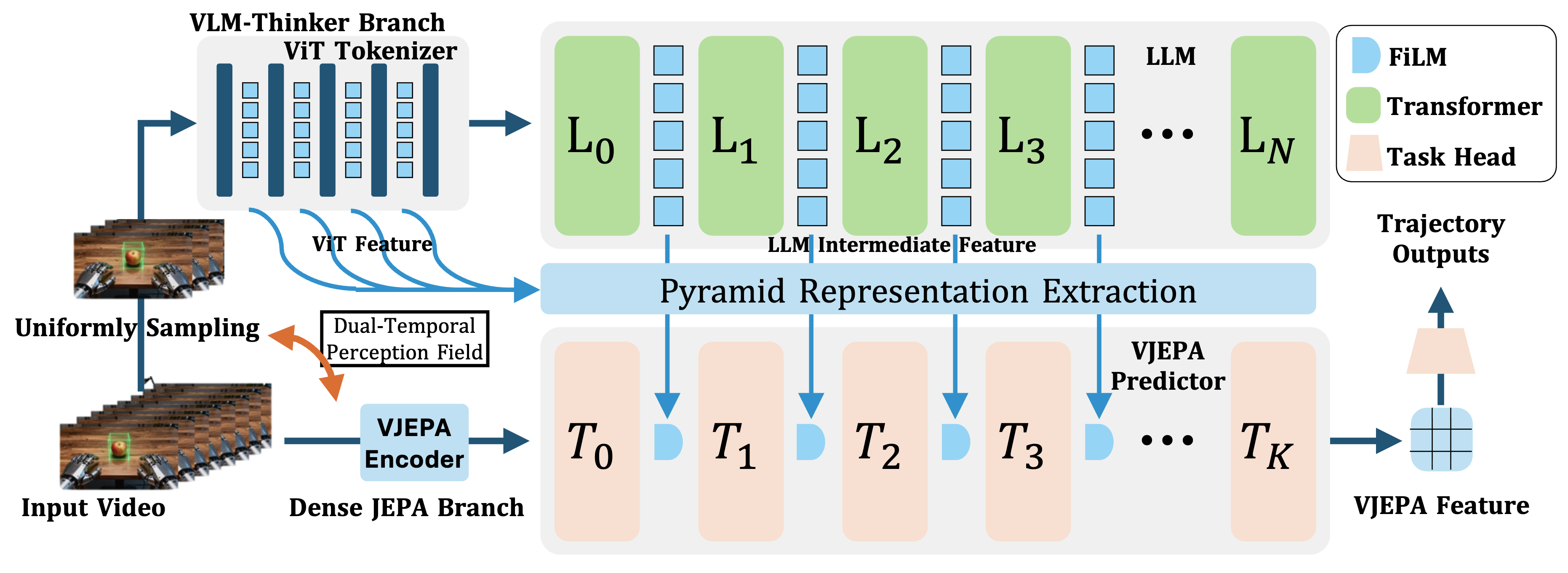
Overview
- The VLM-thinker branch provides high-level reasoning guidance from Qwen3-VL-Thinking features.
- The dense JEPA branch models video dynamics and supplies low-level embodied features for prediction.
- The released training path predicts future trajectory outputs from JEPA features conditioned by pyramid guidance from the VLM branch.
- This public snapshot is intentionally minimal: it includes the core train/eval code, preprocessing scripts, retained EgoDex helpers, and a bundled
vjepa2/dependency subtree required by the released path.
Repository Layout
thinkjepa/
├── cache_train/
│   ├── thinker_train.py
│   ├── thinker_predictor.py
│   ├── models.py
│   ├── rebuild_causal_cache.py
│   ├── build_video_cache_splits.py
│   ├── build_portable_hdf5_bundle.py
│   ├── validate_causal_cache.py
│   └── validate_release_bundle.py
├── egodex/
├── scripts/train.sh
├── vjepa2/
├── requirements-public.txt
├── requirements-extraction.txt
├── LICENSE
└── NOTICE
Environment Setup
Train / Eval Environment
For training and evaluation, we recommend a V-JEPA2-aligned environment.
On this machine, the known working training environment was a conda env similar to vjepa with:
- Python
3.11.15 torch==2.10.0+cu128torchvision==0.25.0+cu128torchaudio==2.10.0+cu128decord==0.6.0numpy==2.3.5h5py==3.16.0opencv-python==4.13.0.92pillow==12.0.0pyyaml==6.0.3timm==1.0.25einops==0.8.2
Example setup:
conda create -n thinkjepa-train python=3.11 -y
conda activate thinkjepa-train

# Install a PyTorch stack that matches your CUDA runtime and wheel index.
# The local working environment used CUDA 12.8 wheels.
pip install torch==2.10.0+cu128 torchvision==0.25.0+cu128 torchaudio==2.10.0+cu128 \
  --index-url https://download.pytorch.org/whl/cu128

pip install -r requirements-public.txt
The release already bundles the vjepa2/ source subtree used by the documented ThinkJEPA path. By default, the wrapper scripts point VJEPA2_ROOT to ./vjepa2.
The upstream V-JEPA2 project contains a broader research stack, including tools such as tensorboard and wandb. Those extras are not required by the released ThinkJEPA train/eval path.
Qwen3-VL Extraction Environment
If you want to run cache extraction yourself, use a dedicated Qwen3-VL environment instead of reusing the lean train/eval env. On this machine, the known working extraction environment was a conda env similar to qwen3vl with:
- Python
3.10.19 torch==2.10.0torchvision==0.25.0torchaudio==2.10.0+cu128torchcodec==0.10.0+cu128transformers==5.2.0qwen-vl-utils==0.0.14huggingface-hub==1.4.1decord==0.6.0numpy==2.2.6h5py==3.16.0pillow==12.1.1matplotlib==3.10.8pyyaml==6.0.3accelerate==1.12.0sentencepiece==0.2.1safetensors==0.7.0
Example setup:
conda create -n qwen3vl python=3.10 -y
conda activate qwen3vl

# Install a PyTorch + torchcodec stack that matches your CUDA runtime and wheel index.
# The local working extraction environment used CUDA 12.8 wheels.
pip install torch==2.10.0 torchvision==0.25.0 torchaudio==2.10.0 \
  --index-url https://download.pytorch.org/whl/cu128
pip install torchcodec==0.10.0+cu128 \
  --index-url https://download.pytorch.org/whl/cu128

pip install -r requirements-extraction.txt
The causal cache reconstruction script decodes raw MP4 files with decord.
If you only plan to reproduce training/evaluation from the released Hugging Face cache, you can skip this extraction environment entirely.
Data And Cache Preparation
Use The Prepared Cache
Resolve the Hugging Face iso branch to an immutable dataset commit and
materialize exactly that revision into an empty local directory:
The dataset is gated. Accept its access conditions in the Hugging Face web UI, then authenticate on the training machine before downloading:
hf auth login
export BUNDLE=/path/on/shared/storage/thinkjepa_iso
export HF_HOME=/path/on/shared/storage/huggingface

export ISO_REVISION="$(python - <<'PY'
from huggingface_hub import HfApi

print(HfApi().dataset_info("haichaozhang/cache", revision="iso").sha)
PY
)"

python - <<'PY'
import os
from huggingface_hub import snapshot_download

snapshot_download(
    repo_id="haichaozhang/cache",
    repo_type="dataset",
    revision=os.environ["ISO_REVISION"],
    local_dir=os.environ["BUNDLE"],
    allow_patterns=[
        "cache/**",
        "supervision_hdf5/**",
        "manifests/portable_v1/**",
        "full_validation.json",
        "VALIDATED_SUCCESS",
    ],
)
PY
Validate the materialized bundle before training:
chmod -R a-w "${BUNDLE}/cache" "${BUNDLE}/supervision_hdf5"

python cache_train/validate_release_bundle.py \
  --bundle-root "${BUNDLE}" \
  --expected-count 2000 \
  --verify-only
Do not combine files from different cache revisions. DATA_DIR and
CACHE_DIR must refer to the separate supervision and feature directories
shown above.
Training
The training entry point fixes the following method settings:
- 32 observed and 32 future raw frames;
- independent V-JEPA encoder forwards for observed and target clips;
- both cached VLM streams and all cached VLM layers;
- FiLM conditioning in every ThinkJEPA predictor layer;
- causal attention in every predictor layer;
- cached V-JEPA latents, with no online V-JEPA inference.
Batch sizes are per GPU. Training writes ckpt_latest.pt for resumption and
ckpt_best.pt for the epoch with the lowest validation ADE.
For the prepared cache, a 200-epoch run on two H200 GPUs with batch size 16 per GPU is expected to take approximately 7 hours.
Smoke test
The smoke test uses the same model and data path as full training, bounded to two train and two validation batches:
export BUNDLE=/path/on/shared/storage/thinkjepa_iso
export RUN_ROOT=/path/on/shared/storage/thinkjepa_runs/smoke
export HF_HOME=/path/on/shared/storage/huggingface

DATA_DIR="${BUNDLE}/supervision_hdf5" \
CACHE_DIR="${BUNDLE}/cache" \
TRAIN_MANIFEST="${BUNDLE}/manifests/portable_v1/train_cache.txt" \
VAL_MANIFEST="${BUNDLE}/manifests/portable_v1/test_cache.txt" \
SPLIT_META="${BUNDLE}/manifests/portable_v1/meta.json" \
OUT_DIR="${RUN_ROOT}" \
EPOCHS=1 \
DEBUG=1 \
MAX_TRAIN_BATCHES=2 \
MAX_EVAL_BATCHES=2 \
CHECKPOINT_SELECTION=last \
NO_PRELOAD_CACHE_TO_MEMORY=1 \
bash scripts/train.sh
Single-GPU training
export BUNDLE=/path/on/shared/storage/thinkjepa_iso
export RUN_ROOT=/path/on/shared/storage/thinkjepa_runs/thinkjepa_1gpu_seed42
export HF_HOME=/path/on/shared/storage/huggingface

DATA_DIR="${BUNDLE}/supervision_hdf5" \
CACHE_DIR="${BUNDLE}/cache" \
TRAIN_MANIFEST="${BUNDLE}/manifests/portable_v1/train_cache.txt" \
VAL_MANIFEST="${BUNDLE}/manifests/portable_v1/test_cache.txt" \
SPLIT_META="${BUNDLE}/manifests/portable_v1/meta.json" \
OUT_DIR="${RUN_ROOT}" \
GPU_LIST=0 \
NPROC_PER_NODE=1 \
TRAIN_BATCH_SIZE=16 \
TEST_BATCH_SIZE=16 \
NUM_WORKERS=4 \
PREFETCH_FACTOR=1 \
EPOCHS=200 \
SEED=42 \
CHECKPOINT_SELECTION=best \
NO_PRELOAD_CACHE_TO_MEMORY=1 \
AUTO_RESUME=1 \
bash scripts/train.sh
Four-GPU training
This configuration uses four GPUs with batch size 16 per GPU, giving an effective global batch size of 64.
export BUNDLE=/path/on/shared/storage/thinkjepa_iso
export RUN_ROOT=/path/on/shared/storage/thinkjepa_runs/thinkjepa_4gpu_b16_seed42
export HF_HOME=/path/on/shared/storage/huggingface

# Use the local socket transport for this single-node run. This also avoids
# inheriting an incompatible site-provided OFI NCCL plugin.
unset NCCL_NET_PLUGIN NCCL_NET_OFI_PROVIDER NCCL_PLUGIN_P2P
export NCCL_NET=Socket
export NCCL_IB_DISABLE=1
export NCCL_SOCKET_IFNAME=lo
export GLOO_SOCKET_IFNAME=lo
export NCCL_NVLS_ENABLE=0

DATA_DIR="${BUNDLE}/supervision_hdf5" \
CACHE_DIR="${BUNDLE}/cache" \
TRAIN_MANIFEST="${BUNDLE}/manifests/portable_v1/train_cache.txt" \
VAL_MANIFEST="${BUNDLE}/manifests/portable_v1/test_cache.txt" \
SPLIT_META="${BUNDLE}/manifests/portable_v1/meta.json" \
OUT_DIR="${RUN_ROOT}" \
GPU_LIST=0,1,2,3 \
NPROC_PER_NODE=4 \
TRAIN_BATCH_SIZE=16 \
TEST_BATCH_SIZE=16 \
NUM_WORKERS=4 \
PREFETCH_FACTOR=1 \
EPOCHS=200 \
SEED=42 \
CHECKPOINT_SELECTION=best \
NO_PRELOAD_CACHE_TO_MEMORY=1 \
AUTO_RESUME=1 \
bash scripts/train.sh
CHECKPOINT_SELECTION=best selects the checkpoint with minimum validation
ADE; its FDE is the FDE from that same ADE-selected epoch. The portable file
named test_cache.txt is passed as the validation manifest in the commands
above. Because it participates in model selection, its metrics are validation
results rather than independent held-out test results. Final test reporting
must use a separate group-disjoint test split that was not used for checkpoint
selection. CHECKPOINT_SELECTION=last instead keeps the final epoch without
selecting on validation. validation remains accepted as an alias for best.
Cache reconstruction
cache_train/rebuild_causal_cache.py supplies only observed frames to the VLM
and invokes V-JEPA independently for the observed and target clips. Run its
contract self-test before full extraction:
python cache_train/rebuild_causal_cache.py \
  --file_dir /path/to/raw/mp4/root \
  --output_dir /path/on/shared/storage/cache_smoke \
  --vjepa_checkpoint /path/to/vjepa2_vitl.pt \
  --self_test
For a full rebuild, use an isolated raw root containing exactly the 2000 selected MP4 files expected by the bundle validator:
export RAW_ROOT=/path/to/selected_2000_raw_videos
export FEATURE_ROOT=/path/on/shared/storage/causal_features
export VJEPA_CHECKPOINT=/path/to/vjepa2_vitl.pt
export HF_HOME=/path/on/shared/storage/huggingface
export QWEN_REVISION="immutable-qwen-commit-sha"

python cache_train/rebuild_causal_cache.py \
  --file_dir "${RAW_ROOT}" \
  --output_dir "${FEATURE_ROOT}" \
  --pretrained Qwen/Qwen3-VL-2B-Thinking \
  --qwen_revision "${QWEN_REVISION}" \
  --vjepa_checkpoint "${VJEPA_CHECKPOINT}" \
  --layers 0 4 8 12 16 20 24 27 \
  --dataset_prompt_mode off \
  --max_new_token_num 16 \
  --qwen_res 256 \
  --save_dtype fp16 \
  --hf_home "${HF_HOME}"
After extraction, validate the causal feature set and construct a portable bundle with separate HDF5 supervision:
export RAW_ROOT=/path/to/raw/mp4/root
export FEATURE_ROOT=/path/on/shared/storage/causal_features
export HDF5_SOURCE=/path/to/original/egodex_hdf5/root
export SPLIT_STAGE=/path/on/shared/storage/group_split
export BUNDLE=/path/on/shared/storage/thinkjepa_portable
export SOURCE_REPORT=/path/on/shared/storage/source_cache_validation.json

python cache_train/validate_causal_cache.py \
  --raw_dir "${RAW_ROOT}" \
  --cache_dir "${FEATURE_ROOT}" \
  --expected_count 2000 \
  --output_json "${SOURCE_REPORT}"

python cache_train/build_video_cache_splits.py \
  --dataset egodex \
  --data_root "${RAW_ROOT}" \
  --cache_root "${FEATURE_ROOT}" \
  --output_dir "${SPLIT_STAGE}" \
  --subset_size 2000 \
  --train_ratio 0.9 \
  --split_seed 42 \
  --group_by parent

python cache_train/build_portable_hdf5_bundle.py \
  --feature-dir "${FEATURE_ROOT}" \
  --hdf5-source-dir "${HDF5_SOURCE}" \
  --source-split-dir "${SPLIT_STAGE}" \
  --output-dir "${BUNDLE}" \
  --expected-count 2000

mkdir -p "${BUNDLE}/cache"
cp -a --reflink=auto "${FEATURE_ROOT}/." "${BUNDLE}/cache/"
chmod -R a-w "${BUNDLE}/cache" "${BUNDLE}/supervision_hdf5"

python cache_train/validate_release_bundle.py \
  --bundle-root "${BUNDLE}" \
  --source-cache-report "${SOURCE_REPORT}" \
  --expected-count 2000 \
  --write-contract

python cache_train/validate_release_bundle.py \
  --bundle-root "${BUNDLE}" \
  --source-cache-report "${SOURCE_REPORT}" \
  --expected-count 2000 \
  --verify-only
Third-Party Sources
This release retains third-party components that are necessary for the released reproduction path.
- EgoDex-derived helpers under
egodex/are adapted from Apple's EgoDex project.- Source repository: https://github.com/apple/ml-egodex
- Retained notice files:
egodex/LICENSE.txtegodex/ACKNOWLEDGEMENTS.txtegodex/utils/LICENSE.txtegodex/utils/ACKNOWLEDGEMENTS.txt
- The bundled
vjepa2/subtree is derived from the V-JEPA2 repository.- Source repository: https://github.com/facebookresearch/vjepa2
- Retained notice files:
vjepa2/LICENSEvjepa2/APACHE-LICENSE
These third-party notices continue to apply to their respective subtrees and are not replaced by the root ThinkJEPA release license.
Citation
If you use ThinkJEPA, please cite the paper and link to the original repository:
- Repository: https://github.com/Hai-chao-Zhang/ThinkJEPA
@article{zhang2026thinkjepa,
  title={ThinkJEPA: Empowering Latent World Models with Large Vision-Language Reasoning Model},
  author={Zhang, Haichao and Li, Yijiang and He, Shwai and Nagarajan, Tushar and Chen, Mingfei and Lu, Jianglin and Li, Ang and Fu, Yun},
  journal={arXiv preprint arXiv:2603.22281},
  year={2026}
}
See CITATION.cff and CITATION.bib for machine-readable and BibTeX citation metadata.
Attribution
If you use, modify, or redistribute ThinkJEPA or derivative code, please:
- retain the
LICENSEandNOTICEfiles - retain applicable third-party notices that ship with the repository
- cite the ThinkJEPA paper where citation practices apply
- include a link to the original repository: https://github.com/Hai-chao-Zhang/ThinkJEPA
License
The root repository is released under the custom ThinkJEPA Attribution License (BSD-3-Clause-based, custom). Redistribution and modification are broadly permitted, provided that required attribution, notice retention, change-marking, and repository-link requirements are followed.
See:
LICENSENOTICE