
GradientHQ/symphony-coord
GradientHQ/symphony-coord has 1,084 GitHub stars and 168 forks. Star changes are not measured yet. Last checked 2026-11-09 10:33 UTC. Last push 2026-10-10.
Task & Plan-K → Capability-Guided Screening (CGS) → Contextual Bandit Routing (CBR) & CoT-P → Aggregate & Learn
Measured star growth
- in 24h
- Update delayed
- in 7 days
- Update delayed
- in 15 days
- Update delayed
- in 1 month
- Update delayed
Net star changes over overlapping periods, not daily totals. Missing measurements are left blank. Stars measure attention, not software quality.
README.md
OriginalSymphony-Coord
Adaptive Routing for Multi-Agent LLM Systems
Agents That Learn Who Should Solve What


📄 Paper · 🌐 Live Demo · 💡 Ecosystem
Contents
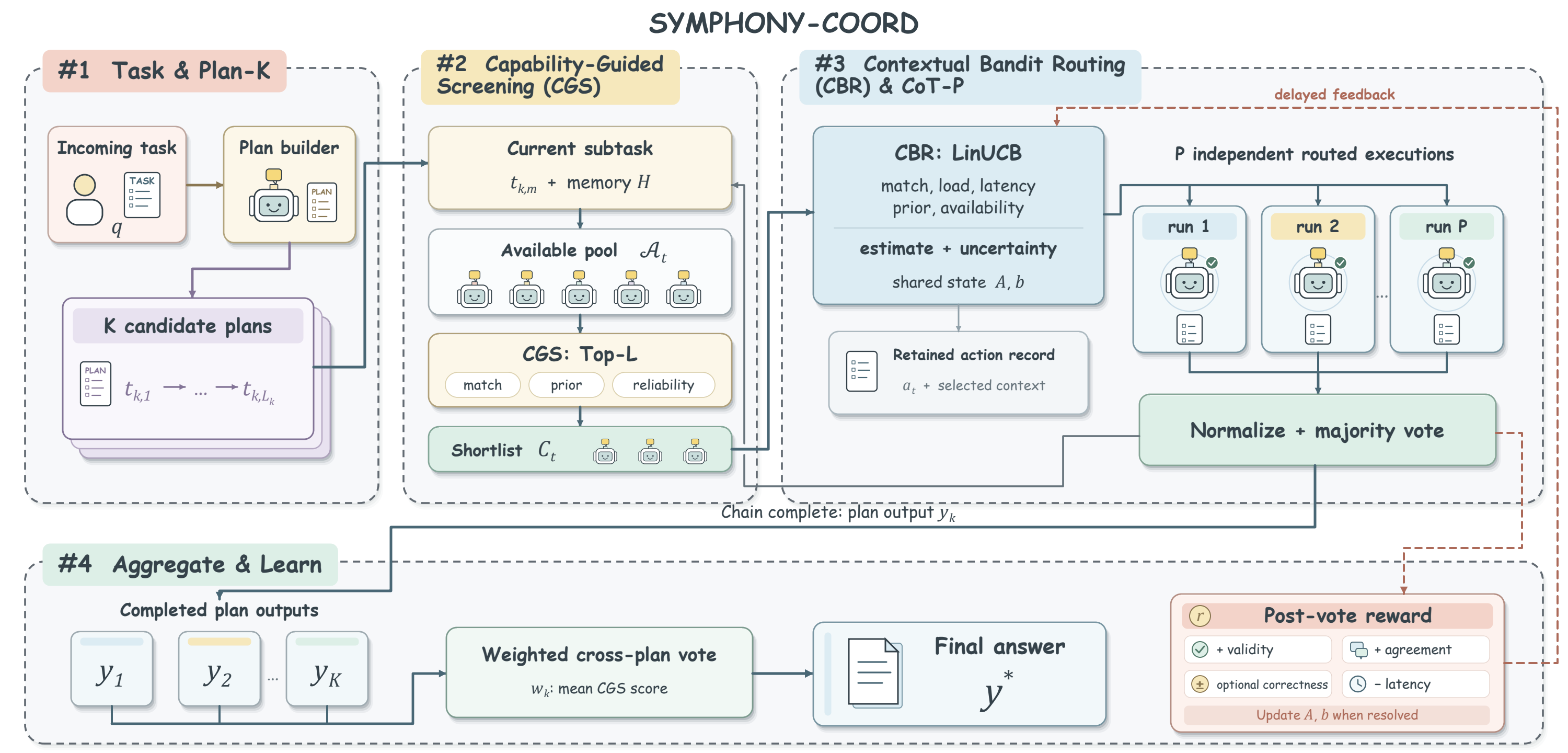
Task & Plan-K → Capability-Guided Screening (CGS) → Contextual Bandit Routing (CBR) & CoT-P → Aggregate & Learn
Overview
Symphony-Coord is a task-local routing framework for multi-agent LLM systems. It formulates subtask-level executor selection as an online contextual bandit problem, using task information and observable service state.
Instead of relying on static expert assignment or handcrafted orchestration policies, Symphony continuously learns routing decisions from interaction outcomes.
The framework has four components, as shown above:
- Task & Plan-K: form candidate plans and ordered subtask chains.
- Capability-Guided Screening (CGS): retain a Top-L shortlist using capability match, prior success, and reliability.
- Contextual Bandit Routing (CBR) & CoT-P: select executors with LinUCB and collect repeated subtask outputs.
- Aggregate & Learn: combine outputs by subtask-level majority voting and weighted cross-plan voting, then update the selector when action-linked feedback is resolved.
Core mechanisms include:
- capability-guided, non-executing Top-L screening
- LinUCB routing using task and service context
- repeated subtask execution with majority voting
- weighted aggregation across candidate plans
- action-linked records for delayed post-vote feedback
Through continual feedback, routing policies evolve online and improve coordination quality over time.
Citation
@misc{guan2026symphonycoordadaptiveroutingmultiagent,
      title={Symphony-Coord: Adaptive Routing for Multi-Agent LLM Systems},
      author={Zhaoyang Guan and Huixi Cao and Ming Zhong and Yin Wang and Guanyu Liu and Eric Yang and Lynn Ai and Yongxin Ni and Bill Shi},
      year={2026},
      eprint={2602.00966},
      archivePrefix={arXiv},
      primaryClass={cs.MA},
      url={https://arxiv.org/abs/2602.00966},
}
Acknowledgements
We thank the open-source research community for foundational work in:
- decentralized systems
- online bandit optimization
- multi-agent reasoning
- Chain-of-Thought coordination
- distributed inference systems
License
MIT License
Explore related projects
codecrafters-io/build-your-own-x
Master programming by recreating your favorite technologies from scratch.
561,592 starspublic-apis/public-apis
A collective list of free APIs
497,914 starsmorluto/rea
Reverse engineer anything with agents, from app behavior down to native binaries.
449,710 starsopenclaw/openclaw
The AI that really does things. Any OS. Any Platform. The lobster way. 🦞
394,301 stars