
GeekFamilyCorp/TricorderKit
About
The local-first second brain for your AI agents - measured, self-improving, and gated so it can't leak what you keep private. 13 Claude Code plugins, 21 skills, Ollama, Neo4j, Qdrant.
AIMeasured star growth
- in 24h
- 0
- in 7 days
- Collecting history
- in 15 days
- Collecting history
- in 1 month
- Collecting history
Net star changes over overlapping periods, not daily totals. Missing measurements are left blank. Stars measure attention, not software quality.
README.md
Original
TricorderKit
The local-first second brain for your AI agents — measured, self-improving, and gated so it can't leak what you keep private.





100 % vs 33–50 %multi-hop answers foundGraphRAG vs flat RAG · reproduce |
−84 % tokensto answer "what was true at T"temporal memory · reproduce |
−82 % comparisonsto find duplicates, same F1embedding dedup · reproduce |
4 gateson every push, local + CIsecrets · names · docs · contracts |
Install · See it work · Field notes · Measured · Architecture · Inside · Docs · FAQ
⚡ Install in one line
Inside Claude Code:
/plugin marketplace add GeekFamilyCorp/TricorderKit
then pick what you need, e.g. /plugin install graphify@tricorderkit (hybrid RAG) — 13 engine plugins are listed in the marketplace. No Docker needed for the five method plugins; the full local engine is one git clone away (Quick start).
🎬 See the guardrails work
Real output of the repo's own pre-push hook (its messages are in French, the author's working language).
TK_PRIVATE_TERMSlists names that must never go public: the hook blocks them before the push and, because CI logs are public, reports a digest — never the name. The same checks run again in CI.
Why TricorderKit?
Most agent setups are a pile of prompts and scripts that nobody can audit, reproduce, or improve. TricorderKit treats an agent like an operating system for knowledge work: every intention becomes a workflow that is traceable, testable, and reusable — and the system measures and improves itself over time.
| Ad-hoc agent setup | TricorderKit | |
|---|---|---|
| Where it runs | Cloud, your data leaves the machine | Local-first — Ollama, Neo4j, Qdrant on your box (or your own server) |
| Claims | "It works on my prompt" | Measured — offline benchmarks + 579 tests |
| Quality | Hope | Gates — secrets, public-boundary, docs-sync, plugin contracts — pre-push & CI |
| Evolution | Manual prompt-tweaking | Self-improving loop — proposals, gated by tests + human review |
| Reproducibility | "Works on my laptop" | Versioned plugins with declared contracts, runbooks, deterministic selftests |
Honesty first: every number below comes from the selftests and offline benchmarks in this repo, and the badges above are live CI results, not static claims. No inflated metrics, no fake stars.
🆕 What's new
Since v1.1.0 (June 2026), ordered by how much each area moved. Full details in the CHANGELOG ([1.2.0]).
| Area | What changed | Where |
|---|---|---|
| Claude plugins | Five generic plugins for Claude (Cowork / Claude Code): 21 skills, all MIT, no data and no private paths | cowork-plugins/ |
| Plugin contracts | Every one of the 13 plugins now declares a preflight: contract — inputs, dependencies, env vars (presence only, never values), stop conditions, bounded retry, rollback, escalation. make preflight runs in --strict mode inside make gates |
core/contracts/skill_preflight.schema.json · scripts/check_preflight_contract.py |
| Remote services | Run Temporal, Neo4j and Qdrant on an always-on machine while your vault stays local — environment variables only, one-step rollback. caps probes the remote service and never starts a local copy |
docs/10_REMOTE_SERVICES.md · examples/remote-services/ · tools/caps/ |
| Workflow engine | Bounded Temporal retries (no more infinite default), worker compatible with a remote Temporal, foreground worker loop for scheduled tasks | plugins/workflow-engine/ |
| Resilience | Deduplicated backups (restic + rclone) with retention/prune/check; adaptive batch runner (AIMD rate control + checkpoint/resume) | tools/backup/ · tools/batch/ |
| Security | gitleaks enforced in the pre-push hook and in CI; the boundary gate now matches private terms by SHA-256 digest (never stored in clear), across spellings and in file paths, with no folder-wide whitelist; it also catches public IPv4 addresses; hardened .gitignore (keys, tokens, cookies, vaults) |
.githooks/pre-push · .github/workflows/ |
| Multi-agent channel | canal_agents v3: replies routed back to the requester, sequence numbers under a file lock, generated schema, reproducible tests |
canal_agents/ |
| Marketplace | document-ingestion, learning-engine and scraper-runtime exposed — 13 plugins in the Claude Code marketplace |
.claude-plugin/marketplace.json |
🧪 Field notes from a real project
TricorderKit is not a demo. Its author uses it every day to run a private knowledge-base project: the public engine stays generic, the domain lives in a private linked project.
- Six months of daily use (since April 2026): several Claude sessions working in parallel, coordinated through a file- and git-based message protocol — the pattern packaged here as
canal_agents/. - The anti-leak gate comes from a real incident. In October 2026, content from that private project slipped into this public repository through a whitelist that exempted whole folders. We fixed the cause — private terms are now matched by digest in content and file paths, with no folder-wide whitelist — neutralised the engine, and restarted the public history from a clean commit. The demo above is that fix.
- Gates find bugs in the gates. Preparing that demo showed the pre-push hook was not marked executable, so Linux and macOS silently skipped it. Fixed: the hook is now executable and
make install-hookssets the bit.
🛡️ Governance & guardrails
Handing an agent real autonomy over your second brain is only safe if it can't leak your secrets, act on a malicious web page, publish private notes, or run away on cost. TricorderKit ships a numbered, versioned rule-set enforced by deterministic gates — not prose an agent can ignore:
- Untrusted tool output is data, never instructions — an embedded "do X" is surfaced, not executed (anti prompt-injection)
- Secret scanning on every push (gitleaks, pre-push hook + CI) — secrets live in a vault, never in the repo
- Public / private routing — a boundary gate blocks private terms, personal paths and public IPs before any public push
- Plugin contracts — a plugin that does not declare its inputs, stop conditions and rollback fails
make gates - Irreversibility gates — explicit confirmation before push / send / delete; pre-push shows exactly what ships
- Cost & loop circuit-breaker · bounded retries · zero-loss memory (boot cache, session logs, immediate backup)
- The Rule of Two — never combine untrusted input + sensitive access + external write unattended
→ Full model: docs/09_GOVERNANCE_GUARDRAILS.md
🚀 Quick start
git clone https://github.com/GeekFamilyCorp/TricorderKit.git
cd TricorderKit

# 1. Health check — what's installed, what's missing
python cli/tk.py doctor

# 2. Bring up the optional local stack (RAG + workflows + observability)
docker compose --profile graph up -d        # Neo4j + Qdrant
#   ... profiles: graph | workflows | observability (start only what you need)

# 3. Try it
python cli/tk.py status
python cli/tk.py research run "<topic>" --dry-run   # research pipeline (add --yes to call the sources)

# 4. Before you push anything: run the same gates as CI
make gates                                   # boundary · docs-sync · preflight contracts
No GPU required. The heavy components are opt-in (Docker profiles) so a fresh clone boots light.
Want Neo4j, Qdrant and Temporal on an always-on machine (home server, NAS, VPS) while your vault stays local? See docs/10_REMOTE_SERVICES.md — environment variables only, one-step rollback.
🤖 Use it inside Claude
TricorderKit ships two families of plugins for Claude.
1. The 13 engine plugins — Claude Code marketplace (.claude-plugin/marketplace.json):
/plugin marketplace add GeekFamilyCorp/TricorderKit
/plugin install graphify@tricorderkit
2. Five method plugins — generic working methods, no data, installable as-is in Claude (Cowork / Claude Code) from cowork-plugins/:
| Plugin | Skills | What it brings |
|---|---|---|
tk-token-economy |
model-router · budget · context-compress · caveman · docs-fresh |
route each task to the cheapest model that can do it, estimate the budget, compress long contexts, read up-to-date library docs before coding |
tk-agent-security |
agent-config-audit · cli-compress |
read-only audit of an agent's own MCP servers, hooks, permissions and plain-text secrets; compact command output |
tk-data-ops |
neo4j-graph-ops · graphrag-hybrid · scrape-adaptive · watch-changes |
Neo4j access (read-only by default), hybrid vector + graph retrieval, polite adaptive scraping, change watching (changedetection / RSS) |
tk-knowledge |
head-agent · skill-manager · skill-evals · doc-to-skill |
multi-agent orchestration, skill inventory and audit, skill test suites, turn documentation into a skill |
tk-dev-discipline |
dev-protocol · code-corrector · debugging-and-error-recovery · doubt-driven-development · interview-me · observability-and-instrumentation |
a development protocol, web-code hardening, structured debugging, adversarial self-review, scoping interviews, instrumentation |
Install one: cd cowork-plugins/<plugin> && python -m zipfile -c ../<plugin>.plugin ., then add the .plugin file in Claude (Settings → Capabilities).
🧭 Architecture
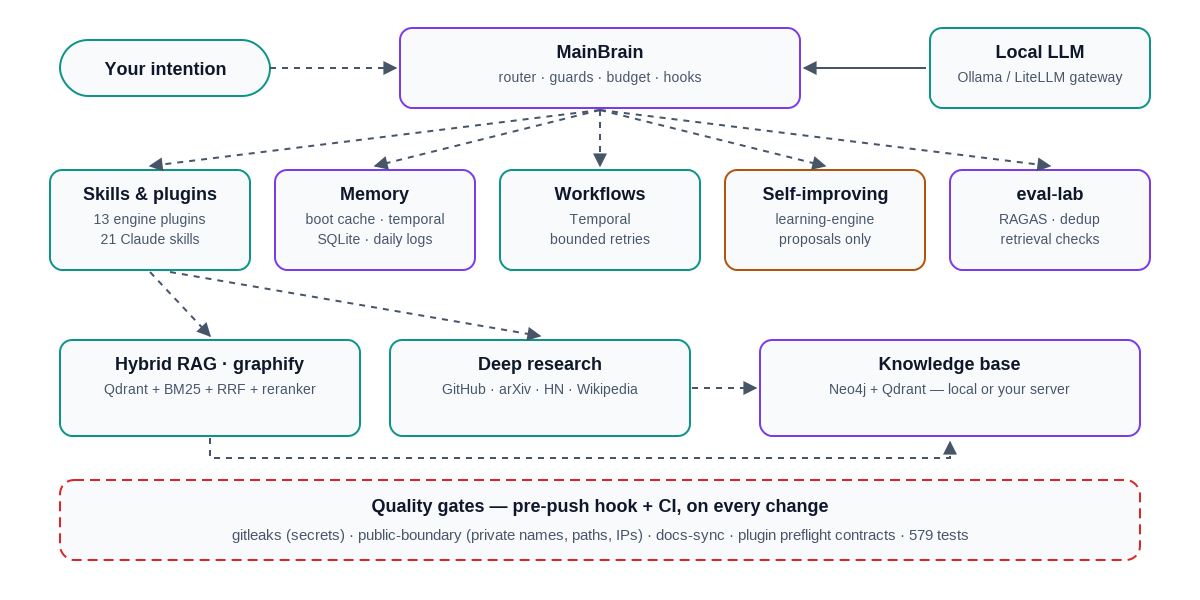
Everything is local-first: the agent (Claude or a local model via the Ollama/LiteLLM gateway), the knowledge base (Neo4j + Qdrant), the memory (SQLite), and the workflow engine (Temporal) run on your machine — or, if you choose, the three heavy services run on a server you own (docs/10).
📊 Measured results
Real numbers from the offline benchmarks shipped under experiments/ (each has a --selftest; figures below re-run on 28 Oct 2026). Reproduce with python experiments/<name>/<script>.py --selftest.
| Capability | Benchmark | Result |
|---|---|---|
| Embedding-blocking dedup | vs. exhaustive fuzzy, equal quality | same F1 at −82 % comparisons |
| Temporal memory (bi-temporal, SQLite) | "what was true at time T" | 100 % accuracy, −84 % tokens vs full-context |
| GraphRAG | multi-hop relational questions, equal budget | 100 % coverage vs 33–50 % flat RAG |
| Evaluator-driven tuning (OpenEvolve-style) | auto-tune dedup thresholds | F1 0.909 → 1.0, GPU-free, local LLM |
| RAG evaluation (RAGAS) | faithfulness / relevancy / context | objective scoring, LLM-as-judge optional |
Test suite: 579 tests collected (pytest), run in CI on every push — the live result is the tests badge at the top of this page. Plus a god-mode innovation radar that scans the state of the art weekly and proposes improvements (human-validated, never auto-adopted).
🧩 What's inside
| Folder | What it holds |
|---|---|
plugins/ |
13 engine plugins, each with a declared preflight contract: deep-research-core (autonomous research), graphify (local-first hybrid RAG), learning-engine (self-improvement), token-optimizer (model routing + budget), eval-lab (quality evaluators), workflow-engine (Temporal), document-ingestion, scraper-runtime, connector-hub, obsidian-agent-layer, security-audit-cli, memory-boot, cli-forge |
cowork-plugins/ |
5 Claude method plugins, 21 skills (see Use it inside Claude) |
skills/ |
composable skills incl. god-mode (innovation radar), code-corrector (web fix/hardening), agent-config-audit (audit the agent's own MCP/hooks/permissions/secrets), doc-to-skill, dev-protocol, skill-manager, consolidate-memory, tk-orchestrator, subtitle-fix |
core/ |
MainBrain v1.5 (decision algorithm), hook layer, JSON contracts (skill output, plugin preflight) |
cli/tk.py |
one CLI: status · doctor · skill · workflow · vault · research · project · security · mcp · rapport |
tools/ |
caps (capability manager, local or remote services) · backup (restic + rclone) · batch (adaptive runner) · audit · observability |
canal_agents/ |
file-based protocol for several agents to exchange requests and replies safely |
experiments/ |
isolated, offline-runnable PoCs (RAGAS, temporal memory, dedup, GraphRAG, OpenEvolve). Promoted only on decision |
examples/ |
ready-to-adapt setups, e.g. remote-services/ (generic docker-compose bound to a private IP) |
See STATUS.md for the per-plugin dashboard and ROADMAP.md for what's next.
📚 Documentation index
| # | Document | Read it to… |
|---|---|---|
| 00 | What is TricorderKit | get the idea in five minutes |
| 01 | How it works | follow an intention from input to traced output |
| 02 | What is in place | see the operational inventory |
| 03 | What to do next | pick your next step after install |
| 04 | LLM operating guide | brief an LLM agent working inside the repo |
| 05 | Hooks policy | understand Pre-Intent / Pre-Execution / Post-Execution hooks |
| 06 | Workflow standard | write workflows and agents the house way |
| 07 | Second-brain routing | route notes and knowledge to the right place |
| 08 | Context policy | keep agent context small and relevant |
| 09 | Governance & guardrails | see every rule and the gate that enforces it |
| 10 | Remote services | move Temporal, Neo4j and Qdrant to another machine |
| 11 | Skill improvement loop | let real sessions improve your skills (task-observer + session-memory), human-approved |
| — | Architecture · Infrastructure | the component map and the Docker stack |
| — | Linked projects · Anonymization | plug your own private project into the public engine, safely |
Operators: INSTALL.md · RUNBOOK_INFRA.md · CHANGELOG.md.
❓ FAQ
Do I need a GPU or a cloud API?
No. TricorderKit is local-first and runs against a local LLM (Ollama via a LiteLLM gateway with retry + local fallback). Cloud models are optional.
My laptop sleeps — can the heavy services live elsewhere?
Yes. Temporal, Neo4j and Qdrant can run on any always-on machine you own (home server, NAS, VPS) over a private network; your notes, embeddings and workers stay on your workstation. It's a matter of three environment variables, and removing them reverts. See docs/10_REMOTE_SERVICES.md.
Can I use parts of it without the whole stack?
Yes. The five plugins in cowork-plugins/ are pure working methods for Claude: no database, no Docker, no data. Install only the one you need.
Is it tied to a specific domain?
The public engine is generic. It's a CLI-first agentic OS for knowledge work; the knowledge base, sources, and skills are yours to define — see linked projects to keep your domain private.
How does "self-improving" stay safe?
The learning loop only produces proposals (drafts). Promotion requires green tests and human review. Quality gates (gitleaks, public-boundary, docs-sync, preflight contracts) run on every push and in CI.
Why "TricorderKit"?
After the Star Trek tricorder — a tool that scans, analyzes, and synthesizes information on demand.
⭐ Help others find it
If TricorderKit saved you a leak, a token or an evening, a star helps other people find it — and tells us which direction to push next. Questions, ideas and field reports are welcome in Issues.
License
MIT — see LICENSE. Each skill also states its license in its SKILL.md header. Contributions and stars welcome. ⭐
TricorderKit v1.2.0 — GeekFamilyCorp — 2026
Explore related projects
Loading…