
Gang-Qu/HATNet-SPI
Gang-Qu/HATNet-SPI has 30 GitHub stars and 5 forks. Star changes are not measured yet. Last checked 2026-11-13 23:09 UTC. Last push 2026-10-24.
Measured star growth
- in 24h
- Collecting history
- in 7 days
- Collecting history
- in 15 days
- Collecting history
- in 1 month
- Collecting history
Net star changes over overlapping periods, not daily totals. Missing measurements are left blank. Stars measure attention, not software quality.
About
Dual-scale Transformer for Large-scale Single-Pixel Imaging
Developer ToolsREADME.md
OriginalHATNet-SPI (CVPR 2024)
Official PyTorch implementation of Dual-Scale Transformer for Large-Scale Single-Pixel Imaging.
Gang Qu, Ping Wang, and Xin Yuan.
Overview
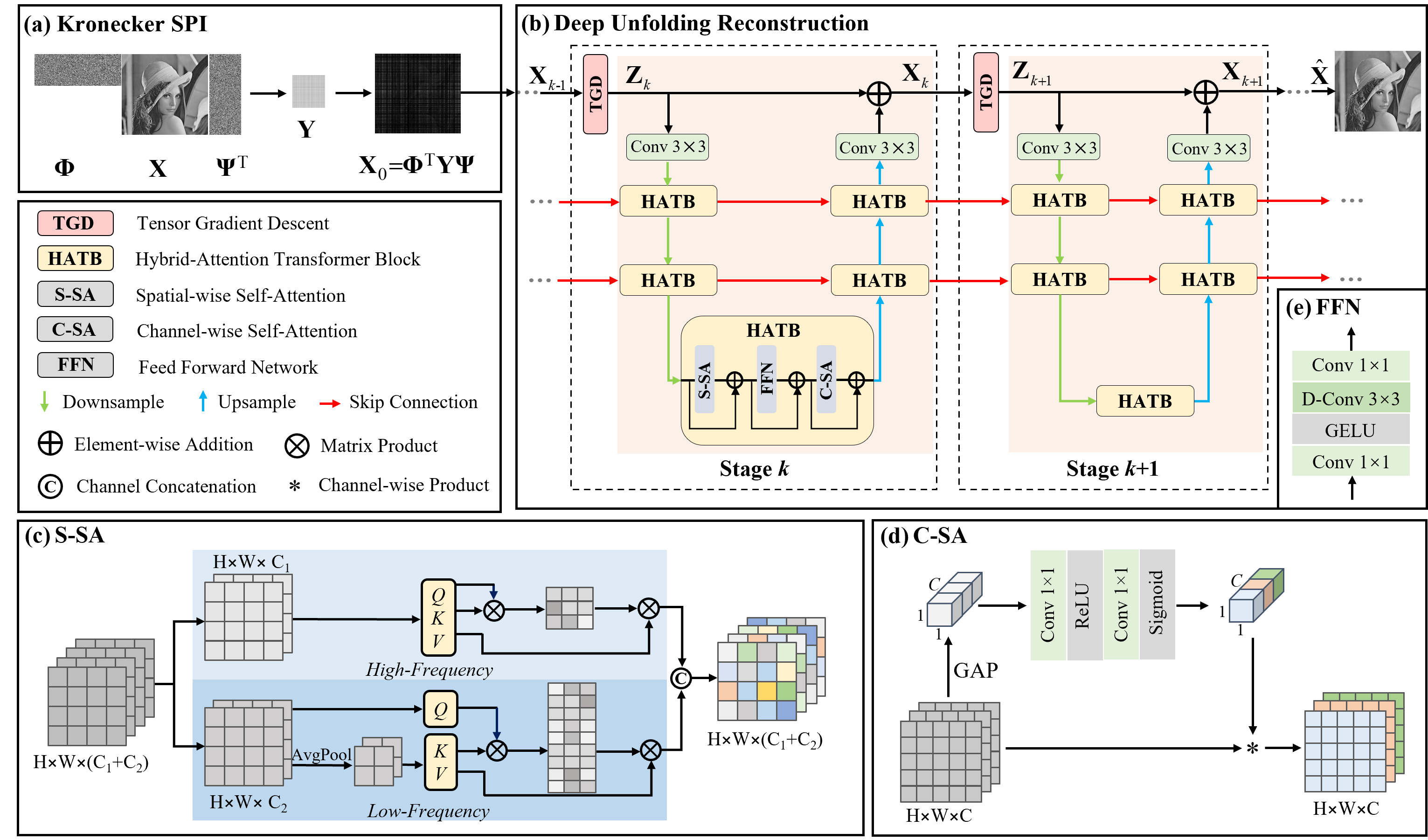
HATNet is a deep unfolding network for large-scale single-pixel imaging. It combines a Kronecker sensing model with efficient tensor gradient descent and a hybrid-attention multi-scale denoiser. Dual-scale spatial attention captures image details at different scales, while channel attention recalibrates global features. The paper evaluates reconstruction quality on synthetic data and measurements from a real single-pixel imaging prototype.
Installation
git clone https://github.com/Gang-Qu/HATNet-SPI.git
cd HATNet-SPI
conda create -n hatnet python=3.13.2 -y
conda activate hatnet
python -m pip install --upgrade pip
python -m pip install torch==2.6.0 torchvision==0.21.0 \
  --index-url https://download.pytorch.org/whl/cu126
python -m pip install numpy==2.1.3 scipy==1.15.1 \
  scikit-image==0.25.0 scikit-learn==1.6.1 \
  opencv-python-headless==4.11.0.86 einops==0.8.1 \
  albumentations==2.0.5
Repository Structure
HATNet-SPI/
  model/network.py    # HATNet architecture
  dataset/BSDS400/    # Training images
  dataset/Set11/      # Benchmark images
  Figs/              # Paper illustrations and results
  opts.py            # Model, dataset, and optimization settings
  train.py           # Training
  test.py            # Evaluation and reconstruction image export
  utils.py           # Data loading, metrics, and utilities
Data Preparation
The repository includes BSDS400 training images and the Set11 benchmark under dataset/. To use other image directories, supply --train_data_path and --benchmark_path.
The data loaders use the Y channel of OpenCV's YCrCb conversion. Training augmentation includes random cropping, horizontal and vertical flipping, and resizing.
Configuration
Configure the image dimensions, measurement dimensions, and architecture in opts.py. The defaults use size=[256, 256], meas_size=[181, 181], and seven unfolding stages, corresponding to approximately 50% sampling.
Training
Run the following command from the repository root:
python train.py \
  --train_data_path ./dataset/BSDS400 \
  --benchmark_path ./dataset/Set11 \
  --device cuda
Citation
@InProceedings{Qu_2024_CVPR,
  author    = {Qu, Gang and Wang, Ping and Yuan, Xin},
  title     = {Dual-Scale Transformer for Large-Scale Single-Pixel Imaging},
  booktitle = {Proceedings of the IEEE/CVF Conference on Computer Vision and Pattern Recognition (CVPR)},
  month     = {June},
  year      = {2024},
  pages     = {25327--25337}
}
Explore related projects
codecrafters-io/build-your-own-x
Master programming by recreating your favorite technologies from scratch.
562,346 starspublic-apis/public-apis
A collective list of free APIs
498,784 starsmorluto/rea
Reverse engineer anything with agents, from app behavior down to native binaries.
457,615 starsopenclaw/openclaw
The AI that really does things. Any OS. Any Platform. The lobster way. 🦞
394,399 stars