
Fratres-X-AI/mavmrf
Fratres-X-AI/mavmrf has 34 GitHub stars and 13 forks. GitHot measured 0 stars in 24 hours. Last checked 2026-11-13 22:55 UTC. Last push 2026-07-19.
What you can do
- Multi-sensor simulation — sonar, acoustic, optical, and magnetic streams
- Honest detection modes — simulation default; YOLO when trained or explicitly requested
- Fusion & tracking — IoU-matched object IDs, weighted fusion, SORT-style tracks
- Operator outputs — bearing, estimated range, bearing rate, contact typing, change detection
Measured star growth
- in 24h
- 0
- in 7 days
- Collecting history
- in 15 days
- Collecting history
- in 1 month
- Collecting history
Net star changes over overlapping periods, not daily totals. Missing measurements are left blank. Stars measure attention, not software quality.
About
MAVMRF: simulation-first multi-sensor maritime detect-track-classify framework
Developer ToolsREADME.md
OriginalMAVMRF


Maritime Autonomous Vehicle Monitoring and Response Framework — a simulation-first Python pipeline for multi-sensor maritime detect, track, and classify.
Built by Fratres X AI — reviewable AI, autonomy, and defensive-technology prototypes with physics-first modeling and conservative maturity labels.
On a fresh clone, monitor mode uses simulation detections by default (no YOLO download). YOLO is opt-in via training, --pretrained, or --weights. There is no hosted web demo — clone it, run it, fork it.
Layout note: Application code lives in the
marmf/directory; the installable package name ismavmrf.
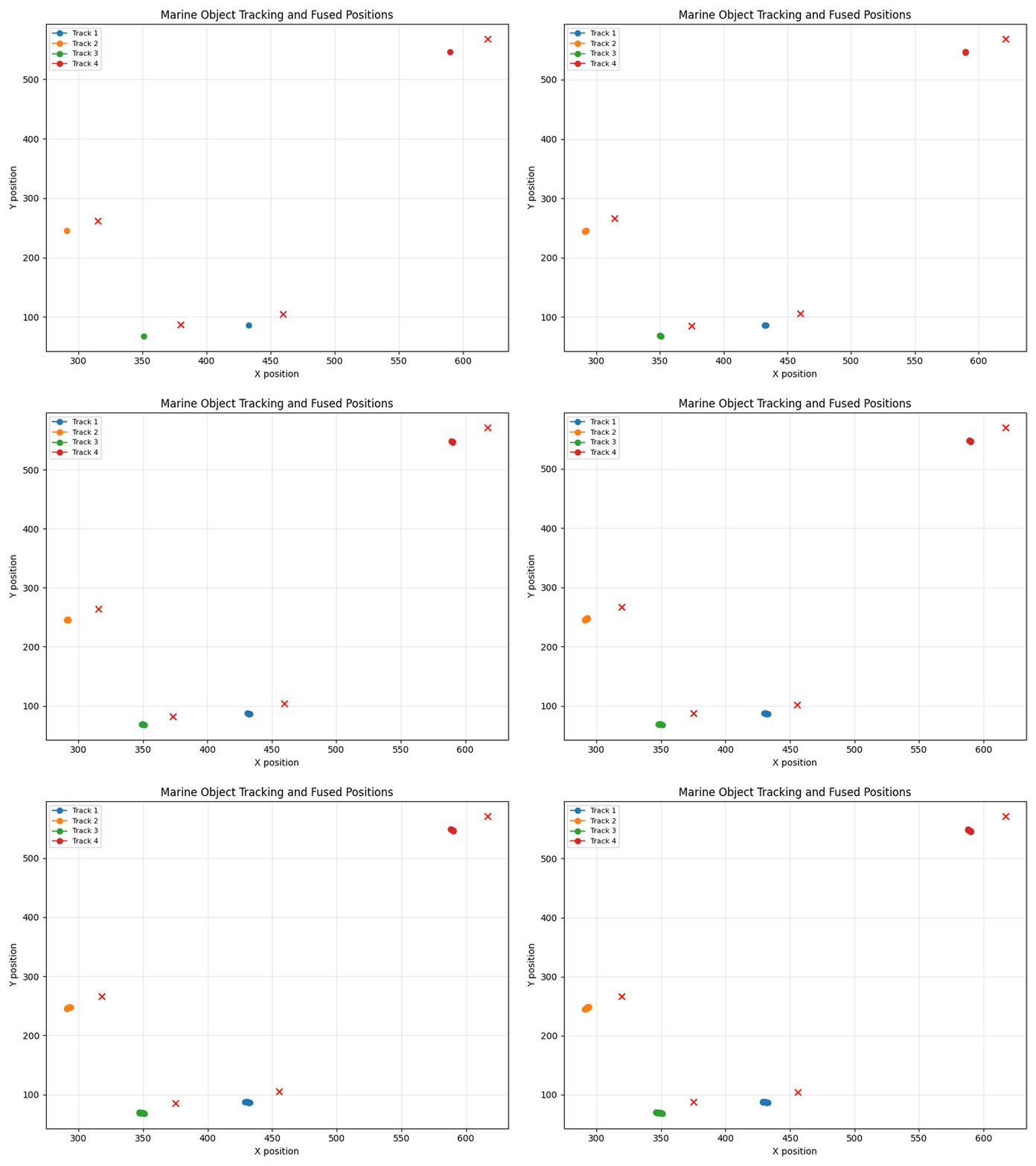
Still frame: 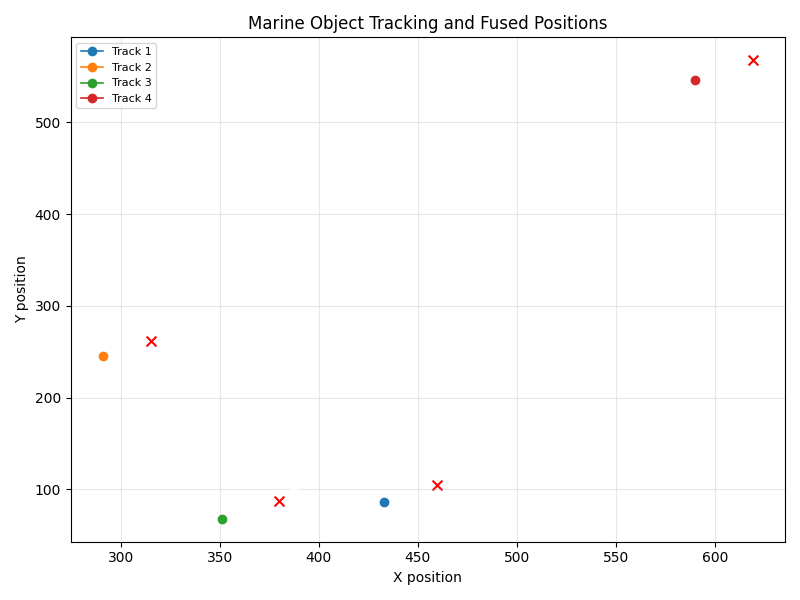
Contents
- Highlights
- Local demo (this is the live path)
- Quick start
- Detection modes
- Optional: train on synthetic data
- Architecture
- Design decisions and tradeoffs
- What we would change next
- Seeded benchmark
- Related work
- Related Fratres X threads
- Documentation
- Repository layout
- Tech stack
- Contributing
- Citation
- Disclaimer
- License
Highlights
- Multi-sensor simulation — sonar, acoustic, optical, and magnetic streams
- Honest detection modes — simulation default; YOLO when trained or explicitly requested
- Fusion & tracking — IoU-matched object IDs, weighted fusion, SORT-style tracks
- Operator outputs — bearing, estimated range, bearing rate, contact typing, change detection
- File replay — JSON frames via
JsonFileSensorAdapter(incoming_data/samples/) - Reproducible gates — seeded benchmark under
docs/benchmarks/ - Automated tests + GitHub Actions CI
Local demo (this is the live path)
No cloud app. The demo is a local run that writes reports and visualizations under marmf/reports/.
This is the Fratres X open-source posture: you run the stack.
# Windows
cd marmf
scripts\demo.ps1

# Linux / macOS
cd marmf
chmod +x scripts/demo.sh
./scripts/demo.sh
Equivalent one-liner after install:
cd marmf
python main.py --mode monitor --no-trained --duration 10 --num-objects 8
Regenerate the README GIF from a short run:
cd marmf
python main.py --mode monitor --no-trained --duration 3 --num-objects 4
python scripts/make_demo_gif.py
Quick start
cd marmf
python -m venv .venv

# Windows
.venv\Scripts\activate

# Linux / macOS
# source .venv/bin/activate

pip install -r requirements.txt
pip install -e .
python main.py --mode monitor --duration 10 --num-objects 8 --no-trained
From the repo root:
pip install -e marmf
Reports include detection_source (simulation, trained, pretrained, or explicit).
Detection modes
| Mode | How to enable |
|---|---|
simulation (default) |
No flags; uses simulator optical detections |
trained |
After main.py --mode train; auto-loads best.pt |
pretrained |
--pretrained (downloads yolov8n.pt) |
explicit |
--weights PATH |
Use --no-trained to skip auto-loading local trained weights.
Optional: train on synthetic data
cd marmf
python scripts/generate_dataset.py --clean
python main.py --mode train
python main.py --mode monitor
Architecture
See docs/ARCHITECTURE.md for pipeline diagram, module map, extension points, and how MAVMRF sits next to other Fratres X defensive-sensing / contested-autonomy work.
Simulated / file streams → preprocess → detect → track → fuse → report
Design decisions and tradeoffs
Maturity: simulation / prototype — not a fielded maritime C2 product.
| Choice | Why | Tradeoff |
|---|---|---|
| Simulation detections by default | Fresh clone stays honest and offline; no silent COCO YOLO download | Optical “detections” are synthetic until you train or pass --weights / --pretrained |
| IoU match before fusion | Keeps sonar/acoustic/magnetic joins on the same contact when YOLO boxes differ from sim boxes | Assumes overlapping 2D boxes; not a full 3D association layer |
| SORT-style tracker | Fast, reviewable track continuity for demos and gates | No deep appearance re-ID; coasting behavior is deliberately simple |
| Weighted multi-sensor fusion | Makes the multi-modal story concrete in reports | Weights are heuristic, not learned calibration from real sensors |
| Clone-and-run only | Matches Fratres X “you run it, you own the stack” open-source posture | No hosted demo for drive-by clicks |
This thread sits alongside Fratres X work on defensive sensing and contested autonomy: multi-modal streams, conservative fusion, and outputs you can audit — without claiming operational readiness.
What we would change next
- Real adapter implementations behind
SensorAdapter(AIS / acoustic / optical feeds) with recorded replay fixtures - Association beyond 2D IoU (bearing-range gates, timing uncertainty)
- Calibration / clutter models grounded in measured sensor noise, not only sim knobs
- Stronger track lifecycle metrics (continuity, ID switches) in the seeded benchmark
- Optional Docker one-liner for locked environments — still local, still yours
Seeded benchmark
Fixed-seed simulation gate (not field performance):
cd marmf
python scripts/benchmark.py --seed 42 --duration 5 --num-objects 6
Results live in docs/benchmarks/ (README.md + seeded_run.json).
Related work
MAVMRF is a simulation-first lab baseline. Domain surveys and open trackers that situate the design:
- Survey: Multi-sensor data fusion in maritime surveillance (PeerJ) — fusion methods; YOLO + tracking as common optical paths.
- Benchmark: Autoferry sensor fusion dataset — multi-sensor MOT fixtures with ground truth.
- Validated tracker: harbour-multi-sensor-tracking — radar/camera/AIS/GNSS + EKF/Hungarian, sim + harbour runs.
Full comparison table: docs/RELATED_WORK.md.
Related Fratres X threads
Sibling lab threads on fratres-x.com — same posture: physics-first modeling, conservative maturity labels, reviewable prototypes.
| Thread | Focus |
|---|---|
| Charybdis | Contested autonomy — hybrid UUV navigation, conservative fusion, validation gates |
| Anti Edge Node | Defensive sensing — acoustic / RF / visual fusion, audit logs, field-node concept |
| HYPERLINK | Missile-defense modeling — imperfect model constellations, uncertainty, simulation |
Profile pin checklist: docs/PROFILE_SETUP.md.
Documentation
| Doc | Description |
|---|---|
| docs/README.md | Documentation index |
| docs/ARCHITECTURE.md | Pipeline and extension points |
| docs/RELATED_WORK.md | Surveys, benchmarks, how MAVMRF fits |
| docs/benchmarks/ | Seeded reproducible gates |
| docs/ZENODO_SETUP.md | Mint a Zenodo DOI for releases |
| docs/SOLUTION_BRIEF.md | Executive narrative |
| docs/capability_matrix.md | Capability → evidence |
| docs/DEMO_SCRIPT_3_MIN.md | Demo script |
| CHANGELOG.md | Release history |
| SUPPORT.md | Where to get help |
| SECURITY.md | Vulnerability reporting |
Full CLI reference: marmf/README.md.
Repository layout
| Path | Description |
|---|---|
marmf/ |
Core framework (package name mavmrf) |
docs/ |
Architecture, brief, samples, screenshots, benchmarks |
CONTRIBUTING.md |
Setup, tests, CI |
marmf/tests/ |
Pytest suite |
Tech stack
Python 3.12 · OpenCV · NumPy · Ultralytics (YOLOv8) · PyTorch · Matplotlib · SciPy · pytest · ruff
Contributing
See CONTRIBUTING.md. By participating, you agree to the Code of Conduct.
Citation
See CITATION.cff. Prefer the “Cite this repository” button on GitHub when available.
Disclaimer
Portfolio prototype using simulated sensor data. Not intended for operational deployment without live sensor integration and validation. Built for scrutiny — not for inflated claims.
License
MIT — see LICENSE.
Explore related projects
codecrafters-io/build-your-own-x
Master programming by recreating your favorite technologies from scratch.
562,340 starspublic-apis/public-apis
A collective list of free APIs
498,777 starsmorluto/rea
Reverse engineer anything with agents, from app behavior down to native binaries.
457,534 starsopenclaw/openclaw
The AI that really does things. Any OS. Any Platform. The lobster way. 🦞
394,398 stars