
EspiroFares/Autonomous-UAV
EspiroFares/Autonomous-UAV has 37 GitHub stars and 4 forks. GitHot measured 0 stars in 24 hours. Last checked 2026-11-14 18:46 UTC. Last push 2026-08-31.
What you can do
- Autonomous person-following on real hardware. The full pipeline — camera → MediaPipe Pose → tracking → distance estimation → mission logic → velocity control → ArduPilot — runs on the aircraft's Raspberry Pi 4 and follows a person in real, GPS-denied indoor flight.
- Full sim-to-real workflow. A complete digital twin — Gazebo Harmonic + ArduPilot SITL + MAVROS — runs the exact same ROS 2 stack that flies the real aircraft. Behavior is validated in simulation before it ever touches hardware.
- GPS-denied stable hover. Active disturbance rejection by fusing a TF-Luna LiDAR (altitude) and an optical-flow sensor (lateral) into the flight controller's estimator. Push the drone — it returns to position on its own. (This milestone demo reached 120k+ impressions on LinkedIn.)
- Real-time perception on embedded hardware. MediaPipe Pose at 5–7 Hz on a passively cooled Pi 4, with an end-to-end pipeline latency of ~240 ms — down from ~1 s after systematic latency engineering (see deep-dives).
Measured star growth
- in 24h
- 0
- in 7 days
- Collecting history
- in 15 days
- Collecting history
- in 1 month
- Collecting history
Net star changes over overlapping periods, not daily totals. Missing measurements are left blank. Stars measure attention, not software quality.
About
Sim-first ROS 2 autonomy stack for an indoor person-following drone: Gazebo + ArduPilot SITL digital twin, deployed to real hardware.
Developer ToolsREADME.md
OriginalAutonomous Indoor Person-Following Drone
A sim-to-real ROS 2 autonomy stack — from a Gazebo digital twin to a real ArduPilot quadcopter.
Perception, world modeling, mission logic, control and safety run on a Raspberry Pi companion computer. A separate flight controller owns stabilization and hover. Everything is developed and validated in simulation first, then deployed to hardware — where it now flies and follows for real.










https://github.com/user-attachments/assets/dedac62f-8eef-4a71-9a92-5e3a34abefe3
Highlights
- Autonomous person-following on real hardware. The full pipeline — camera → MediaPipe Pose → tracking → distance estimation → mission logic → velocity control → ArduPilot — runs on the aircraft's Raspberry Pi 4 and follows a person in real, GPS-denied indoor flight.
- Full sim-to-real workflow. A complete digital twin — Gazebo Harmonic + ArduPilot SITL + MAVROS — runs the exact same ROS 2 stack that flies the real aircraft. Behavior is validated in simulation before it ever touches hardware.
- GPS-denied stable hover. Active disturbance rejection by fusing a TF-Luna LiDAR (altitude) and an optical-flow sensor (lateral) into the flight controller's estimator. Push the drone — it returns to position on its own. (This milestone demo reached 120k+ impressions on LinkedIn.)
- Real-time perception on embedded hardware. MediaPipe Pose at 5–7 Hz on a passively cooled Pi 4, with an end-to-end pipeline latency of ~240 ms — down from ~1 s after systematic latency engineering (see deep-dives).
- Fail-safe by design. Every timer-driven node treats stale inputs as invalid; any single node crash degrades the aircraft to a stable altitude-holding hover within ~1.5 s, and the launch system respawns the node. A single bridge node is the only path to the flight controller, and safety holds a veto over mission logic.
- Solo-built, end to end — physics, flight dynamics, perception, control, and the full ROS 2 graph.
Table of Contents
- What it does
- System architecture
- Perception pipeline
- Simulation stack (the digital twin)
- Ground station (live tuning)
- Engineering deep-dives
- Technology stack
- Project status
- Repository structure
- Getting started
- Roadmap
- Author
What it does
The drone autonomously detects a person, locks on, and follows them indoors — where GPS is unavailable. The companion computer turns a camera feed into a target estimate, decides what to do via a mission state machine, and produces high-level velocity commands. The flight controller turns those into stable, hovered flight. It holds a ~2 m following distance and a ~1.2 m lidar-referenced altitude — both live-tunable at runtime — yaws to keep the person centered, and freezes into a safe hover the moment the target — or any part of the pipeline — is lost.
The whole point is the sim-to-real split: the same nodes ran against a simulated quadcopter in Gazebo first and fly the real one now, so the simulator is a true development and regression environment — not a toy.
System architecture
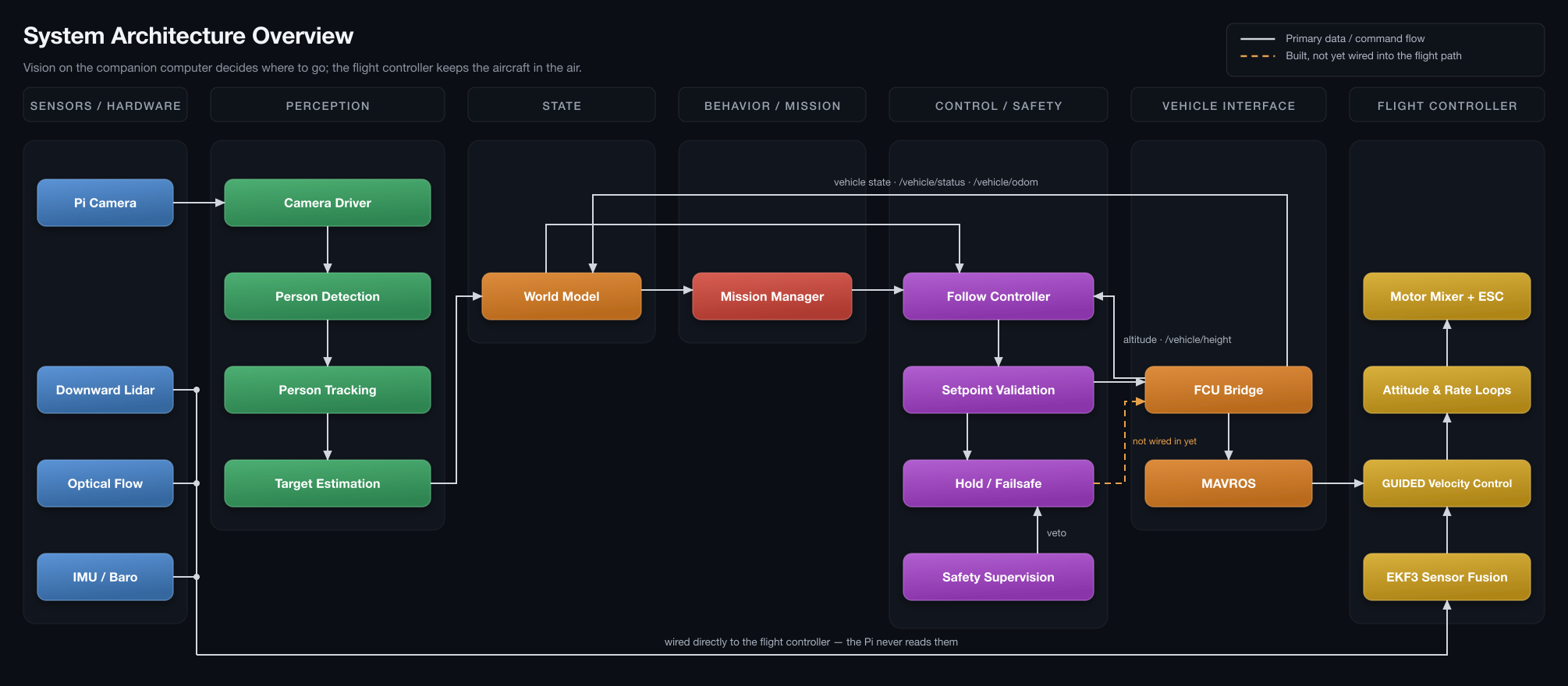
The stack is organized in clean layers. Data flows up from sensors into a world model, through mission and control logic, and back down to the flight controller — crossing the hardware boundary at exactly one place.
System overview
ROS 2 node / topic graph
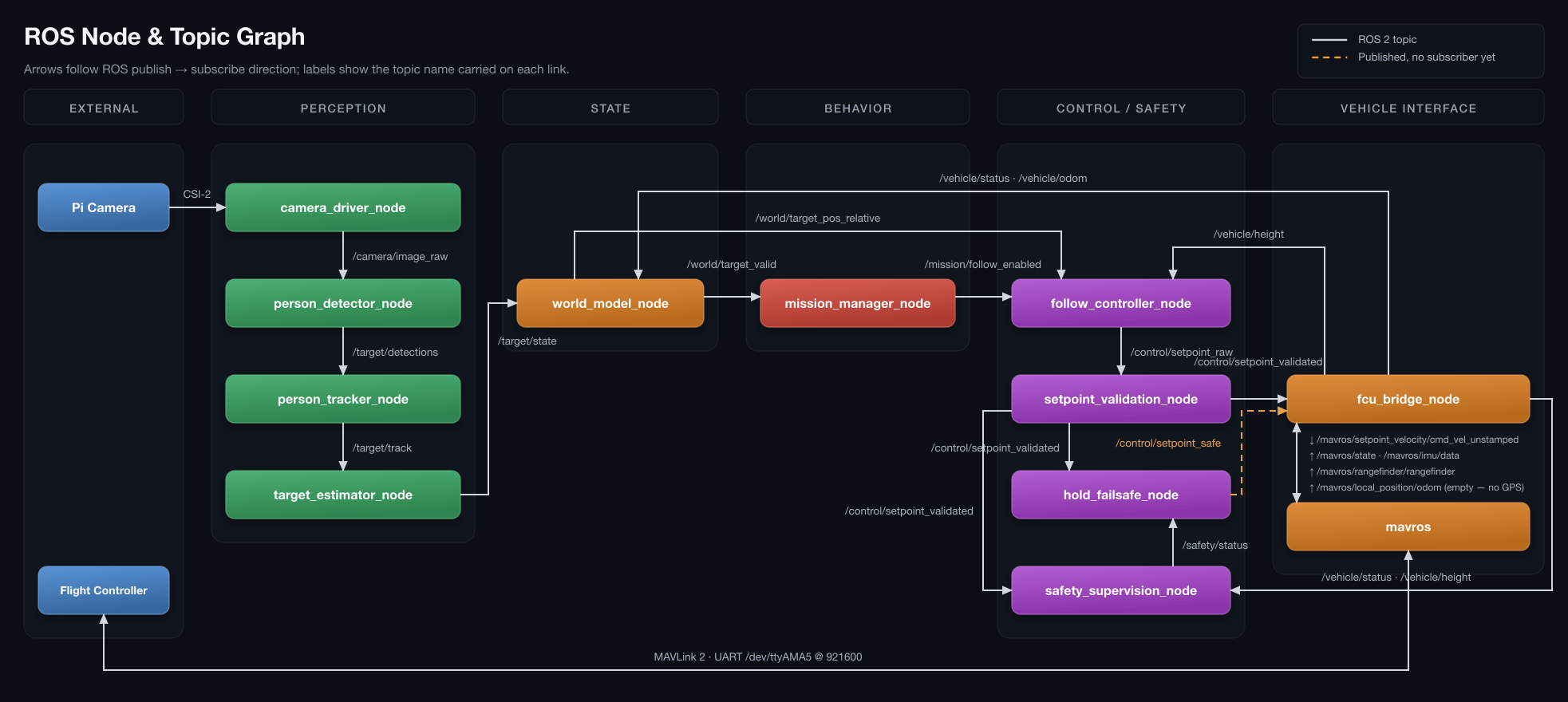
Both figures are generated from a single source of truth —
python3 docs/architecture/generate_diagrams.py— so they stay in step with the code.
Design principles (fixed from day one)
| # | Principle | Why it matters |
|---|---|---|
| 1 | fcu_bridge_node is the sole gateway to the flight controller |
No other node talks to the FC. One bridge keeps the hardware boundary clean and the rest of the stack fully testable in simulation. |
| 2 | Safety has veto | The safety layer can block any setpoint and force a hold/failsafe at any time, overriding mission logic. |
| 3 | ROS sends high-level commands only | ROS outputs vx, vy, vz, yaw_rate. The FC keeps its inner stabilization/hover loops — ROS never reimplements them. |
| 4 | Stability-critical sensors stay on the FC | Optical flow and the downward rangefinder belong to the low-level flight stack and are not moved onto the Pi. |
Perception pipeline
A streaming ROS 2 pipeline turns raw frames into a metric target estimate:
camera  ─►  person_detector   ─►  person_tracker  ─►  target_estimator  ─►  /target/state
(Pi camera     (MediaPipe Pose,     (EMA smoothing)    (pinhole geometry:
 via picamera2  shoulder landmarks)                     distance + yaw error)
 or Gazebo)
person_detector_node(Python, MediaPipe Pose) — locates a person from shoulder landmarks and emits a bounding box + shoulder width in pixels. Runs inference in a background thread on the latest frame only, so the camera stream can never queue up stale data.person_tracker_node(C++) — exponential-moving-average smoothing to suppress detection jitter.target_estimator_node(C++) — converts pixel measurements to a distance estimate via a pinhole camera model, plus a normalized yaw error for steering.
Downstream, world_model_node fuses perception with vehicle state, mission_manager_node runs the
behavior state machine (IDLE → TRACKING → FOLLOWING ↔ TARGET_LOST / SAFETY_HOLD) with a grace period
against momentary detection dropouts, and follow_controller_node produces clamped, validated velocity
setpoints — including a continuous lidar-referenced altitude hold.
On-hardware performance (Pi 4, passive cooling): 5–7 Hz detection rate, ~240 ms latency at the tracker output, ~350–400 ms camera-to-command.
Simulation stack (the digital twin)
Gazebo Harmonic (physics + simulated camera)
   ↕  ArduPilot SITL (real flight-control firmware, simulated dynamics)
   ↕  MAVROS  (MAVLink ⇄ ROS 2)
   ↕  fcu_bridge_node ─► the full ROS 2 autonomy stack
The simulator runs the real ArduPilot firmware (Software-In-The-Loop), not an approximation — so flight
modes, arming logic, and the MAVLink control contract behave exactly as on hardware. Gazebo provides a
camera feed bridged into the perception pipeline via ros_gz_bridge, and an animated walking actor acts
as the follow target.
This is what makes the sim-to-real claim real: a bug caught in SITL is a bug that would have happened on the drone — and several were (see deep-dives).
Demo — full autonomy stack in Gazebo + ArduPilot SITL. The complete perception → mission → follow loop running against the simulated quadcopter. Since ported to real hardware — see the demo above.
https://github.com/user-attachments/assets/22fade36-4afa-4486-8f35-493470875aa7
Ground station (live tuning)
A browser-based ground station connects to the aircraft over a rosbridge websocket and turns the whole autonomy stack into something you can tune, watch, and review in real time — no rebuilds, no redeploys.
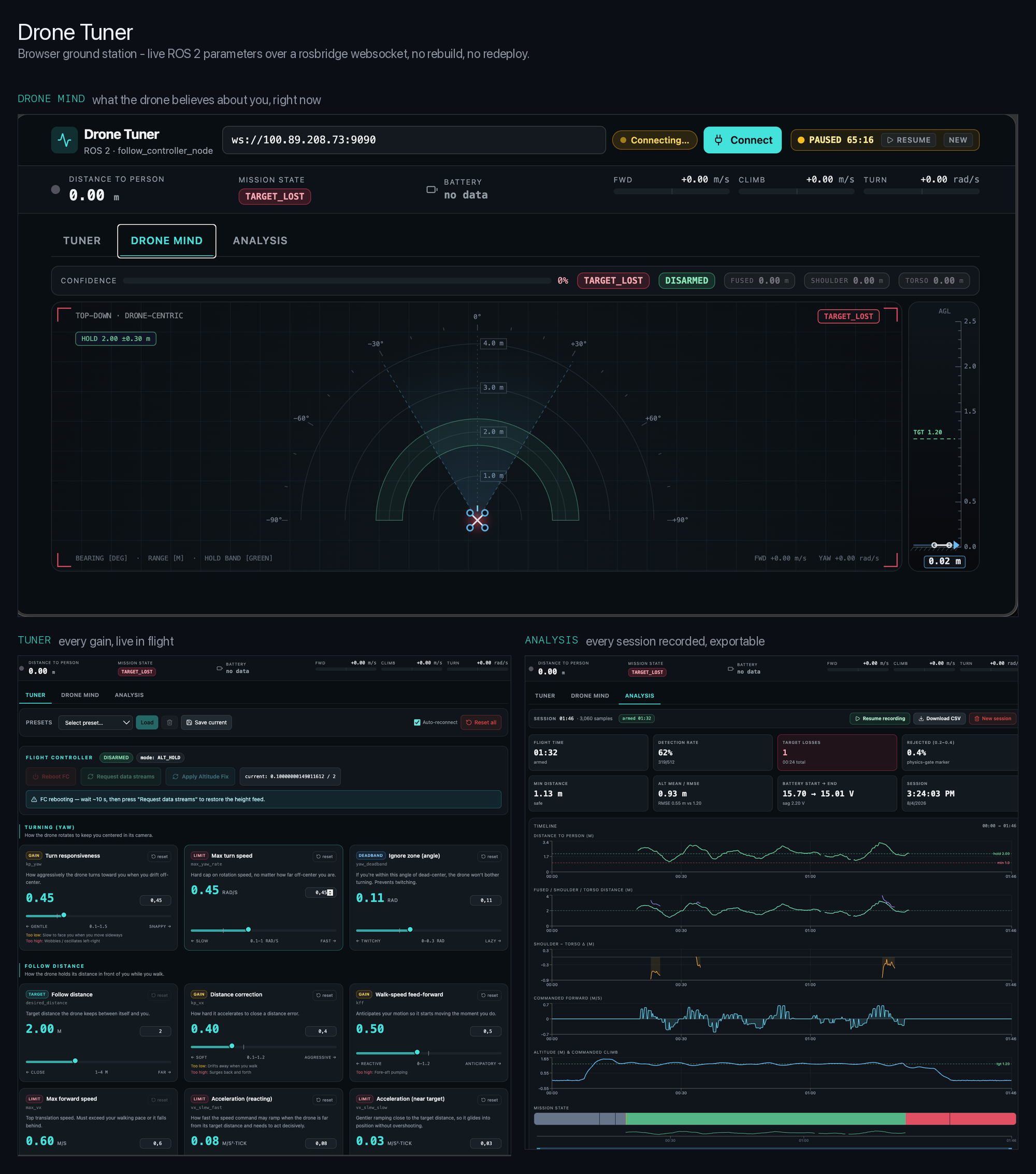
- Tuner — every controller gain is a live ROS 2 parameter; sliders push changes to
follow_controller_nodeinstantly (yaw, follow distance, altitude, safety limits) with per-parameter guidance. A Flight Controller panel exposes MAVROS actions: arm/mode status, Reboot FC, Request data streams, and a one-shot Apply Altitude Fix. - Drone Mind — a synthetic HUD built purely from telemetry (no video): a top-down view of the tracked person, hold zone, camera FOV and intent, plus a side-view altitude ladder against the target height.
- Analysis — an in-app ring-buffer recording with synchronized distance / velocity / altitude timelines, a mission-state strip, computed flight stats, and CSV export for offline analysis.
Built with React + TanStack Start and roslib.js, talking to rosbridge_server on the Pi. Lives in its
own repository: follow-drone-guardian.
Engineering deep-dives
A few of the harder problems solved along the way — the kind of thing that doesn't show up in a feature list.
Velocity commands in the wrong reference frame — why GUIDED mode "went crazy" while LOITER was perfect
On hardware, LOITER hovered flawlessly, but the moment GUIDED mode engaged, the drone flew off in
directions that had nothing to do with the camera. Every sensor checked out — so the fault had to be in
what the stack was sending. The culprit: MAVROS interprets velocity setpoints in LOCAL_NED (world
frame) by default. The controller computes "forward = toward the person" in body frame — so "forward"
was silently a fixed compass direction. As the drone yawed to track the person, its translation direction
never rotated with it: it spiraled while chasing an error it could never correct. One line in the MAVROS
config (mav_frame: BODY_NED) fixed it. The lesson generalizes: a controller and its executor must agree
on the reference frame, and that contract lives in configuration, not code.
Cutting perception latency from ~1 s to 240 ms — rate was never the bottleneck
The follower felt sluggish and overshot its turns, and the obvious suspect was the 5–7 Hz detection rate on the Pi. Profiling the pipeline told a different story: the rate was fine — the data was a second old. The latency budget: a depth-10 QoS queue in front of MediaPipe (~330 ms of always-stale frames, since the detector processed the oldest frame of a queue that never drained), inference (~150 ms), an aggressive EMA smoother (~360 ms of filter lag), and four unsynchronized 10 Hz timer hops (~250 ms). Fixes: QoS depth 1
- BEST_EFFORT on image topics, latest-frame-only threading in the detector, EMA α 0.3 → 0.6, camera 30 → 15 fps (feeding frames that were only thrown away was pure CPU heat). Result: ~240 ms at the tracker with detection rate unchanged — and a drone that turns toward where you are, not where you were a second ago.
Altitude hold that only worked in LOITER — and the fix that had never actually run
In GUIDED mode the drone slowly wandered in altitude, while LOITER held it perfectly. Root cause #1:
streaming vz = 0 velocity commands doesn't mean "hold altitude" — it means "hold zero climb rate," which
integrates every small EKF velocity bias into an unanchored random walk. LOITER holds an altitude position;
the command stream had replaced that with something weaker. The fix was a continuous P-loop on measured
height. Root cause #2 made it interesting: the loop read altitude from /mavros/local_position/odom — which
is permanently empty on a GPS-denied vehicle, because ArduPilot never sets an EKF origin and therefore
never emits LOCAL_POSITION_NED. The altitude controller had silently never executed. The final design reads
the downward lidar directly (which is also the better reference for "~1.2 m above the floor") — and a
deadband was deliberately removed, since a deadband on a velocity-commanded altitude loop creates a
drift-and-correct limit cycle. Continuous small corrections are exactly what LOITER does internally.
GPS-denied stable hover: a feedback loop hiding in the EKF logs
Indoor flight has no GPS, so position must come from a downward TF-Luna LiDAR (Z) and an optical-flow sensor (X/Y) fused into ArduPilot's EKF3 estimator. Early hover was unstable and oscillated. Digging into the EKF3 dataflash logs revealed the optical-flow and gyro contributions were effectively 180° out of phase — the correction was reinforcing the disturbance instead of cancelling it, a positive feedback loop. Fixing the orientation/sign of the fused signal turned the oscillation into crisp active disturbance rejection: nudge the drone and it drives itself back to where it started.
Monocular distance estimation — and a 3× calibration bug that drove the drone into its target
Range to the target is estimated from a pinhole camera model using the person's shoulder width in pixels.
During SITL testing the drone kept accelerating straight through the target instead of holding distance.
The cause: the camera's focal length was hardcoded for the wrong field of view, so every distance estimate
came out ~3× too large — the controller always believed the target was farther than the stop distance and
never slowed down. Found it by recording the pipeline with ros2 bag and cross-referencing the ArduPilot
crash logs, then recomputed the focal length from the camera's actual horizontal FOV. A reminder that a
perception bug shows up as a control failure.
GUIDED-mode takeoff vs. a continuous setpoint stream
ArduPilot's GUIDED mode requires a continuous velocity-setpoint stream as a keepalive. But that same stream
(vz = 0) silently overrides an in-progress NAV_TAKEOFF — the vehicle would arm, accept the takeoff,
never actually climb, and then auto-disarm on the ground-idle safety timer (a plain disarm, not a crash).
Isolating this required separating ArduPilot's own behavior from the ROS stack's, and it surfaced a real
ordering constraint in the offboard-control contract that the bridge node has to respect.
A multi-week altitude bob that lived in a single estimator parameter
For weeks the drone refused to hold a clean altitude in GUIDED — it bobbed ~10–15 cm and, worse, seemed
unable to climb past ~1.1 m, while STABILIZE climbed freely. Stack, battery, surface-tracking mode and a
dozen parameters were eliminated one by one from flight logs. The real cause was in the EKF3 vertical
channel: propwash and airframe vibration were corrupting the IMU-derived vertical velocity, and the estimator
was trusting it over the clean lidar. Down-weighting that vibration-corrupted velocity and tightening the
rangefinder's trust (EK3_RNG_M_NSE, RNGFND_FILT) let the estimator lean on the lidar it should have
trusted all along — height-hold standard deviation during motion dropped to ~5 cm. The lesson: not every
"control" problem is in the controller — sometimes the loop is fine and the estimate it closes on is the bug.
The drone dipped every time it flew forward — a downward lidar that lies when the airframe tilts
With altitude hold finally solid in a hover, a subtler artifact showed up in the follow: the drone sank a few
centimeters every time it accelerated forward and recovered as it stopped — "forward = down, backward = up."
Flight-log analysis ruled out a control limit cycle (altitude noise was nearly identical moving vs. hovering),
which pointed at geometry. To translate, a multirotor pitches; the body-fixed downward lidar then measures a
slanted range, height / cos(pitch), and reads too high — so the altitude P-loop saw "too high" and
commanded down, actively driving the dip. The fix projects the raw range back onto vertical using the FC's
attitude quaternion (height = range · cos(pitch) · cos(roll), the R₃₃ term) before it reaches the
controller, with a graceful fallback to the raw range if attitude is briefly unavailable. The directional
coupling vanished — measured forward-vs-backward drift dropped to noise.
Yaw that was either too slow or oscillating — until it accounted for distance
Steering-to-center felt sluggish when tracking someone at range, yet twitchy and oscillation-prone up close.
The two complaints share one cause: yaw is driven by the bearing angle atan2(y, x), and at close range a
small sideways step produces a large bearing swing — so a fixed gain over-reacts near the drone and
under-reacts far away. The control law now scales the yaw gain with distance (gentle inside a reference
radius, full authority beyond it, with a floor so it never stops facing you). Combined with a bearing-based —
never lateral-offset — error, it holds a smooth lock across the whole follow envelope.
Technology stack
| Layer | Technology |
|---|---|
| Framework | ROS 2 Jazzy (CycloneDDS) |
| Languages | C++17 (rclcpp), Python 3 |
| Perception | OpenCV 4, MediaPipe Pose, cv_bridge, picamera2 |
| Flight control | ArduPilot (Copter), MAVLink 2 via MAVROS over UART |
| Simulation | Gazebo Harmonic, ArduPilot SITL, ros_gz_bridge |
| Build / tooling | CMake, ament_cmake, colcon |
| Ground station | React + TanStack Start, roslib.js, rosbridge_server |
| Hardware | Raspberry Pi 4 (Ubuntu 24.04, native) · ArduPilot FC · Pi Camera · TF-Luna LiDAR · optical-flow sensor |
Project status
Honest split between what runs in simulation and what's proven on the real aircraft.
| Capability | Simulation (Gazebo + SITL) | Real hardware |
|---|---|---|
| Stable hover / position hold (GPS-denied) | ✅ | ✅ active disturbance rejection |
| Full perception pipeline (MediaPipe Pose → distance) | ✅ end-to-end | ✅ 5–7 Hz on the Pi, ~240 ms latency |
| Mission state machine + follow control | ✅ end-to-end | ✅ flight-tested person following |
| Lidar-referenced altitude hold in GUIDED | — | ✅ |
fcu_bridge_node (MAVROS gateway) |
✅ | ✅ over UART |
| Live parameter tuning (ROS params + web dashboard) | ✅ | ✅ runtime, no rebuild |
| Stale-data watchdogs + crash-safe degradation | — | ✅ any node crash → stable hover |
| Safety supervisor / failsafe nodes | 🔧 built, 23 unit tests, not launched yet | 🔧 fcu_bridge still reads /control/setpoint_validated |
Verification. Every push builds the whole workspace in a ROS 2 Jazzy container and runs
47 unit tests, cppcheck, and the ROS linters. The tests cover the places where a wrong
number does real damage rather than crashing something: the monocular range model (pinhole
fit, median filter, and the physics gate that rejects impossible target motion), the velocity
envelope applied to every command before it reaches the flight controller, and the safety
layer's fail-closed rules — including that a silent supervisor counts as a veto, not consent.
A separate job regenerates the architecture diagrams and fails if the committed figures have
drifted from the code.
Component breakdown
- Done:
drone_interfaces(custom messages) · full perception pipeline (camera_driver,person_detector,person_tracker,target_estimator) ·world_model·mission_manager·follow_controllerwith altitude hold ·setpoint_validation·fcu_bridge· single-command launch with auto-respawn · mock nodes for hardware-free testing · runtime-tunable ROS parameters · browser tuning dashboard (rosbridge) · CI with unit tests on the range model and the velocity envelope - Next: ground-test
drone_safetyand switchfcu_bridge_nodeover to/control/setpoint_safe· preflight check script · target reacquisition after TARGET_LOST
Repository structure
Expand tree
Autonomous-UAV/
├── docs/architecture/        # Diagram generator (generate_diagrams.py) + rendered SVG/PNG
└── software/drone_ws/src/
    ├── drone_interfaces/     # Custom .msg definitions (built first)
    ├── drone_perception/     # Camera → MediaPipe Pose → tracker → distance estimate
    ├── drone_state/          # fcu_bridge, world_model, mock FC/target
    ├── drone_behavior/       # Mission state machine
    ├── drone_control/        # Follow controller (incl. altitude hold) + setpoint validation
    ├── drone_safety/         # System supervisor + hold failsafe (not in the flight path yet)
    └── drone_bringup/        # Launch (MAVROS + stream setup + full stack, respawn)
Getting started
The stack runs natively on Ubuntu 24.04 with ROS 2 Jazzy. On the Raspberry Pi, CycloneDDS is required
(export RMW_IMPLEMENTATION=rmw_cyclonedds_cpp).
Build the workspace
cd software/drone_ws
colcon build            # drone_interfaces builds first automatically
source install/setup.bash
Fly the real aircraft
One launch file brings up MAVROS (UART to the FC), requests the FC data streams, and starts all ten nodes with auto-respawn:
ros2 launch drone_bringup real_chain.launch.py
Verify before arming: /vehicle/height is publishing (~0.3 m on the ground), /target/detections at
5–7 Hz. Then: arm in LOITER over open floor → take off → throttle to mid → switch to GUIDED. The ROS stack
takes over; the LOITER switch is the manual override at all times.
Run the Gazebo + ArduPilot SITL simulation
Prerequisites: ArduPilot SITL (sim_vehicle.py), the ardupilot_gazebo plugin, and Gazebo Harmonic.
- Gazebo (server + GUI) with the warehouse world.
- ArduPilot SITL —
sim_vehicle.py -v ArduCopter -f gazebo-iris --model JSON --out tcpin:0.0.0.0:5770 - MAVROS —
ros2 launch mavros apm.launch fcu_url:=tcp://127.0.0.1:5770 - Camera bridge —
ros2 run ros_gz_bridge parameter_bridge ...camera...image - Autonomy stack — the same nodes as on hardware.
For a hardware-free look at the architecture, the mock nodes (mock_fcu_node, mock_target_node)
replace the FC and the perception pipeline respectively.
Roadmap
- End-to-end mock chain
- Full perception pipeline (MediaPipe Pose)
- Gazebo + ArduPilot SITL digital twin with
fcu_bridge_node - GPS-denied stable hover with disturbance rejection on real hardware
- Raspberry Pi 4 companion-computer integration (native, no container)
- Autonomous person-following on the real aircraft
- Stale-data watchdogs — crash-safe degradation to hover
- Runtime-tunable ROS parameters + browser tuning dashboard
- Ground-fitted range calibration (shoulder and torso, least-squares)
- Physics gate — reject target jumps no person could make
- CI: workspace build, unit tests and linters on every push
- Safety supervisor + hold failsafe (
drone_safety), unit tested - Ground-test the safety layer and put it in the flight path
- Preflight check script
- Target reacquisition after TARGET_LOST
Author
Fares Espiro — M.Sc. student in Autonomous Systems @ Linköping University. Robotics · Computer Vision · Embedded AI. Building robots end-to-end, from physics simulation to sim-to-real deployment.


