
EGalahad/vla-scratch
EGalahad/vla-scratch has 356 GitHub stars and 15 forks. GitHot measured 0 stars in 24 hours. Last checked 2026-11-19 11:21 UTC. Last push 2026-09-01.
What you can do
- TensorClass is used to define explicit data boundaries between modules, making our codebase fully typed and modular.
- This allows heterogeneous dataset co-training, and clearer data flow between datasets, policies, and transforms.
- We rewrite the forward pass of VLMs to eliminate all host-device syncs.
- Instead of relying on generic libaries like accelerate, vla-scratch leverage native torch operations like FSDP2 and gradient checkpointing for dedicated performance tuning.
Measured star growth
- in 24h
- 0
- in 7 days
- Collecting history
- in 15 days
- Collecting history
- in 1 month
- Collecting history
Net star changes over overlapping periods, not daily totals. Missing measurements are left blank. Stars measure attention, not software quality.
About
VLA-Scratch is a modular, performant and efficient stack with minimal dependencies that makes training, evaluating, and serving Vision-Language-Action (VLA) models fast and approachable.
Developer ToolsREADME.md
OriginalVLA-Scratch


VLA-Scratch is a modular, performant and efficient stack with minimal dependencies that makes training, evaluating, and serving Vision-Language-Action (VLA) models fast and approachable.
🚀 Quickstart
We use uv to manage dependencies. Run GIT_LFS_SKIP_SMUDGE=1 uv sync to set up the environment.
Verify your installation with the following commands:
# Training
uv run torchrun --standalone --nnodes=1 --nproc_per_node=8 \
    scripts/train_policy.py \
    policy=pi-qwen \
    data=libero-spatial \
    lr.base=5e-5 \
    +lr.vlm_bridge=1e-5 \
    +lr.action_expert=5e-5 \
    wandb.mode=online

# Evaluation
uv run scripts/eval_policy.py \
    checkpoint_path=hf:elijahgalahad/libero-spatial-qwen \
    data=libero-spatial \
    data.video_backend=pyav \
    merge_policy_cfg=true

# Serving
uv run scripts/serve_policy.py \
    checkpoint_path=hf:elijahgalahad/libero-spatial-qwen \
    data=libero-spatial \
    merge_policy_cfg=true
See scripts/README.md for more training commands. See examples/libero for LIBERO evaluation instructions.
✨ Key-Features
- Explicit Data Model for Composable Modules
TensorClassis used to define explicit data boundaries between modules, making our codebase fully typed and modular.- This allows heterogeneous dataset co-training, and clearer data flow between datasets, policies, and transforms.

- Dedicated Tuning for a First-Class Performance Stack
- We rewrite the forward pass of VLMs to eliminate all host-device syncs.
- Instead of relying on generic libaries like
accelerate,vla-scratchleverage nativetorchoperations likeFSDP2and gradient checkpointing for dedicated performance tuning.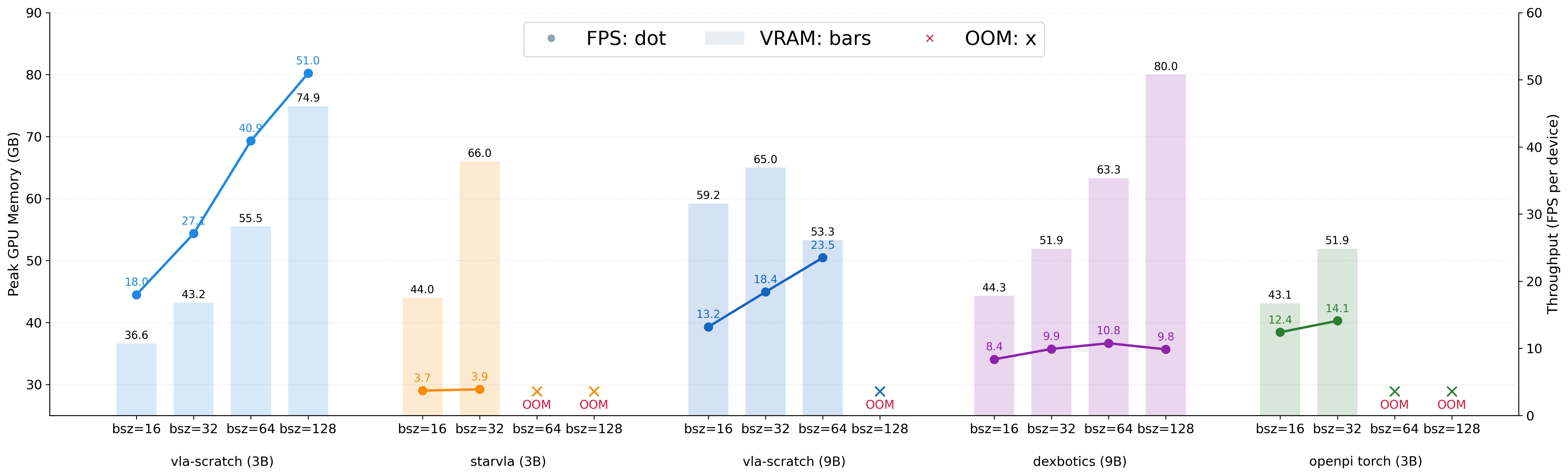
- Rich Feature Set Out-of-the-Box
- Multi-source dataset co-training: VQA and robotic datasets co-training.
- Multi VLM backbone support: Qwen3-VL, PaliGemma 1/2, SmolVLM.
- Simulation-ready checkpoints and serving scripts.
- Clarity-Focused Hydra Workflow for Seamless Experimentation
🗂️ Codebase Structure
| Path | Description |
|---|---|
vla_scratch/transforms/ |
Data transforms and TensorClass models |
vla_scratch/datasets/ |
Dataset loaders and transforms |
vla_scratch/policies/ |
Policy interfaces, bridges, and action heads |
scripts/ |
Training/eval/serving scripts |
🧭 Developer Guide
| Use Case | Where to go |
|---|---|
| Create a new dataset | 1) Create a new folder, e.g. vla_scratch/datasets/<dataset_name>.2) Add implementation and configs (e.g. dataset.py, config.py).3) Register the dataset config with Hydra ConfigStore in config.py under the data group. |
| Add a new VLM backbone | 1) Create a new folder under vla_scratch/policies/modules/vlm_bridge/.2) Implement preprocessing in processor.py, define the policy_input contract between preprocessing and encoding, and implement the main encoding in bridge.py.3) Wire the backbone into vla_scratch/policies/pi/policy.py. |
| Add a new loss term | 1) Add the loss inside compute_loss in vla_scratch/policies/pi/policy.py2) Return it in log_dict so it is logged to Weights & Biases. |
| Format code | Run uvx ruff format. |
🛠️ Troubleshooting (To be Continued)
RTX 5090 Compatibility
Issue
PyTorch stable has not yet fully supported CUDA 12.8 for RTX 5090
(Blackwell-generation GPU, compute capability sm_120).
This may lead to kernel launch failures or CUDA unavailable errors.
Solution
Use PyTorch-Nightly instead of stable PyTorch.
Add the following to your <pyproject.toml>:
```
[[tool.uv.index]]
name = "pytorch-nightly-cu128"
url = "https://download.pytorch.org/whl/nightly/cu128"
default = true

[[tool.uv.index]]
url = "https://pypi.org/simple"

[tool.uv.sources]
torch = { index = "pytorch-nightly-cu128" }
torchvision = { index = "pytorch-nightly-cu128" }
triton = { index = "pytorch-nightly-cu128" }

```