
DresdenGman/Grid-Extreme-Risk-Toolkit-GERT-
DresdenGman/Grid-Extreme-Risk-Toolkit-GERT- has 60 GitHub stars and 1 forks. GitHot measured 0 stars in 24 hours. Last checked 2026-11-16 19:41 UTC. Last push 2026-11-11.
Measured star growth
- in 24h
- 0
- in 7 days
- Collecting history
- in 15 days
- Collecting history
- in 1 month
- Collecting history
Net star changes over overlapping periods, not daily totals. Missing measurements are left blank. Stars measure attention, not software quality.
About
Probabilistic grid-risk decision support with tail-risk analysis, calibration gates, and explicit data/model provenance.
Web & AppsREADME.md
Original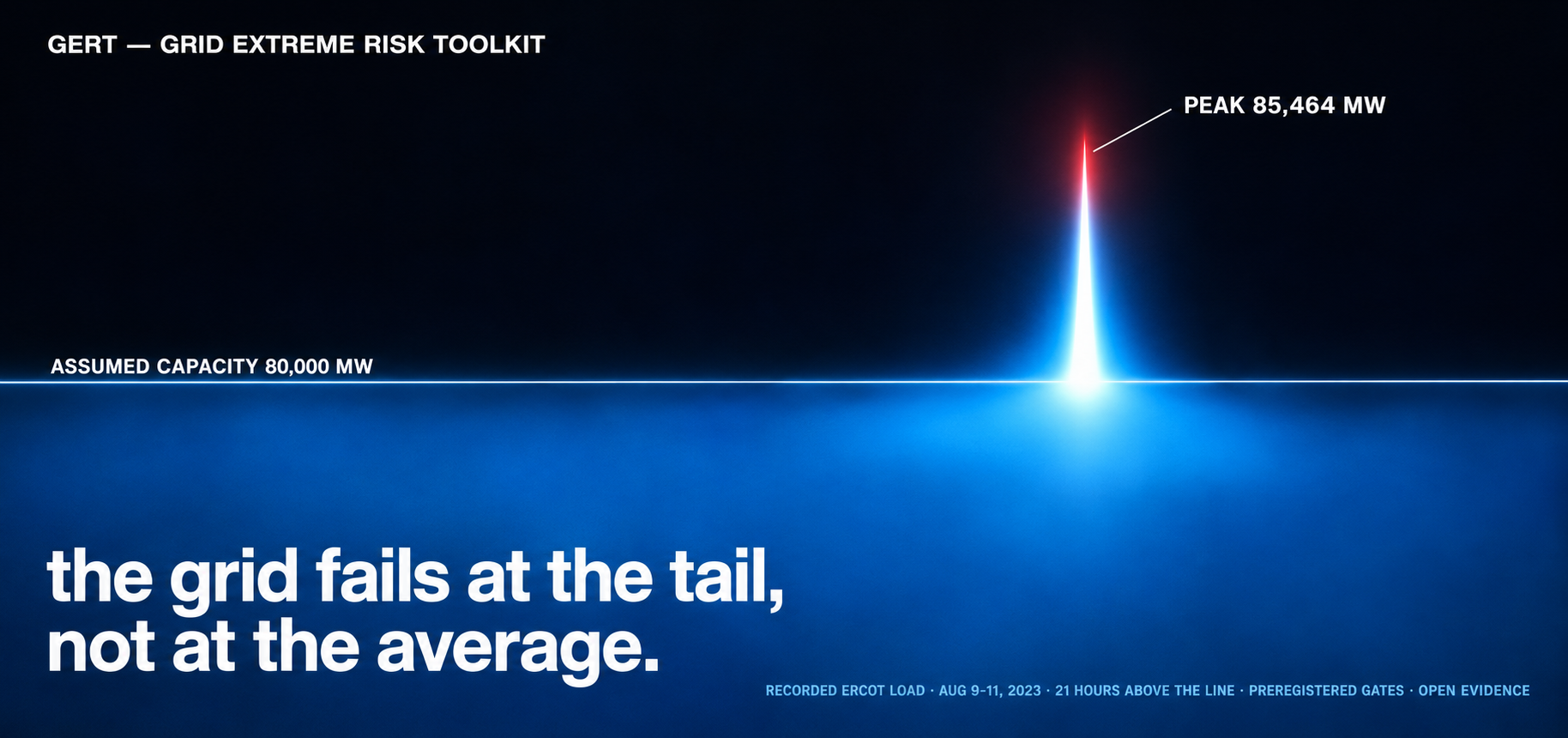



Probabilistic grid-risk decision support with tail-risk analysis, calibration gates, and explicit data/model provenance.
| 216 | 115+ participants | Skill is not enough | Archived |
|---|---|---|---|
| recorded ERCOT hours in the public Historical Lab — every number on this page can be recomputed from them | ran the lab in two pilot sessions; 57 returned the survey, and their criticism is printed below, not buried | the latest model candidate scored pinball skill +0.76 to +0.84 — and was rejected for missing its calibration gates | software and dataset carry separate Zenodo DOIs (badges above); releases are versioned and citable |
Start here
| If you want to… | Go here | Time |
|---|---|---|
| Reproduce the Historical Lab calculations yourself | Colab reproduction notebook or reproduction guide | ~15 min |
| Review the evidence, including why the latest model candidate was rejected | Evidence page and the v1.4 decision record | ~10 min |
| Run GERT with a class or group | 20-minute workshop plan | 20 min |
The problem, in one picture
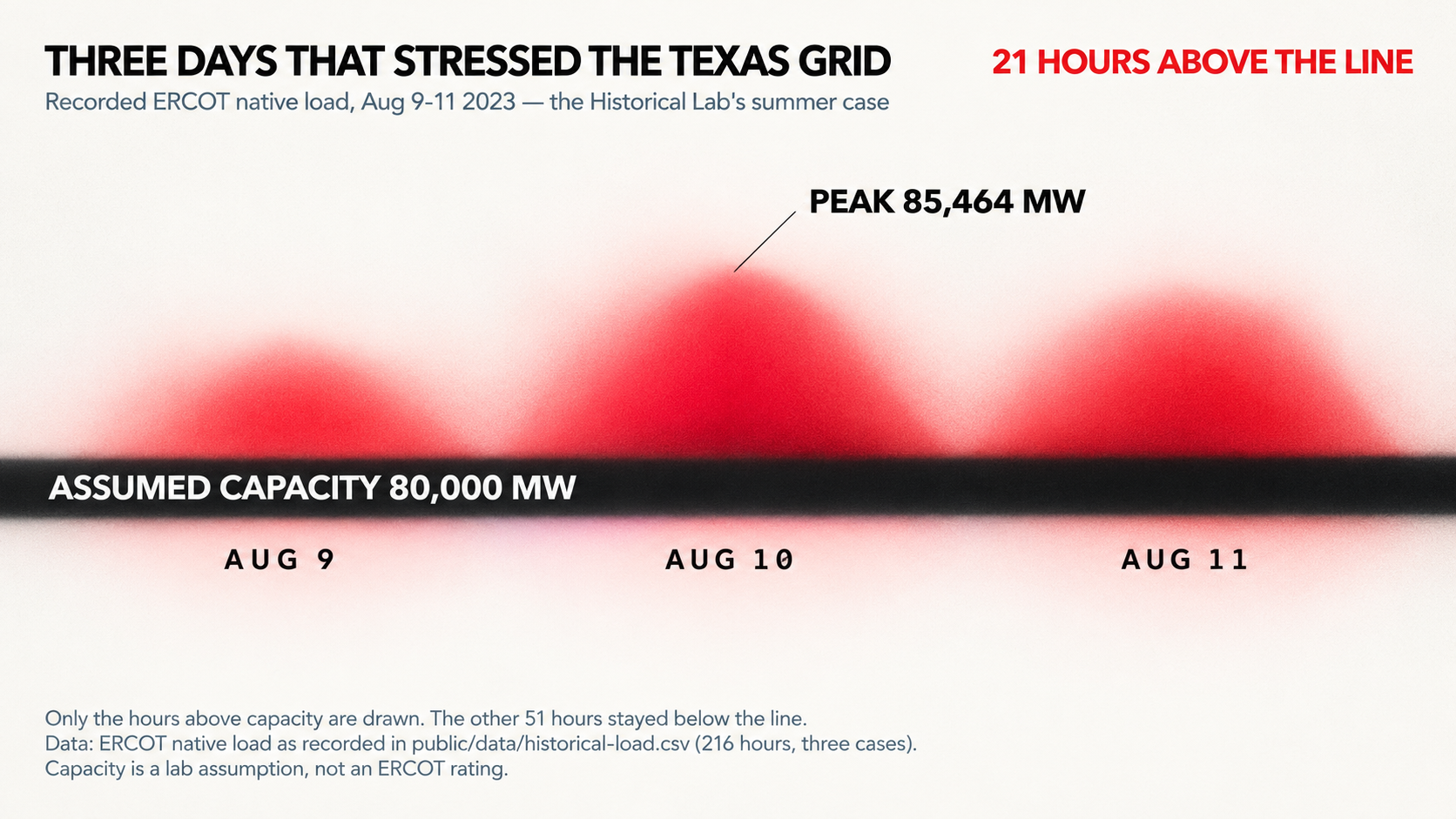
In August 2023, Texas electricity demand crossed an 80,000 MW line 21 times in three days. A grid does not fail at the average — it fails at the tail. GERT exists to make that tail visible early: how close an unlikely-but-plausible demand peak comes to the system boundary, what would have to change to stay clear of it, and — just as visibly — when its own forecasting model is not good enough to be trusted with the answer.
How a candidate earns the right to serve
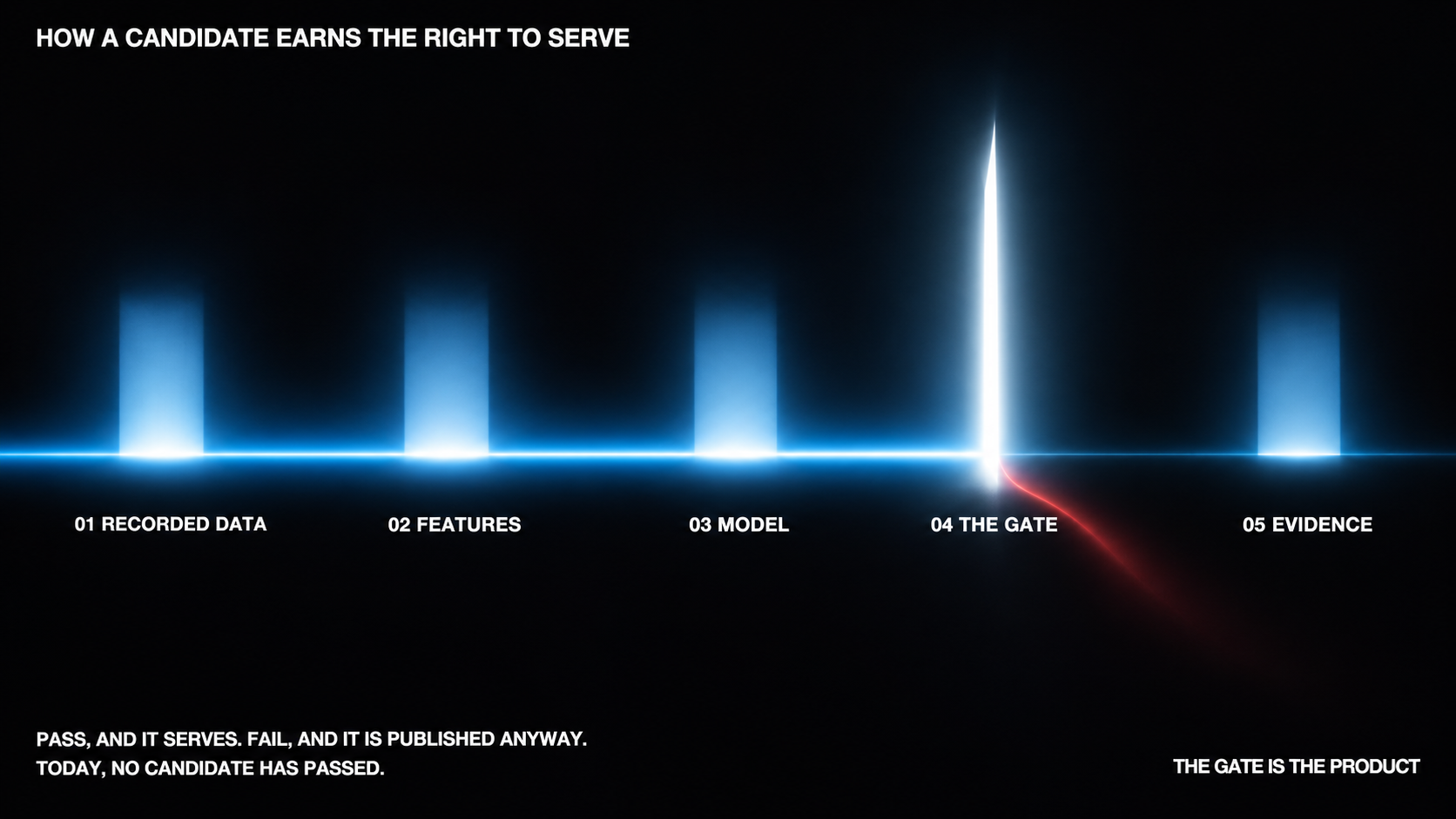
Every model candidate is judged against gates that are written down before its evaluation window is opened — and the verdict is published either way.
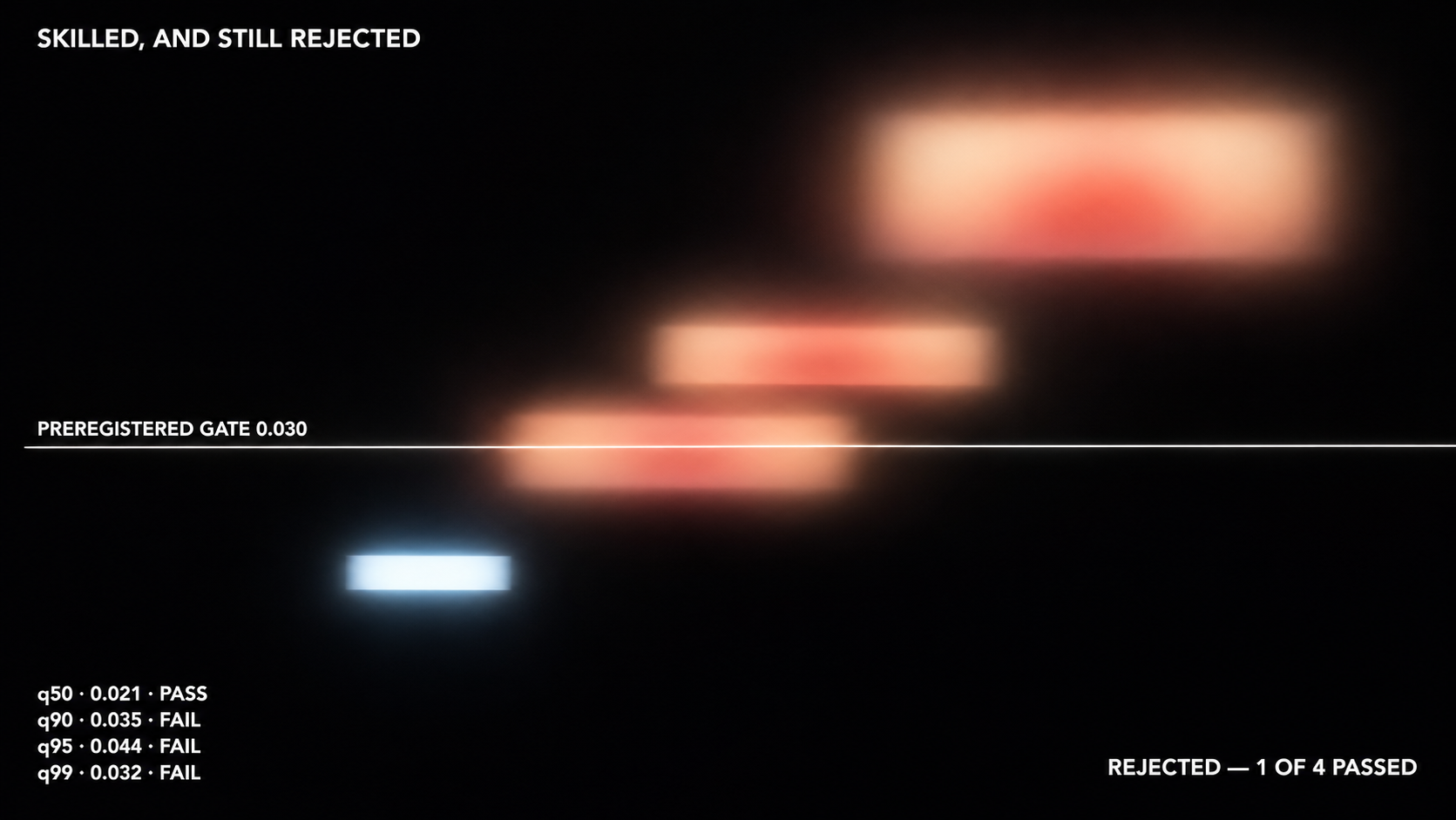
Latest probabilistic candidate (ercot-delta-quantile-v1.4) — rejected for production, by its own predeclared gates (frozen 96-hour evaluation window; machine-readable evidence in evidence/ercot_v1_4_validation.json, full record in docs/DECISION_RECORD_ERCOT_v1_4.md):
| Gate | Requirement | Observed | Result |
|---|---|---|---|
| Pinball skill vs frozen seasonal baseline | > 0 at every quantile | +0.76 to +0.84 | Pass |
| Q50 calibration error | ≤ 0.03 | 0.021 | Pass |
| Q90 calibration error | ≤ 0.03 | 0.035 | Fail |
| Q95 calibration error | ≤ 0.03 | 0.044 | Fail |
| Q99 calibration error | ≤ 0.03 | 0.032 | Fail |
| Quantile crossings | 0 | 0 | Pass |
Ninety-six hourly observations is a small sample for tail quantiles — the tail sample diagnostic documents what this window can and cannot resolve. The gates were applied exactly as predeclared: the thresholds were fixed before the evaluation window was opened and were not relaxed after the failure. Until a candidate passes every gate, the prediction, scenario, and validated-backtest endpoints return an explicit 503. The next candidate (v1.5, per-quantile recalibration) is already preregistered under the same rules.
Historical Lab — the part anyone can run today

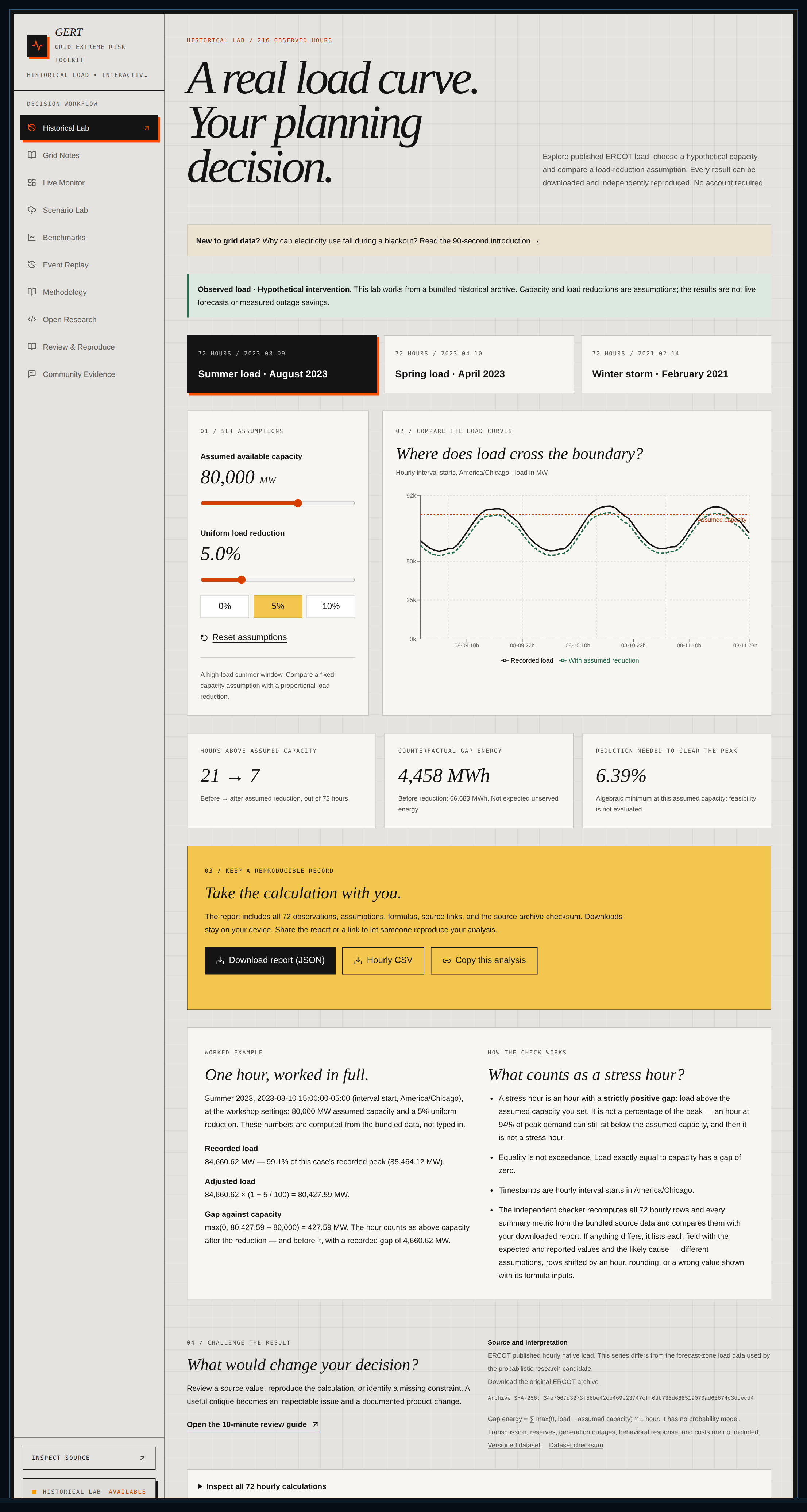
Historical Lab (public, no credentials needed) — 216 observed hourly ERCOT native-load values across three 72-hour windows (Aug 9–11 2023, Apr 10–12 2023, Feb 14–16 2021). Reference check for one case (summer-2023, 72 h, assumed capacity 80,000 MW), recomputed with the repo's independent Python checker (scripts/verify_historical_report.py):
| Setting | Hours above capacity | Gap energy | Minimum uniform reduction to clear the peak |
|---|---|---|---|
| 0% reduction | 21 | 66,683 MWh | 6.393% |
| 5% reduction | 7 | 4,458 MWh | 6.393% |
The minimum uniform reduction is a property of the recorded peak (85,464 MW) against the assumed capacity, so it is identical in both rows by definition.
Open the working lab · Review it in 10 minutes · Reproduce the calculations · Run a 20-minute workshop · Pilot feedback — 57 responses
Select a case, set an assumed capacity and a uniform load reduction, compare outcomes, then export the hourly CSV and a JSON report with sources, assumptions, and checksums. This is deterministic historical analysis: capacity and interventions are counterfactual assumptions, and the calculated gap energy is not a probabilistic forecast, expected unserved energy, or realized savings. Reviewers can use the Historical Lab without credentials or a model server.
What participants said
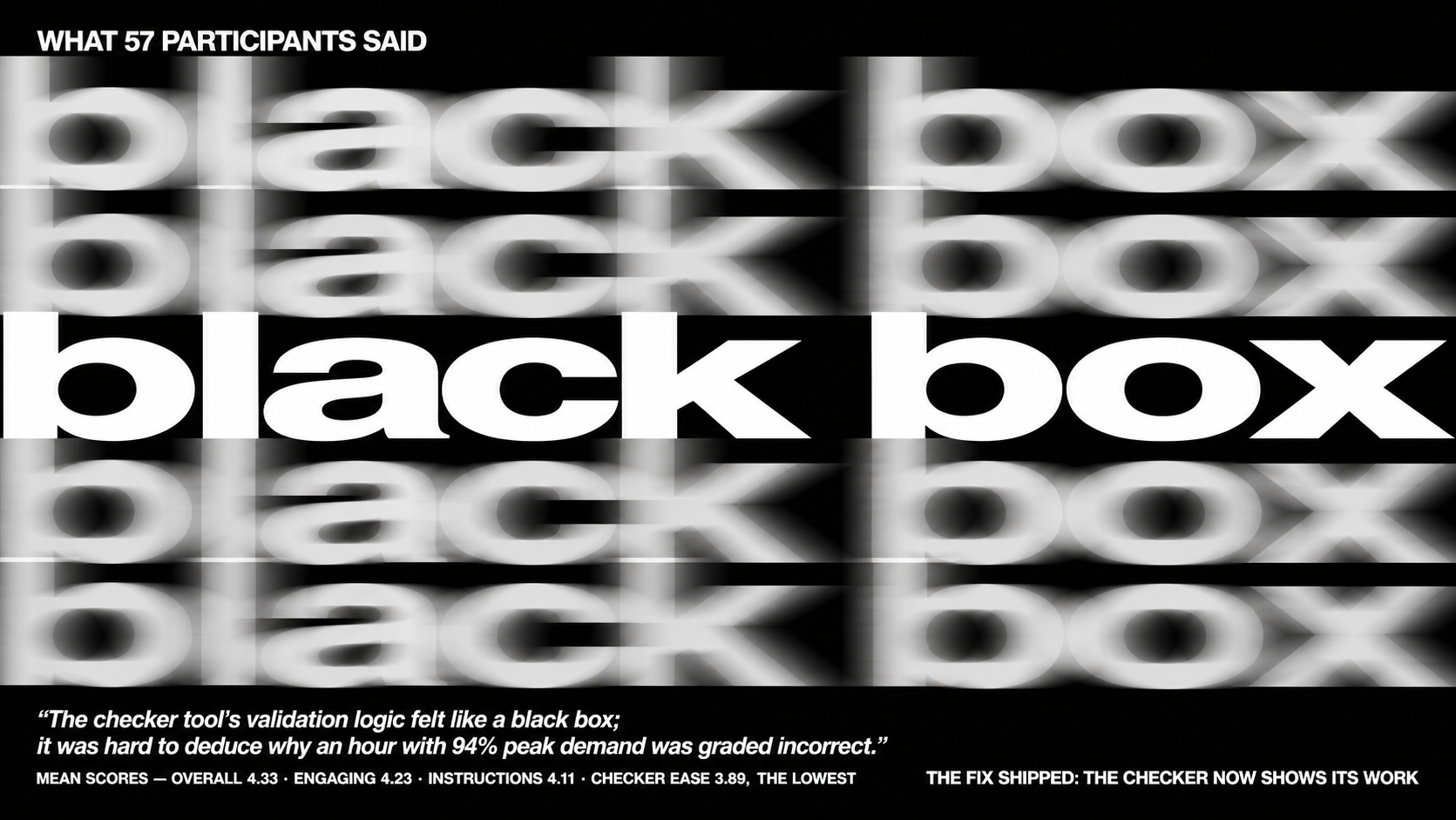
"The checker tool's validation logic felt like a black box; it was hard to deduce why an hour with 94% peak demand was graded incorrect." — pilot participant, quoted with consent (full feedback report)
That criticism was acted on in the open: the checker now explains every rejection field by field — expected value, submitted value, difference, and the likely cause — and the lab page works a real example end to end before asking anyone to trust it.
See it
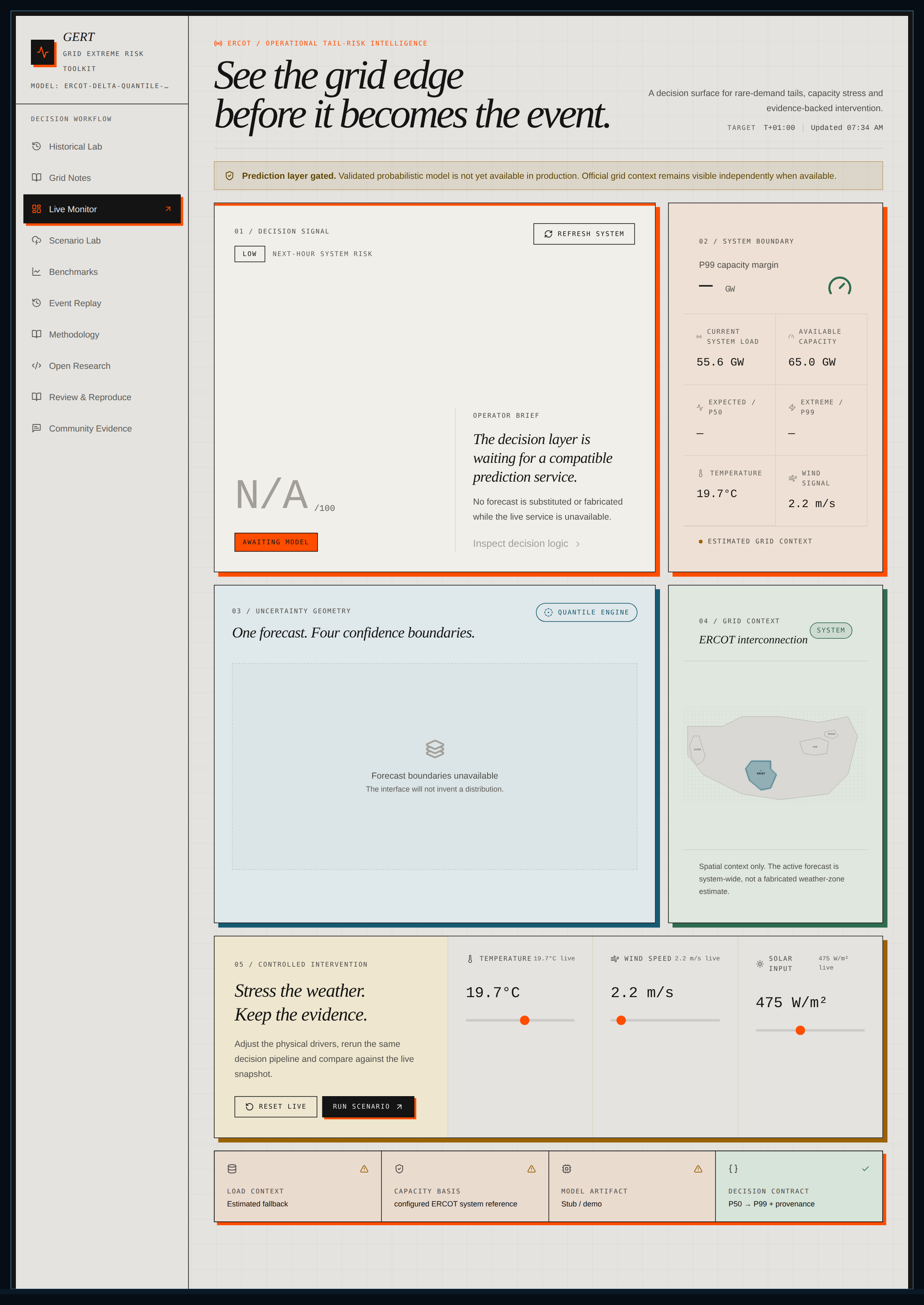
The Historical Lab, running on the bundled 216-hour dataset — assumptions on the left, the crossing chart and the three headline numbers on the right, then a worked example that shows every step of one hour's arithmetic:
 |
 |
| Live Monitor. The gate is visible in the product itself: the candidate is labeled REJECTED, the signal reads AWAITING MODEL, and no forecast is substituted or fabricated while the service is unavailable. | Review & Reproduce. The standing invitation: a five-minute counterexample, a guided 10-minute review, and full reproduction without the website. |
Public product state
- Official operating context: the backend can retrieve current ERCOT load and adequacy data with server-side ERCOT credentials.
- Weather context: live weather is retrieved from external public sources with timestamps and provenance.
- Probabilistic model: the latest
ercot-delta-quantile-v1.4candidate is rejected for production. It demonstrated positive pinball skill at every reported quantile, but missed the predeclared ±3 percentage-point calibration tolerance at Q90, Q95, and Q99 on the frozen 96-hour evaluation window. - Production behavior: prediction, scenario, and validated-backtest endpoints return an explicit
503until avalidated_productionartifact is active. - Evidence: sanitized candidate results remain public through
GET /model/evidenceand the Evidence page. - Presentation mode:
?demo=1is an explicit simulated mode for interface demonstrations. Live mode never falls back to simulated predictions after an error.
GERT is research and decision-support software, not autonomous grid control. Unvalidated, simulated, fallback, and unavailable states are labeled and never silently promoted to production authority.
The release contract and promotion gates are documented in docs/PRODUCT_RELEASE_ACCEPTANCE.md.
Product surfaces
| Surface | Purpose | Authority |
|---|---|---|
| Live Monitor | Official load, capacity context, weather, timestamps, and provenance | Operational context |
| Scenario Lab | Perturb weather and physical drivers through the active model contract | Gated until model validation |
| Event Replay | Explain how tail pressure can evolve during an extreme event | Labeled educational reconstruction |
| Evidence | Publish skill, coverage, promotion gates, provenance, and limitations | Versioned observed evidence |
Mathematical core
GERT models a conditional distribution rather than only a conditional mean. For quantile level q, training minimizes pinball loss:
Lq(y, y_hat) = max(q(y - y_hat), (q - 1)(y - y_hat))
The current research path predicts one-hour load change relative to the latest official load anchor and reconstructs ordered P50/P90/P95/P99 levels. Promotion requires all frozen gates to pass:
- Positive pinball skill against the frozen month-hour baseline at every served quantile.
- Absolute empirical-coverage error no greater than
0.03at P50/P90/P95/P99. - Quantile-crossing rate no greater than
0.05. - Finite outputs and serving features available at prediction time.
- An immutable metadata, evaluation, and evidence bundle.
A failed candidate remains research evidence; thresholds are not changed after the evaluation window is observed.
Architecture
ERCOT Public API ─┐
                  ├─ FastAPI evidence + data layer ── Next.js product UI
Weather sources ──┘               │
                                  ├─ artifact validation gate
                                  ├─ risk and scenario services
                                  └─ SQLite/PostgreSQL persistence
- Frontend: Next.js 16, React 18, TypeScript, Tailwind CSS, Recharts.
- Backend: FastAPI, Pydantic 2, SQLAlchemy 2, NumPy/SciPy/scikit-learn.
- Public release: Vercel Next.js frontend with same-origin
/api/gertruntime. Historical analysis runs entirely in the browser. FastAPI/Railway remains a separate supported deployment path. - Security: explicit production CORS, request IDs, rate limits, no-store API responses, browser security headers, non-root container, and server-only credentials.
Local development
To run the public Historical Lab alone:
npm ci
npm run dev
No ERCOT credentials, Python environment, or running backend are required for that workflow. The optional separate backend setup is below.
Requirements:
- Node.js 22+
- Python 3.12+
git clone https://github.com/DresdenGman/Grid-Extreme-Risk-Toolkit-GERT-.git
cd Grid-Extreme-Risk-Toolkit-GERT-

npm ci
python3 -m venv .venv
./.venv/bin/pip install -r requirements.txt -r requirements-training.txt

cp .env.example .env
Run the backend and frontend in separate terminals:
APP_ENV=development MODEL_BACKEND=stub ./.venv/bin/uvicorn api.app:app --reload --port 8000
NEXT_PUBLIC_API_URL=http://localhost:8000 NEXT_PUBLIC_DATA_MODE=live npm run dev
Open http://localhost:3000; API documentation is at http://localhost:8000/docs.
The stub is available for development, but production deliberately refuses stub predictions. To run a real artifact, set MODEL_BACKEND=real and MODEL_ARTIFACT_DIR to a validated artifact directory.
Configuration
Backend secrets belong only in Railway or a local ignored environment file. Never expose them with a NEXT_PUBLIC_ prefix.
| Variable | Purpose |
|---|---|
APP_ENV |
development, test, or production |
ALLOWED_ORIGINS |
Comma-separated exact frontend origins |
DATABASE_URL |
SQLite or PostgreSQL connection string |
MODEL_BACKEND |
stub or real |
MODEL_ARTIFACT_DIR |
Required for MODEL_BACKEND=real |
ERCOT_API_USERNAME |
ERCOT Public API credential, backend only |
ERCOT_API_PASSWORD |
ERCOT Public API credential, backend only |
ERCOT_API_SUBSCRIPTION_KEY |
ERCOT subscription key, backend only |
NEXT_PUBLIC_API_URL |
Public backend base URL compiled into the frontend |
NEXT_PUBLIC_DATA_MODE |
live for public use; demo only for explicit presentation builds |
See .env.example for the full template.
Verification
# Backend and model contracts
./.venv/bin/python -m pytest -q

# Frontend
npm run lint
npm run test:frontend
npm run build

# Dependency security
npm audit --audit-level=high
./.venv/bin/pip-audit -r requirements.txt --progress-spinner off

# Container
docker build -t gert-backend .
CI repeats the tests, typecheck, dependency audits, production build, container readiness, production stub gate, CORS checks, and security-header checks.
API truth-state endpoints
GET /health— process liveness and active backend label.GET /ready— database readiness.GET /status— public capability state without configuration or secrets.GET /model/evidence— versioned sanitized candidate evaluation.GET /load/current?region=ERCOT_SYSTEM— current operating context.POST /predict— probabilistic inference; gated in production without a validated artifact.
License
MIT