
Danielz-z/LGF-EEG-Emotion
About
PyTorch implementation of a local-global feature fusion framework for subject-independent EEG emotion recognition under LOSO evaluation.
Machine LearningWhat you can do
- Local–global feature fusion: combines channel-wise EEG, graph-based connectivity, and multifractal features.
- Subject-independent evaluation: strictly follows the LOSO protocol.
- Transformer-based architecture for fusing heterogeneous modalities.
- Complete PyTorch pipeline: feature extraction → model training → evaluation.
Measured star growth
- in 24h
- 0
- in 7 days
- 0
- in 15 days
- Collecting history
- in 1 month
- Collecting history
Net star changes over overlapping periods, not daily totals. Missing measurements are left blank. Stars measure attention, not software quality.
README.md
OriginalLGF-EEG-Emotion
English | 简体中文
LGF-EEG-Emotion is a PyTorch implementation of a local–global feature fusion framework for subject-independent EEG emotion recognition under the Leave-One-Subject-Out (LOSO) evaluation protocol.
Overview
Cross-subject EEG emotion recognition is challenging due to strong inter-subject variability
and the non-stationary nature of EEG signals.
This project proposes a local–global feature fusion framework, which integrates:
- Local features: channel-wise EEG representations
- Global features: graph-based connectivity descriptors
- Auxiliary features: multifractal characteristics capturing long-range temporal dynamics
A transformer-based architecture is adopted to effectively fuse heterogeneous modalities and improve subject-independent generalization.
Highlights & Achievements
Awards & Recognition
- 📄 Paper accepted as an Oral Presentation at the IEEE Engineering in Medicine and Biology Conference (EMBC).
- Local–Global Feature Fusion for Subject-Independent EEG Emotion Recognition
Preprint: https://arxiv.org/abs/2601.08094
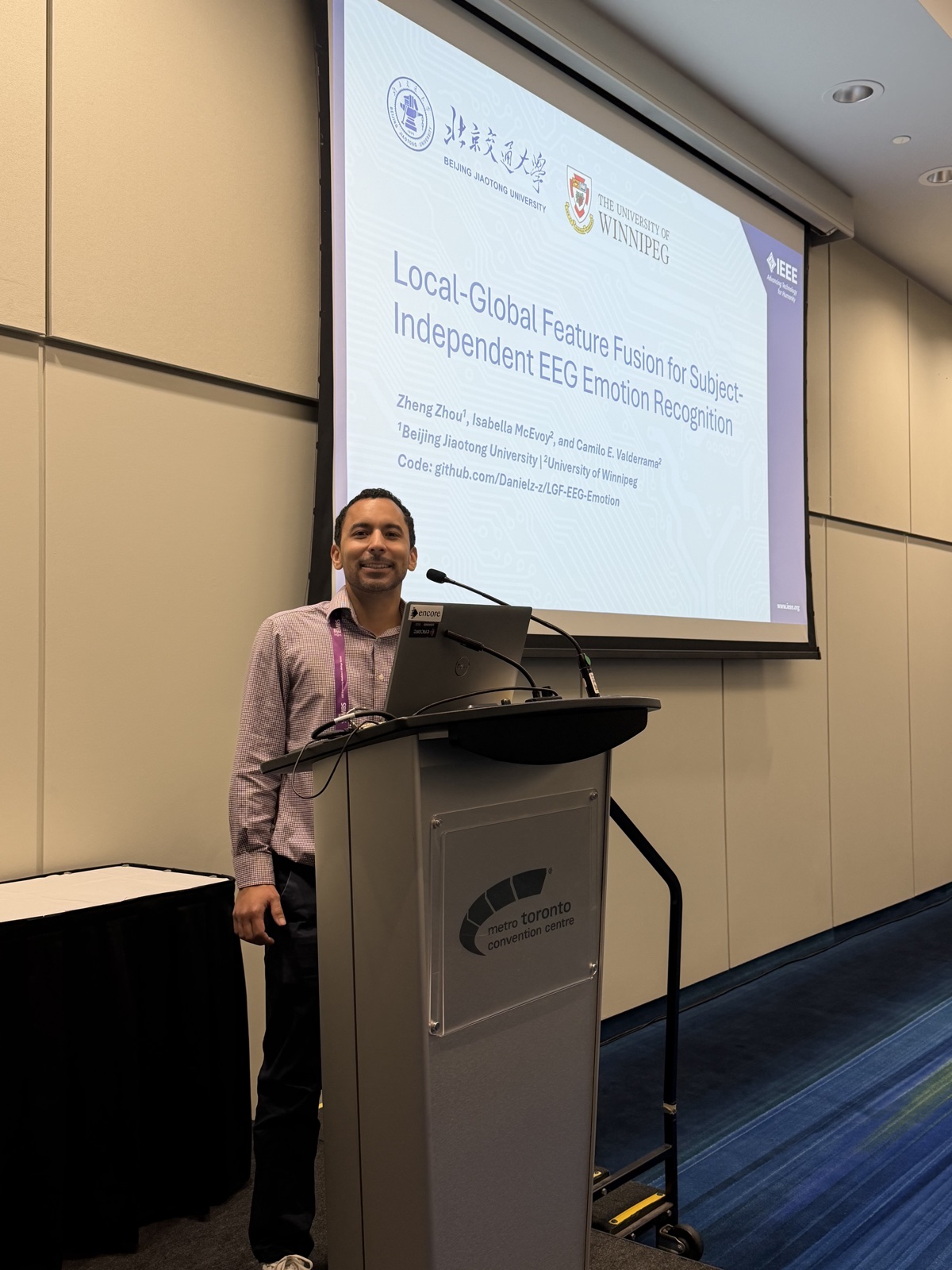
Oral presentation delivered by Prof. Camilo E. Valderrama at IEEE EMBC, Toronto
Core Highlights
- Local–global feature fusion: combines channel-wise EEG, graph-based connectivity, and multifractal features.
- Subject-independent evaluation: strictly follows the LOSO protocol.
- Transformer-based architecture for fusing heterogeneous modalities.
- Complete PyTorch pipeline: feature extraction → model training → evaluation.
Project Structure
LGF-EEG-Emotion/
│
├── datasets/
│ └── dataset_MAET.py
│
├── feature_extraction/
│ ├── extract_EEG_features.py
│ ├── extract_aux25_features.py
│ ├── compute_graph_features_per_trial.py
│ └── multifractal_features.py
│
├── preprocessing/
│ ├── aggregate_npz_to_trial25.py
│ └── generate_labels_csv.py
│
├── models/
│ └── MAET_model.py
│
├── training/
│ ├── train_MAET_LOSO.py
│ └── train_baselines_LOSO.py
│
├── evaluation/
│ ├── compute_loso_mean_confusion_and_metrics.py
│ ├── infer_metrics_from_checkpoints.py
│ ├── subject_accuracy_bar.py
│ └── summarize_baselines.py
│
├── .gitignore
├── LICENSE
└── README.md
Dataset
This codebase is designed for multi-subject EEG emotion datasets (e.g., SEED-VII or similar benchmarks).
⚠️ Important Notes:
- No raw EEG data, extracted features, labels, or pretrained models are included in this repository.
- Due to licensing and privacy constraints, users must obtain and preprocess datasets independently.
- Directory paths and file formats should be adapted accordingly.
Feature Extraction
The framework supports multiple complementary feature types:
Local EEG Features
- Extracted from sliding windows
- Channel-wise representations (e.g., Differential Entropy)
Global Graph Features
- EEG channels treated as nodes
- Connectivity descriptors computed per trial
Multifractal Features
- Capture non-linear and long-range temporal dynamics
- Used as auxiliary information to enhance robustness
All window-level features are aggregated into trial-level representations before model training.
Training
Proposed Model (LOSO)
python training/train_MAET_LOSO.py
Baseline Models (LOSO)
python training/train_baselines_LOSO.py
Each training run:
- Leaves one subject out for testing
- Trains on all remaining subjects
- Repeats for all subjects
Evaluation
To compute aggregated metrics and confusion matrices:
python evaluation/compute_loso_mean_confusion_and_metrics.py
Dependencies
pip install -r requirements.txt
Reproducibility Guidelines
To ensure fair and reproducible results:
- Fix random seeds for all experiments
- Use consistent window length and step size across subjects
- Apply identical preprocessing and feature extraction pipelines
- Evaluate strictly under the LOSO protocol
Citation
If you find this repository useful in your research, please consider citing it. A BibTeX entry will be provided upon paper publication.
Acknowledgements
This implementation was developed as part of an academic research project.
Some design inspirations are drawn from open-source transformer-based architectures.
Contact
For questions, issues, or suggestions, please open an issue on GitHub.
Explore related projects
Loading…