
CipherSecurityLab/CipherMQ
CipherSecurityLab/CipherMQ has 29 GitHub stars and 3 forks. GitHot measured 0 stars in 24 hours and 0 in 7 days. Last checked 2026-11-14 09:49 UTC. Last push 2026-09-15.
What you can do
- Mutual TLS (mTLS): Ensures secure client-server communication with two-way authentication using ECDSA P-384 certificates.
- Hybrid Encryption: X25519 ECDH + XSalsa20-Poly1305 ("sealed box") protects the per-message session key; ChaCha20-Poly1305 encrypts the message payload.
- Role-Based Access Control (ACL): Clients are assigned roles (sender, receiver, admin) based on their mTLS certificate CN. Each role has a strict set of permitted commands senders cannot declare queues, receivers cannot publish, and unknown identities are rejected at connection time.
- Rate Limiting: Token-bucket rate limiting with per-role publish throttling, per-IP and per-CN connection limits to prevent abuse and resource exhaustion.
Measured star growth
- in 24h
- 0
- in 7 days
- 0
- in 15 days
- Collecting history
- in 1 month
- Collecting history
Net star changes over overlapping periods, not daily totals. Missing measurements are left blank. Stars measure attention, not software quality.
About
Strong Encryption, Exactly-Once Semantics, and Built-In Key Management for Trusted Brokers
SecurityREADME.md
OriginalCipherMQ: A New Generation Secure Message Broker





CipherMQ is a secure, high-performance message broker for encrypted message transmission between senders and receivers using a push-based architecture. It leverages hybrid encryption X25519 (Elliptic-Curve Diffie-Hellman) combined with XSalsa20-Poly1305 (NaCl/libsodium "sealed box" construction) to protect the per-message session key, and ChaCha20-Poly1305 to encrypt the message payload itself for confidentiality and authenticity, combined with Mutual TLS (mTLS) for secure client-server communication. The system ensures zero message loss and exactly-once delivery through robust acknowledgment mechanisms, with messages temporarily held in memory and routed via exchanges and queues. Message metadata and receivers' public keys are stored in a PostgreSQL database; public keys at rest are additionally encrypted with AES-256-GCM before being persisted.
CipherMQ now includes role-based Access Control (ACL), rate limiting, Prometheus-compatible metrics, a real-time admin dashboard, and heartbeat monitoring for production-grade deployments.
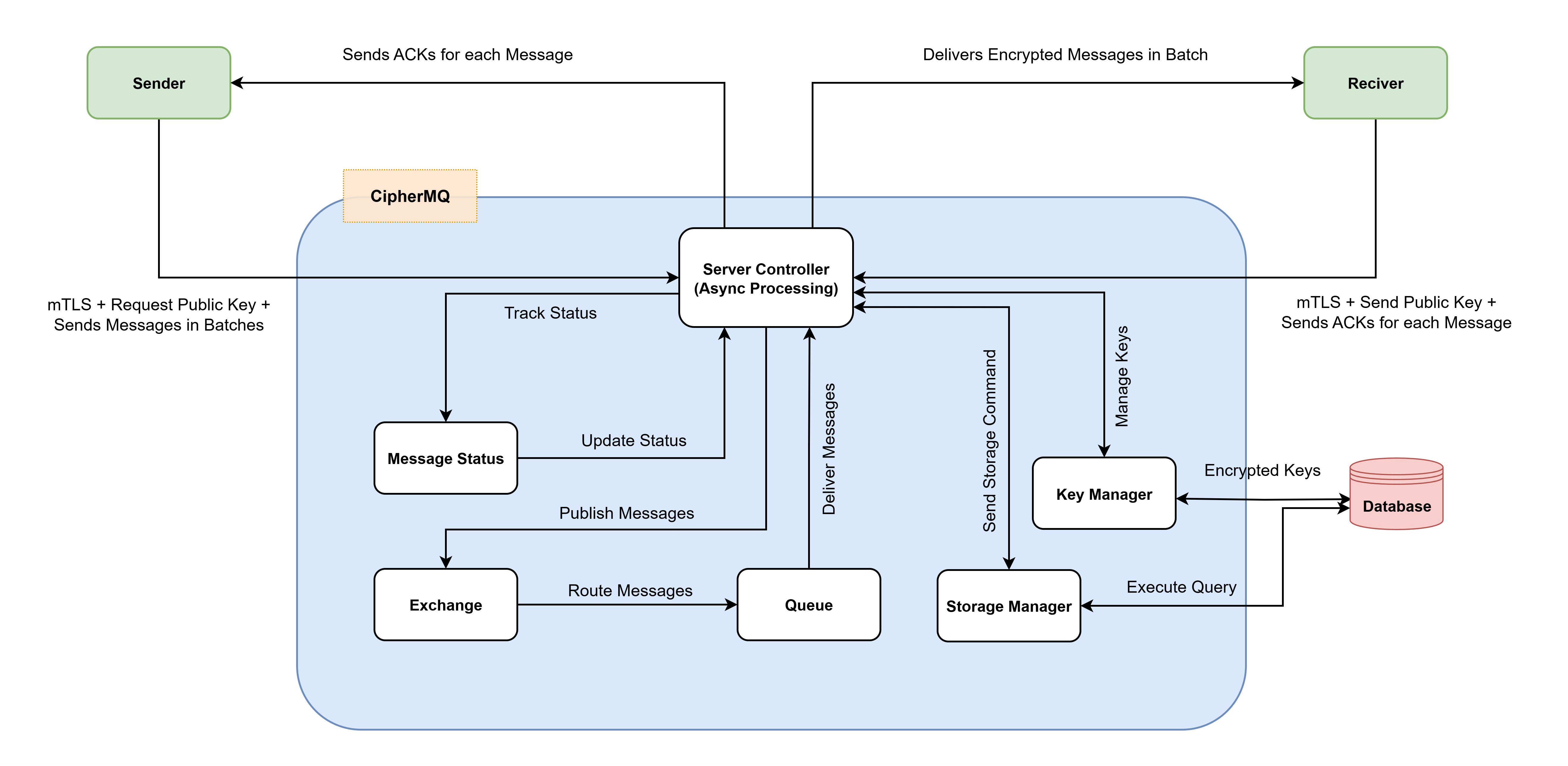
Architecture at a Glance
Why CipherMQ?
| Problem | CipherMQ Solution |
|---|---|
| Messages intercepted in transit | mTLS between all clients and server |
| Messages readable by the broker | End-to-end encryption (broker never sees plaintext) |
| No guarantee of delivery | Sender retries + exactly-once delivery via ACK mechanism |
| No access control | Role-based ACL tied to mTLS certificate identities |
| No production visibility | Real-time admin dashboard + Prometheus metrics |
| Resource exhaustion attacks | Token-bucket rate limiting with per-IP/per-CN caps |
Table of Contents
- Features
- Prerequisites
- Installation
- Configuration
- Project Structure
- Usage
- Architecture
- Access Control (ACL)
- Rate Limiting
- Metrics & Monitoring
- Admin Console
- Diagrams
- Future Improvements
- Contributing
- License
Features
- Mutual TLS (mTLS): Ensures secure client-server communication with two-way authentication using ECDSA P-384 certificates.
- Hybrid Encryption: X25519 ECDH + XSalsa20-Poly1305 ("sealed box") protects the per-message session key; ChaCha20-Poly1305 encrypts the message payload.
- Role-Based Access Control (ACL): Clients are assigned roles (
sender,receiver,admin) based on their mTLS certificate CN. Each role has a strict set of permitted commands senders cannot declare queues, receivers cannot publish, and unknown identities are rejected at connection time. - Rate Limiting: Token-bucket rate limiting with per-role publish throttling, per-IP and per-CN connection limits to prevent abuse and resource exhaustion.
- Prometheus-Compatible Metrics: Atomic counters for messages published, acknowledged, delivered, errors, connections, and rate-limit rejections; gauge metrics for connected clients, queue count, messages in queues, consumers, and uptime all exportable in Prometheus text format.
- Admin Console & Real-Time Dashboard: A dedicated mTLS-secured admin server exposes node status as JSON and Prometheus metrics; a companion web dashboard (Axum + HTML) polls the admin server and renders live server health, queue details, binding maps, connection statistics, and counter data.
- Heartbeat Monitoring: Receivers send periodic heartbeats; the server tracks liveness per client and automatically cleans up timed-out connections.
- Public Key Registration: Receivers register their public keys with the server using the
register_public_keycommand, which are securely stored and retrievable by senders via theget_public_keycommand. - Zero Message Loss: Sender retries until server acknowledgment (
ACK <message_id>), and server retries delivery until receiver acknowledgment (ack <message_id>). - Exactly-Once Delivery: Receiver deduplicates messages using
message_idto prevent reprocessing. - Batch Processing: Sender collects and sends messages in batches, ensuring all queued messages are delivered.
- Real-time Processing: Sender transmits each message immediately upon generation, ensuring instant delivery without queuing or batching delays.
- Asynchronous Processing: Built with Tokio for concurrent, high-performance connection handling.
- Push-Based Messaging: Messages are delivered to connected receiver as soon as they are published.
- Thread-Safe Data Structures: Uses
DashMapfor safe multi-threaded operations on the broker's in-memory state. - Flexible Routing: Supports exchanges and queues with routing keys for efficient message delivery.
- Persistent Storage: Stores message metadata and AES-256-GCM-encrypted public keys in PostgreSQL.
- Structured Logging: JSON-based logging with rotation and level-based filtering on the server; JSON file logging plus a readable console layer on both clients.
Prerequisites
To run CipherMQ with TLS, you need:
- Rust: Version 1.56 or higher.
- PostgreSQL: Version 10 or higher.
- Certificates & Key Generation: Use the provided Rust script to generate mTLS certificates & x25519 key pairs.
Installation
1. Clone the Repository
git clone https://github.com/CipherSecurityLab/CipherMQ.git
2. Generate mTLS Certificates
Run the provided Rust certificate-authority tool to generate the CA certificate, server certificate, and one client certificate per Common Name you pass on the command line:
cd root
cd create_ca_key/Rust_CA_Maker_ECDSA_P-384_Multi_Client
cargo run -- receiver_1 sender_1 admin
This produces:
ca.crt: Certificate Authority (CA) certificate for verifying server and client certificates.server.crt: Server certificate for mTLS.server.key: Server private key for mTLS.client.crt: Client certificate for mTLS (one set per CN:sender_1,receiver_1,admin).client.key: Client private key for mTLS.
Note: Store
ca.keysecurely and do not distribute it. It is only used for certificate generation.Security Note: Restrict access to
server.key,client.key(chmod 600).
3. Generate x25519 Keys
Run the provided script to generate x25519 key pairs for hybrid encryption for the receiver:
cd root
cd create_ca_key/Rust_Key_Maker_X25519
cargo run --release
Outputs:
receiver_private.key: Receiver's private key for decryption.receiver_public.key: Public key for sender encryption.
Security Note: Restrict access to
receiver_private.key(chmod 600).
4. Set up the Rust Server
cd root
cd server
cargo build --release
5. Set Up Database
Initialize PostgreSQL:
sudo -u postgres psql
CREATE USER mq_user WITH PASSWORD 'mq_pass';
CREATE DATABASE ciphermq;
GRANT ALL PRIVILEGES ON DATABASE ciphermq TO mq_user;
\c ciphermq
GRANT ALL PRIVILEGES ON SCHEMA public TO mq_user;
Configuration
Server Configuration
Create a config.toml file in the CipherMQ root directory:
[server]
address = "127.0.0.1:5672"
connection_type = "tls"

[tls]
cert_path = "../create_ca_key/Rust_CA_Maker_ECDSA_P-384_Multi_Client/certs/server.crt"
key_path = "../create_ca_key/Rust_CA_Maker_ECDSA_P-384_Multi_Client/certs/server.key"
ca_cert_path = "../create_ca_key/Rust_CA_Maker_ECDSA_P-384_Multi_Client/certs/ca.crt"

[logging]
level = "error"
info_file_path = "logs/server_info.log"
debug_file_path = "logs/server_debug.log"
error_file_path = "logs/server_error.log"
rotation = "daily"
max_size_mb = 100

[database]
host = "localhost"
port = 5432
user = "mq_user"
password = "mq_pass"
dbname = "ciphermq"

[encryption]
algorithm = "x25519_chacha20_poly1305"
aes_key = "YOUR_BASE64_ENCODED_32_BYTE_AES_KEY"

[performance]
max_queue_size = 10000
heartbeat_timeout = 60
cleanup_interval = 3000
consumer_cleanup_interval = 60
idle_timeout_sec = 60

[admin]
enabled = true
address = "127.0.0.1:9091"
allowed_cns = ["admin"]

[rate_limit]
enabled = true
global_rps = 100.0
global_burst = 200.0
publish_rps = 50.0
publish_burst = 100.0
max_connections_per_ip = 50
max_connections_per_cn = 20

[acl]
sender_cns = ["sender_1"]
receiver_cns = ["receiver_1"]
admin_cns = ["admin"]
Note: Replace
YOUR_BASE64_ENCODED_32_BYTE_AES_KEYwith a 32-byte key encoded in base64. Generate it using:
openssl rand -base64 32
Configuration Sections
| Section | Description |
|---|---|
[server] |
Broker listen address and connection type (tls) |
[tls] |
Paths to server certificate, private key, and CA certificate for mTLS |
[logging] |
Log level, file paths, rotation policy, and max file size |
[database] |
PostgreSQL connection parameters |
[encryption] |
Encryption algorithm and AES-256-GCM key for encrypting public keys at rest |
[performance] |
Max queue size, heartbeat timeout, cleanup intervals, idle timeout |
[admin] |
Admin console toggle, listen address, and allowed admin CNs |
[rate_limit] |
Global and publish-specific RPS/burst limits, per-IP and per-CN connection caps |
[acl] |
Client CN → role mapping for sender, receiver, and admin roles |
Client Configuration
Each client reads config.json from its own working directory (clients/sender_1/, clients/receiver_1/, clients/admin/). The exchange_name, queue_name, and routing_key values must match across the Sender's bindings, the Receiver's top-level fields, and one another so that publishes route to the correct queue.
Receiver (clients/receiver_1/config.json)
| Field | Description |
|---|---|
queue_name, exchange_name, routing_key |
Identify the queue this receiver declares, binds, and consumes from. |
server_address, server_port |
Broker TCP endpoint. |
tls.certificate_path |
CA certificate used to verify the server. |
tls.client_cert_path / tls.client_key_path |
This receiver's mTLS client certificate and key. |
tls.check_hostname |
When false, skips TLS hostname verification (the certificate chain is still validated); intended for development against localhost or IP-only endpoints. |
logging.* |
Log level and JSON log file paths. |
Sender (clients/sender_1/config.json)
| Field | Description |
|---|---|
receiver_client_ids |
One client ID, or an array of client IDs, this sender will fetch public keys for and address messages to. |
exchange_name, bindings |
Exchange/queue/routing-key triples the sender declares and binds before publishing. |
server_address, server_port, tls.* |
Same meaning as on the Receiver. |
sender.num_messages |
Total number of messages to generate and send in this run. |
sender.max_inflight |
Maximum number of messages awaiting ACK at any one time (semaphore-bounded backpressure). |
sender.max_retries |
Retry attempts for an unacknowledged message before it is marked permanently failed. |
sender.ack_timeout_secs |
Seconds to wait for an ACK before a message is treated as unacknowledged. |
sender.tcp_connect_timeout_secs |
Seconds to wait while establishing each TCP connection. |
sender.batch_size / sender.batch_delay_ms |
Messages per logical batch and the pause between batches (for progress logging/pacing only). |
sender.message.content_template |
Template string for generated message bodies; supports {sender_id}, {correlation_id}, {timestamp}, {seq}, and any key from extra_fields. |
sender.message.extra_fields |
Extra key/value pairs available to the template. |
Admin Console (clients/admin/config.json)
| Field | Description |
|---|---|
server_name |
Display name shown on the dashboard. |
poll_interval_secs |
How often the admin client polls the server for status data. |
web_address |
Address the web dashboard listens on (host:port). |
tls.* |
CA cert, client cert, and client key for mTLS connection to the admin server. |
server.admin_address |
The server's admin console endpoint (host:port). |
Project Structure
CipherMQ/
├── server/
│   ├── src/
│   │   ├── main.rs               # Entry point: logging, state init, ACL, heartbeat monitor, shutdown
│   │   ├── server.rs             # Client request handling, ACL enforcement, message processing
│   │   ├── connection.rs         # mTLS connection management and CN extraction
│   │   ├── state.rs              # Server state: queues, exchanges, bindings, consumers (DashMap)
│   │   ├── auth.rs               # mTLS authentication (WebPkiClientVerifier)
│   │   ├── storage.rs            # PostgreSQL storage actor: metadata, encrypted public keys
│   │   ├── config.rs             # Configuration parsing and validation
│   │   ├── acl.rs                # Role-based access control (Role enum, AclManager, permission checks)
│   │   ├── rate_limiter.rs       # Token-bucket rate limiter with per-IP/per-CN connection limits
│   │   ├── metrics.rs            # Atomic counters, Prometheus exporter, status renderer
│   │   └── admin_server.rs       # mTLS admin console: JSON status, Prometheus metrics, queue info
│   ├── Cargo.toml                # Rust dependencies
│   └── config.toml               # Server configuration (all sections)
│
├── clients/
│   ├── sender_1/
│   │   ├── Cargo.toml            # Sender dependencies
│   │   ├── config.json           # Sender configuration
│   │   └── src/
│   │       └── main.rs           # Sender: fetch keys, hybrid-encrypt, async pipeline with backpressure
│   │
│   ├── receiver_1/
│   │   ├── Cargo.toml            # Receiver dependencies
│   │   ├── config.json           # Receiver configuration
│   │   └── src/
│   │       └── main.rs           # Receiver: register key, consume, decrypt, ack, reconnect
│   │
│   └── admin/
│       ├── Cargo.toml            # Admin console dependencies
│       ├── config.json           # Admin console configuration
│       └── src/
│           ├── main.rs           # Axum web server with /api/status endpoint
│           ├── poll.rs           # Background polling thread over mTLS
│           └── dashboard.html    # Real-time HTML dashboard
│
├── docs/                         # Documentation and diagrams
└── create_ca_key/                # Certificate and key generation utilities
Usage
Important: Run these commands in four separate terminals in the specified order (Server → Receiver → Sender → Admin).
1. Run the Server (First Terminal)
Start the server with TLS support:
cd root
cd server
cargo run --release
Server listens on configured address, initializes DB connections, ACL, rate limiter, metrics, heartbeat monitor, and admin console (if enabled), then awaits client registrations.
2. Run the Receiver (Second Terminal)
Start the receiver to subscribe to messages:
cd root
cd clients/receiver_1
cargo run --release
- Registers public key with the server.
- Declares queue & exchange.
- Subscribes as a push consumer.
- Sends periodic heartbeats.
- Decrypts incoming messages and persists to
data/received_messages.jsonl. - Sends
ack <message_id>for every newly processed message and automatically reconnects if the connection drops.
3. Run the Sender (Third Terminal)
cd root
cd clients/sender_1
cargo run --release
- Fetches receiver public key.
- Generates and hybrid-encrypts the configured number of sample messages for every receiver.
- Publishes them over an async pipeline bounded by
max_inflight, retries unacknowledged messages with exponential backoff, and reports final throughput and failure counts.
4. Run the Admin Console (Fourth Terminal)
cd root
cd clients/admin
cargo run --release
- Connects to the server's admin endpoint over mTLS.
- Opens a web dashboard at the configured
web_address(default:http://127.0.0.1:8080). - Displays real-time server health, queue details, binding maps, connection statistics, and counter data.
Architecture
CipherMQ is a message broker system with the following components:
- Server (
server/src/): A Rust/Tokio broker that handles mTLS connections, message routing, and delivery using exchanges and queues. Includes role-based ACL enforcement, token-bucket rate limiting, Prometheus-compatible metrics, heartbeat monitoring, and an mTLS-secured admin console. Public keys are encrypted with AES-256-GCM and stored in PostgreSQL. - Sender (
clients/sender_1/): Fetches receiver public keys usingget_public_key, hybrid-encrypts messages (X25519 sealed box + ChaCha20-Poly1305), sends them through an async, semaphore-bounded pipeline, and ensures delivery with retries. - Receiver (
clients/receiver_1/): Registers its public key with the server usingregister_public_key, receives, decrypts, deduplicates, and stores messages in JSONL format, with acknowledgment retries and periodic heartbeats. - Admin Console (
clients/admin/): An Axum-based web dashboard that polls the server's admin endpoint over mTLS and renders real-time node status, queue/binding/exchange details, connection statistics, and Prometheus metrics. - mTLS Integration (
auth.rs,connection.rs): Supports secure two-way authentication usingtokio-rustlsandWebPkiClientVerifier. - Hybrid Encryption: X25519 ECDH + XSalsa20-Poly1305 (sealed box) wraps a per-message session key; ChaCha20-Poly1305 encrypts the message content with that session key.
- Key Storage (
storage.rs): Public keys are encrypted with AES-256-GCM and stored in PostgreSQL, accessible via theregister_public_keyandget_public_keycommands.
For a detailed architecture overview, see CipherMQ Project Architecture.
Access Control (ACL)
CipherMQ enforces role-based access control by mapping each client's mTLS certificate Common Name (CN) to one of three roles:
| Role | CNs (configurable) | Permitted Commands |
|---|---|---|
| Sender | sender_cns in [acl] |
publish, publish_batch, get_public_key, ack, resend |
| Receiver | receiver_cns in [acl] |
declare_queue, declare_exchange, bind, consume, ack, register_public_key, heartbeat |
| Admin | admin_cns in [acl] |
All commands (full access) |
| Unknown | (any CN not listed) | Rejected at connection time no commands available |
ACL is enforced in two places:
- Connection time (
server.rs): Unknown CNs are rejected immediately withAccess denied: unrecognized client identity. - Per-command (
server.rs): Each command is checked against the permission matrix before execution. Denied commands receiveAccess denied: <reason> (role=<role>).
The admin console also verifies that connecting clients have an admin CN before serving any data.
Rate Limiting
CipherMQ includes a token-bucket rate limiter with configurable parameters:
| Parameter | Default | Description |
|---|---|---|
global_rps |
100.0 | Maximum requests per second per client CN (all commands) |
global_burst |
200.0 | Burst capacity for the global bucket |
publish_rps |
50.0 | Additional rate limit for publish/publish_batch commands per CN |
publish_burst |
100.0 | Burst capacity for the publish bucket |
max_connections_per_ip |
50 | Maximum concurrent connections from a single IP address |
max_connections_per_cn |
20 | Maximum concurrent connections per client CN |
Rate limiting can be toggled on/off via [rate_limit].enabled. When a request is rate-limited, the server responds with Rate limited. When a connection is rejected due to connection limits, the connection is silently closed.
Metrics & Monitoring
CipherMQ exposes Prometheus-compatible metrics on the admin server endpoint (metrics command):
Counters:
ciphermq_messages_published_totalTotal messages publishedciphermq_messages_acked_totalTotal messages acknowledgedciphermq_messages_delivered_totalTotal messages deliveredciphermq_errors_totalTotal server errorsciphermq_connections_totalAccepted client connectionsciphermq_connections_rejected_rate_limit_totalConnections rejected by rate limitciphermq_connections_rejected_conn_limit_totalConnections rejected by connection limitciphermq_requests_rate_limited_totalRequests rejected by rate limit
Gauges:
ciphermq_connected_clientsCurrent connected clientsciphermq_queue_countCurrent queue countciphermq_messages_in_queuesMessages currently in queuesciphermq_consumer_countCurrent consumersciphermq_uptime_secondsServer uptime
All counters use lock-free atomic operations (AtomicU64) for high-concurrency performance.
Admin Console
The admin console provides two interfaces:
1. Terminal Admin Client
A text-based mTLS client that connects to the server's admin endpoint and supports:
statusHuman-readable server statusjsonFull JSON status with queues, bindings, exchanges, connection statsmetricsPrometheus-format metricsqueuesQueue counts and message totalsconnectionsPer-IP and per-CN connection breakdownquit/exitDisconnect
2. Web Dashboard
An Axum-based web server that polls the admin endpoint and renders a real-time HTML dashboard showing:
- Server health and uptime
- Connected clients, queues, consumers, exchanges
- Messages published, acknowledged, delivered
- Rate-limit rejections and connection limits
- Per-queue message counts and consumer counts
- Full binding map (exchange → queue → routing_key)
- Connection statistics by IP and CN
Diagrams
The following diagrams, located in docs/diagrams, illustrate CipherMQ's architecture and mTLS flow:
- Sequence Diagram: Shows the end-to-end message flow, including mTLS handshakes, public key registration, and hybrid encryption.
- Activity Diagram: Details the operational flow, including mTLS connection setup, key registration, and message processing.
- Component Diagram: Maps the server's internal modules, the Sender and Receiver clients, and PostgreSQL, and how they connect.
- ER Diagram: Documents the
message_metadataandpublic_keysPostgreSQL tables and their columns. - Deployment Diagram: Shows where certificates and keys live, which ports are used, and the trust boundaries between hosts.
Future Improvements
⌛ Implement distributed clustering using the Raft consensus algorithm.
⌛ Add support for post-quantum cryptography (PQC) algorithms.
Add support for Hardware Security Modules (HSM) for key management.
Contributing
Contributions are welcome! Please:
- Review the Contributor License Agreement (CLA).
- Check the PR template checkbox to confirm agreement.
- Follow coding standards and include tests.
For major changes, open an issue to discuss your proposal.
License
This project is licensed under the MIT License. See the LICENSE file for details.
Explore related projects
trimstray/the-book-of-secret-knowledge
A collection of inspiring lists, manuals, cheatsheets, blogs, hacks, one-liners, cli/web tools and more.
258,387 starsHack-with-Github/Awesome-Hacking
A collection of various awesome lists for hackers, pentesters and security researchers
125,488 starsswisskyrepo/PayloadsAllTheThings
A list of useful payloads and bypass for Web Application Security and Pentest/CTF
82,670 starscaddyserver/caddy
Fast and extensible multi-platform HTTP/1-2-3 web server with automatic HTTPS
79,034 stars