
CassiopeiaCode/CosyRedactGateway
CassiopeiaCode/CosyRedactGateway has 107 GitHub stars and 22 forks. GitHot measured 0 stars in 24 hours, 0 in 7 days, and +1 in 15 days. Last checked 2026-11-17 02:47 UTC. Last push 2026-10-31.
Measured star growth
- in 24h
- 0
- in 7 days
- 0
- in 15 days
- +1
- in 1 month
- Collecting history
Net star changes over overlapping periods, not daily totals. Missing measurements are left blank. Stars measure attention, not software quality.
About
Lightweight, stateless privacy gateway for LLM APIs — redact secrets before OpenAI/Anthropic upstreams and restore them transparently in SSE and tool calls.
SecurityREADME.en.md
Original
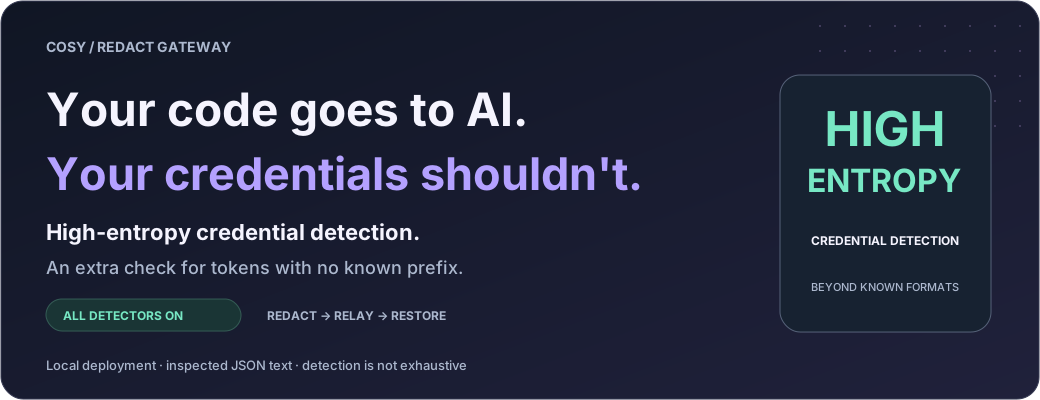
Cosy Redact Gateway
High-entropy credential detection. Beyond known key formats.




简体中文 · English
High entropy ·
Start locally ·
Verify detection ·
Connect your app ·
Security
A credential does not need an sk- prefix to be sensitive. An internal service token can be a bare random-looking string—inside pasted code, configuration, logs, or a tool result.
Cosy is a developer-focused LLM redaction gateway built around high-entropy credential detection. Alongside known key formats, it statistically scores eligible text blocks for random-looking credential candidates, without requiring a provider prefix or an assignment label such as password=.
With all detectors enabled, high-entropy detection complements structured checks and Gitleaks-compatible secret rules. Matched values become reversible placeholders before forwarding; known, unchanged placeholders are restored in responses, supported SSE streams, and tool-call arguments. The configuration flag for high-entropy detection is H.
For a local-first developer workflow, run Cosy on your machine and route your supported LLM calls through it. The examples below enable every detector with /$https://….
Scope: this protects matched values in inspected JSON text, not all host traffic. Detection can miss secrets. Upstream authentication is still forwarded. A hosted gateway sees the original request before redaction. Security boundary →
High-entropy credentials do not always come with a label
A known-format rule asks whether text matches a configured pattern. High-entropy detection also asks whether an eligible block looks unusually unlike ordinary English text. That gives unlabeled, random-looking credentials another route to detection—even when there is no provider prefix or credential assignment label to match.
| Detection layer | What it adds |
|---|---|
| Known formats & structured rules | Recognize supported provider signatures, credential assignments, and structured personal data. |
| High-entropy credential detection | Score ASCII alphanumeric blocks longer than 8 characters using length-aware English bigram cross entropy and a symbol-diversity floor. Numeric-only blocks are excluded. |
All on: HPSIBEG |
Combine these approaches. An empty flag section enables the full set; it is not a separate “high-entropy-only” mode. |
The difference is an extra detection path—not a promise that every random string is a credential or that every credential will be caught. Source and calibration: worker.js, entropy methodology.
Beyond a rule match
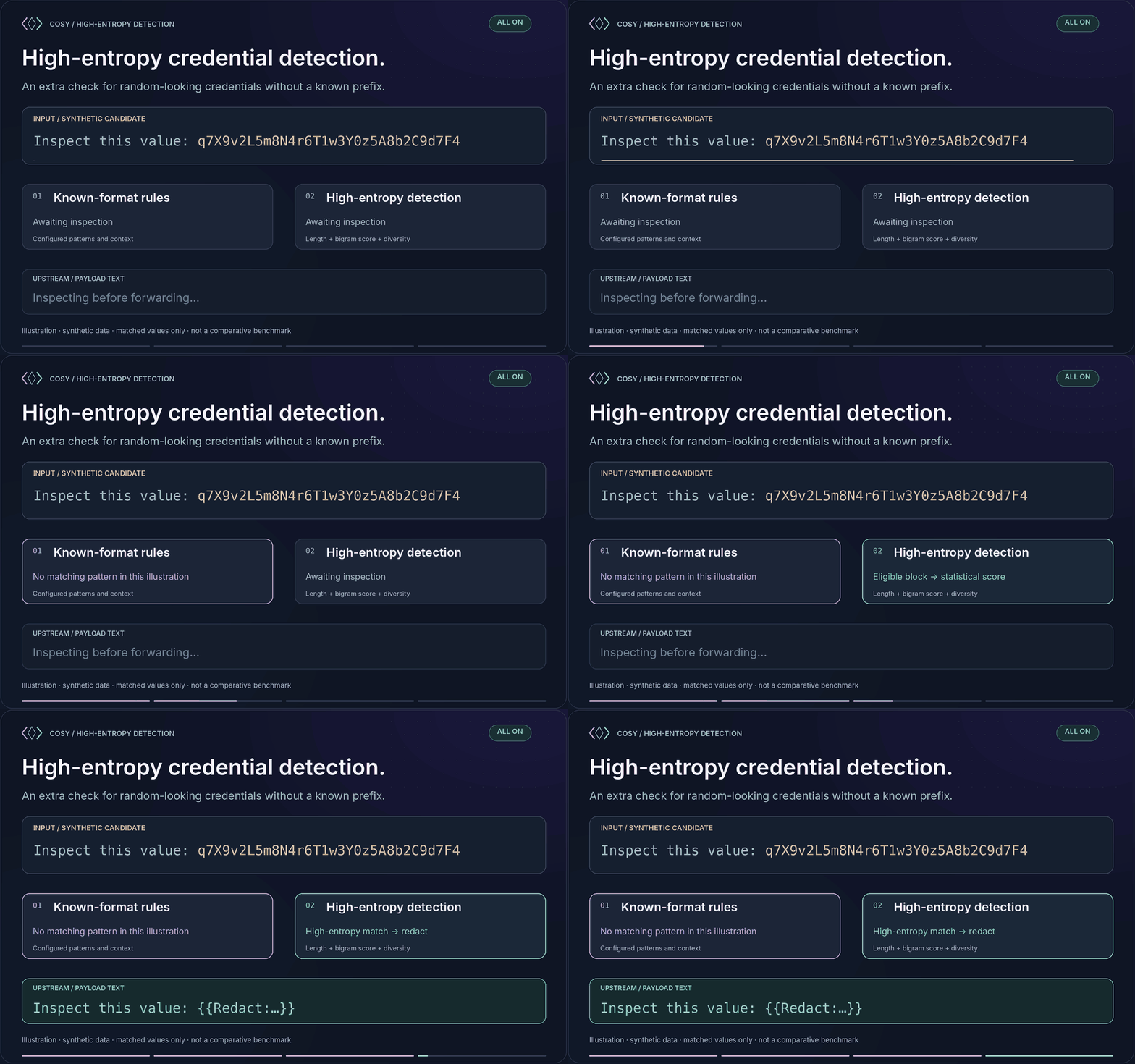
Mechanism illustration, not a test recording. The credential is synthetic and the placeholder is shortened. No real credential is shown.
| Stage | Illustrative text |
|---|---|
| Your app sends | Inspect this value: q7X9v2L5m8N4r6T1w3Y0z5A8b2C9d7F4 |
| If the value is detected, the upstream sees | Inspect this value: {{Redact:…}} |
| The model echoes the token | The value is {{Redact:…}} |
| Cosy restores it for your app | The value is q7X9v2L5m8N4r6T1w3Y0z5A8b2C9d7F4 |
The original value is restored only if the model preserves a known placeholder exactly. Real placeholders contain a 64-character SHA-256 digest. Cosy restores tool arguments too, but does not execute tools or authorize their actions. Full round-trip contract →
Complete redaction and restoration round trip
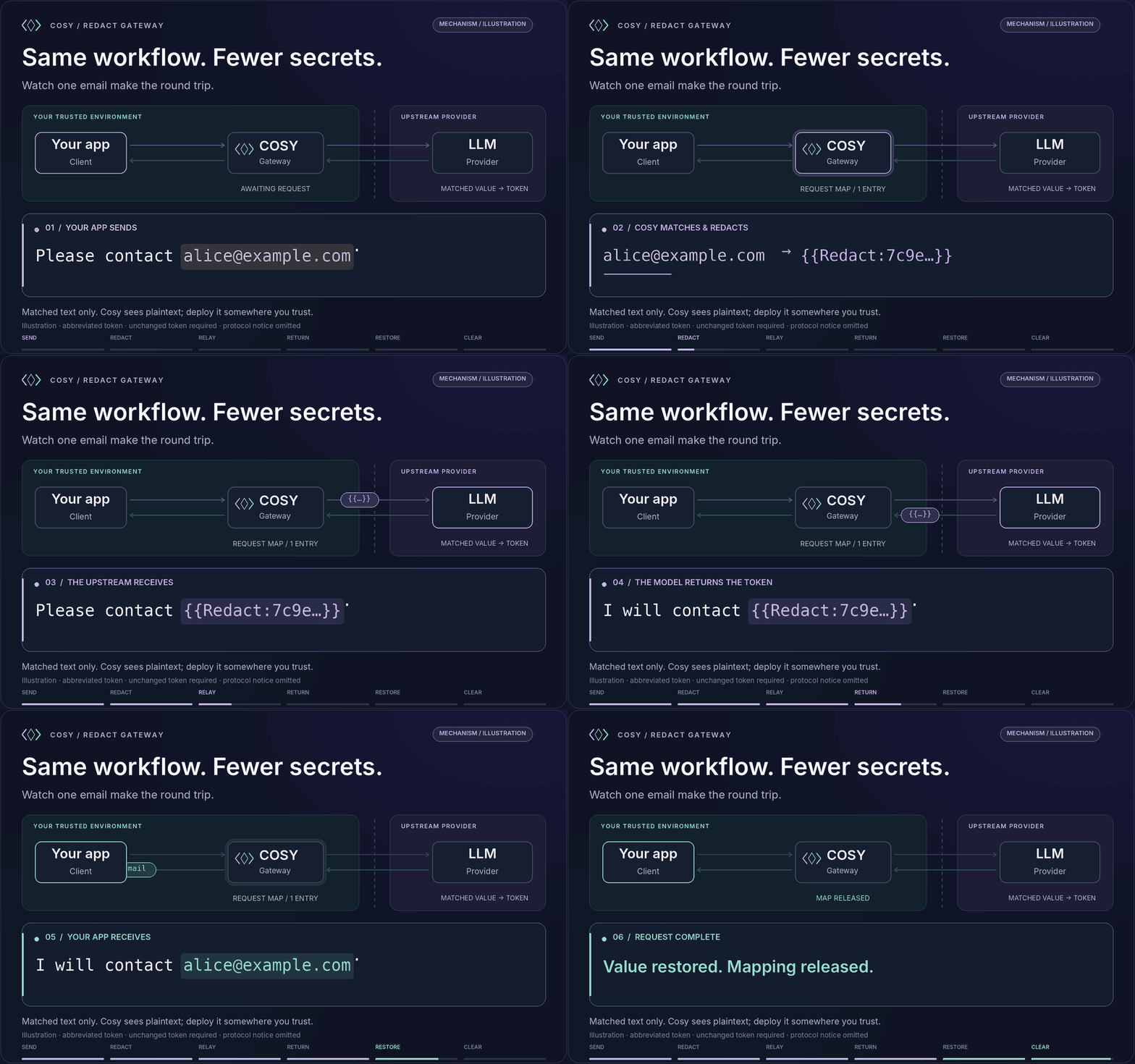
Mechanism illustration using synthetic data. Digests and protocol notices are abbreviated. Restoration requires a known, unchanged placeholder in the current request.
Verify the extra layer
A useful security claim should be inspectable. The repository includes a local-only, no-API-key demonstration that calls the repository's own exported detector and redaction functions:
node scripts/demo-high-entropy.mjs --lang=en
It prints the observed result for the same synthetic, unlabeled candidate under PSIBEG (high-entropy detection off), H (high-entropy detection only), and empty flags (all on). It also checks exact restoration and high-entropy detection's documented exclusions. It uses no network and does not call a model. Results describe these synthetic fixtures only, not production leak rates.
For the project's broader regression and entropy fixtures:
npm test
npm run entropy-report
The repository's published calibration reports 296 / 30,000 natural-word concatenations (0.9867%) classified as high entropy; random hex/base62 recall increases with length. These are synthetic fixture results, not a production leak rate or an independently reproduced benchmark in this README update. Methodology · High-entropy detection: evidence, verification, and limitations
Start locally. Turn every detector on.
1. Run the gateway on your machine
Use Node.js 20+, Git, and a terminal. No gateway runtime dependencies need to be installed. The HTTP example uses Bash and curl 7.76+.
git clone https://github.com/CassiopeiaCode/CosyRedactGateway.git
cd CosyRedactGateway
npm start
The local development adapter listens on http://127.0.0.1:8787 by default. Keep it bound to loopback for this workflow.
2. Check locally, without a provider account
In another terminal, from the same repository directory:
curl --fail --silent --show-error http://127.0.0.1:8787/healthz
node scripts/demo-high-entropy.mjs --lang=en
The first command checks availability; the second exercises synthetic detector fixtures without network access. Neither requires an API key.
3. Route a request through the full policy
Export OPENAI_API_KEY with your usual secret-management method and OPENAI_MODEL as a model available to your account. This is a real upstream call and may incur provider charges.
: "${OPENAI_API_KEY:?Set OPENAI_API_KEY in this shell first}"
: "${OPENAI_MODEL:?Set OPENAI_MODEL to a model available to your account}"

node --input-type=module -e '
  const payload = {
    model: process.env.OPENAI_MODEL,
    messages: [{
      role: "user",
      content: "Repeat this value exactly: q7X9v2L5m8N4r6T1w3Y0z5A8b2C9d7F4"
    }],
    stream: true
  };
  process.stdout.write(JSON.stringify(payload));
' | curl --fail-with-body --no-buffer \
  -H 'content-type: application/json' \
  -H "authorization: Bearer ${OPENAI_API_KEY}" \
  --data-binary @- \
  'http://127.0.0.1:8787/$https://api.openai.com/v1/chat/completions'
The empty section before $ enables HPSIBEG: all detectors, including high-entropy detection. Your app receives the original value when a detected value's token is echoed unchanged. Model output is not deterministic. Quote routed URLs in single quotes in shell commands to preserve $.
Provider authentication headers are forwarded to the chosen upstream. This example tests protection of content in the request body, not concealment of the key required to authenticate the API call.
Add the layer to your developer workflow
Keep the upstream API key, model, and request shape. Change the destination to a Cosy route. Your client must preserve the embedded upstream URL and append API paths correctly.
Every route below enables all detectors, including high-entropy detection. Your client must actually send the relevant calls through the gateway.
OpenAI Python SDK
Install the SDK in your application environment, not as a gateway dependency: python -m pip install openai. With OPENAI_API_KEY, OPENAI_MODEL, and the local gateway ready:
import os
from openai import OpenAI

client = OpenAI(
    api_key=os.environ["OPENAI_API_KEY"],
    base_url="http://127.0.0.1:8787/$https://api.openai.com/v1",
)

response = client.responses.create(
    model=os.environ["OPENAI_MODEL"],
    input="Repeat this value exactly: q7X9v2L5m8N4r6T1w3Y0z5A8b2C9d7F4",
)
print(response.output_text)
The expected routed path ends in $https://api.openai.com/v1/responses. The same base URL can be used for Chat Completions. SDK configuration reference
Anthropic JavaScript SDK
Install @anthropic-ai/sdk in your application. Set ANTHROPIC_API_KEY and ANTHROPIC_MODEL to an available model, then run this as an .mjs file:
import Anthropic from '@anthropic-ai/sdk';

const apiKey = process.env.ANTHROPIC_API_KEY;
const model = process.env.ANTHROPIC_MODEL;
if (!apiKey || !model) {
  throw new Error('Set ANTHROPIC_API_KEY and ANTHROPIC_MODEL first.');
}

const client = new Anthropic({
  apiKey,
  baseURL: 'http://127.0.0.1:8787/$https://api.anthropic.com',
});

const message = await client.messages.create({
  model,
  max_tokens: 128,
  messages: [{
    role: 'user',
    content: 'Repeat this value exactly: q7X9v2L5m8N4r6T1w3Y0z5A8b2C9d7F4',
  }],
});
console.log(message.content);
The SDK adds /v1/messages; do not add an extra /v1 to this base URL. SDK source and configuration
IDE assistants, CLI tools, and custom HTTP clients
For a tool with a configurable API base URL, start from its actual wire protocol:
| API family | Example base URL |
|---|---|
OpenAI-style client that appends /chat/completions or /responses |
http://127.0.0.1:8787/$https://api.openai.com/v1 |
Anthropic-style client that appends /v1/messages |
http://127.0.0.1:8787/$https://api.anthropic.com |
| Custom HTTP client | Supply the full endpoint after $, as in the curl example. |
Protocol support is not the same as a verified product integration. Cursor, Claude Code, Codex, and other tools may differ by version, authentication mode, URL handling, and where the request originates. No version-specific end-to-end claim is made here. Verify the outgoing path with synthetic data before routing sensitive work. A remotely executed client cannot reach your machine's 127.0.0.1.
More coverage, without replacing your stack
| Design choice | What it means for your stack |
|---|---|
| Single-file core | Inspect or deploy worker.js; it uses Web Fetch, Web Streams, and Web Crypto APIs. |
| Pass-through protocols | Preserve upstream request shapes instead of converting between API families. |
| Request-local mappings | Restore values without a persistent replacement database. |
| Streaming-aware restoration | Handle supported text and tool-argument deltas, including tokens split across SSE events and HTTP chunks. |
| Explicit detector policy | Choose structured detectors, high-entropy detection, and Gitleaks-compatible rules with URL flags. |
| Apache-2.0 licensed | Read the license and third-party notices; keep the privacy layer in your own stack. |
Start with every detector; tune with your own fixtures
https://<cosy-host>/<flags>$<full-upstream-url>
An empty flag section enables every detector. HPSIBEG is the explicit all-on form. Unknown letters return HTTP 400 rather than silently changing the policy.
| Flag | Detector | Scope |
|---|---|---|
H |
High-entropy credential detection | ASCII alphanumeric blocks longer than 8 characters; length-aware bigram scoring. Numeric-only blocks are excluded. |
P |
Phone numbers | PRC mobile numbers and international +… forms. |
S |
Long sk- secrets |
sk- followed by at least 60 ASCII alphanumeric characters; not every provider key format. |
I |
PRC citizen ID | Identity-number candidates with checksum validation. |
B |
Bank-card candidates | 13–19 digits with Luhn validation, including common grouped forms. |
E |
Email addresses | Email-pattern matches, such as [email protected]. |
G |
Gitleaks-compatible rules | The documented rule set contains 218 JavaScript entries, with keywords, secret groups, entropy checks, and allowlists. |
Choose flags for your data, then evaluate false positives and missed matches. A checksum match does not establish that an account or identity is real. G is a serverless-compatible evaluator, not a promise of full Gitleaks CLI parity. Detector details →
Protocols and streaming
| API family | Request handling | Response handling |
|---|---|---|
| OpenAI Chat Completions | JSON text redaction + user-message notice | JSON; supported SSE text and tool/function deltas |
| OpenAI Responses | String or message-array input + notice | JSON; supported SSE text and function-argument deltas |
| Anthropic Messages | Messages + user-message notice | JSON; supported SSE text and partial-JSON tool deltas |
| Other JSON endpoints | Generic string redaction; notice only if a supported body family is recognized | Text/JSON restoration; no blanket guarantee for arbitrary streaming schemas |
Cosy does not convert OpenAI requests into Anthropic requests, or vice versa. Non-empty non-JSON request bodies are rejected with HTTP 415 instead of bypassing redaction. Selected control fields, URLs, and image/audio payload fields are excluded to avoid corrupting requests.
Streaming claims with a test trail
The repository documents tests for every split position of a 75-byte placeholder, plus one-byte HTTP transport chunks, supported SSE formats, tool/reasoning deltas, and local HTTP/Node adapter integration. Follow the implementation in worker.js and the fixtures in test/.
npm test
npm run entropy-report
The documented entropy fixture classifies 296 of 30,000 natural-word concatenations (0.9867%) as high entropy. Random hex/base62 recall rises with length. These are synthetic fixture results, not real-world privacy guarantees, throughput benchmarks, or an independent audit. Methodology and reproduction →
Watch a placeholder survive SSE chunk boundaries
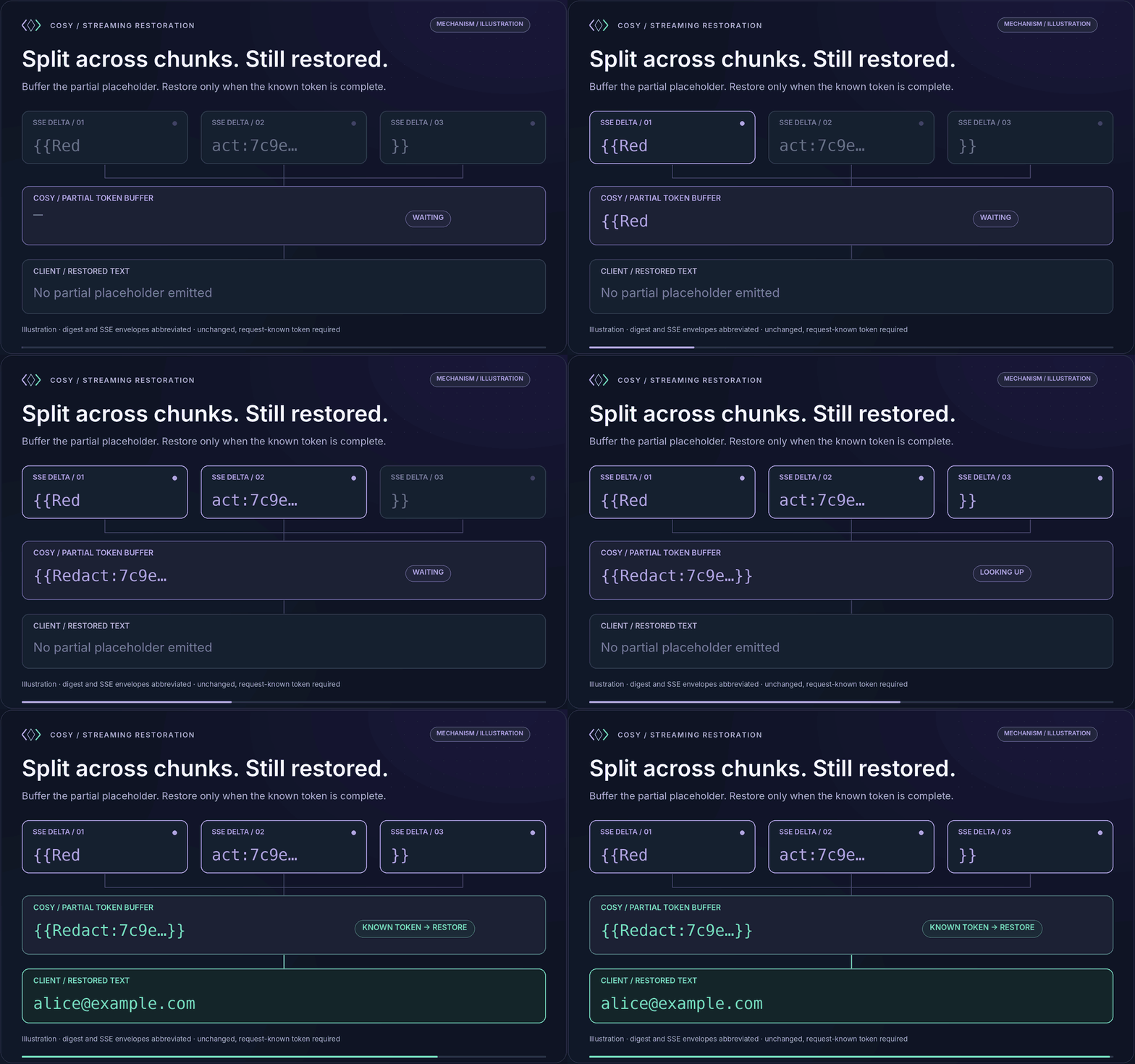
Mechanism illustration, not a live recording. Digests and SSE envelopes are abbreviated. This shows known-token buffering and restoration, not compatibility certification for arbitrary stream schemas.
Deploy where you trust the gateway
| Runtime | Entry point | Intended route |
|---|---|---|
| Cloudflare Workers | worker.js |
Module Worker; no application build step |
| Deno | worker.js |
Direct execution or a Deno Deploy entry point |
| Node.js 20+ | node-server.mjs |
Local development adapter |
Cloudflare Workers
From the repository directory, with Wrangler and your Cloudflare account configured:
npm test
npx wrangler deploy
wrangler.toml already points at worker.js. Alternatively, upload it as a module Worker. Configure the upstream allowlist as a Worker variable; a local shell variable alone does not configure a deployed Worker.
REDACT_ALLOWED_HOSTS=api.openai.com,api.anthropic.com
Add your own upstream hostname when needed. Wrangler is deployment tooling, not a gateway runtime dependency. Before allowing public traffic, also add access control and review Security.
Deno
Run in a trusted environment and restrict upstream hosts:
REDACT_ALLOWED_HOSTS=api.openai.com,api.anthropic.com \
  deno run --allow-net --allow-env worker.js
Direct execution calls Deno.serve(...) and reads environment variables. The same module can be the entry point of a Deno Deploy project; configure its environment and access controls in that deployment.
Security is a boundary, not a badge
The gateway is trusted; the upstream is not trusted with matched plaintext. Original requests, provider credentials, and replacement maps exist inside the gateway runtime. Deploying on a hosted runtime means trusting that host—not keeping processing entirely on your laptop.
| Cosy does | Cosy does not promise |
|---|---|
| Replace matching text before forwarding | Find every sensitive value or preserve every task's answer quality |
| Keep replacement maps request-local and unpersisted | Cryptographic erasure, anonymous requests, or cross-request restoration |
| Restore unchanged, known response tokens | Recover tokens that a model edits or invents |
| Reject unsupported non-JSON request bodies | Inspect image/audio content or redact every URL, header, or control field |
| Filter proxy/browser identity headers | Hide upstream credentials: Authorization and x-api-key are forwarded intentionally |
Before exposing a deployment: set REDACT_ALLOWED_HOSTS, keep private-upstream blocking enabled, and add external authentication/access control. A host allowlist restricts destinations; it does not authenticate callers. Review surrounding request logs and retention policies. Do not rely on the built-in hostname checks as a complete network egress or SSRF defense.
Default limits are 16 MiB per request body and 16,384 unique replacements per request. Default CORS is *; that is not access control. All runtime settings → · Existing security policy →
A few important questions
Does “keep credentials local” mean no credential ever leaves the host?
No. It describes the goal of replacing matched values in inspected payload text before forwarding from a local deployment. It is not a host-wide zero-leak guarantee. Authorization and x-api-key are sent to the upstream by design; skipped fields, missed matches, and traffic bypassing Cosy remain outside that protection. A cloud Worker or remote Deno instance is not your local machine.
Is this encryption or irreversible anonymization?
Neither. Cosy replaces selected strings with salted-hash identifiers and keeps an in-memory lookup table to reverse the substitution. The surrounding prompt still goes upstream. Hash identifiers do not eliminate all inference or correlation risks.
What does “request-local” mean?
The plaintext-to-token map belongs to one request and its response stream. It is discarded afterwards. The salt is generated per runtime/isolate, not per request: the same plaintext can produce the same token in that runtime. Tokens from an older request cannot be restored unless the current request establishes the corresponding mapping.
Will my existing workflow behave identically?
Not necessarily. Matching text is changed, a notice is injected into a supported user message, selected headers are filtered, and only recognized streaming fields receive protocol-specific handling. Redaction can affect tasks that need the original value; false positives can remove useful context. Test your own prompts and tools with synthetic fixtures first.
Can I use a private or local upstream?
Literal private, loopback, and link-local destinations are blocked by default after hostname normalization. Only disable REDACT_BLOCK_PRIVATE_UPSTREAMS in an intentionally trusted private deployment. An allowlist and network-level egress restrictions remain important. Routing and errors →
Help make the boundary better
Useful contributions include detector regression cases, missed-match/false-positive reports, reproducible client integrations, and SSE edge cases. Start an issue with the runtime, protocol, flags, and a synthetic or sanitized reproduction. Never attach real credentials or private prompts. Run npm test before submitting a change; follow SECURITY.md for security-reporting guidance.
Further reading
Routing, lifecycle, and runtime settings · Entropy calibration · Source · Tests · Third-party notices
Acknowledgements & license
The URL envelope follows TransformVetter's /{config}${upstream-url} convention; Cosy does not include its protocol-conversion or moderation engine. Some rule signatures derive from Gitleaks; see third-party notices.
Thanks to the Linux.do community for its support. Released under the Apache License 2.0.
Your code goes to AI. Your credentials shouldn't. Inspect locally before forwarding.