
BruceLanLan/augur has 708 GitHub stars and 119 forks. GitHot measured 0 stars in 24 hours and +17 in 7 days. Last checked 2026-11-22 07:59 UTC. Last push 2026-11-16.
Measured star growth
- in 24h
- 0
- in 7 days
- +17
- in 15 days
- Collecting history
- in 1 month
- Collecting history
Net star changes over overlapping periods, not daily totals. Missing measurements are left blank. Stars measure attention, not software quality.
About
🦉 Augur — 本地优先的投资研究记忆系统:18 位投资大师独立分析 + 加权共识,证据带时间语义、每次运行可复查,CLI / Dashboard / MCP。A local-first research memory system with 18 investor personas.
Developer ToolsREADME_EN.md
Original🇨🇳 中文 | 🇺🇸 English
🦉 Augur
Not another AI stock picker. A local research memory system that remembers what you knew, when you knew it, what changed, and who disagrees — and why.






⚠️ For research and education only. Not investment advice. The masters are rule-based simulations of publicly known investment philosophies, not the views of those people. Every score, Kelly size and valuation depends on data quality and model assumptions.
Contents: Why Augur · What's new in v13 · Quick Start · Upgrading to v13 (and older upgrades) · 18 Masters · Dashboard · Claude / Agent · CLI · Feature Maturity · Data & Privacy · Development · Docs & Roadmap
🤔 Why Augur
Most AI finance tools give you an answer. Augur gives you research artifacts you can check later.
| Typical AI tool | Augur | |
|---|---|---|
| What you get | "On one hand… on the other…" | 18 independent master verdicts, where they agree and where they fight |
| Where data came from | Unclear | Every evidence item carries its source, business time, availability time and retrieval time |
| Missing data | Silently zero | Marked missing; masters that need the field abstain and say why |
| Three months later | No memory | Each run is an immutable RunBundle you can export, compare and audit |
| Where your data lives | Someone's cloud | Locally in ~/.augur (override with AUGUR_DATA_DIR), no telemetry |
✨ What's new in v13
This section follows the order a new user actually works in: add tickers to the watchlist → backfill earnings dates → run the earnings cycle → read the research artifacts → open the dashboard. The v13 screenshots were taken on 2026-10-29 with real AAPL / MSFT / NVDA data (live market data + SEC EDGAR). Earnings dates estimated from the reporting cadence are labelled estimated in both the CLI output and the dashboard; they are not dates the companies announced. Terminal shots show the main part of the output.
1. Build a watchlist: augur watchlist add
augur watchlist add AAPL
augur watchlist add MSFT
augur watchlist add NVDA
The watchlist is the input to the earnings cycle: augur earnings, augur cycle and the dashboard Earnings Queue all read their tickers from it.
2. Backfill earnings dates: augur earnings --backfill
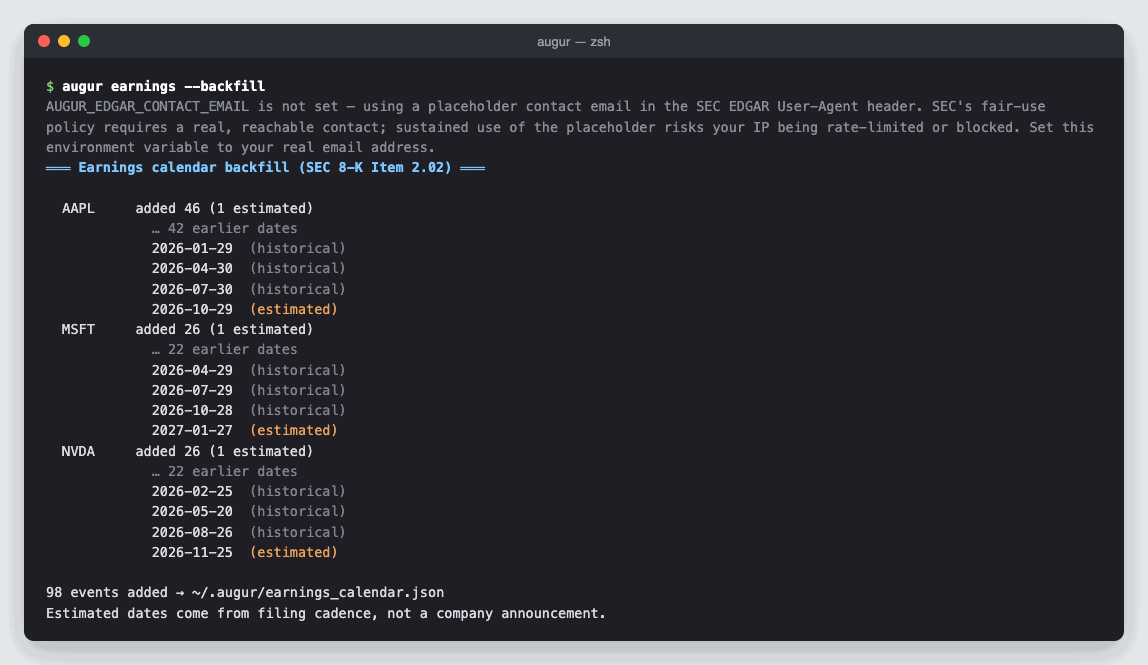
Reads each watchlist ticker's SEC 8-K filings with Item 2.02 (results of operations) to fill past earnings dates, then estimates the next date from the recent reporting cadence and marks it estimated, never confirmed. Entries you wrote in <data dir>/earnings_calendar.json are never overwritten. It needs network access and AUGUR_EDGAR_CONTACT_EMAIL; pass -t AAPL to backfill specific tickers only. The screenshot keeps only the latest few dates per ticker and folds the earlier ones into one line; each of the three tickers has one estimated date.
3. The earnings cycle in one command: augur cycle
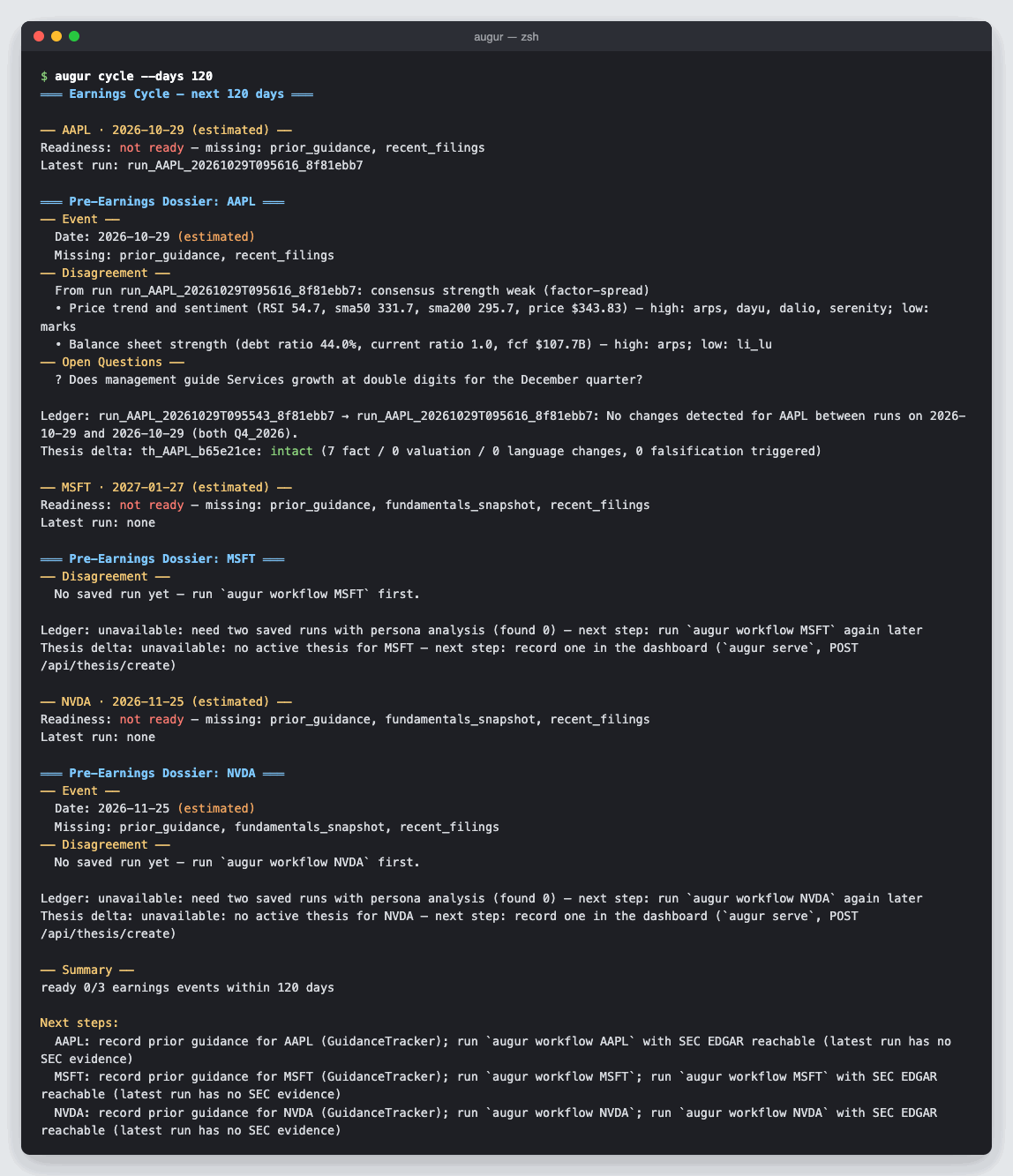
For every watchlist ticker reporting in the next N days (30 by default), it shows dossier readiness, the dossier, what changed between the two latest runs and the thesis delta, then ends with ready X/Y and a next step per ticker. It reads saved local state only and never goes to the network; anything missing is named together with the command that fills it. The screenshot uses --days 120 so that all three estimated dates fall inside the window. None of the three was ready at the time (no prior guidance record and no SEC evidence; MSFT and NVDA had no saved run yet), so the summary reads ready 0/3, followed by a next step per ticker.
4. Research artifacts: dossier, research report and built-in skills
augur dossier AAPL builds the pre-earnings dossier, augur report from-run AAPL builds a research report from the latest run, and augur skill run runs a whole research workflow in one command.
The screenshots below are real AAPL runs from 2026-09-17. The output of these commands has not changed since, so the original images are kept.
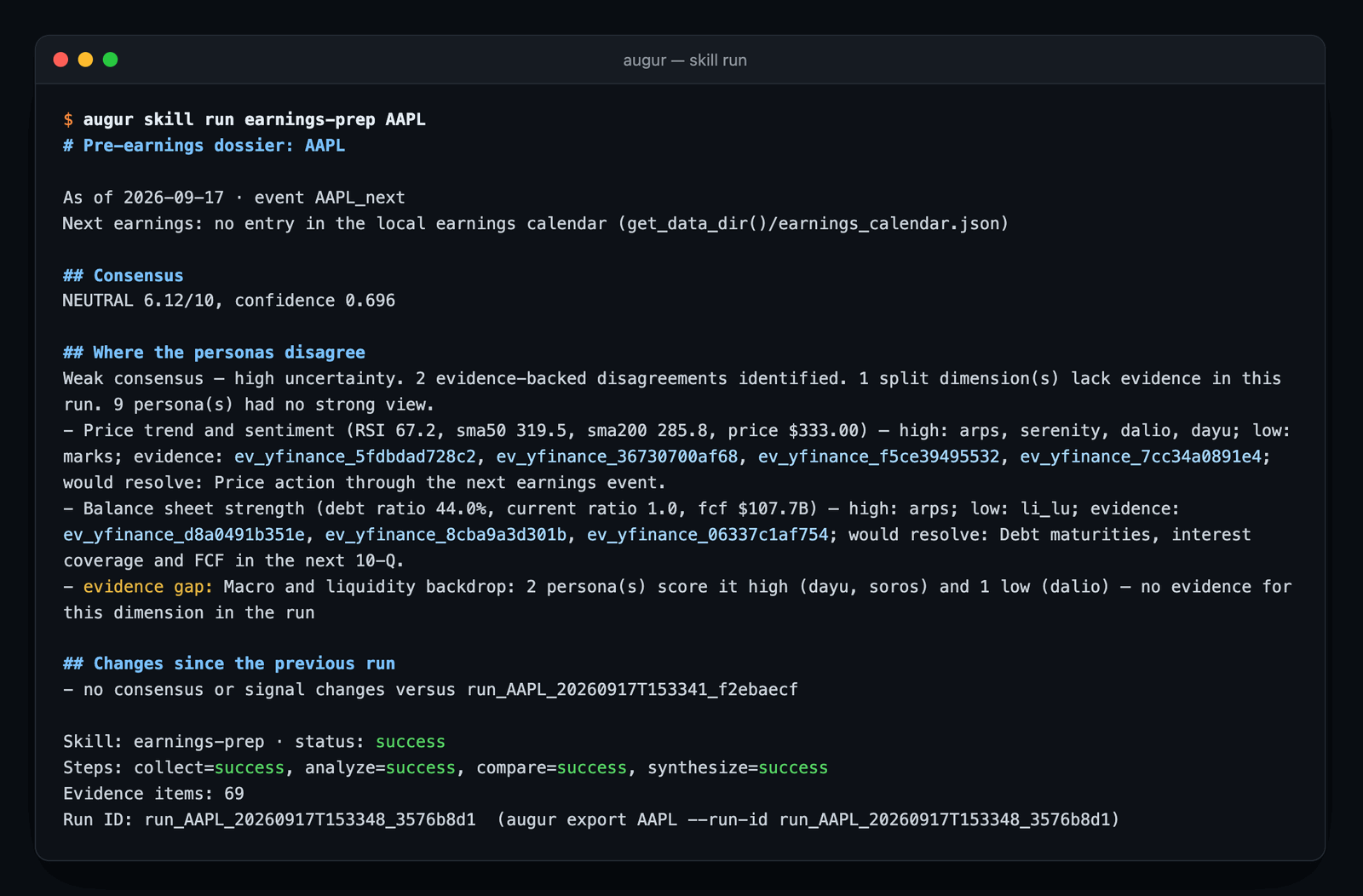
augur skill run earnings-prep AAPL: the 18-master consensus, disagreements that cite evidence IDs one by one, splits with no supporting evidence flagged as an "evidence gap", and a diff against the previous run. The next earnings date comes from the local earnings calendar (which the --backfill step above can fill) and is shown as confirmed or estimated; if the calendar has no entry, it says so instead of guessing. Before any step starts, the runner checks that every capability, network domain and local resource the workflow touches is declared in the manifest; if anything fails, nothing runs. Each run is saved as a RunBundle you can export and audit.
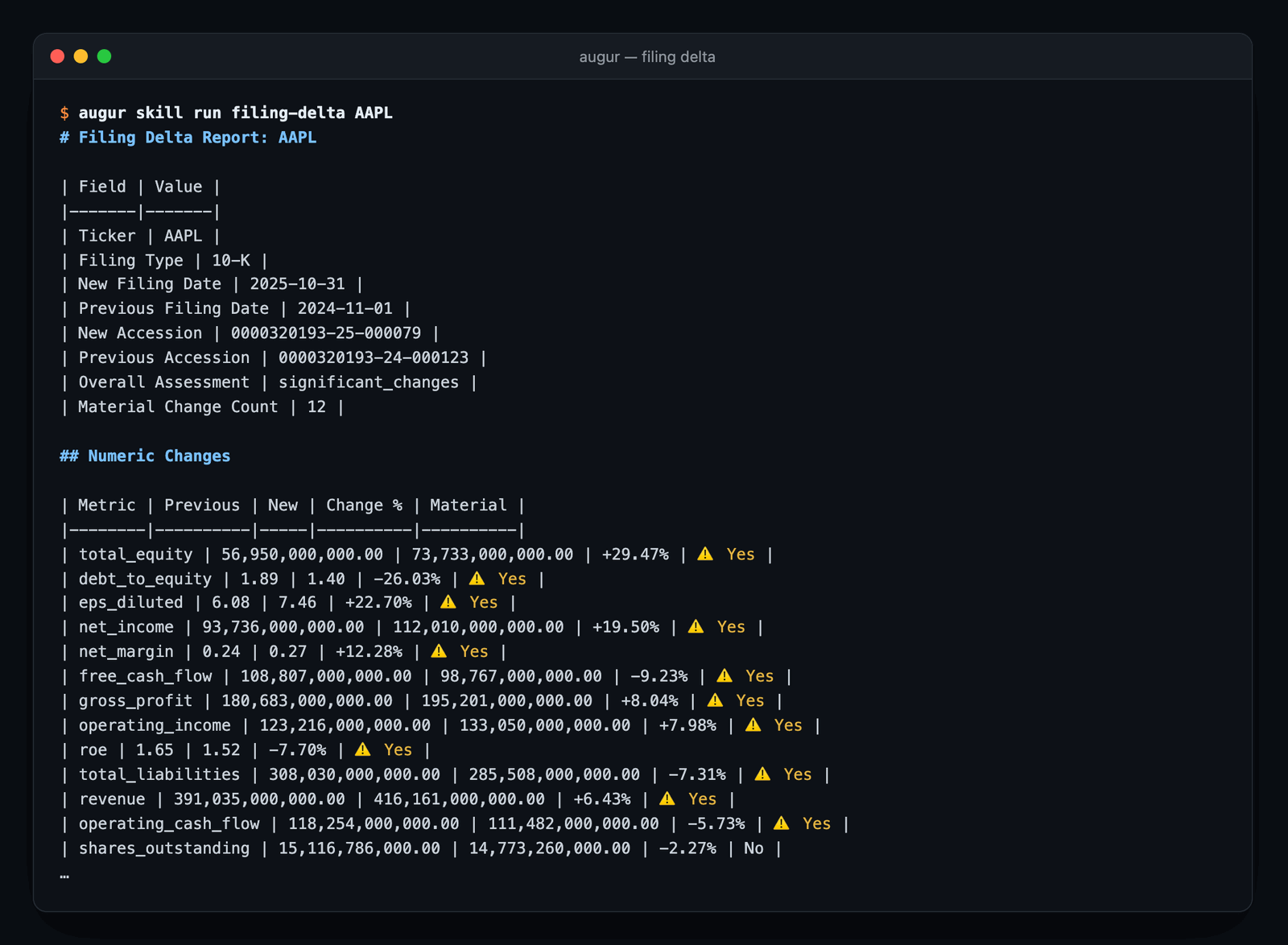
augur skill run filing-delta AAPL: pulls XBRL data for the two latest 10-Ks and lists material changes (≥5%), no accession numbers needed. Also built in: debt-covenant-review (leverage and interest coverage) and insider-cluster-review (Form 4 insider clusters). See the Skill guide (Chinese).
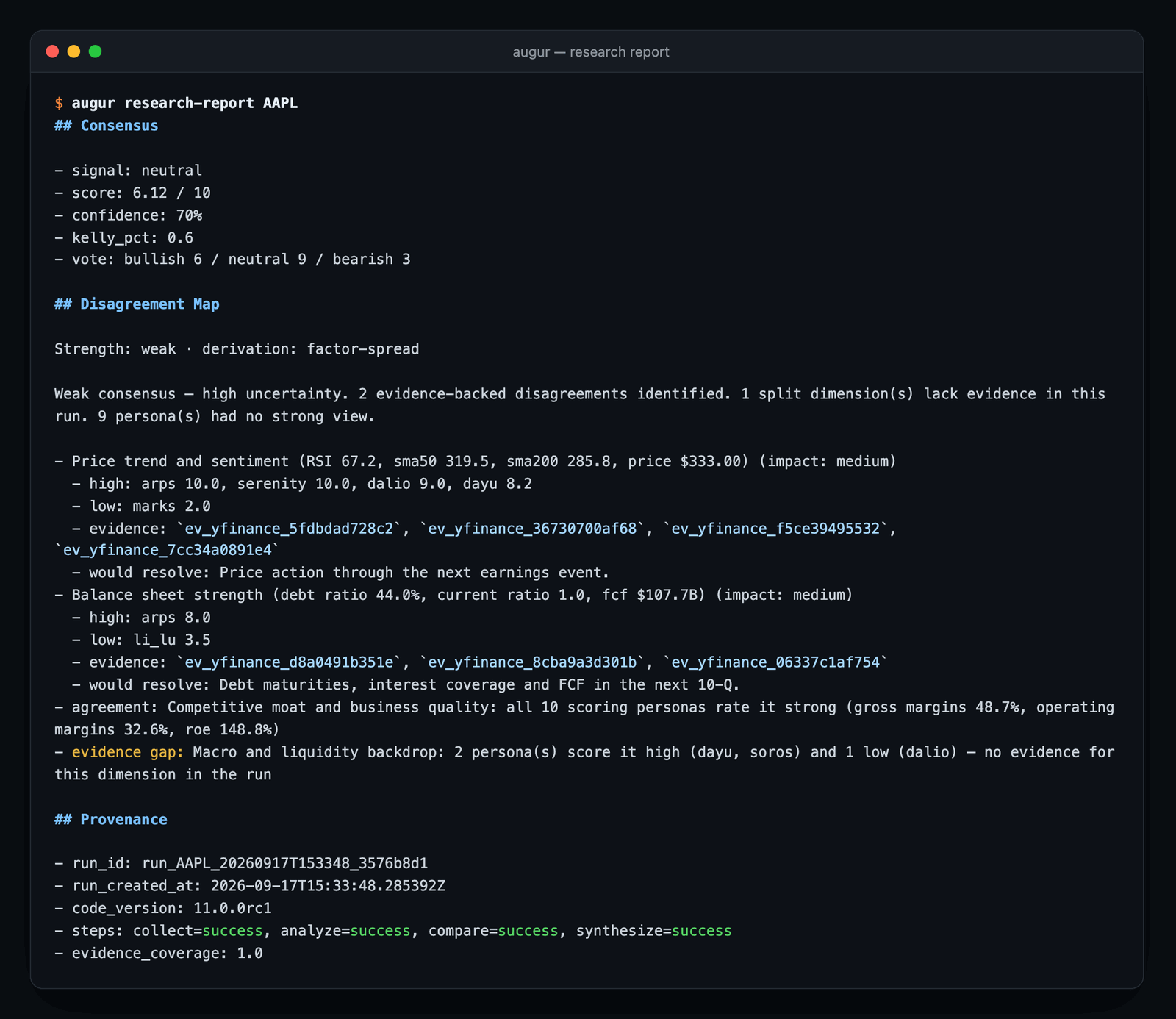
augur report from-run AAPL (the screenshot predates the rename from augur research-report; the output is the same): the vote split, the dimensions the masters disagree on (each citing evidence IDs and saying what fact would settle it), where they agree, splits with no evidence, and the run ID, code version, step status and evidence coverage.
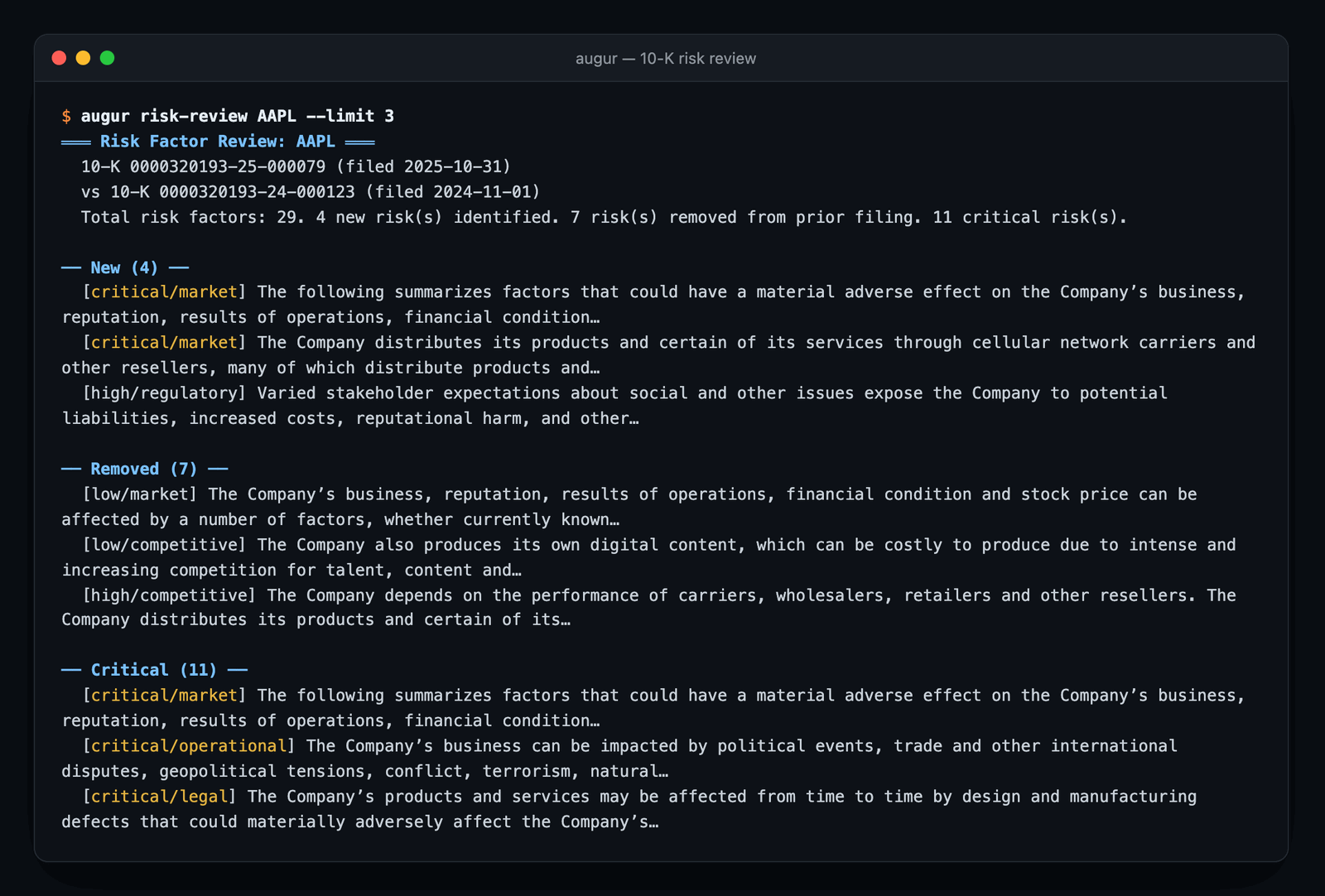
augur risk-review AAPL: compares the risk factor sections of the two latest 10-Ks and lists new, removed and escalated risks. It is rule-based, so a small wording change can show up as both "new" and "removed".
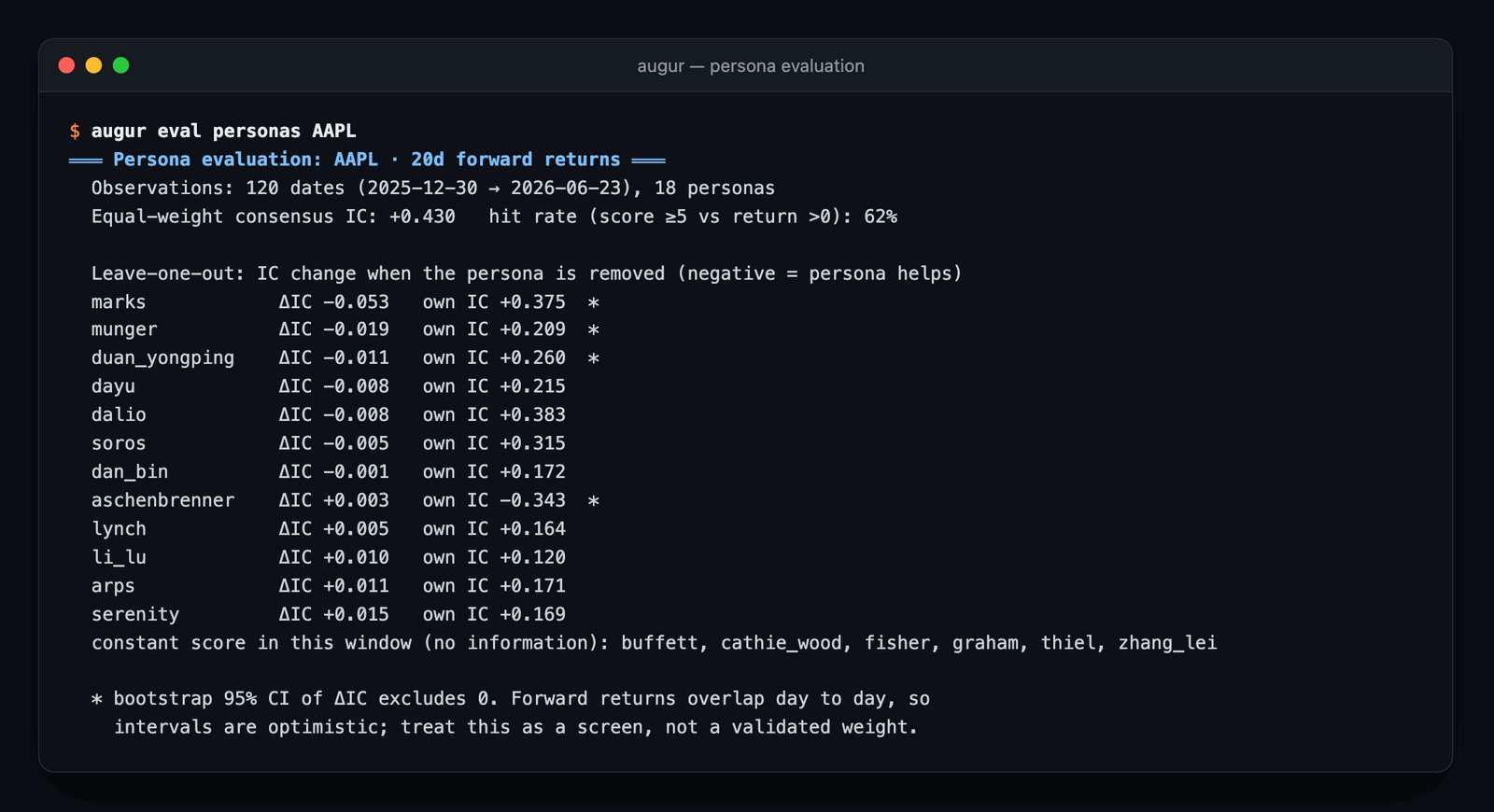
augur eval personas AAPL: using the records written by augur backtest, it removes one master at a time and shows whether the consensus IC gets better or worse; masters with a constant score (no information) are listed separately. Forward returns overlap day to day, so intervals are optimistic: treat it as a screen, not a validated weight. augur eval factors treats each master's score as a factor and gives its IC and t-test.
5. Dashboard
augur serve --open opens http://localhost:8000. These screenshots were also taken on 2026-10-29 with real AAPL / MSFT / NVDA data.
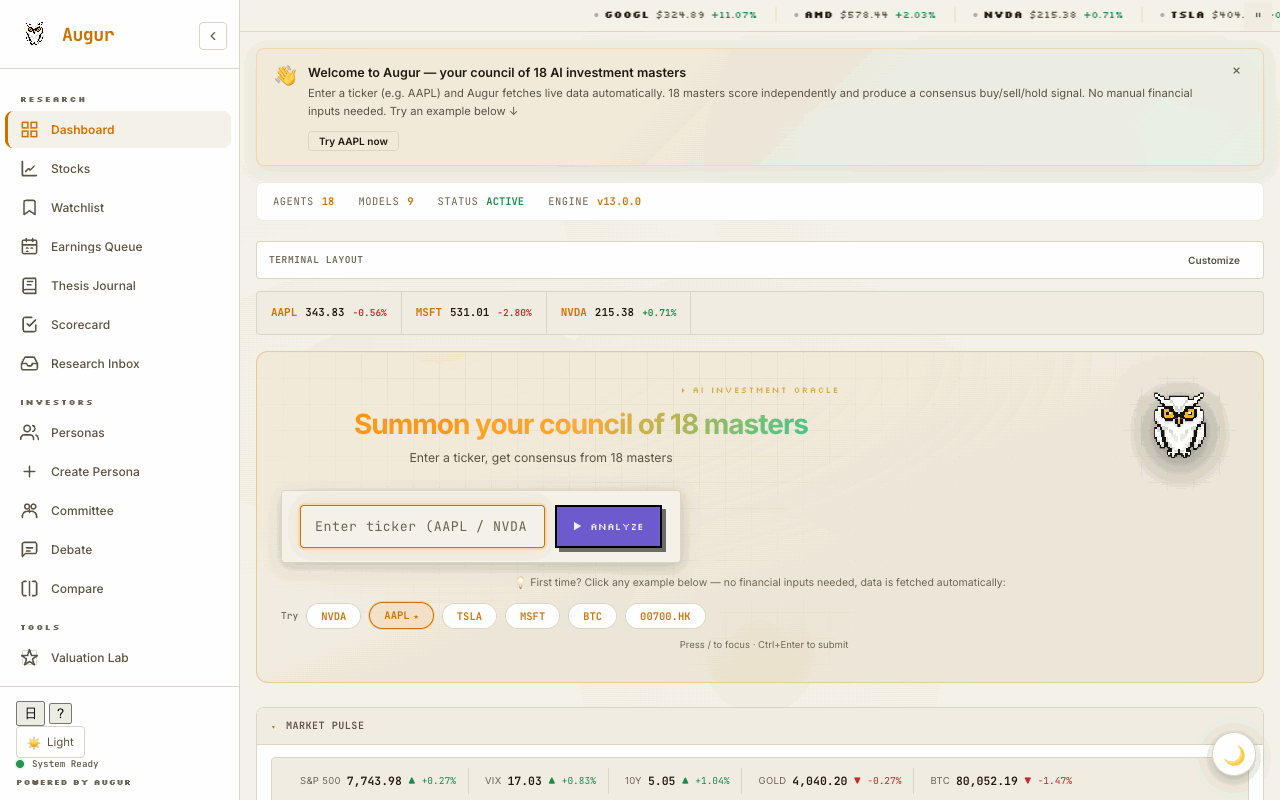
Home: market tape and masters overview. The sidebar is grouped into Research / Investors / Tools / System.
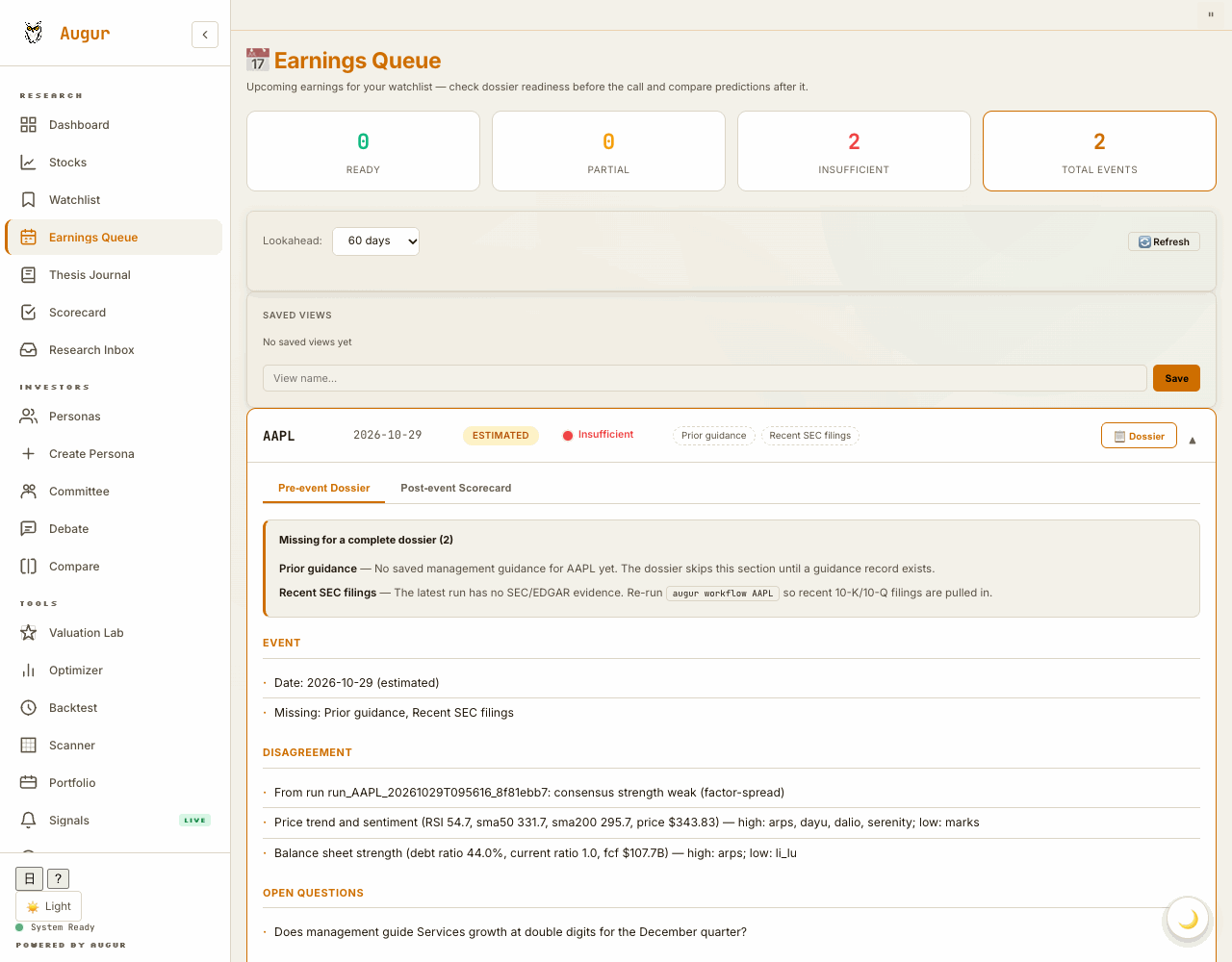
/earnings: the Earnings Queue reads the same watchlist and earnings calendar as augur earnings. Each ticker lists the dossier items that are still missing and the command that fills each one; estimated dates are labelled estimated.
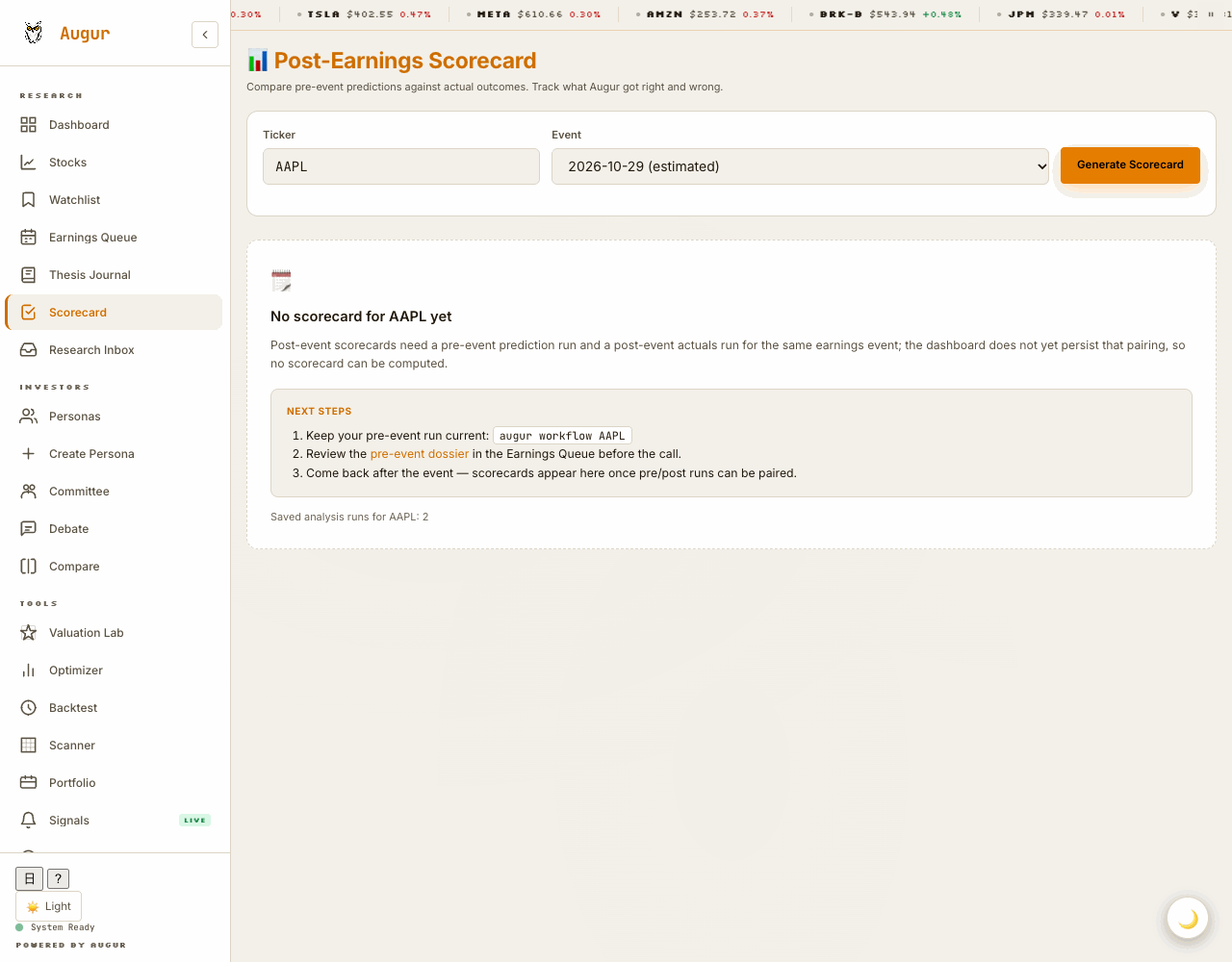
/scorecard: the post-earnings scorecard checks which research questions the pre- and post-event runs answered. Without enough data it shows unavailable with the reason instead of placeholder content. The screenshot shows exactly that state: the dashboard does not yet keep a pre-event/post-event run pairing, so it cannot build a real scorecard (the CLI augur scorecard can compare against answered research questions).
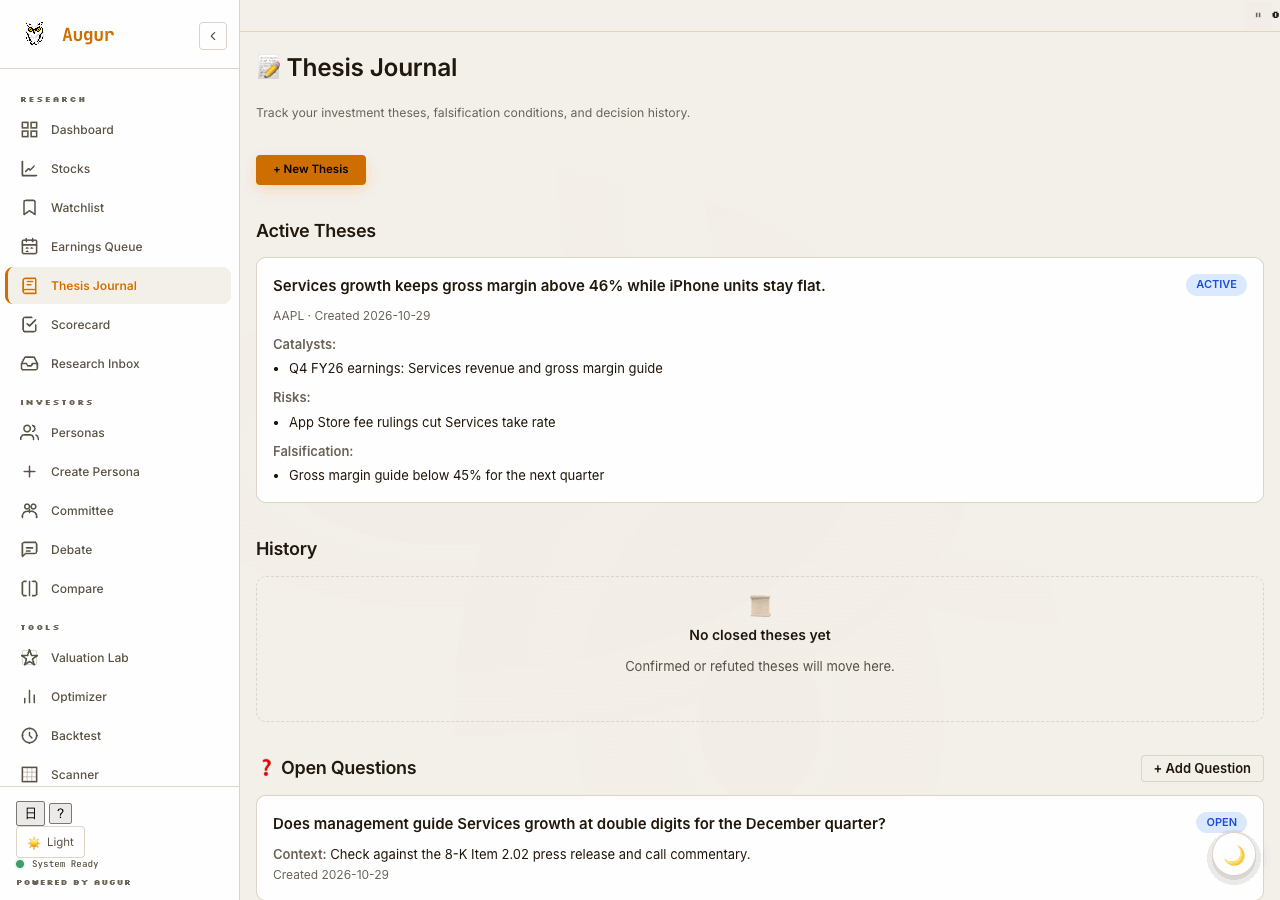
/thesis: record a thesis with catalysts, risks and falsification conditions, next to open research questions and a decision log. Research questions are stored locally and also appear in augur dossier. The thesis and question in the screenshot were entered by hand while taking it; they are examples, not research conclusions.
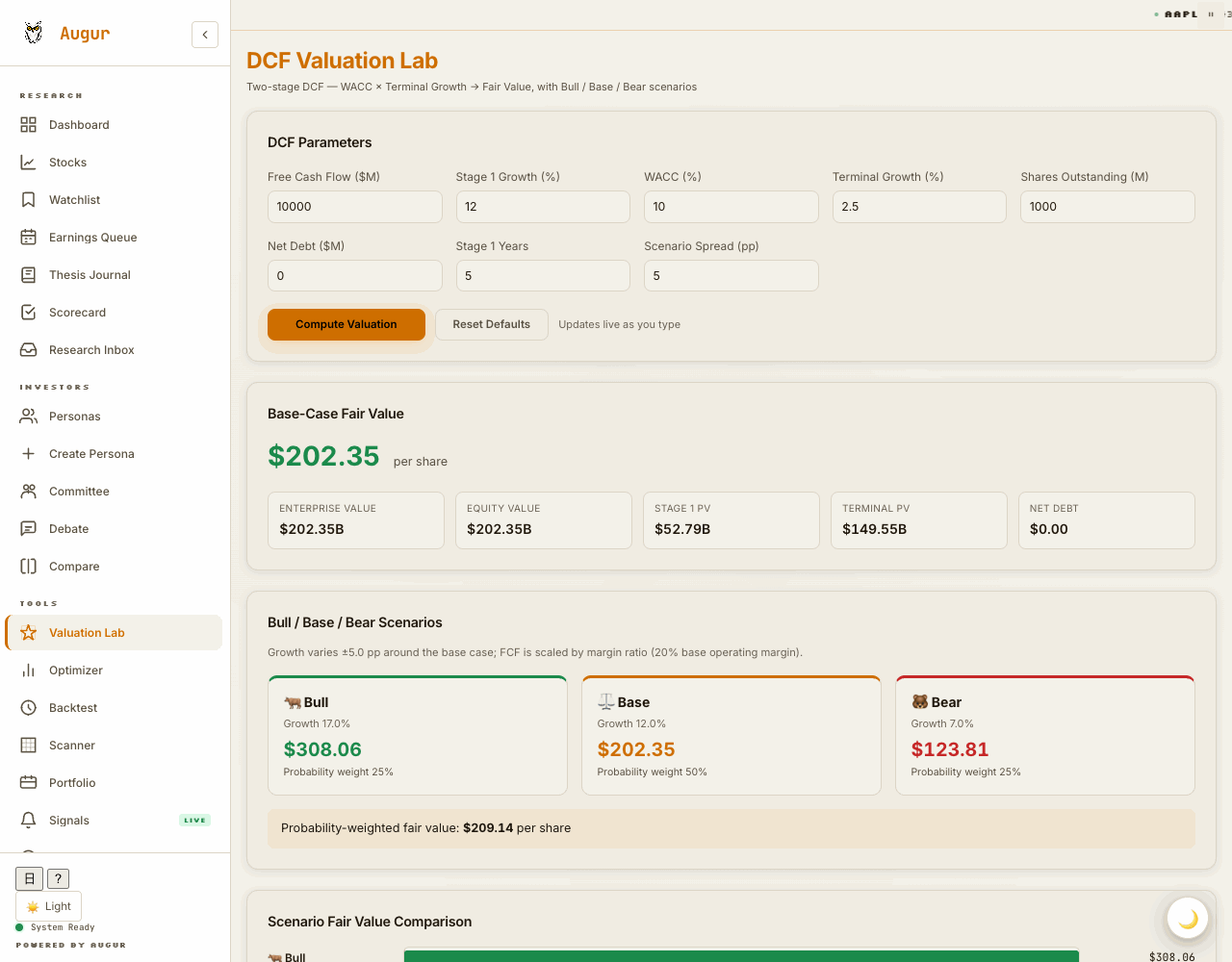
/valuation: a two-stage DCF that recomputes as you type, with bull / base / bear scenarios and a probability-weighted fair value, plus a WACC × terminal-growth sensitivity grid further down the page. The inputs in the screenshot are examples, not a valuation call.
🚀 Quick Start (5 minutes)
Python 3.10+.
git clone https://github.com/BruceLanLan/augur.git && cd augur
python3 -m venv .venv && source .venv/bin/activate
pip install -e ".[data]"            # core + live yfinance data
# optional: pip install -e ".[data,mcp]"  MCP server
#           pip install -e ".[export]"    PDF export

# SEC EDGAR requires a real contact address in requests (US fundamentals)
export AUGUR_EDGAR_CONTACT_EMAIL="[email protected]"
Dashboard:
augur serve --open # http://localhost:8000 · ⌘K command palette
CLI research loop (every command below was verified on a fresh install):
augur analyze AAPL                 # 18 masters + weighted consensus + Kelly size
augur workflow AAPL                # tracked pipeline, saves a RunBundle, prints the Run ID
augur report from-run AAPL         # from the latest run: consensus, disagreement map, provenance
augur export AAPL --format md      # export the latest run (md / json / evidence-pack / pdf)
augur committee AAPL --preset value -q "Is the moat widening or narrowing?"
augur valuation AAPL               # two-stage DCF, auto-fills FCF/shares/net debt and says so
augur skill run earnings-prep AAPL # built-in research skill: pre-earnings dossier (3 more skills)
augur watchlist add AAPL           # add to the watchlist
augur earnings --backfill          # backfill the watchlist's earnings dates from SEC 8-K (needs network)
augur cycle                        # earnings cycle for the watchlist: what is ready, what is missing, next step
Offline? augur analyze NVDA --pe 60 --roe 0.45 takes manual metrics; augur backtest AAPL --demo uses synthetic data. augur cycle reads local state only and never goes to the network.
🔄 Upgrading from v12 to v13
v13 is a cleanup plus one new feature. The only breaking changes are the three below, all at the import level; command-line usage is unchanged.
| Change | What to do |
|---|---|
| Python 3.10+ is required (3.9 reached end of life in October 2025) | Recreate your virtualenv with 3.10 or newer |
augur.accounting, augur.capital_allocation, augur.debate_engine, augur.relative_val and augur.portfolio_risk moved to augur.experimental.<same name> |
Change from augur.accounting import ... to from augur.experimental.accounting import .... No product path uses these modules and their API may change |
Compatibility modules augur.coordinator, augur.skill_spec, augur.mcp_entry removed |
Import from augur.registry, augur.schemas.skill_spec and augur.mcp_server instead; the augur-mcp command is unaffected |
New: augur earnings --backfill fills past earnings dates for your watchlist from SEC 8-K filings (Item 2.02, results of operations) and estimates the next date from the recent cadence, marked estimated, never confirmed. Entries you wrote in the calendar are kept. After a backfill, augur cycle has events to work on.
Upgrading from v11 to v12
12.0 fixes correctness, 12.1 adds one command for the whole earnings cycle (augur cycle), and 12.2 groups the CLI and tidies the dashboard. v12 adds no masters and no pages. It fixes the joints of the two loops Augur is built around: the earnings research cycle and learning from past predictions. In v11 each command worked alone, but the chain was broken.
| Change | Effect | What to do |
|---|---|---|
| Learned-weights file moves to schema 2 | On first load, outcomes recorded by v11 and the accuracy/weights built on them are discarded (pending predictions are kept). v11 applied one "latest 30-day return" to predictions made on different days, so those outcomes did not belong to the predictions they were stored on | Nothing. Learned weights are off by default (AUGUR_FORCE_LEARNED), so analysis results are unaffected |
| Each prediction resolves at its own horizon | Return from the close on the prediction day to the close 30 days later; nothing expires after 60 days; every outcome is appended to <data dir>/prediction_outcomes.jsonl for audit |
— |
| One prediction per master per day | Re-analysing a ticker used to add another prediction each time | — |
augur earnings without -t reads the real watchlist |
It read the wrong key and the queue was always empty | Add tickers with augur watchlist add AAPL |
| Dashboard earnings pages show no hard-coded content | Missing data is shown with the reason and next step instead of placeholder risks | — |
Research questions are saved to <data dir>/thesis/questions.json |
They survive a dashboard restart and appear in augur dossier |
— |
| Grouped commands (12.2) | watchlist-add → watchlist add, cron-run → cron run, research-report → report from-run, ledger / citations / comments / audit / decisions / verify-pack → records ..., ic-report → eval ic, skills → skill profiles, compat → skill compat |
Old names keep working until the next major release and only add one note line on stderr; scripts that parse stdout are unaffected |
Full list in CHANGELOG.md.
Upgrading from v10
v11.0.0 was never released on its own; its contents shipped with v12.0.0. v11 is a trust and research-foundation release, and these behaviour changes still apply in v12 and v13:
| Change | Effect | What to do |
|---|---|---|
insider_ownership / institutional_ownership go from 0 to Optional[float] |
Missing values are None; the 11 masters that use them abstain |
Handle None in custom code |
| Rolling-IC weights are no longer blended by default | Only applied when calibration status is validated-calibrated |
AUGUR_FORCE_RIC=1 to experiment |
| Learned (R6) weights are no longer blended by default | With little data they turn noise into "skill" | AUGUR_FORCE_LEARNED=1 to experiment |
| SEC EDGAR market cap is now in billions of USD | The overlay used to return raw USD, distorting size and FCF-yield checks; replay-derived factor/IC results produced before v11 carry that error | Regenerate replay artifacts if you rely on them |
augur serve / augur api bind to 127.0.0.1 by default |
Not reachable from the LAN out of the box | Set AUGUR_API_TOKEN, then pass --host 0.0.0.0 |
Legacy replay records without field_availability are rejected |
Clear error instead of silent loading | Regenerate |
MCP works with mcp 1.x and 2.x |
— | — |
Then follow the v11 → v12 and v12 → v13 steps above (including Python 3.10+). Full details: docs/RELEASE_NOTES_v11.md and CHANGELOG.md.
🎭 18 Investment Masters
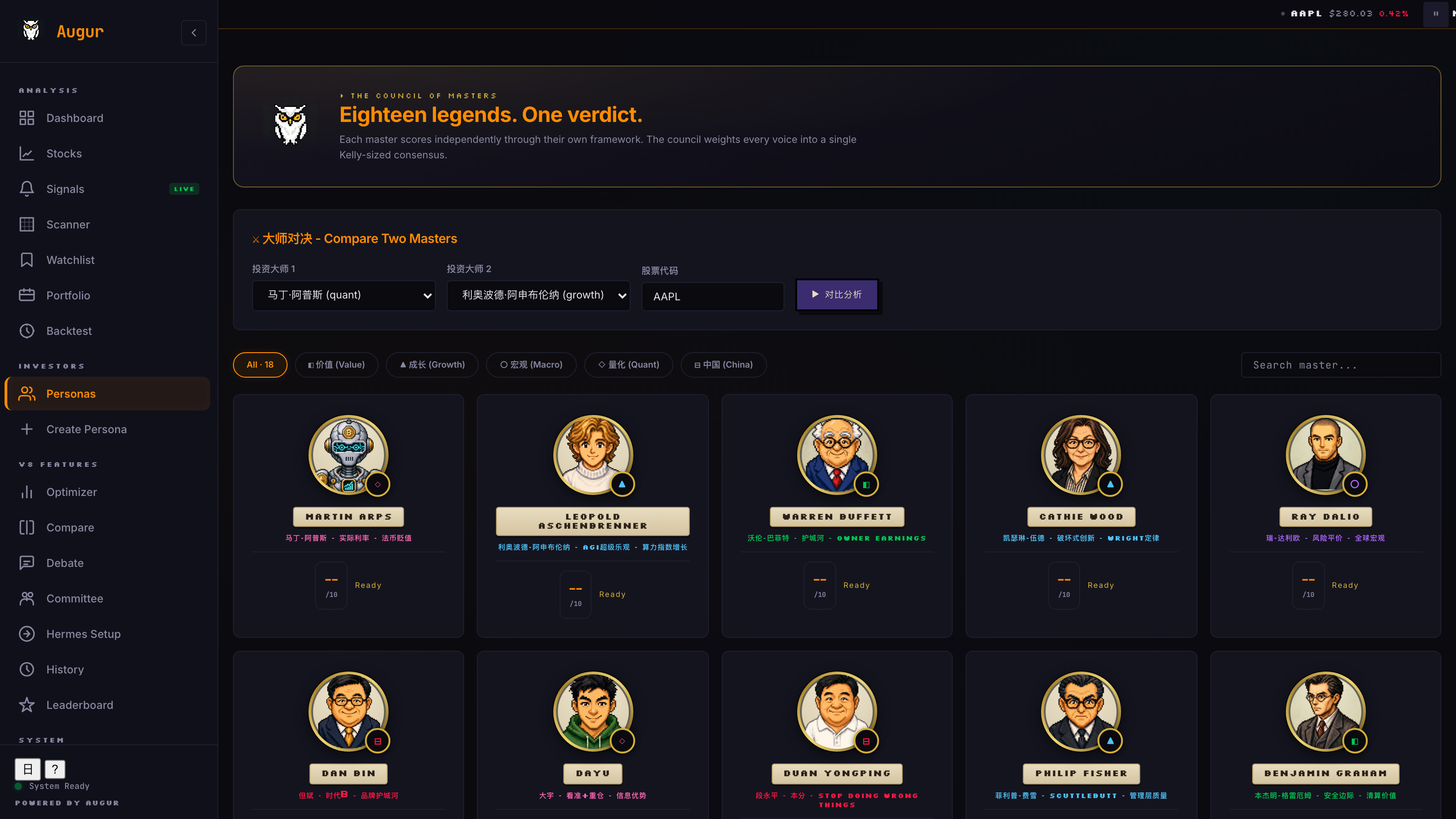
Rule-based portraits of investment philosophies across value, growth, macro and Chinese markets. Chinese masters answer in Chinese.
| School | Masters |
|---|---|
| 🏦 Classic Value | Warren Buffett · Benjamin Graham · Charlie Munger · Philip Fisher |
| 🚀 Growth & Innovation | Peter Lynch · Cathie Wood · Peter Thiel · Leopold Aschenbrenner |
| 🌍 Macro & Cycles | Ray Dalio · George Soros · Howard Marks · ARPS (crypto/gold) |
| 🇨🇳 Chinese Value | Duan Yongping · Zhang Lei · Li Lu · Dan Bin · Dayu |
| ⚙️ Special | Serenity (AI compute supply chain) |
The consensus engine weights by confidence, data coverage and sector relevance, and outputs a signal, score, confidence and Kelly position size. augur list-personas shows all IDs.
📊 Dashboard
Run augur serve, then open http://localhost:8000.
| Page | Path | What it does |
|---|---|---|
| Home | / |
Market tape + masters overview |
| Masters | /personas |
All 18 masters |
| Stock analysis | /stocks |
Enter a ticker, 18 masters analyze it |
| Committee / Debate / Compare | /committee · /debate · /compare |
Preset committees, multi-round debate, radar comparison |
| History | /history |
Run history and heatmap |
| Thesis Journal | /thesis |
Theses, falsification conditions, decision log |
| Earnings | /earnings · /scorecard |
Earnings queue, post-earnings scorecard |
| Research inbox | /inbox |
Aggregated items needing attention |
| Valuation lab | /valuation |
DCF inputs + sensitivity grid |
| Portfolio / Watchlist / Settings | /portfolio · /watchlist · /settings |
Kelly allocation, scheduled analysis, layout and master subsets |
🔌 Claude / Agent Integration
The MCP server exposes 14 tools (including augur_run_skill for the built-in skills), 7 research prompts and 5 read-only resource types (augur://evidence/{id}, augur://runs/{id}, augur://thesis/{id}, augur://decisions/{id}, augur://ledger/{ticker}/{quarter}). It was verified with real stdio client sessions on both mcp 1.x and 2.x.
pip install -e ".[data,mcp]"
Claude Desktop config:
{
  "mcpServers": {
    "augur": { "command": "augur-mcp", "env": { "AUGUR_EDGAR_CONTACT_EMAIL": "[email protected]" } }
  }
}
There are also Hermes / OpenClaw skill packs (src/skills/, see docs/hermes-setup-guide.md) and Telegram / Slack / Lark / WeChat bot entry points.
💻 CLI Cheat Sheet
# Analysis
augur analyze AAPL [--persona buffett] [--json]
augur workflow TSLA --steps fetch,analyze,consensus,committee,debate,sentiment
augur committee NVDA --agents buffett,munger,dalio
augur batch AAPL MSFT NVDA

# Research artifacts
augur report from-run AAPL [--format json]    # consensus + evidence-derived disagreement + provenance and latency
augur export AAPL --format md|json|evidence-pack|pdf [-o PATH] [--run-id ...]
augur records verify-pack pack.zip              # check every file's SHA-256 in an evidence pack
augur dossier AAPL                              # pre-earnings dossier
augur valuation AAPL [--fcf 100e9 --shares 15e9 --growth 0.08 --wacc 0.10]
augur risk-review AAPL                          # new / removed / escalated risk factors across the last two 10-Ks
augur records ledger AAPL                       # what changed between the two latest analysed runs
augur thesis-delta AAPL                         # active theses vs the two latest runs (offline)
augur scorecard AAPL [--pre RUN --post RUN]     # post-earnings scorecard: pre-event answers vs outcomes
augur cycle [--days 30] [--format markdown]     # watchlist through the earnings cycle: readiness / dossier / ledger / thesis delta
augur filing-delta AAPL --new q3.json --prev q2.json

# Built-in research skills (permission-checked, saved as RunBundles)
augur skill list · augur skill show filing-delta
augur skill run earnings-prep|filing-delta|debt-covenant-review|insider-cluster-review AAPL

# Evaluation (on records written by augur backtest)
augur backtest AAPL --days 120 [--demo] · augur eval ic
augur eval personas AAPL [--horizon 20]         # consensus IC, hit rate, leave-one-out contribution per master
augur eval factors AAPL                         # each master's score as a factor: IC, t, p

# Research records
augur records decisions list|resolve|report     # decision outcomes and win rate
augur records comments add|list|resolve         # comments on runs / theses / decisions / evidence
augur records citations report|list|accept|reject|fixed # citation-correction queue
augur records audit [--action ...]              # audit log

# Data
augur fetch AAPL · augur sentiment AAPL · augur insider AAPL · augur earnings --days 30 · augur doctor
augur earnings --backfill          # backfill the earnings calendar from SEC 8-K Item 2.02: past dates + one cadence-estimated next date (tagged estimated; never overwrites hand-written entries)

# Monitoring & servers
augur watchlist add AAPL · augur watchlist show · augur watchlist watch AAPL NVDA --interval 60
augur cron run · augur cron start
augur serve [--port 8000] · augur mcp-server · augur skill profiles · augur skill compat
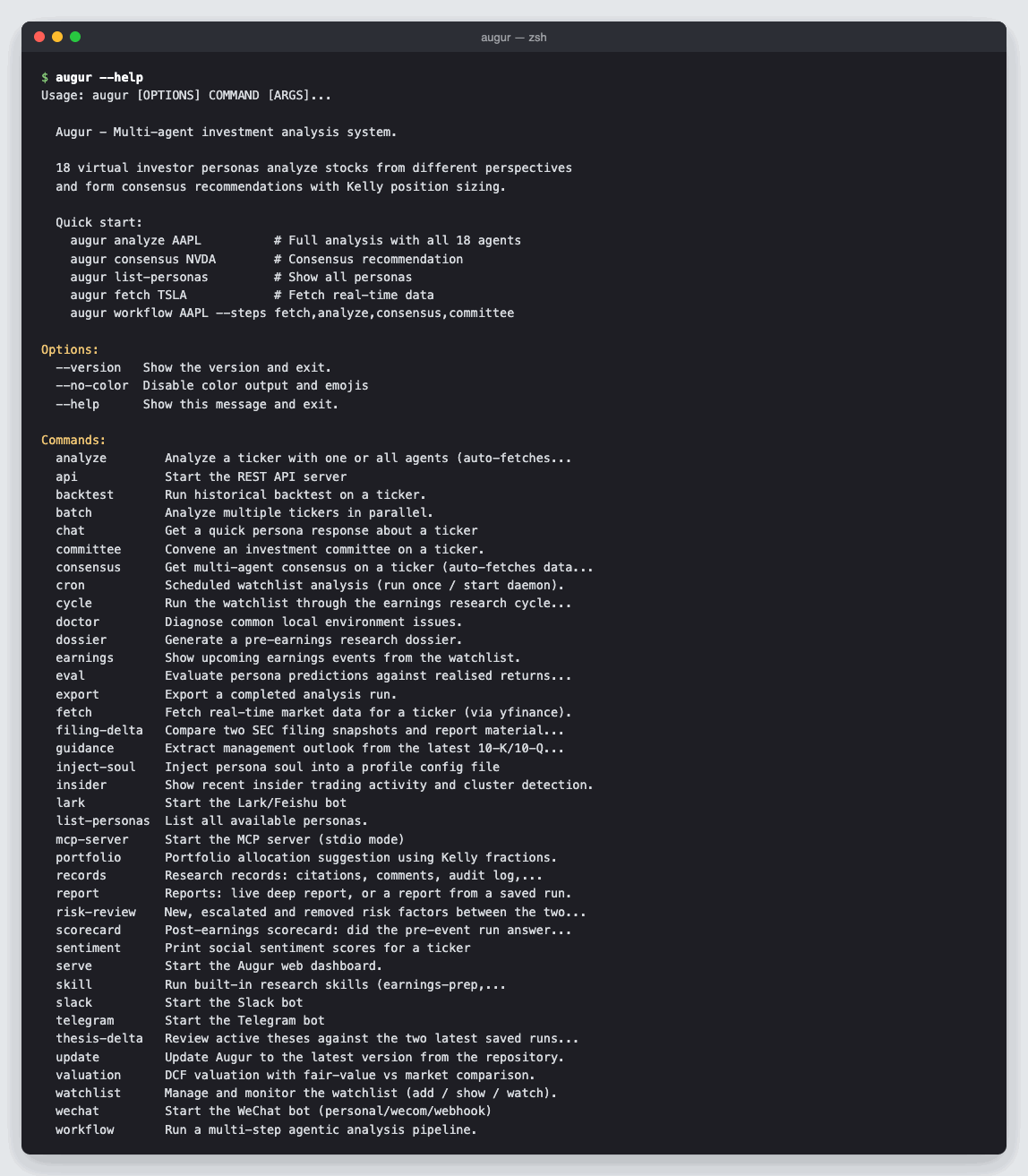
augur --help lists all 38 top-level commands (37 in a pip install, where augur update is hidden). Since v12.2 related commands are grouped (watchlist / cron / report / records / eval / skill); the old flat names (e.g. watchlist-add, research-report, ic-report, ledger) keep working until the next major release, are hidden from --help, and print a one-line hint with the new form on stderr. augur report AAPL is unchanged and is the same as augur report run AAPL.
🧭 Feature Maturity
Stated plainly, so "there is code for it" is not mistaken for "it works".
| Status | Scope |
|---|---|
| Stable | 18-master analysis and consensus, the CLI research loop above, main dashboard pages, MCP server, RunBundles and export, the data-source chain (yfinance → SEC EDGAR overlay) |
| Works, with stated limits | The four built-in skills (only built-in manifests run; covenant review defaults to reference thresholds, not the company's credit agreements; earnings dates come from the local calendar file earnings_calendar.json, which you can write by hand or fill from SEC 8-K with augur earnings --backfill; the estimated next date is labelled estimated); the disagreement map (derived from per-dimension master scores and cites evidence, with a fixed dimension-to-metric table); augur risk-review (rule-based: a reworded risk factor can show as one new plus one removed item); augur eval (single-ticker time-series IC with overlapping forward returns — optimistic significance, a screen only); augur guidance (needs AUGUR_EDGAR_GUIDANCE_EXTRACTION=1 and calls a paid LLM); PDF export (needs the [export] extra) |
| Experimental (off by default) | Rolling-IC dynamic weights (AUGUR_FORCE_RIC=1), learned weights (AUGUR_FORCE_LEARNED=1) — neither has passed a pre-registered out-of-sample test |
| Code only, no entry point | augur.experimental.accounting (accounting quality), augur.experimental.capital_allocation, augur.experimental.debate_engine (the dashboard /debate page uses a different implementation), augur.experimental.relative_val (relative valuation), augur.experimental.portfolio_risk — unit-tested, but no CLI, dashboard or MCP path calls them; usable as a library, not product features |
| Not instrumented yet | Token usage in run records (only latency is recorded) |
🔒 Data & Privacy
- All state lives in a local data directory (
~/.augurby default,AUGUR_DATA_DIRto change it). No telemetry. Single-user with no sign-up by default (optional multi-user mode viaAUGUR_MULTI_USER=1). - Network requests Augur makes: market and fundamentals data (yfinance, SEC EDGAR); optional LLM calls, only when you configure a key and enable the feature; dashboard pages load Chart.js from the jsDelivr CDN.
- The dashboard listens on localhost only by default. Set
AUGUR_API_TOKENbefore exposing it; see docs/self-hosted-guide.md.
Key environment variables:
| Variable | Purpose |
|---|---|
AUGUR_DATA_DIR |
Data directory |
AUGUR_EDGAR_CONTACT_EMAIL |
Contact address SEC EDGAR requires (a placeholder with a warning is used if unset) |
AUGUR_API_TOKEN / AUGUR_MULTI_USER |
Dashboard /api/* authentication |
AUGUR_CORS_ORIGINS |
Allowed CORS origins |
AUGUR_FORCE_RIC / AUGUR_FORCE_LEARNED |
Turn on experimental dynamic weights |
AUGUR_SKIP_MACRO_FETCH |
Skip the VIX/SPY macro fetch (offline or CI) |
AUGUR_EDGAR_GUIDANCE_EXTRACTION |
Enable LLM-based guidance extraction (paid) |
🔧 Development
python3 -m venv .venv && source .venv/bin/activate
pip install -e ".[dev,data,mcp]" "ruff>=0.16,<0.17" build

make verify     # full test suite + ruff + wheel/sdist build with sha256 digests
make lint       # ruff (rule set pinned to E4/E7/E9/F)
make test-wheel # install the built wheel into a fresh venv and smoke-test it
- Tests run against a temporary
AUGUR_DATA_DIR, never write to your~/.augur, and pass with the network fully blocked. - CI (
.github/workflows/):Testsruns the full suite on Python 3.10 / 3.11 / 3.12 and asserts the collected test count;Hermetic Smokeinstalls from the wheel and the sdist into fresh venvs and runs ruff and pip-audit. - See CONTRIBUTING.md.
📚 Docs & Roadmap
| Document | Contents |
|---|---|
| docs/ROADMAP.md | The single authoritative roadmap: current phase, verification point for each step, candidates after v13 and open decisions (Chinese) |
| docs/RELEASE_NOTES_v11.md | v11 release notes and migration guide (v12 and v13 changes are in CHANGELOG.md) |
| docs/reviews/ | Project reviews, each finding with its evidence level and fix (Chinese) |
| docs/schema-reference.md | EvidenceItem / Claim / StepResult / RunBundle / SkillSpec |
| docs/api-reference-v11.md | Python API / REST / MCP |
| docs/examples.md | Worked examples |
| docs/self-hosted-guide.md | Docker / systemd / reverse proxy / auth |
| docs/INDEX.md | Full documentation index |
📝 Changelog
v13.0.0 — Earnings dates from SEC, Python 3.10, smaller public API (current)
- Earnings date backfill:
augur earnings --backfillfills past earnings dates from SEC 8-K filings (Item 2.02) and estimates the next one from the cadence (marked estimated);augur cycleno longer depends on a hand-written calendar - Breaking: Python 3.10+; five modules with no product entry point moved to
augur.experimental; three compatibility modules removed. See "Upgrading from v12 to v13" above
v12.2.0 — One command tree, clearer dashboard
- Grouped CLI:
watchlist/cron/report/records/eval/skillgroups;augur --helpgoes from 47 to 38 entries; old names still work and point to the new form - Dashboard: sidebar grouped into Research / Investors / Tools / System with the Earnings Queue, Thesis Journal, Scorecard and Research Inbox now linked; earnings rows show readable missing items and the command that fills each; the scorecard event picker no longer hangs on Loading; Thesis Journal empty states, errors and phone layout reworked
- Learning data: the dashboard and the cron job no longer overwrite each other's writes
v12.1.0 — The earnings cycle in one command
augur cycle: for each watchlist ticker reporting soon — readiness, dossier, change since the last run, thesis delta — ending withready X/Yand a next step per tickeraugur scorecard: which research questions the pre- and post-event runs answeredaugur thesis-delta: active theses against the two latest runs
v12.0.0 — Earnings loop and honest learning
- Learning outcomes fixed: each master prediction resolves at its own 30-day horizon (v11 applied one "latest 30-day return" to predictions made on different days); nothing ages out, the boundary is by calendar day, and every outcome is appended to
prediction_outcomes.jsonlfor audit; one prediction per master per day. Outcomes recorded by v11 are discarded on first load; pending predictions are kept - Earnings loop wiring: the earnings queue reads the real watchlist, dossier readiness uses saved runs, and the dashboard no longer shows hard-coded earnings content
- Research records: research questions persist, same-second run ordering fixed, runs record the real package version
- Three 2026-09-17 rounds shipped for the first time (v11.0.0 GA was never released): built-in skill runner (
augur skill run, permission-checked before any step), disagreement map derived from per-dimension master scores with cited evidence,augur evalover backtest records,augur risk-reviewacross two 10-Ks,augur ledgerbetween two runs, research-record commands (decision outcomes / comments / citation corrections / audit log), evidence-pack digest verification; plus fixes found by running everything from a fresh install:workflowcheckpoint crash, evidence timestamp timezone bug,export/research-report/dossierwired to real runs,committeecrash, SEC EDGAR market cap off by 10⁹, valuation inventing inputs, servers exposed on the LAN by default, avatars 404 in pip installs, MCP support formcp2.x, CI false-green fixed - See CHANGELOG and ROADMAP
v11.0.0-rc1 — Research Memory System
- Research foundation: EvidenceItem with three time semantics, Claim, StepResult, immutable RunBundle, declarative SkillSpec v1
- Research loop: Thesis Journal, Filing Delta, disagreement map, Guidance Tracker, research inbox, DCF valuation lab
- Trust: missing data propagated explicitly, calibration status labels, unvalidated dynamic weights off by default
See CHANGELOG.md.
v10.15.0 — public sync release
Real SEC EDGAR fundamentals, three credibility fixes, augur doctor environment diagnostics.
v10.0.0 and earlier
v10: Bloomberg-style terminal + workflows + MCP tools · v9: Hermes Agent + committees · v8: HD-2D design system
MIT License · Created by BruceLanLan (X: @BruceBlue)
For research and education only. Not investment advice.
Explore related projects
Loading…