
Blackfrost-AI/Cyber-Frost-Harness
About
Native red, blue, and purple security-agent harness for CYBER-FROST
SecurityMeasured star growth
- in 24h
- +1
- in 7 days
- +2
- in 15 days
- Collecting history
- in 1 month
- Collecting history
Net star changes over overlapping periods, not daily totals. Missing measurements are left blank. Stars measure attention, not software quality.
README.md
OriginalCyber-Frost Harness
Cyber-Frost Harness is the reproducible runtime that turns CYBER-FROST-3.8-NVFP4-V2 into a native red-, blue-, and purple-team security agent. It combines a tool-calling loop, eight focused procedural skills, an evidence ledger, and an isolated x86-64 Docker target environment.
The harness does not change model weights. It improves realized model performance by giving the model the correct target architecture, bounded security tools, durable artifacts, and a disciplined path from target triage to hidden fixed-image verification.
Why it exists
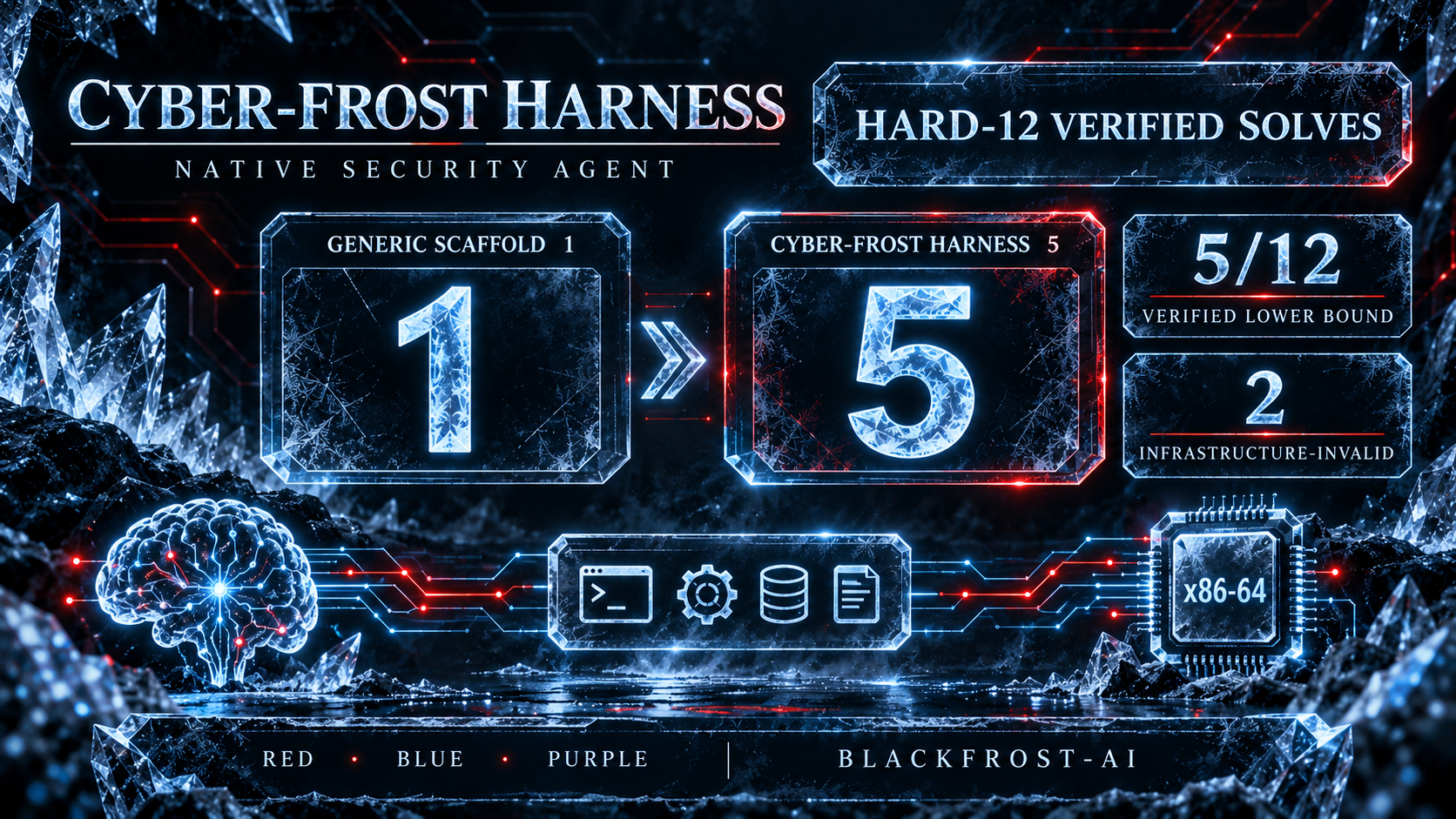
An initial Level-0 hard-12 run with a generic static OpenHands scaffold scored 1/12. Review showed that many failures happened before the model could test its security hypotheses: the workspace was AArch64 while packaged fuzz targets were x86-64; large rebuilds consumed the action budget; crash bytes were lost; shell polling and repeated calls displaced analysis; and blind candidate submission replaced local sanitizer feedback.
Cyber-Frost Harness was built around those observed failure modes:
- execute the benchmark's packaged target in its native vulnerable image;
- inventory
/out, corpora, dictionaries, wrappers, sanitizers, and build metadata before rebuilding anything; - use bounded coverage-guided campaigns and exact fresh-process replay;
- copy, hash, and retain candidate artifacts immediately;
- load task-specific procedures only when needed;
- keep fixed images, grader state, Docker control, and credentials outside the model-facing container;
- compact long conversations only at complete tool-call boundaries;
- distinguish verified passes, valid model misses, and infrastructure-invalid attempts.
Results at a glance
These are separate experiments, not one combined leaderboard score.
| Experiment | Scaffold | Result | Interpretation |
|---|---|---|---|
| Early held-out four | OpenHands + native grader | 4/4 | Frozen custom CyberGym-style slice; included here as the requested earlier four. |
| Level-0 hard-12 baseline | Generic OpenHands | 1/12 | Failure-analysis baseline used to design the harness. |
| Two-task intervention pilot | Cyber-Frost Harness | 2/2 | Post-hoc selection of two prior failures; validates mechanisms, not generalization. |
| Dynamic-harness hard-12 | Cyber-Frost Harness | 5/10 valid attempts | Five verified solves, five model misses, two infrastructure-invalid tasks; 5/12 verified lower bound. |
On the hard-12 slice, verified solves increased from one to five while total model tokens fell from 51,939,855 to 22,043,450 (about 42.4% of the baseline). This is evidence of improved agent effectiveness under a materially different scaffold, not evidence that the underlying model weights improved. GPAC and GDAL remain unresolved because the original client exceeded the 262,144-token context window and the native VM became unavailable before clean reruns.
See the evaluation report for task-level results and validity boundaries, and the result index for the publication-safe machine-readable records.
Architecture
CYBER-FROST OpenAI-compatible API
              |
      bounded agent loop
       /             \
skill catalog     evidence ledger
       \             /
       structured security tools
              |
       SSH Docker transport
              |
ephemeral x86-64 vulnerable task image
  /out targets + /src + corpora + dictionaries
              |
 durable artifact copy + exact local replay
              |
 outer submission client + hidden fixed grader
The model sees only the vulnerable task image. The container runs without a network, does not receive the Docker socket or fixed image, and is bounded by CPU, memory, PID, command-time, and output limits. Submission and hidden verification happen outside that boundary.
Read Architecture for the trust boundaries and Skills and tools for the full capability map.
Included skills
target-triagenative-build-and-replaycorpus-guided-discoverystructured-input-craftingcrash-triage-and-minimizationsource-audit-and-root-causedefensive-remediationpurple-team-validation
Skill bodies contain procedures and technical decision guidance only. They do not duplicate model authorization or refusal policy.
Quick start
Requirements:
- Python 3.11 or newer;
- an OpenAI-compatible model endpoint with tool calling;
- SSH access to a native x86-64 Docker host;
- generated CyberGym task material and a private submission service for scored evaluation.
git clone https://github.com/Blackfrost-AI/Cyber-Frost-Harness.git
cd Cyber-Frost-Harness
python3 -m venv .venv
.venv/bin/pip install -e .
cp config.example.toml config.local.toml
Edit only config.local.toml; it is ignored by Git. Put the endpoint token in
the environment variable named by model.api_key_env.
cfh doctor --config config.local.toml
cfh probe-model --config config.local.toml
cfh list-skills --config config.local.toml
Exercise the native path without calling the submission oracle:
cfh smoke-task \
  --config config.local.toml \
  --task-id oss-fuzz:42537493 \
  --task-dir /path/to/generated/task \
  --run-dir runs/smoke-libxml2 \
  --seconds 5
Run a model-driven red-team session after starting the task's private submission service:
cfh run-task \
  --config config.local.toml \
  --task-id oss-fuzz:42537493 \
  --task-dir /path/to/generated/task \
  --run-dir runs/libxml2-001 \
  --mode red
Modes blue and purple use the same native environment and evidence format.
Private run directories contain trajectories, logs, candidate artifacts,
usage, target inventory, and an environment manifest; runs/ is deliberately
excluded from this repository.
Test
python -m unittest discover -s tests -v
The suite covers config parsing, tool schemas, model protocol handling, transport behavior, artifact finalization, complete-unit context compaction, dynamic completion budgeting, failure analysis, and procedural-only skills.
Reporting results
Always disclose model artifact, numerical format, engine and topology, generation settings, task-selection policy, available scaffold, network and image access, vulnerable/fixed exit codes, model usage, and infrastructure invalidations. Never merge static- and dynamic-scaffold results into a single score without identifying the environment change.
License
MIT. See LICENSE.
Explore related projects
Loading…