
BillHuang2001/evogit
BillHuang2001/evogit has 1,352 GitHub stars and 182 forks. GitHot measured -2 in 7 days. Last checked 2026-11-10 19:06 UTC. Last push 2026-08-10.
Winner of the Multi-Agent Track at the AgentX Competition (Agentic AI Summit).
What you can do
- 🧠 Decentralized Coordination: Agents operate independently and coordinate organically through the shared version graph. This resembles stigmergy in biological systems, where interactions are indirect and mediated by the environment.
- ⚙️ Git-Native Evolution: The entire framework is built on Git. Evolutionary concepts map directly to Git primitives, making the process inherently compatible with standard developer tools.
- 🌿 Traceable & Auditable Lineage: Every edit, merge, and decision is recorded as an immutable Git commit. This provides full transparency and reproducibility of the entire development process.
- 🤝 Sparse Human Oversight: The human's role shifts from a coder to a high-level Product Manager. You define initial goals and provide periodic, lightweight feedback to prune unproductive branches and promote promising ones.
Measured star growth
- in 24h
- Update delayed
- in 7 days
- -2
- in 15 days
- Collecting history
- in 1 month
- Collecting history
Net star changes over overlapping periods, not daily totals. Missing measurements are left blank. Stars measure attention, not software quality.
README.md
Original
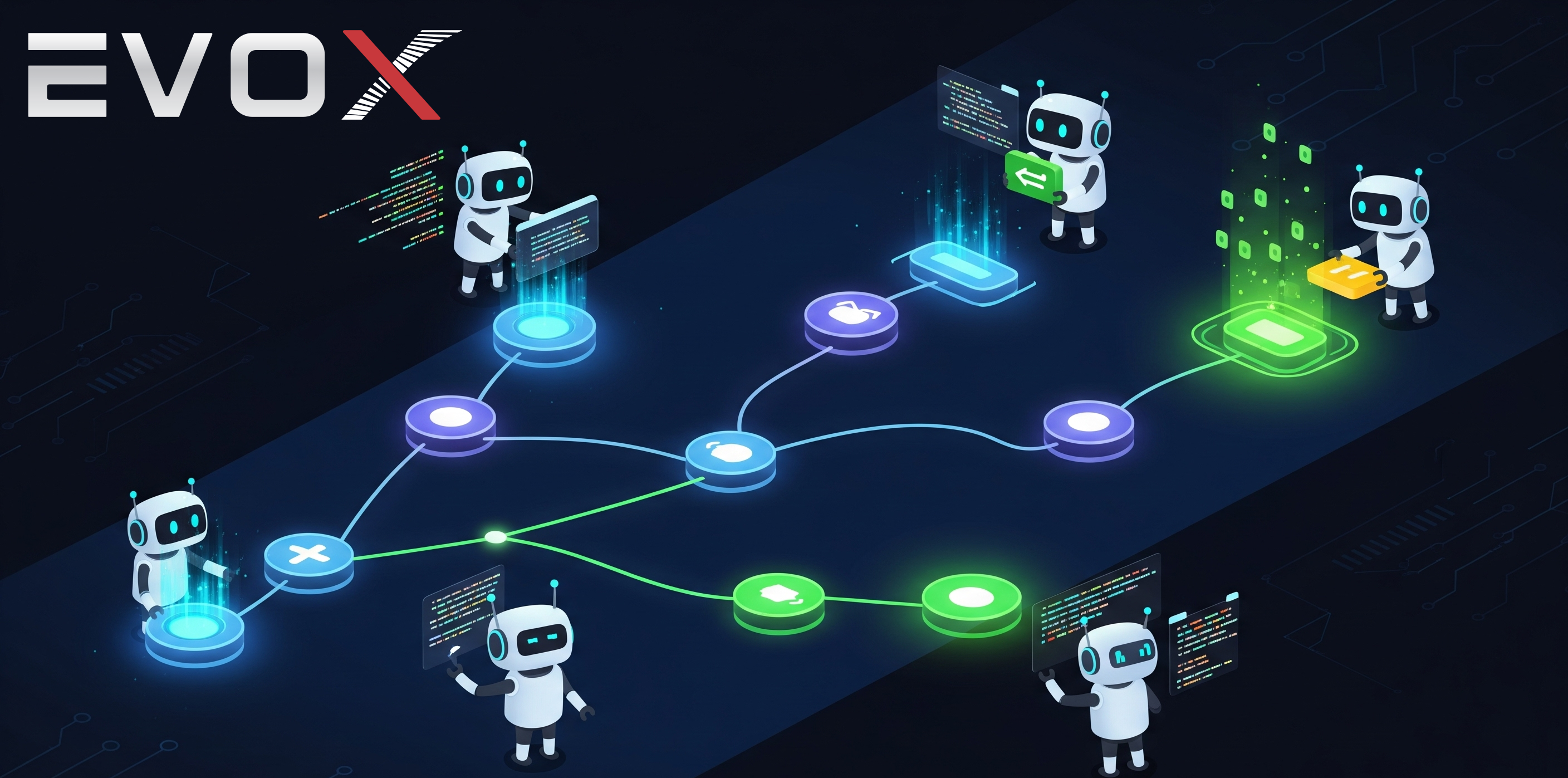
Decentralized Code Evolution via Git-Based Multi-Agent Collaboration
🏆 EvoGit: 1st Place in AgentX Multi-Agent Track
Winner of the Multi-Agent Track at the AgentX Competition (Agentic AI Summit).




[!IMPORTANT] 🚀 EvoGit has evolved into EvoX Genesis — the successor project, born out of EvoGit! The new home of this work is https://github.com/EMI-group/genesis — follow it for all the latest development, including our landmark achievement of scaling to hundreds of thousands of lines of code with zero human intervention — for just a few dollars. 💸
🎬 EvoGit Animation (click to hide)

👋 Table of Contents
🚀 Overview
EvoGit is a decentralized multi-agent framework that reimagines software development as a collaborative, evolutionary process. It deploys a population of independent coding agents that evolve a shared codebase asynchronously, without centralized coordination, explicit message passing, or shared memory.
All coordination emerges implicitly through a Git-based phylogenetic graph that tracks the complete version lineage. This graph allows agents to read from and write to the repository, enabling scalable parallel exploration while preserving a consistent, auditable history of every change.
For detailed methodology and experimental results, refer to our paper.
✨ Key Features
- 🧠 Decentralized Coordination: Agents operate independently and coordinate organically through the shared version graph. This resembles stigmergy in biological systems, where interactions are indirect and mediated by the environment.
- ⚙️ Git-Native Evolution: The entire framework is built on Git. Evolutionary concepts map directly to Git primitives, making the process inherently compatible with standard developer tools.
- 🌿 Traceable & Auditable Lineage: Every edit, merge, and decision is recorded as an immutable Git commit. This provides full transparency and reproducibility of the entire development process.
- 🤝 Sparse Human Oversight: The human's role shifts from a coder to a high-level Product Manager. You define initial goals and provide periodic, lightweight feedback to prune unproductive branches and promote promising ones.
📦 Live Demos
Explore how EvoGit enables collaborative AI development across two real-world projects. For more details, please visit the respective GitHub repositories and inspect the Git history to see how multiple agents evolved the code.
📃 Web Applicaiton Development -- link
A multi-agent AI system collaboratively builds a complete one-page interactive website—from layout and UI to animations and dark mode. The project was initialized by a human product manager and guided with ~10 feedback interventions.
🔍 Result (click to expand)
The final web page demonstrates a polished UI with support for both light and dark themes.

🧠 Meta-Level Code Synthesis -- link
AI agents iteratively evolve a meta-level algorithm designer, which itself generates and refines a solver for the classic Bin Packing Problem. This creates a two-layer pipeline: EvoGit → Auto Algorithm Designer → Bin Packing Solver A human manager provided an initial setup and ~5 rounds of feedback throughout the optimization process.
🔍 Result (click to expand)
The AI-generated automatic algorithm design program efficiently found a solver that minimizes bin usage, as shown in the final output script:
def bin_packing_solver(items: list[float], budget: int) -> list[int]:
    import time

    if not items or not all(0 <= w <= 1 for w in items):
        return []

    start_time = time.time()

    items_sorted = sorted(enumerate(items), key=lambda x: x[1], reverse=True)
    bins = []
    bin_indices = [-1] * len(items)

    for index, weight in items_sorted:
        placed = False
        for bin_index, bin_weight in enumerate(bins):
            if bin_weight + weight <= 1:
                bins[bin_index] += weight
                bin_indices[index] = bin_index
                placed = True
                break
        if not placed:
            bins.append(weight)
            bin_indices[index] = len(bins) - 1

    best_solution = bin_indices[:]
    best_bin_count = len(bins)

    def refine_solution():
        nonlocal best_solution, best_bin_count
        for _ in range(100):  # attempt refinement a number of times
            new_bins = []
            new_bin_indices = [-1] * len(items)
            new_solution = []
            for i in range(len(items)):
                weight = items[i]
                placed = False
                for bi in range(len(new_bins)):
                    if new_bins[bi] + weight <= 1:
                        new_bins[bi] += weight
                        new_bin_indices[i] = bi
                        placed = True
                        break
                if not placed:
                    new_bins.append(weight)
                    new_bin_indices[i] = len(new_bins) - 1
            new_bin_count = len(new_bins)

            if new_bin_count < best_bin_count:
                best_solution = new_bin_indices
                best_bin_count = new_bin_count

            if (time.time() - start_time) * 1000 > budget:
                break

    refine_solution()

    return best_solution
The optimized code is automatically saved as best_solution.py after the search process completes.
🧬 How to Explore the Results
EvoGit uses Git not only as a version control tool, but also as a transparent window into the code evolution process. Here's how to inspect our demos:
- 🧑💻 The human-initialized seed lives in the
mainbranch. - 🤖 AI-generated code lives in branches named:
host<i>-individual-<j>, wherei= host node index,j= agent index. - 🔍 Each agent branch contains an independent development trajectory. You can explore these using GitHub’s commit history or local Git tools.
- 📈 Git diffs and logs reveal the precise changes made in each commit.
- 🧭 Use
git log --graphor GitHub’s branch visualization (under Insights -> Network) to see how code diverged and converged over time.
🔍 Example Git Graph (click to expand)
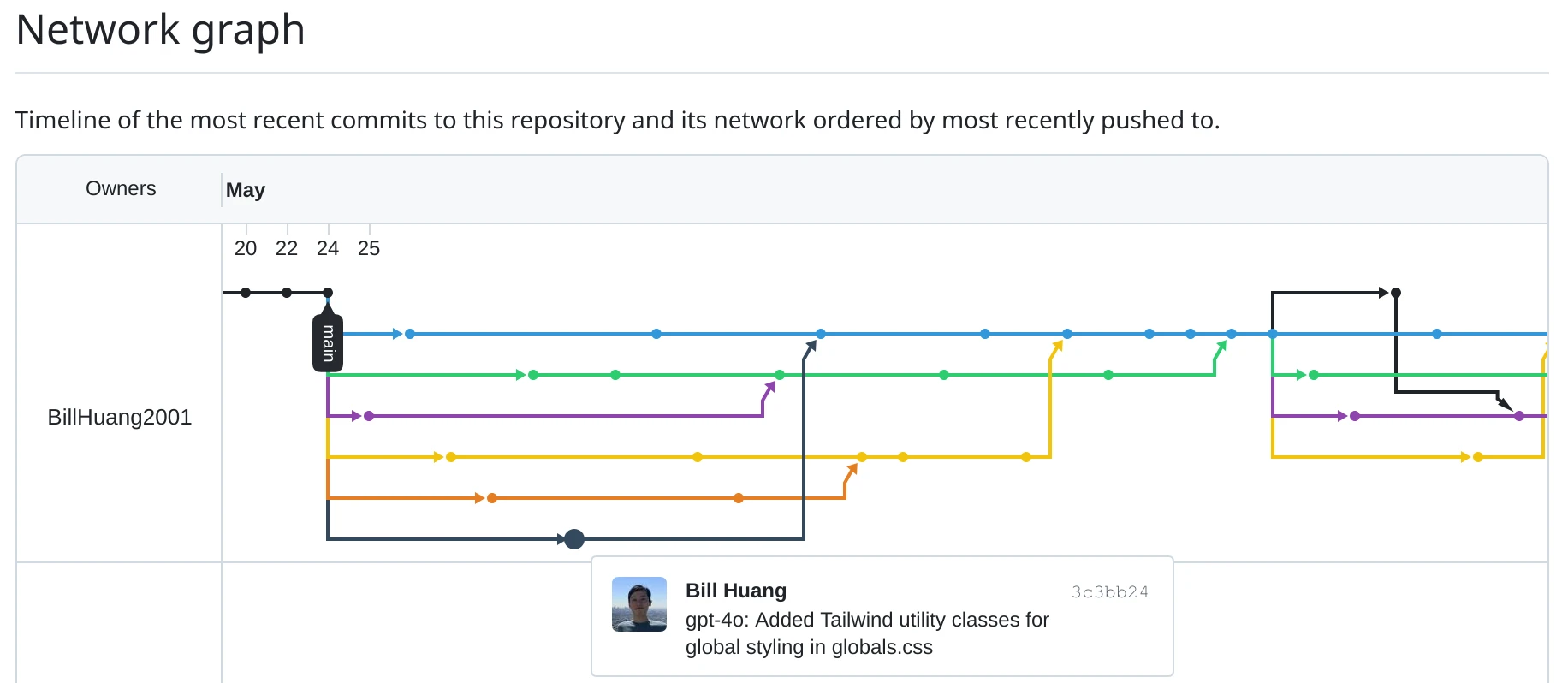
All changes are versioned and traceable. Every commit represents an autonomous decision by an agent—captured, auditable, and reproducible through Git.
[!NOTE] GitHub may hide some branches. Click “View all branches” on the repo page to see the complete version graph.
📚 Paper
Read the full framework design, evaluation methodology, and results in our paper:
📢 Current Status
EvoGit has evolved into EvoX Genesis! 🚀
Born out of EvoGit, the successor project has achieved something truly incredible: scaling to hundreds of thousands of lines of code with zero human intervention — for just a few dollars. 💸
Follow the new repository at https://github.com/EMI-group/genesis for the latest development, releases, and updates. The journey continues there!
Explore related projects
codecrafters-io/build-your-own-x
Master programming by recreating your favorite technologies from scratch.
561,634 starspublic-apis/public-apis
A collective list of free APIs
497,998 starsmorluto/rea
Reverse engineer anything with agents, from app behavior down to native binaries.
450,355 starsopenclaw/openclaw
The AI that really does things. Any OS. Any Platform. The lobster way. 🦞
394,308 stars