
Asaf-Livne/raw-patch-attribution
Asaf-Livne/raw-patch-attribution has 36 GitHub stars and 0 forks. GitHot measured 0 stars in 24 hours. Last checked 2026-11-14 18:33 UTC. Last push 2026-09-22.
Measured star growth
- in 24h
- 0
- in 7 days
- Collecting history
- in 15 days
- Collecting history
- in 1 month
- Collecting history
Net star changes over overlapping periods, not daily totals. Missing measurements are left blank. Stars measure attention, not software quality.
About
Attribute an image to the model that generated it — from raw pixels, with a ~6M-parameter CNN (RPA).
Machine LearningREADME.md
OriginalRPA: Scalable Black-Box Model Attribution for Images
Asaf Livne · Amir Jevnisek · Shai Avidan
Tel Aviv University



Attribute an image to the model that generated it — from raw pixels, with a ~6M-parameter CNN.
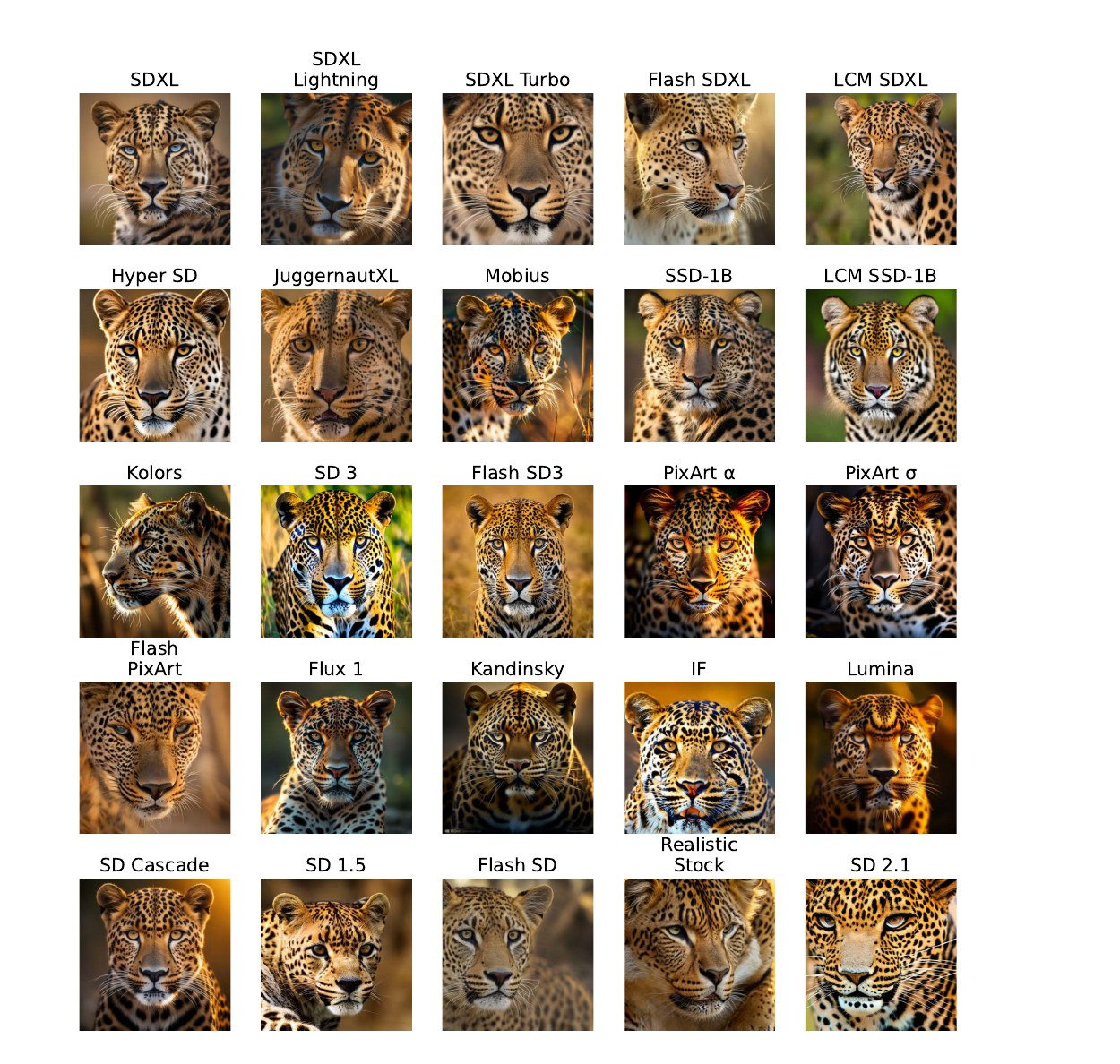
Same prompt, twenty-five generators. Telling them apart is the attribution problem.
📰 News
- [2026-09] Checkpoints, configs and inference updated to the 64×64-patch model of the current paper version.
- [2026-08] Code and pretrained checkpoints released.
- [2026-08] arXiv preprint released.
🧠 Overview
The rapid proliferation of generative models raises the model attribution problem: given only an image, can we determine which model produced it? Existing methods have grown as elaborate as the generators they target, on the assumption that a more sophisticated generator demands a more sophisticated attributor. We show it does not.
RPA (Raw-Patch Attribution) attributes images in the strictest black-box setting with a lightweight CNN. Despite its simplicity it attributes more models at higher accuracy than prior work, is data-efficient, runs at a cost independent of the number of candidate models, and stays robust to the compression, blur, and resizing images undergo in the wild.
Training for closed-set attribution also yields a versatile feature extractor: the same representation recovers model lineage without supervision, flags unseen generators, and admits new models through few-shot adaptation rather than retraining.
Why RPA?
- 🪶 Small. ~6M parameters, no pretrained encoder, no foundation-model backbone.
- 🔒 Strictly black-box. Image only — no generator weights, no VAE, no prompts.
- 📐 Resolution-invariant. 64² to 4096² without retraining; cost is independent of the number of candidate models.
- 🧩 More than a classifier. The same features give open-set rejection, unsupervised lineage, and few-shot adaptation for free.
🔍 Method
Three steps, one small network.
| Step | What happens | |
|---|---|---|
| 01 | Patch division | Split the image into fixed 64×64 RGB patches, overlapping at the edges so every pixel is covered exactly once in the weighting. |
| 02 | Per-patch classification | A compact ~6M-parameter CNN — three strided-conv blocks, global average pool, linear head — scores each patch against every candidate generator in one forward pass. |
| 03 | Aggregation | Per-patch scores combine into one image-level label via an overlap-corrected weighted average (logit_avg). |
📊 Results
Black-box attribution
From the image alone, with no model access at all. Top-1 accuracy (%) and per-image inference time (ms, mean ± std, RTX 5090).
| Method | Params (M) | Infer. (ms) | DRAGON (25) | OpenFake (27) |
|---|---|---|---|---|
| DE-FAKE | 151 | 9.96 ± 1.31 | 62.0 | 57.3 |
| USIA | 427 | 9.61 ± 1.01 | 52.1 | 50.1 |
| LIDA | 23.5 | 23.6 ± 12.5 | 24.0 | 17.7 |
| OCC-CLIP | 151 | 7.87 ± 1.12 | 8.6 | 15.8 |
| RPA (ours) | 5.9 | 2.79 ± 0.04 | 98.9 | 95.0 |
EfficientFormer releases neither code nor data; it reports 91.0 % on 13 classes of private data with ~4× more images per class.
White-box comparison
On AEDR's eight-model benchmark, where competitors are given each candidate's autoencoder. Mean pairwise accuracy and per-image inference time.
| Method | Access | Infer. (s) | Acc. (%) |
|---|---|---|---|
| LatentTracer | Model weights | 24.06 ± 0.01 | 70.3 |
| AEDR | VAE weights | 0.267 ± 0.003 | 95.1 |
| RPA (ours) | Image only | 0.00279 ± 0.00004 | 99.5 |
Two orders of magnitude faster than the closest competitor, and strictly black-box; 98.8 % in the harder 8-way single-label setting. Baseline accuracies are taken from AEDR; all inference times are re-measured on our hardware, per candidate model (ours: one fp16 pass over the 256 patches of a 1024² query, PNG decode excluded).
Open-set & discovery
Trained on 17 of OpenFake's 27 generators, with 10 held out as unseen:
| Task | Metric |
|---|---|
| Rejecting unseen generators | AU-OSCR 0.875 ± 0.037 over five draws (best draw 0.918) |
| Clustering the 10 unseen sources | ARI 0.64 · NMI 0.84 · 98 % purity (7 clusters recovered against 10 true sources; five-draw mean ARI 0.54 · NMI 0.78 · 93 % purity) |
| Recovering model lineage (OpenFake-27, no supervision) | cophenetic r = 0.910 |
Adaptation
A frozen 17-class OpenFake backbone with a freshly fit 27-way linear head (28 K parameters, ~2 min). Mean ± std over five 17/10 draws.
| Eval. subset | Before | After |
|---|---|---|
| Original 17 | 95.8 ± 1.3 | 93.3 ± 1.8 |
| New 10 | — | 85.1 ± 4.2 |
| All 27 | — | 90.3 ± 0.5 |
Across benchmarks, an OpenFake backbone with a new head attributes DRAGON's 25 generators at 96.6 % (vs. 98.9 % for DRAGON's own model); the reverse reaches 86.8 % (vs. 95.0 %).
Few-shot adaptation
Nine unseen GenImage generators, N labeled images per class, LIDA's protocol. Only a linear head is fit — the backbone stays frozen.
| Method | 1-shot | 10-shot |
|---|---|---|
| ResNet | 17.4 | 21.4 |
| DIRE | 14.3 | 17.2 |
| ESSP | 17.0 | 22.4 |
| LIDA | 40.4 | 54.0 |
| RPA (ours, OpenFake backbone) | 47.7 ± 3.5 | 72.0 ± 0.8 |
| RPA (ours, DRAGON backbone) | 52.0 ± 3.6 | 72.4 ± 0.9 |
Baselines as published in LIDA.
🛠️ Installation
git clone https://github.com/Asaf-Livne/raw-patch-attribution.git
cd raw-patch-attribution
pip install -e .
Optional extras, each pulling in only what its entry point needs:
pip install -e ".[cluster]"    # hdbscan + umap-learn, for `cluster.py discovery`
pip install -e ".[download]"   # datasets, for `scripts/download_data.py`
pip install -e ".[plot]"       # matplotlib, for training-curve PNGs
🎮 Pretrained checkpoints
Both headline classifiers are published as release assets (~25 MB each), keeping the repository light.
| Checkpoint | Benchmark | Classes | Top-1 | Download |
|---|---|---|---|---|
dragon_25class.pt |
DRAGON | 25 | 98.9 % | ⬇ |
openfake_27class.pt |
OpenFake | 27 | 95.0 % | ⬇ |
BASE=https://github.com/Asaf-Livne/raw-patch-attribution/releases/download/v1.0
curl -L -o checkpoints/dragon_25class.pt   $BASE/dragon_25class.pt
curl -L -o checkpoints/openfake_27class.pt $BASE/openfake_27class.pt
shasum -a 256 -c checkpoints/SHA256SUMS
See checkpoints/README.md for loading them directly in Python.
📦 Data preparation
python scripts/download_data.py dragon   --output-dir datasets --config Regular
python scripts/download_data.py openfake --output-dir datasets/openfake --samples-per-class 1400
DRAGON downloads pre-split. OpenFake downloads flat per class, and
PatchFolderDataset applies a seeded 750/250/400 train/val/test split at load
time. GenImage — used only as the few-shot adaptation target, as a
9-generator subset under LIDA's protocol — is not included here; prepare it
per that benchmark's own release.
Point each config's dataset.data_root at your data. Config strings expand
${ENV_VAR} and ~, so the shipped configs stay machine-independent:
export DRAGON_DATA_ROOT=datasets/dragon_regular
export OPENFAKE_DATA_ROOT=datasets/openfake
🚀 Training
python train.py --config configs/dragon_25class.yaml --output runs/dragon_25class --seed 42
Swap in configs/openfake_27class.yaml for OpenFake. A run directory holds
best.pt, last.pt, a config snapshot, curves.csv, and channel statistics;
re-running against the same --output auto-resumes from last.pt.
For the robustness variant, train with on-the-fly JPEG / blur / resize corruption — same code path, different config:
python train.py --config configs/dragon_20class_robust.yaml --output runs/dragon_robust --seed 42
🎯 Evaluation
python eval.py --checkpoint checkpoints/dragon_25class.pt \
    --config configs/dragon_25class.yaml \
    --split test --aggregation logit_avg --num_patches "1 16 256"
--num_patches accepts a list; each image is scored with min(N, its own tile
count) patches, so a budget at or above the tile count means all patches (256
for a 1024² image at 64×64) and mixed-resolution benchmarks are handled
correctly. Results land in summary.json plus per-budget confusion matrices.
Inference tiles the image on the GPU in one gather and runs the BatchNorm-folded network in fp16 (fp32 on CPU): about 3 ms per 1024² image (256 patches) on an RTX 5090, PNG decode excluded, with no change in accuracy.
For the "what does the CNN see" frequency analysis, set
dataset.input_filter to lowpass, highpass, or fftmag in the eval config.
🔬 Beyond closed-set attribution
The same trained backbone drives three further capabilities — no retraining.
Open-set attribution — reject generators never seen in training
Carve out a known-class subset, train on it, then score against the full label map: every class the checkpoint was not trained on is treated as unseen. Detection uses max-softmax-probability under all-patch logit averaging, and is reported threshold-free (AUROC, AU-OSCR).
python scripts/split_known_unknown.py --label-map configs/label_maps/openfake_27class.json \
    --n-known 17 --seed 42 --output configs/label_maps/openfake_17known_seed42.json

python train.py --config configs/openfake_17known.yaml --output runs/openset_seed42 --seed 42

python openset.py --checkpoint runs/openset_seed42/best.pt \
    --config configs/openfake_27class.yaml --output runs/openset_seed42/eval
Lineage & unseen-source discovery — unsupervised structure in the features
lineage clusters per-generator mean features hierarchically and reports the
cophenetic correlation; discovery runs UMAP + HDBSCAN over the classes the
checkpoint was never trained on and scores the result against their true
labels (ARI / NMI / purity). Neither uses any lineage or discovery labels.
python cluster.py lineage --checkpoint checkpoints/openfake_27class.pt \
    --config configs/openfake_27class.yaml --output runs/openfake_27class/lineage

python cluster.py discovery --checkpoint runs/openset_seed42/best.pt \
    --config configs/openfake_27class.yaml --output runs/openset_seed42/discovery
Requires the cluster extra.
Adaptation — admit new generators by fitting a linear head
The backbone is frozen and its penultimate features cached once, so fitting the head takes seconds to minutes instead of a full retrain. All three published regimes share one script; they differ only in what target data feeds the cache.
# full: extend a known-subset backbone to the benchmark's complete class set
python adapt.py --checkpoint runs/openset_seed42/best.pt \
    --config configs/openfake_27class.yaml --output runs/adapt_full27 --transplant

# cross-dataset: freeze a backbone trained on one benchmark, fit a head on another
python adapt.py --checkpoint checkpoints/dragon_25class.pt \
    --config configs/openfake_27class.yaml --output runs/cross_d2o

# few-shot on GenImage-9 (LIDA's protocol)
python adapt.py --checkpoint checkpoints/openfake_27class.pt \
    --config configs/genimage_9class.yaml --output runs/fewshot_10shot \
    --shots 10 --train_views 20 --val_split val --test_split val
--transplant keeps the trained head row for any class shared by name with
the source checkpoint, so only genuinely new classes start from scratch.
📁 Repository layout
train.py       train a classifier (on-the-fly augmentation)
eval.py        closed-set evaluation: multi-patch aggregation, robustness, frequency analysis
openset.py     open-set attribution (reject unseen generators)
cluster.py     lineage recovery + unseen-source clustering
adapt.py       adapt a frozen backbone to new classes (full / cross-dataset / few-shot)

datalib/       dataset, patch tiling, augmentation, open-set metrics
models/        the CNN
configs/       one YAML per run, plus label_maps/ ({class_name: folder}, one per benchmark)
scripts/       data download + known/unknown split generator
checkpoints/   download target for the pretrained classifiers
Every entry point takes --config <path> plus its own flags.
📝 Citation
@misc{livne2026scalableblackboxmodelattribution,
  title         = {Scalable Black-Box Model Attribution for Images},
  author        = {Asaf Livne and Amir Jevnisek and Shai Avidan},
  year          = {2026},
  eprint        = {2608.15652},
  archivePrefix = {arXiv},
  primaryClass  = {cs.CV},
  url           = {https://arxiv.org/abs/2608.15652}
}
💡 Acknowledgments
This work builds on the following public benchmarks and baselines:
- DRAGON — 25-generator attribution benchmark.
- OpenFake — 27-generator benchmark.
- GenImage / LIDA — few-shot adaptation protocol.
- AEDR — the white-box eight-model comparison benchmark.
📄 License
Released under the MIT License.