
AngelHuang5335/pantrykind
AngelHuang5335/pantrykind has 53 GitHub stars and 0 forks. GitHot measured 0 stars in 24 hours. Last checked 2026-11-15 08:09 UTC. Last push 2026-11-02.
Measured star growth
- in 24h
- 0
- in 7 days
- Collecting history
- in 15 days
- Collecting history
- in 1 month
- Collecting history
Net star changes over overlapping periods, not daily totals. Missing measurements are left blank. Stars measure attention, not software quality.
About
A private, self-hosted kitchen companion. Track food, cook what you have, share a shopping list, and waste a little less. Python + Django.
Self-hostedREADME.md
OriginalPantryKind
Less in the bin. More on your plate.
A private, self-hosted kitchen companion for using what you already have.




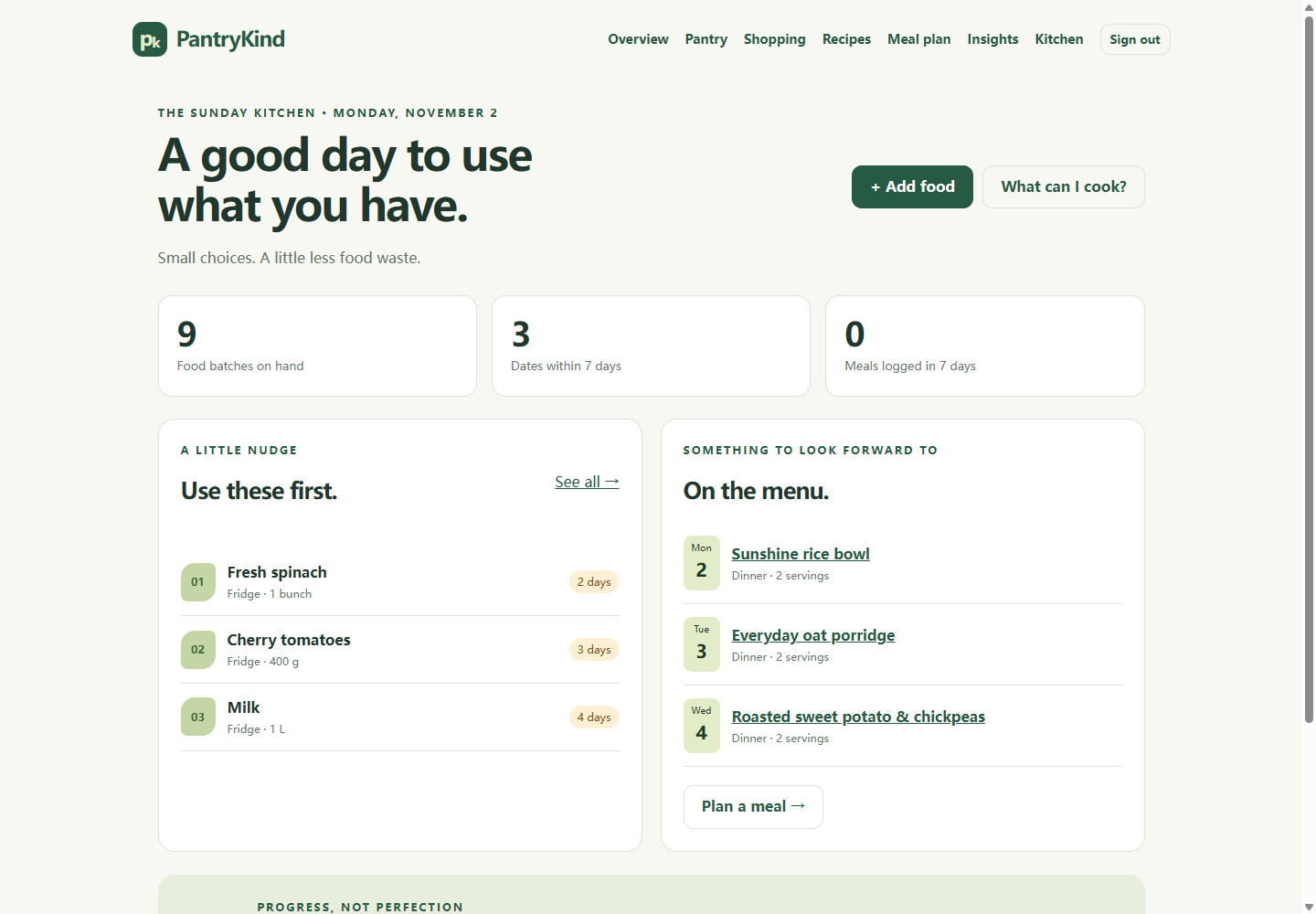
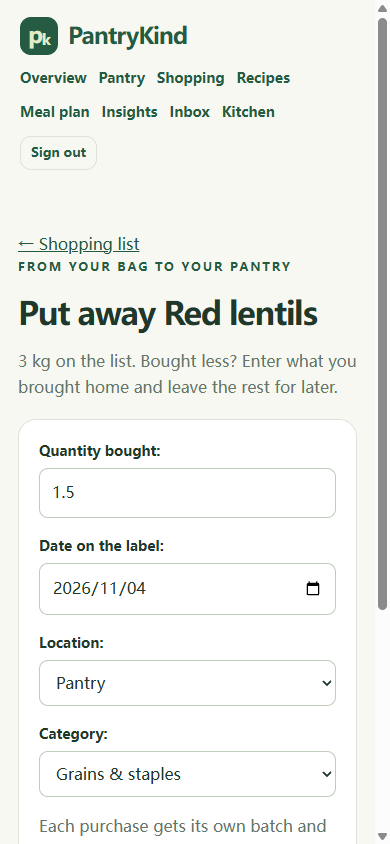
See recipes, purchases, reminders and the mobile layout
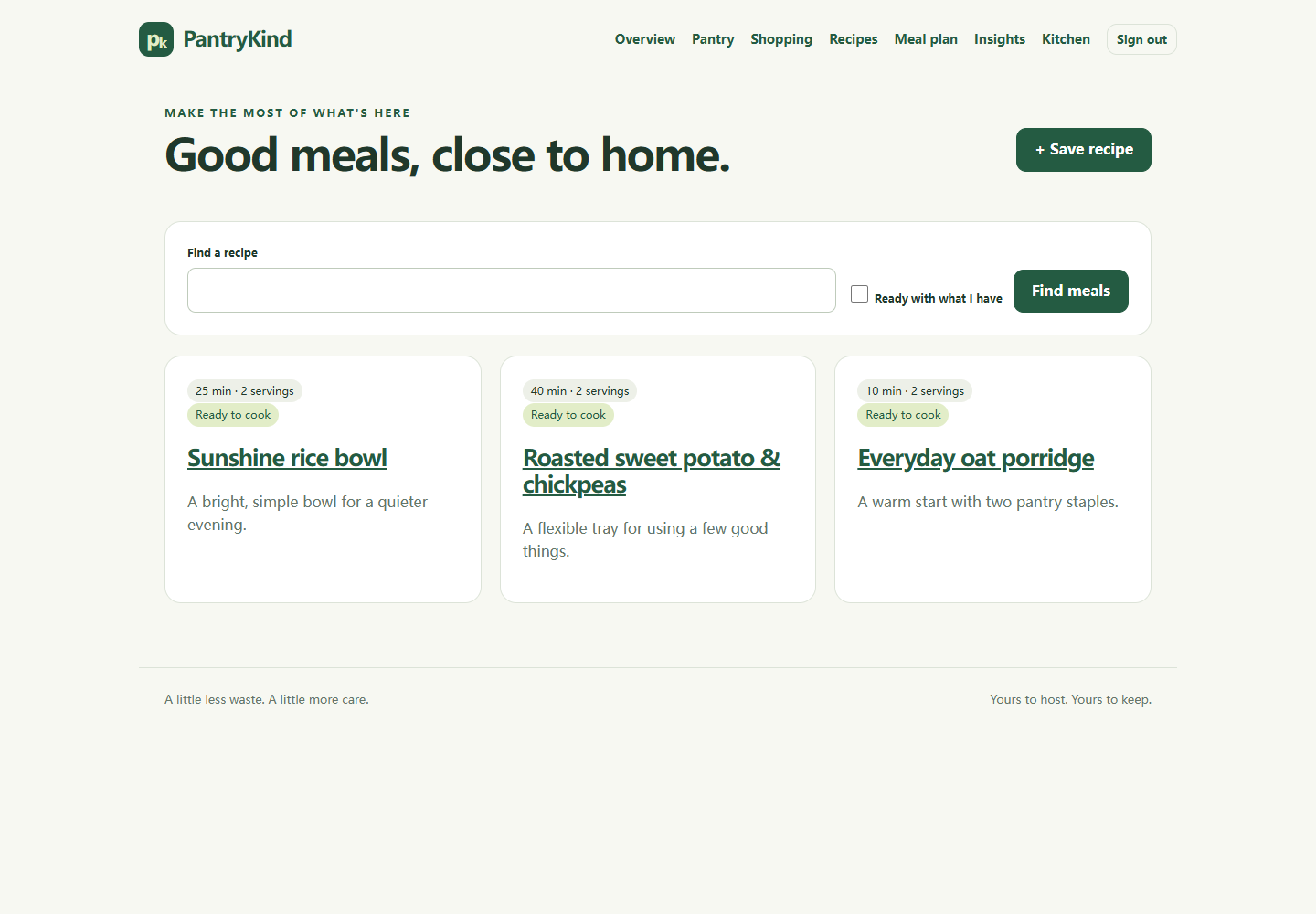
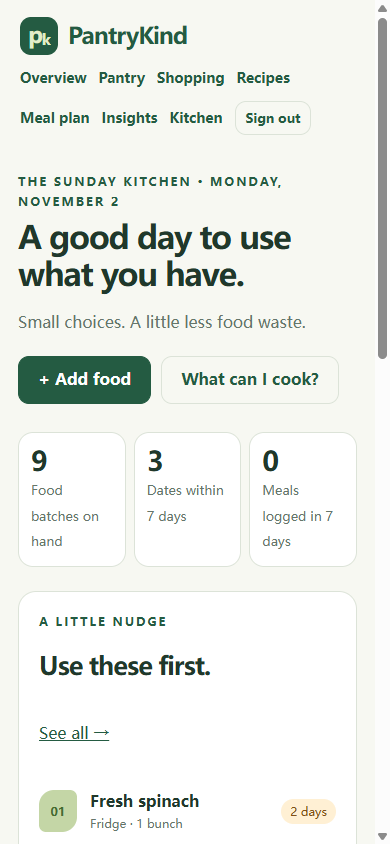
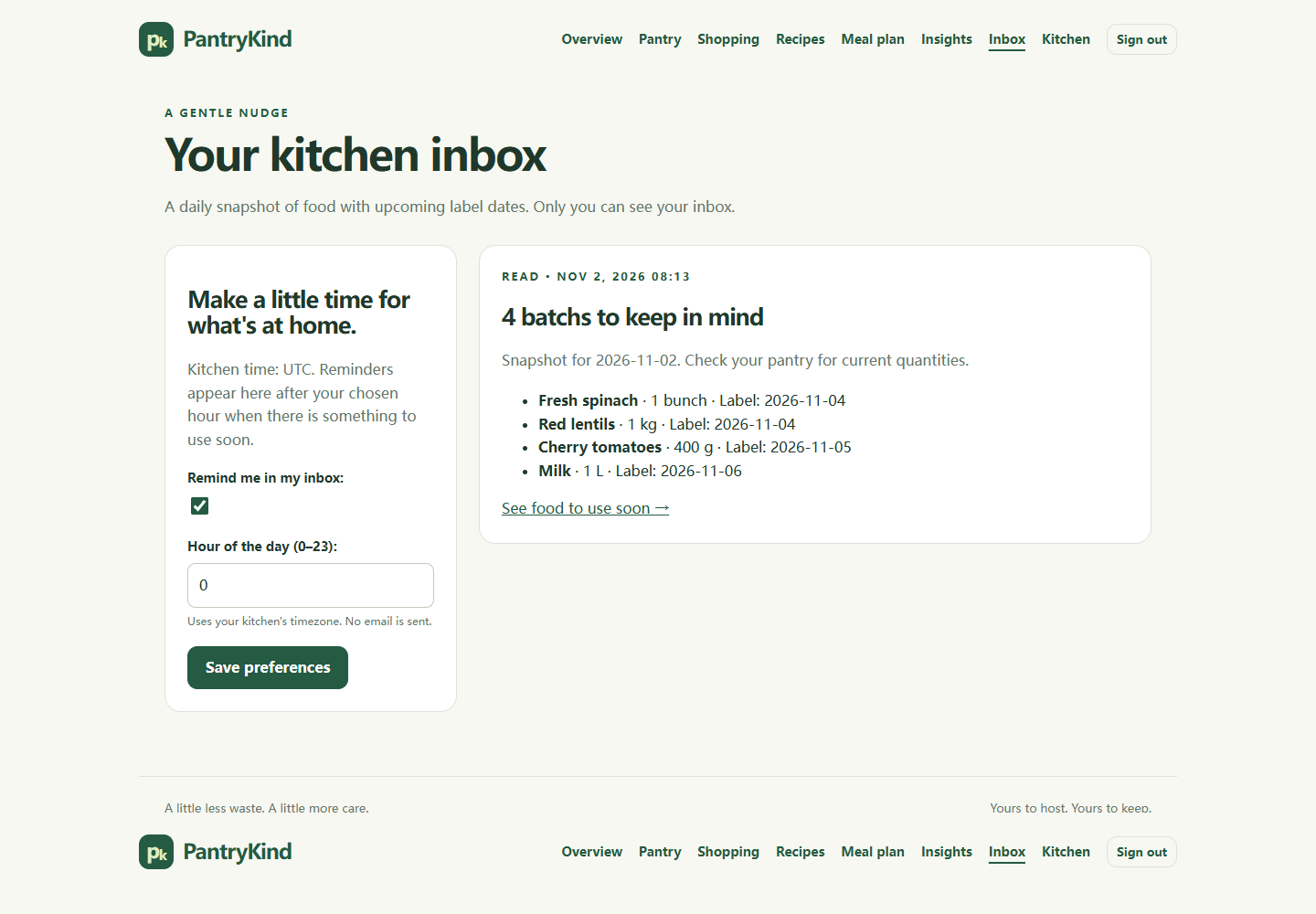
A calmer kitchen, one meal at a time
You buy spinach. It disappears behind a jar. You buy it again.
PantryKind gives the food already in your kitchen a little visibility: which batch needs attention, which recipe you can make tonight, and what is actually missing from your next shop.
No subscriptions. No paid AI keys. No barcode database. No external runtime services for the core application. Your server stores your data. The application does not bundle analytics or advertising scripts.
What it does
- Know what is there: dated batches, categories, storage locations, partial quantities, search and filters.
- Use it thoughtfully: use-soon views, reversible archiving, consumption and waste records, and first-expiring batch deductions when you explicitly log a cooked meal.
- Shop once: a shared checklist, duplicate merging, low-stock gaps and recipe missing ingredients. Put away partial purchases as new dated batches, with a purchase history and retry-safe stock ledger.
- Find dinner at home: save your recipes, match compatible quantities, scale servings and filter ready-to-cook meals. Grams/kilograms and millilitres/litres convert; unknown pack sizes do not.
- Plan together: weekly meals, calendar downloads, separate kitchens, expiring invitations and owner/member access.
- Keep control: validated CSV preview/import, a read-only integration API, verified SQLite backup/restore and optional PostgreSQL deployment.
- Get a gentle nudge: opt-in daily inbox reminders in your kitchen's timezone, durable scheduling, crash recovery and bounded retries. No email service is required.
This is a household organisation tool. Dates are copied from labels and are not a food-safety assessment. Insights show your recorded activity; they do not claim measured money, carbon or total waste savings.
Quick start
Requires Python 3.12 or newer. No Node.js build or database server is needed.
git clone https://github.com/AngelHuang5335/pantrykind.git
cd pantrykind
python -m venv .venv
# Linux / macOS
source .venv/bin/activate
# Windows PowerShell: .\.venv\Scripts\Activate.ps1
python -m pip install -r requirements.txt
python manage.py migrate
python manage.py runserver 127.0.0.1:8000
Open http://127.0.0.1:8000, create an account, and name your kitchen. Add a few things from your fridge; you do not need a perfect inventory to get started.
Try a populated kitchen
python manage.py seed_demo
Choose your own password when prompted. Sign in as demo. This creates an independent kitchen with sample food, three original recipes and a short meal plan. It never clears an existing database or overwrites an existing username. Use --username another-name for a second demo.
Everyday workflow
- Add food as a batch, or choose Shopping → Put away to receive a full or partial purchase with its own label date.
- Open Overview to see items approaching their dates.
- Save a recipe using the same food names as your pantry. Recipes → Ready with what I have finds meals whose measured ingredients are on hand.
- Scale portions if needed. Add missing quantities to Shopping, or explicitly record cooking to update stock.
- Use Insights to review what you used or discarded, keeping different units separate.
Planning and checking off shopping items do not automatically create or deduct stock. A new purchase with a different date belongs in a separate batch. Food past its recorded date is excluded from automatic recipe matching.
Self-hosting
Start with the deployment guide. Set a unique production SECRET_KEY, disable DEBUG, configure hosts and HTTPS, and protect account registration and login at your reverse proxy. .env.example documents variables; native Python does not automatically load a .env file. Docker Compose reads the configured .env file.
cp .env.example .env
# Edit .env: generate a secret, set DEBUG=false and configure your hosts.
docker compose up --build -d
SQLite data lives in a persistent volume. Do not delete that volume during upgrades. See backup and restore and the optional PostgreSQL deployment. The current release is intended for trusted households.
Useful commands
python manage.py pantry_digest 1
python manage.py backup_pantry /private/backups/kitchen.sqlite3
python manage.py verify_backup /private/backups/kitchen.sqlite3
python manage.py enqueue_reminders
python manage.py reminder_worker --limit 100
python manage.py reminder_status
python manage.py test --settings=config.test_settings
Schedule both reminder commands every minute for enabled users; delivery appears in the app's private Inbox. See reminder operations. The manual pantry_digest remains a local text report. See also API, architecture, security and release notes.
Development
python -m pip install -r requirements-dev.txt
python -m ruff check .
python -m ruff format --check .
python manage.py makemigrations --check --dry-run
python manage.py test --settings=config.test_settings
The fast test settings use a weak password hasher only for isolated tests; production settings retain Django's normal password hashing. CI includes Python 3.12/3.13, PostgreSQL races, container builds and an opt-in Playwright browser suite. Validation notes record the local checks and the passing CI run for the release code.
The recipe catalogue uses one stock index and three database queries, independent of recipe count. A reproducible synthetic benchmark compares 500 recipes and 2,000 batches; see performance scope and results.
Scope and limitations
Ingredient matching uses normalised exact names, not semantic similarity. It will not assume “tomato” and “tomatoes” are the same food, or that one pack has a known weight. Pantry updates are designed for modest household traffic; multi-process SQLite deployments still have SQLite's single-writer limits. There is no offline sync, barcode scanning, built-in email delivery or public hosted demo. Docker configuration is supplied; consult release notes for what was actually validated.
Make it a little kinder
Have a useful kitchen habit this tool could support? Open an issue with a concrete example using sample data. Contributions are welcome under the MIT license.