
AndreiiArhire/LightMIS
AndreiiArhire/LightMIS has 33 GitHub stars and 1 forks. GitHot measured 0 stars in 24 hours. Last checked 2026-11-12 04:12 UTC. Last push 2026-09-30.
LightMIS: Ultra-Lightweight Medical Image Segmentation Without a Stage-Wise Decoder
Measured star growth
- in 24h
- 0
- in 7 days
- Update delayed
- in 15 days
- Update delayed
- in 1 month
- Update delayed
Net star changes over overlapping periods, not daily totals. Missing measurements are left blank. Stars measure attention, not software quality.
README.md
OriginalLightMIS: Ultra-Lightweight Medical Image Segmentation Without a Stage-Wise Decoder


Andrei Arhire, Mihaela Breaban, Radu Timofte
LightMIS employs a compact multi-scale encoder in which an Adaptive Fusion Cascade (AFC) processes features at every spatial scale. Each AFC combines AKF-based preprocessing, the proposed Progressive Receptive Fusion (PRF) module, and residual AKF refinement. PRF enriches narrow feature representations through temporary channel expansion, complementary depthwise receptive fields, and progressive cross-branch information transfer. For narrow-channel configurations, a conventional decoder introduces costly repeated upsampling and stage-wise encoder–decoder fusion. LightMIS therefore replaces it with a compact aggregation head: Scale-Aligned Projection (SAP) blocks process and align the output of every encoder level to a common resolution and channel width, after which the aligned features are fused and refined by a final AFC.
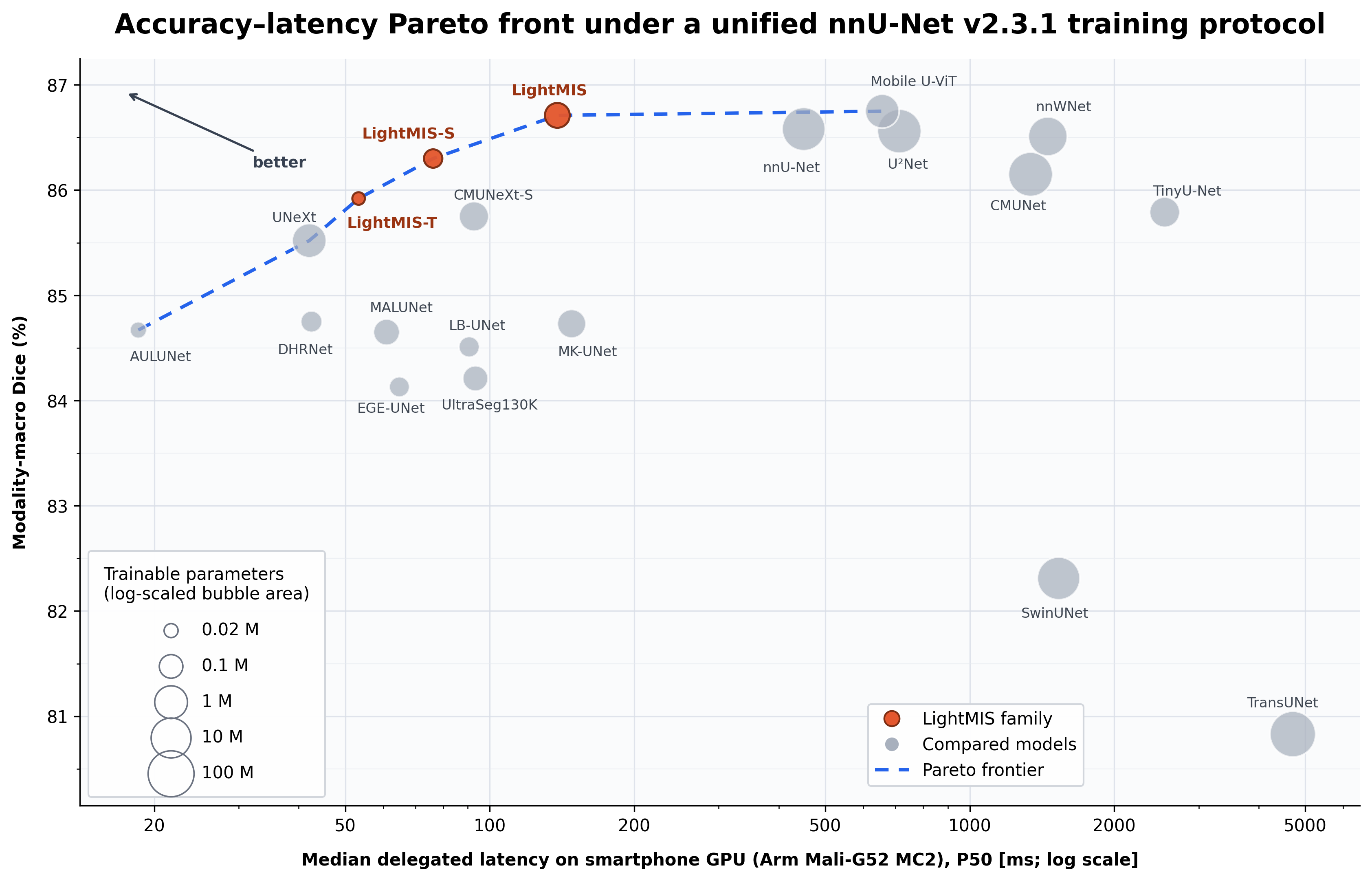
Evaluated under a common nnU-Net v2.3.1 protocol using five-fold cross-validation on six datasets spanning five imaging domains of 2D binary medical image segmentation, LightMIS achieves closely matched observed modality-macro performance on region-overlap metrics, together with competitive boundary-distance results relative to substantially larger models, including Mobile U-ViT, nnWNet, and nnU-Net. At the same time, LightMIS uses 90.58–99.61% fewer parameters and requires 82.54–96.14% fewer GFLOPs than these models. On a smartphone equipped with an Arm Mali-G52 MC2 GPU, all LightMIS variants achieve full GPU delegation (100% GPU operator coverage), with median delegated latency ranging from 53.31 ms for LightMIS-T to 138.31 ms for LightMIS.
How to Use
Install and configure nnU-Net. The experiments in this repository use nnU-Net v2.3.1.
Download the following datasets:
Convert each dataset to the nnU-Net raw-data format using the provided dataset-conversion scripts.
Run nnU-Net planning and preprocessing for the 2D configuration:
nnUNetv2_plan_and_preprocess -d 100 --verify_dataset_integrity -c 2dThe exact five fold partitions and nnU-Net plan files used in the experiments are provided for reproducibility.
Move nnUNetTrainer_LightMIS.py to .../nnUNet/nnunetv2/training/nnUNetTrainer/ of the configured nnUNet
Train LightMIS using five-fold cross-validation:
CUDA_VISIBLE_DEVICES=0 nnUNetv2_train 100 2d 0 -tr nnUNetTrainer_LightMIS && \
CUDA_VISIBLE_DEVICES=0 nnUNetv2_train 100 2d 1 -tr nnUNetTrainer_LightMIS && \
CUDA_VISIBLE_DEVICES=0 nnUNetv2_train 100 2d 2 -tr nnUNetTrainer_LightMIS && \
CUDA_VISIBLE_DEVICES=0 nnUNetv2_train 100 2d 3 -tr nnUNetTrainer_LightMIS && \
CUDA_VISIBLE_DEVICES=0 nnUNetv2_train 100 2d 4 -tr nnUNetTrainer_LightMIS
After all five folds have been trained, nnU-Net automatically saves the validation predictions generated for each fold.
Pretrained checkpoints are also provided and can be used to run inference on data preprocessed with nnU-Net.
Additional reproducibility resources:
- The exact baseline commit hashes used in the experiments.
- The metric implementation, FLOP-counting, LiteRT conversion, and desktop and mobile benchmarking scripts.
Citation
If you find our work useful or inspiring for your research, please cite our paper:
Acknowledgments
We thank the authors of the compared methods for making their work publicly available. In particular, we acknowledge AULUNet for the original AKF design.
This work was supported by the European Regional Development Fund under Grant No. 338317 (SMIS code).
Contact
Explore related projects
tensorflow/tensorflow
An Open Source Machine Learning Framework for Everyone
201,505 starshuggingface/transformers
🤗 Transformers: the model-definition framework for state-of-the-art machine learning models in text, vision, audio, and multimodal models, for both inference and training.
168,917 starsAUTOMATIC1111/stable-diffusion-webui
Stable Diffusion web UI
165,300 starsComfy-Org/ComfyUI
The most powerful and modular diffusion model GUI, api and backend with a graph/nodes interface. The fastest local inference engine in the world.
146,472 stars