
Always-On-Intelligence/awesome-always-on-personal-intelligence
About
Reading list for the survey Always-On Personal Intelligence: papers, benchmarks, and products on always-on personal AI assistants and LLM agents, covering proactive agents, agent memory, self-evolving agents, wearable AI and smart glasses, GUI and mobile agents, and home robots, organized by Sensing, Memory, and Action.
LearningMeasured star growth
- in 24h
- +7
- in 7 days
- +68
- in 15 days
- Collecting history
- in 1 month
- Collecting history
Net star changes over overlapping periods, not daily totals. Missing measurements are left blank. Stars measure attention, not software quality.
README.md
Original





Contributions are welcome

Overview
Always-on personal intelligence demands more than episodic, task-driven agents. To remain always-on, it requires a continuing loop that sustains assistance between requests, retains personal context, and carries unfinished commitments forward. To grow more personal over time, this loop can also become self-evolving, revising how it works based on past experience.
[!IMPORTANT] The survey organizes always-on personal assistants into three functional modules, Sensing, Memory, and Action, connected by six directed channels that pass information between them. These modules operate under real-world limits, from battery life to privacy and user permissions, and run on models and the scaffolding around them.
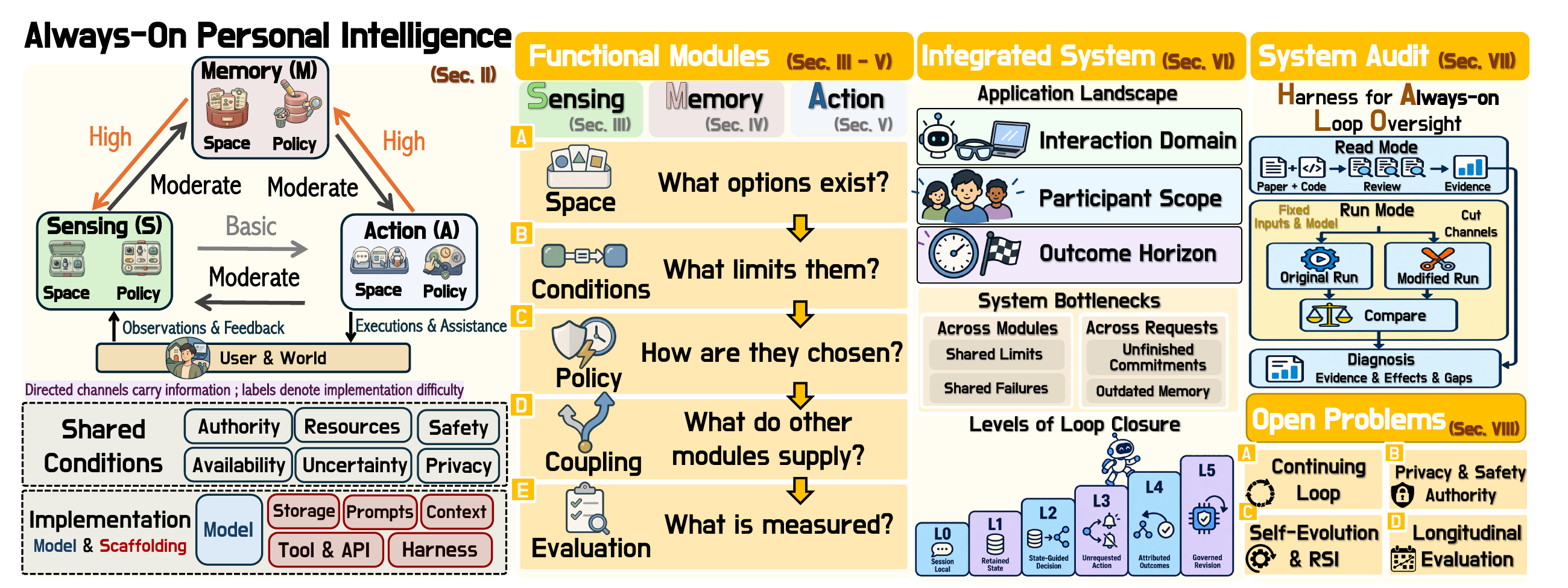
Figure 1. Overview of the roadmap. This roadmap is organized into five parts. We first define always-on personal intelligence as a continuing loop that connects Sensing, Memory, and Action through six directed channels. We then review each module by its space, conditions, policy, coupling, and evaluation. Building on these reviews, we examine integrated systems, their bottlenecks, and their levels of loop closure, and audit existing systems with HALO in read and run modes. Finally, we discuss the open problems in always-on personal intelligence.
How to read the list. Sections and titles follow the survey's module chapters, and each work appears once, under the section where the survey discusses it. Long sections are divided into the survey's own sub-categories: the paragraphs of its text, the groups of its benchmark tables, or its open problems, and a work the survey cites sits under the one that cites it. Every work the survey cites is listed: works cited only in its Introduction or Foundations are under Background, and works added by the daily scan, which the survey does not cite yet, sit where they fit its framework. Each list runs from the newest work to the oldest, except the application and loop-closure lists, which run from the highest loop-closure level (L5) down. A channel tag such as M→S marks a work discussed under that coupling channel, L0 to L5 give a system's level in the loop-closure table, and Product marks a published study of a product. Products are listed separately under Products, one line per product with its official page.
 Foundations
Always-on personal intelligence is personal assistance that maintains two core properties for the same user. Operational continuity is the ability to keep operating between explicit requests and to decide when to act or wait. State durability is the ability to preserve user-specific state for later use and to carry unresolved commitments across interaction boundaries. The continuing loop, the foundation of always-on personal intelligence, provides both properties through the recurring operation of Sensing, Memory, and Action.
Its self-evolving extension uses operating experience to make durable revisions to the assistant's mechanism, the model weights and the scaffolding that decide how it works, and later steps use the revised mechanism. Storing that the user prefers reminders at their workstation is a state update, while editing the timing rule to wait until they are back there is a revision. A claim of self-evolution that rests on outcome feedback needs a chain of evidence with five steps: record, outcome, attribution, revision, and later use.
Within each module, the survey distinguishes its space, what the module can do and represent, from the local policy that chooses among these options. Six directed coupling channels each carry information from one module to another for the receiving module to use:
| Channel | Information flow | Difficulty | Covered in |
|---|---|---|---|
| S→A | Current context and observed execution state that inform Action's decisions | Basic | Action |
| S→M | Observations that Memory uses to create or update records | Moderate | Memory |
| M→A | Retained personal information and pending commitments that inform Action's decisions | Moderate | Action |
| A→S | Action plans and execution state that guide what Sensing observes and checks | Moderate | Sensing |
| M→S | Retained information that guides what Sensing observes and how it interprets new observations | High | Sensing |
| A→M | Action context and immediate results that Memory uses to maintain task history | High | Memory |
Difficulty is the survey's qualitative rating. Basic marks the S→A path that every agent system has, and High marks channels whose errors are hard to detect and correct.
Every module and channel works under shared conditions, the limits set by the user and the world: privacy, user authority, safety, resource budgets, availability, and uncertainty. Within these limits, each runs on an implementation, the models and the scaffolding around them, such as prompts, tools, memory stores, and the harness that runs the loop.
Systems differ in how completely they close this loop. The six levels are cumulative, and L3 is the first always-on level, because from L3 on both properties hold:
| Level | An assistant reaches it when |
|---|---|
| L0 Session local | It responds within one session and keeps nothing across interactions (the baseline) |
| L1 Retained state | It carries information across sessions: one session writes a memory that a later session can read |
| L2 State-guided decision | Its stored records change later decisions about what to sense or how to act, while it still acts only as requested |
| L3 Unrequested action | It decides for itself whether or when to act without a request, and waiting is one of its choices. Acting at a time or condition the user fixed stays at L2 |
| L4 Attributed outcomes | It links outcome evidence that arrives after a decision, from the world or the user, to that decision, so that it can check or correct its assistance |
| L5 Governed revision | It revises its mechanism only within the shared conditions: a control applies them to every revision before it takes effect, and the revisions that pass carry over into later runs |
The survey's synthesis reveals the thinnest support for two channels: Memory guiding Sensing (M→S), and action outcomes returning to Memory (A→M). These gaps motivate two research priorities: keeping sensing open to unexpected change for reliable operation, and attributing outcomes to earlier decisions for self-evolution.
Background
Works the survey cites in its Introduction and Foundations: early visions of personal assistance, the cognitive architectures and reinforcement learning behind the continuing loop, and the earlier systems its map of the literature starts from.
Introduction and Foundations
- StreamPro: From Reactive Perception to Proactive Decision-Making in Streaming Video.
- A Survey of Context Engineering for Large Language Models.
- Cognitive Architectures for Language Agents.
- A Path Towards Autonomous Machine Intelligence.
- Autonomous Reinforcement Learning: Formalism and Benchmarking.
- Introduction to Soar.
- Towards Wearable Cognitive Assistance.
- The Lumière Project: Bayesian User Modeling for Inferring the Goals and Needs of Software Users.
- The Computer for the 21st Century.
- The Nature of Explanation.







Mapping the Literature
- OmniParser for Pure Vision Based GUI Agent.
- ScreenAI: A Vision-Language Model for UI and Infographics Understanding.
- SeeClick: Harnessing GUI Grounding for Advanced Visual GUI Agents.
- Pix2Struct: Screenshot Parsing as Pretraining for Visual Language Understanding.
- Semantic Hearing: Programming Acoustic Scenes with Binaural Hearables.
- ClearBuds: Wireless Binaural Earbuds for Learning-Based Speech Enhancement.
- Voice Activity Projection: Self-supervised Learning of Turn-taking Events.
- An Intelligent Personal Assistant for Task and Time Management.
- BusyBody: Creating and Fielding Personalized Models of the Cost of Interruption.
- Stuff I've Seen: A System for Personal Information Retrieval and Re-Use.
- StartleCam: A Cybernetic Wearable Camera.
- Cyberguide: A Mobile Context-Aware Tour Guide.
- Remembrance Agent: A Continuously Running Automated Information Retrieval System.
- As We May Think.









 Sensing
 takes in observations and feedback from the user and the world, forming the current context and the state of ongoing tasks.
Sensing Space
- Interactive Benchmarks.
- Artificial Intelligence: A Modern Approach.
- Active perception.


What Starts Observation
Continuous sensing
- Activity Frames: Deterministic Screen-Activity Compilation for Agent Memory and Replay.
- DomusFM: A Foundation Model for Event-Based Behavioral Monitoring in Smart-Homes.
- Mage-VL: An Efficient Codec-Native Streaming Multimodal Foundation Model.
- VibeVoice-ASR-Streaming Technical Report.
- ChainStream: An LLM-based Framework for Unified Synthetic Sensing.
- Moshi: a speech-text foundation model for real-time dialogue.
- Vocell: A 65-nm Speech-Triggered Wake-Up SoC for 10-μW Keyword Spotting and Speaker Verification.
- An Acoustic Signal Processing Chip With 142-nW Voice Activity Detection Using Mixer-Based Sequential Frequency Scanning and Neural Network Classification.
- MyLifeBits: A Personal Database for Everything.


Triggered sensing
- Em-Garde: A Propose-Match Framework for Proactive Streaming Video Understanding.
- GazeAgent: VLM-Guided Implicit Gaze Calibration from Egocentric Multimodal Behavior for AI Glasses.
- Proactive Robot Assistance via Event-Driven Reasoning over State Changes.
- HomeEmergency – Using Audio to Find and Respond to Emergencies in the Home.


On-demand sensing
- PULSE: Agentic Investigation with Passive Sensing for Proactive Affective Intervention in Cancer Survivorship.
- Vision in Action: Learning Active Perception from Human Demonstrations.
- Explore until Confident: Efficient Exploration for Embodied Question Answering.

Observation Formats and Metadata
- CoPE-VideoLM: Leveraging Codec Primitives For Efficient Video Language Modeling.
- Do GUI Agents Believe Their Eyes? Diagnosing State-Belief Reliance on Pixels versus Structure.
- EyeQ: Exploring Corneal Reflection for Mobile Context Sensing.
- GUIGuard-Bench: Toward a General Evaluation for Privacy-Preserving GUI Agents.
- LLaVA-OneVision-2: Towards Next-Generation Perceptual Intelligence.
- OneVision-Encoder: Codec-Aligned Sparsity as a Foundational Principle for Multimodal Intelligence.
- SuperSenseDoctor: A Multimodal and Contactless Agent for Health Tracking.
- Cartridges: Lightweight and general-purpose long context representations via self-study.
- Efficient Motion-Aware Video MLLM.
- AgentDojo: A Dynamic Environment to Evaluate Prompt Injection Attacks and Defenses for LLM Agents.
- Fast Transformer Decoding: One Write-Head is All You Need.



Shared Conditions for Sensing
Whose information is the assistant allowed to observe?
- Privacy-Preserving End-to-End Full-Duplex Speech Dialogue Models.
- Protecting Bystander Privacy via Selective Hearing in Audio LLMs.
- In Focus, Out of Privacy: The Wearer's Perspective on the Privacy Dilemma of Camera Glasses.
- Exploring the Privacy Concerns of Bystanders in Smart Homes from the Perspectives of Both Owners and Bystanders.
- Overlap-aware low-latency online speaker diarization based on end-to-end local segmentation.
- Mobile Sensor Data Anonymization.
- Don't Look at Me That Way! Understanding User Attitudes Towards Data Glasses Usage.
- In Situ with Bystanders of Augmented Reality Glasses: Perspectives on Recording and Privacy-Mediating Technologies.


How long can sensing continue?
- Camera-Free Object Discovery and Interaction with GazeTags.
- Full System Architecture Modeling for Wearable Egocentric Contextual AI.
- MELTing point: Mobile Evaluation of Language Transformers.
- A 510-nW Wake-Up Keyword-Spotting Chip Using Serial-FFT-Based MFCC and Binarized Depthwise Separable CNN in 28-nm CMOS.
- Thermal Model and Countermeasures for Future Smart Glasses.


Can observations reach decisions in time?
- LLM Inference at the Edge: Mobile, NPU, and GPU Performance Efficiency Trade-offs Under Sustained Load.
- A Systematic Evaluation of On-Device LLMs: Quantization, Performance, and Resources.
- lm-Meter: Unveiling Runtime Inference Latency for On-Device Language Models.
- An Empirical Study of Latency in an Emerging Class of Edge Computing Applications for Wearable Cognitive Assistance.


What does remote processing cost?
- Do LLMs Need to See Everything? A Benchmark and Study of Failures in LLM-driven Smartphone Automation using Screentext vs. Screenshots.
- Exploring Multimodal LMMs for Online Episodic Memory Question Answering on the Edge.
- How Much Does It Cost to Answer My Question? Benchmarking Cloud VLM-based VQA Systems.
- Intention-Aware Semantic Agent Communications for AI Glasses.
Sensing Policy
Whether to Observe: Triggering and Wake-Up
- Cambrian-S: Towards Spatial Supersensing in Video.
- CAPTURE: Disentangling Preference Drift from Memory Poisoning in Personalized LLM Agents.
- GlanceAR: Repurposing Phone Sensors via Low-Cost Reflectors for Always-On Obstacle Awareness.
- OpenGlass: Ultra-Low-Power On-Device AI Eyewear with Event-based Vision.
- Perceive Before Reasoning: A Pre-Reasoning Perception Framework for Efficient and Reliable Proactive Mobile Agents.
- Pre-Decoding Acoustic Triage for Budgeted Vision-Language Captioning of Untrimmed Egocentric Video.
- StreamMind: Unlocking Full Frame Rate Streaming Video Dialogue through Event-Gated Cognition.
- SenseCam: A Retrospective Memory Aid.


How Much to Observe: Allocating the Perception Budget
- Accelerating Streaming Video LLMs via Hierarchical Token Compression.
- Spatial Memory for AR Glasses: Hierarchical Visual Acquisition and Source-Linked Recall.
- HD-EPIC: A Highly-Detailed Egocentric Video Dataset.
- HyperVL: An Efficient and Dynamic Multimodal Large Language Model for Edge Devices.
- Q-Frame: Query-aware Frame Selection and Multi-Resolution Adaptation for Video-LLMs.
- ReWind: Understanding Long Videos with Instructed Learnable Memory.
- VisionThink: Smart and Efficient Vision Language Model via Reinforcement Learning.
- VideoLLM-online: Online Video Large Language Model for Streaming Video.


How Much History to Use: Observation Windows
- Audio Interaction Model.
- MOSS-Live: Full-Duplex Real-Time Interaction.
- StreamingVLM: Real-Time Understanding for Infinite Video Streams.
- Efficient Streaming Language Models with Attention Sinks.
- StreamChat: Chatting with Streaming Video.


Where to Cut: Online Segmentation
Action progress and onsets
- End-to-End Streaming Video Temporal Action Segmentation with Reinforce Learning.
- Progress-Aware Online Action Segmentation for Egocentric Procedural Task Videos.
- Streaming Video Temporal Action Segmentation In Real Time.
- Real-time Online Video Detection with Temporal Smoothing Transformers.
- Long Short-Term Transformer for Online Action Detection.
- StartNet: Online Detection of Action Start in Untrimmed Videos.
- Online Detection of Action Start in Untrimmed, Streaming Videos.
- Online Action Detection.



Overlapping and unfamiliar events
- Mamba-OTR: a Mamba-based Solution for Online Take and Release Detection from Untrimmed Egocentric Video.
- Online Generic Event Boundary Detection.
- ActionSwitch: Class-agnostic Detection of Simultaneous Actions in Streaming Videos.
- Object Aware Egocentric Online Action Detection.



Boundaries from prediction and change
- ES-Mem: Event Segmentation-Based Memory for Long-Term Dialogue Agents.
- Event-VStream: Event-Driven Real-Time Understanding for Long Video Streams.
- Event Perception: A Mind/Brain Perspective.

Boundary timing and its value
- Assembly101: A Large-Scale Multi-View Video Dataset for Understanding Procedural Activities.
- Rescaling Egocentric Vision: Collection, Pipeline and Challenges for EPIC-KITCHENS-100.


What to Keep: Compression, Representation, and Redaction
- Imprint: Online Memory Compression for Long-Horizon Egocentric QA.
- Reconstruction and Reflection of Positive Experiences through Resurfacing Laughter-indexed Everyday Moments.
- UTOPI: Efficient Egocentric Long-Video Understanding in AR via User-Guided Token Pre-Compression.
- LiveCC: Learning Video LLM with Streaming Speech Transcription at Scale.
- Kirigami: Lightweight Speech Filtering for Privacy-Preserving Activity Recognition Using Audio.
- Video ReCap: Recursive Captioning of Hour-Long Videos.

Whether Enough Has Been Observed: Interpretation and Readiness
- Ask Now, Use Later: Benchmarking the Proactivity Gap in Long-Lived LLM Agents.
- EgoAsk: Egocentric Teaching of Personalized Object Knowledge for Household Robots.
- N₀-TWAM: Scaling Tactile-Native World-Action Model for Contact-Rich Manipulation.
- Scaling Context-Aware Task Assistants that Learn from Demonstration and Adapt through Mixed-Initiative Dialogue.


Where the Computation Runs: On-Device, Edge, and Cloud
- OpenJarvis: Personal AI, On Personal Devices.
- EgoCHARM: Resource-Efficient Hierarchical Activity Recognition using an Egocentric IMU Sensor.
- DeepWear: Adaptive Local Offloading for On-Wearable Deep Learning.
- Shredder: Learning Noise Distributions to Protect Inference Privacy.
- Neurosurgeon: Collaborative Intelligence Between the Cloud and Mobile Edge.


Where the Result Goes: Routing
- Dispider: Enabling Video LLMs with Active Real-Time Interaction via Disentangled Perception, Decision, and Reaction.
- MIRIX: Multi-Agent Memory System for LLM-Based Agents.
Learning the Sensing Policy
- EyeRobot 2.0: Active Gaze for Precise Manipulation without Wrist Cameras.
- Not All Speech Is Intent: Adaptive Self-Correcting Inference Layer for Post-ASR False Wake-Up.
- Eye, Robot: Learning to Look to Act with a BC-RL Perception-Action Loop.
- VAGEN: Reinforcing World Model Reasoning for Multi-Turn VLM Agents.

Sensing Coupling Across the Loop
Memory to Sensing: the M→S Channel
- VoiceFilter-Lite: Streaming Targeted Voice Separation for On-Device Speech Recognition.

Action to Sensing: the A→S Channel
- ActiveAlign: Aligning Egocentric Manipulation via Active Perception.
- Don't Act Blindly: Robust GUI Automation via Action-Effect Verification and Self-Correction.
- OpenClaw-RL: Train Any Agent Simply by Talking.
- Code-as-Monitor: Constraint-aware Visual Programming for Reactive and Proactive Robotic Failure Detection.
- Ask-before-Plan: Proactive Language Agents for Real-World Planning.
- Robots That Ask For Help: Uncertainty Alignment for Large Language Model Planners.
- Interactive Perception: Leveraging Action in Perception and Perception in Action.



Evaluation
Evaluation Metrics
- TRACE: Temporal Audit and Condition-aware Evaluation of Streaming Video Understanding.
Benchmarks and Evaluation Settings
Perception baselines: supplied input
- BALMS: Benchmarking Agentic LLMs for Longitudinal Mental Health Sensing.
- EgoCross: Benchmarking Multimodal Large Language Models for Cross-Domain Egocentric Video Question Answering.
- EgoNight: Towards Egocentric Vision Understanding at Night with a Challenging Benchmark.
- EgoSAT: A Comprehensive Benchmark of Egocentric Streaming Interaction Understanding.
- EgoSound: Benchmarking Sound Understanding in Egocentric Videos.
- HealthLoopQA: A Context-Aware Question Answering Benchmark for Interpreting Wearable Monitoring Data in Diabetes Care.
- LongCounsel-8: A Benchmark Suite for Longitudinal Depression Tracking from Multi-Session Counseling Dialogues.
- StreamArena: Toward Continuous, Interactive, and Long-Horizon Agentic Streaming Video Understanding.
- WearableQA: A Benchmark for Health Reasoning over Real-World Wearable Data.
- WebPII: Benchmarking Visual PII Detection for Computer-Use Agents.
- ENACT: Evaluating Embodied Cognition with World Modeling of Egocentric Interaction.
- OVO-Bench: How Far Is Your Video-LLM from Real-World Online Video Understanding?
- ScreenSpot-Pro: GUI Grounding for Professional High-Resolution Computer Use.
- SmartHome-Bench: A Comprehensive Benchmark for Video Anomaly Detection in Smart Homes Using Multi-Modal Large Language Models.
- TOMATO: Assessing Visual Temporal Reasoning Capabilities in Multimodal Foundation Models.
- WearVQA: A Visual Question Answering Benchmark for Wearables in Egocentric Authentic Real-world scenarios.
- Ego4D: Around the World in 3,000 Hours of Egocentric Video.
- Recognizing Detailed Human Context In-the-Wild from Smartphones and Smartwatches.






Continuous and triggered capture: coverage and cost
- Ego-METAS: Egocentric online Multimodal Energy-efficient Temporal Action Segmentation benchmark.
- EgoLife: Towards Egocentric Life Assistant.
- EgoTrigger: Toward Audio-Driven Image Capture for Human Memory Enhancement in All-Day Energy-Efficient Smart Glasses.

Organizing supplied streams
- A Simple Baseline for Streaming Video Understanding.
- SENRI: Understanding the Space-Event Nexus in Real-Life Videos.
- MuRAL: A Multi-Resident Ambient Sensor Dataset Annotated with Natural Language for Activities of Daily Living.
- SensorQA: A Question Answering Benchmark for Daily-Life Monitoring.
- Flash-VStream: Memory-Based Real-Time Understanding for Long Video Streams.
- OnlineTAS: An Online Baseline for Temporal Action Segmentation.
- Generic Event Boundary Detection: A Benchmark for Event Segmentation.


Readiness and response timing
- AskStream: When and What to Ask Proactively under Uncertainty in Streaming Video Understanding.
- ECG-Scroll: A Long-Horizon, Streaming Benchmark and Agent Environment for Interpretation of Ambulatory Electrocardiograms.
- EgoPro-Bench: Benchmarking Personalized Proactive Interaction in Egocentric Video Streams.
- HomeSafe-Bench: Evaluating Vision-Language Models on Unsafe Action Detection for Embodied Agents in Household Scenarios.
- StreamGaze: Gaze-Guided Temporal Reasoning and Proactive Understanding in Streaming Videos.
- StreamReady: Learning What to Answer and When in Long Streaming Videos.
- WearVox: An Egocentric Multichannel Voice Assistant Benchmark for Wearables.
- Eyes Wide Open: Ego Proactive Video-LLM for Streaming Video.
- Full-Duplex-Bench: A Benchmark to Evaluate Full-duplex Spoken Dialogue Models on Turn-taking Capabilities.
- OmniMMI: A Comprehensive Multi-modal Interaction Benchmark in Streaming Video Contexts.
- ProactiveVideoQA: A Comprehensive Benchmark Evaluating Proactive Interactions in Video Large Language Models.
- TeleEgo: Benchmarking Egocentric AI Assistants in the Wild.

On-demand: checking again
- PInVerify: An Offline Embodied Benchmark for Active Instance Verification.
- Remember, Verify, or Ask? Evaluating Memory Decisions at Reuse Time.
- VibeLifeBench: Can Your Life Agent Be Proactive and Persistent in a Living World?
- Beyond the Destination: A Novel Benchmark for Exploration-Aware Embodied Question Answering.
- Enter the Mind Palace: Reasoning and Planning for Long-term Active Embodied Question Answering.

Guidance from Memory and Action
- IPIBench: Evaluating Interactive Proactive Intelligence of MLLMs under Continuous Streams.
- SentinelBench: A Benchmark for Long-Running Monitoring Agents.
- TAVIS: A Benchmark for Egocentric Active Vision and Anticipatory Gaze in Imitation Learning.
- VABench: Measuring Embodied Spatial Intelligence through Visual Demonstrations, Active Perception, and Metric Control.
- Where to Look: Can Foundation Models Reach a Target Viewpoint Through Active Exploration?
- Personal VAD: Speaker-Conditioned Voice Activity Detection.

 Memory
 keeps what the assistant learns about the user and hands it back when a decision needs it or a commitment falls due.
Memory Space
- Lost in the Middle: How Language Models Use Long Contexts.
- RULER: What's the Real Context Size of Your Long-Context Language Models?

What Persists: Past, Present, and Future
Retrospective memory: what happened
- Learning to Forget – Hierarchical Episodic Memory for Lifelong Robot Deployment.
- Mitigating Provenance-Role Collapse in Long-Term Agents via Typed Memory Representation.
- Remembering Through Change: Provenance-Preserving Hypergraph Memory for Multimodal Agents.
- Structured Episodic Event Memory.
Profile memory: what holds now
- Fostering Emotional Engagement and Sustained Interaction in Care Homes Through Empathetic Human–Robot Conversation.
- PersonaVLM: Long-Term Personalized Multimodal LLMs.
- Dynamic Open-Vocabulary 3D Scene Graphs for Long-term Language-Guided Mobile Manipulation.
- Mem0: Building Production-Ready AI Agents with Scalable Long-Term Memory.
- O-Mem: Omni Memory System for Personalized, Long Horizon, Self-Evolving Agents.
- Personalized Graph-Based Retrieval for Large Language Models.
- DynaMem: Online Dynamic Spatio-Semantic Memory for Open World Mobile Manipulation.
- Interactive Continual Learning Architecture for Long-Term Personalization of Home Service Robots.
- TidyBot: Personalized Robot Assistance with Large Language Models.



Prospective memory: what is pending
- Designing Robots for Families: In-Situ Prototyping for Contextual Reminders on Family Routines.
- Prospective Memory for Proactive LLM Agents.
- When Should Agents Check External State? Budgeting Observations for Stored Intentions.

Representations and Storage
Structured records and embeddings
- Agent Zero Memory: Provenance-Aware Long-Term Memory for LLM Agents.
- ArborMem: Navigating Interaction States with Memory Forests.
- CreaMem: A Scene-Aware Memory Architecture for Personalized Agents.
- Disentangling Long-Term Memory via Latent Neuro-Symbolic Reasoning.
- ETAMem: Decoupling and Aligning Heterogeneous Memory for Long-Term Conversational Agents.
- HGP:An on-device personalized agent memory via hybrid graph storage.
- Latent Multimodal Memory Reasoning.
- PIA: A Personal Intelligence Agent Turning Health Conversations into Records and Records into Understanding.
- Scalaris: A Scalable Enterprise Memory Architecture for Conversational AI Assistants.
- SodaMem: Evidence-Grounded Temporal Graph Memory for LLM Agents.
Code and dense state
- MemFold: Learning Compact Soft Memory for Long-Context Personalization via On-Policy Optimization.
- Metis: Memory Foundation Model.
- ThinkFlow: Self-Evolving Probabilistic Latent Memory for Lifelong Conversational Agents.
- What Survives When Activation Steering Is Used as Memory.
- Voyager: An Open-Ended Embodied Agent with Large Language Models.
Parametric memory
- DPPM: Dual-Path Parametric Memory for Personalized Language Models.
- ProTTT: Learning to Learn Semantic User Memory with Test-Time Training.
- MEMORYLLM: Towards Self-Updatable Large Language Models.
The choice of a storage architecture
- A Graph-Native Bitemporal Memory Store for Conversational AI Agents.
- Cost and Accuracy of Long-Term Memory in Distributed Multi-Agent Systems Based on Large Language Models.
- Harness the Memory: A Holistic Evaluation of Memory Substrates in Memory Agents.
- Hippocampus: An Efficient and Scalable Memory Module for Agentic AI.
- MemOS: A Memory OS for AI System.

Shared Conditions for Memory
What is the assistant allowed to keep, and for how long?
- AIM: A Privacy-Aware Interoperable Memory Framework for Multi-Agent Multi-User LLM Systems.
- Audience-Bound Persistent Memory: Authorization Across the Memory Lifecycle.
- Can Agents Keep Secrets They Were Never Told? Benchmarking Latent Privacy Risks Across Sessions with MemJoin.
- Characterizing Memory Misalignment in Human-LLM Interaction From User Perspectives.
- Disclosure Begets Disclosure: A Self-Reinforcing Privacy Loop in LLM Agents with Persistent Memory.
- DP-MemView: A Memory Interface for Attribute-Level Transcript Privacy in Long-Term LLM Agents.
- EP-Mem: Elastic Privacy Memory for Social Relationship-Aware LLM Agents.
- MemLeak: Cross-User Semantic Leakage in Multi-Tenant AI Agent Memory.
- MEMORY Wins All: Indirect Bias Injection Attacks via Social Media Content.
- Share-Borne AI Virus: Memory-Hopping Attacks Across LLM Agents.
- Vulnerabilities in Personalization: Assessing Health Privacy Risks in ChatGPT Logs and Memory.
- When Agents Learn to Be You: Benchmarking Privacy Leakage, Impersonation Risk, and Defenses in Persona Skills.
Can the store be reached when it is needed?
- Heirloom: Carrying a Phone's Personalization Across Base-Model Generations.
- Portable Agent Memory: A Protocol for Cryptographically-Verified Memory Transfer Across Heterogeneous AI Agents.
Memory Policy
What to Store and in What Form: Admission and Encoding
Admission
- AdaMem: Learning What to Remember with Adaptive Memory Policies for Personalized Agents.
- AgentMemGate: Addressing Speculation Contamination in Conversational Assistant Memory.
- AMU:Admission and Memory Update for Personalized Conversations---Structured Memory with SLM Guided Control.
- ConMem: Counterfactual Multi-Scenario Probing for Resolving LLM Memory Misalignment.
- Gated Memory: Admission-Controlled Memory Formation for Conversational AI.
- Learning What to Ask for Tomorrow: Active Preference Acquisition for Long-Term Personalized Web Agents.
- Not Yet in the Profile: Uncertainty-Aware Dynamic User Profiling by Learning from Future Interactions.
- ProV-Mem: Proactive Memory for Streaming Video Question Answering.
- SLICE-Mem: Salience-Gated Lightweight Information Curation for Efficient LLM Agent Memory.
- What should AI forget? A design and taxonomy for negative space governance in AI memory.
- When Routine Chats Turn Toxic: Unintended Long-Term State Poisoning in Personalized Agents.
- Who Remembers What? Multi-Granularity Memory Extraction for Multi-User, Multi-Agent Interaction.

Encoding
- FTA-Mem: Fact-Time-Affect Anchored Memory for Low-Density Long-Term Dialogue.
- Interpreting at Write Time: A Policy Ablation for Multi-Goal Agent Memory.
- MEM1: Learning to Synergize Memory and Reasoning for Efficient Long-Horizon Agents.
- MemMachine: A Ground-Truth-Preserving Memory System for Personalized AI Agents.
- Generative Agents: Interactive Simulacra of Human Behavior.

How State Remains Reachable: Indexing and Identity
Indexing
- Accurate and Efficient Long-Term Memory for LLM Agents.
- BIO-MEMART: Biometric-Aware KV Cache Memory for Multi-User LLM Agents.
- EnSIMem: Entity-Structured Indexing for Long-Term Agent Memory.
- From Voiceprints to User Entities: Online Speaker-Memory Construction for Multi-User Spoken Agents.
- Have I Scene This Before? Spatially Grounded Conversational Memory for Complex Queries in Egocentric Assistants.
- Infini Memory: Maintainable Topic Documents for Long-Term LLM Agent Memory.
- Is it my preference? Role Grounding Attack against Agent's Memory via Social Interaction.
- MIRIX-2.0: Multi-Agent Memory System.
- PERSIST: Who-What-When Memory Across Sessions for Full-Duplex Spoken Dialogue.
- Personalizing LLM Agent Memory Using Biometrics.
- RaMem: Contextual Reinstatement for Long-term Agentic Memory.
- A-MEM: Agentic Memory for LLM Agents.
- Zep: A Temporal Knowledge Graph Architecture for Agent Memory.
Maintenance and updates
- Supersede: Diagnosing and Training the Memory-Update Gap in LLM Agents.
- TAMEing the Open-World Personalization: Towards Open-Set Personalized MLLM Assistant.
- TEPA: Revoking Stale Memories for Conflict-Robust Language Agents.
- Hindsight is 20/20: Building Agent Memory that Retains, Recalls, and Reflects.
- Semantic Commit: Helping Users Update Intent Specifications for AI Memory at Scale.
What Is Exposed Now: Retrieval and Delivery
Retrieval
- Agent Memory as Recommendation: Recommender-System Design for Long-Term Memory of LLM Agents.
- APDMem: Agent-Controlled Progressive Disclosure for Query-Adaptive Long-Term Memory.
- Chain on Demand: Deferred Evidence Organization for Long-Term Conversational Memory.
- Controllable Memory Usage: Balancing Anchoring and Innovation in Long-Term Human-Agent Interaction.
- Defense-in-Depth for LLMs: Evaluating Memory Gates Against Activation-Induced and Memory-Induced Sycophancy.
- Do Personalized LLMs Need the Whole Conversation? Matching the Full History with Only 5% of Its Text via Relevance-Filtered Context.
- FlexA-Mem: Budget-Adaptive Agentic Memory for LLM Agents.
- HERO: Human-profile Enhanced Retrieval Optimization Framework for Long-term Agent Memory.
- InferScale: GPU-Native KV Injection for Personalized LLM Serving.
- KITE: Retrieval as a Decision Procedure for Long-Term Conversational Memory.
- Learning from Others, Acting for You: Cross-User Memory Sharing for LLM Agents.
- LINE Conversation History Retrieval for Personal Memory RAG: Evaluating Search Representations and Hybrid Retrieval.
- Madeleine: Learning Involuntary Recall for Conversational Memory from Simulated Lives.
- Memadapter: Counterfactual Adaptation Against Memory-induced Sycophancy.
- Mitigating Over-Personalization in LLMs via Structured Memory.
- Not Forgotten: Implementation and Evaluation of a Personalized Episodic Memory for the Humanoid Robot Head Kim.
- OP-Bench: Benchmarking Over-Personalization for Memory-Augmented Personalized Conversational Agents.
- Over-Personalization Is a Decision Failure: Generation-Induced Apply Bias in LLMs.
- QUMem: Personalized Memory for Query-Conditioned User-State Inference in LLM Agents.
- RALI@iKAT 2026: Retrieval-aware User Profile Denoising via Personalized Conversational Dense Retrieval.
- Relevance Is Not Sufficiency: What Actually Closes the Evidence Gap in Long-Term Memory QA.
- Rethinking Experience Utilization in Self-Evolving Language Model Agents.
- Retrieval-Augmented Online Textual Memory for Episodic Memory Video Question Answering.
- Temporal Evidence Forests for Long-Horizon Multi-Party Conversational Memory.
- The Compliance Trap: Diagnosing How AI Agents Consume Conflicting Memory.
- TrawMem: Reframing Agent Memory as Task-Oriented Role-Adaptive Workspaces.
- VoiceMem: Streaming Dual-Brain Memory for Real-Time Interaction.
- General Agentic Memory Via Deep Research.
- VideoTree: Adaptive Tree-based Video Representation for LLM Reasoning on Long Videos.
- A Simple LLM Framework for Long-Range Video Question-Answering.


Delivery
- Memory That Looks Forward: A Zero-Inference Prospective Term for Personal Memory Retrieval.
- Remember When It Matters: Proactive Memory Agent for Long-Horizon Agents.
- Who Schedules Agent Memory? A Sidecar Approach to Long-Horizon Tasks.
How Records Change: Consolidation and Correction
Consolidation
- Auto-Dreamer: Learning Offline Memory Consolidation for Language Agents.
- Can LLM Agents Organize Their Own Memory?
- CogniFold: Always-On Proactive Memory via Cognitive Folding.
- HyperTrace: Hypothesis-Based Preference Tracing for Online LLM Personalization.
- Hypotheses-Guided Self Distillation for Continual Personalization.
- LightMem: Lightweight and Efficient Memory-Augmented Generation.
- Long-Term Agent Memory through Complementary Curation and Consolidation.
- Memory Beyond Recall: A Dual-Process Cognitive Memory System for Self-Evolving LLM Agents.
- MemQ: Integrating Q-Learning into Self-Evolving Memory Agents over Provenance DAGs.
- PhysMem: Scaling Test-Time Memory for Embodied Physical Reasoning.
- Useful Memories Become Faulty When Continuously Updated by LLMs.
- Agent Workflow Memory.
- Mobile-Agent-E: Self-Evolving Mobile Assistant for Complex Tasks.
- Sleep-time Compute: Beyond Inference Scaling at Test-time.


Correction
- A State Change Is Local, Its Consequences Are Not: Dependency-Aware State Revision for Long-Term Agent Memory.
- CALM: Conflict-Aware Lifecycle Memory Governance for Long-Horizon Language Agents.
- MedCache: Efficient and Temporally Valid Memory for Longitudinal Clinical Agents.
- PreCoMem: Predictive Cognitive Memory for Self-Evolving Long-Term Dialogue Agents.
- StateWise: Diagnosing and Repairing Persistent Operational State Before Agent Actions.
- Toward Robust Personalized Alignment for LLMs: Mitigating Persona Drift in Multi-Turn Dialogue.
- TrackMem: Tracking Evolving Beliefs in Long-Horizon Financial Dialogue.
- When Memory Updates but Behavior Does Not: Repairing Implicit Stale Dependencies in Personalized Agent Responses.
What Stops Influencing Later Decisions: Retirement, Forgetting, and Deletion
- AfterDeleteBench: Auditing Post-Deletion Information Persistence in LLM Agents.
- Can Agents Forget When Asked? A Benchmark for Memory Unlearning in LLM Agents.
- Eternal Sunshine of the Spotless Mind: Systematically Erasing LLM's Memories.
- MemCut: Every Secret Leaves a Trail in the Long-Term Memory of LLM Agents.
- PANDO: Efficient Multimodal AI Agents via Online Skill Distillation.
- Suggested Is Not Superseded: A Pre-Registered Evaluation of a System-One Model as a Memory-Retirement Gate.
- Mind the Gap Between Conversations for Improved Long-Term Dialogue Generation.

Learning the Memory Policy
- Adaptive Memory Index Evolution for Agents.
- EvoGroup: A Self-Evolving Harness for Group Agents in Shared Contexts.
- EvoMemState: Evolving Memory State for Personal Agents.
- Learning Personalized Memory Gating from Delayed One-Sided Feedback.
- Learning What to Share and What to Personalize: Hierarchical Strategy Co-Evolution for Agent Memory.
- MemLife: Curating and Reasoning over Long-Term Egocentric Video Memories.
- MemSkill: Learning and Evolving Memory Skills for Self-Evolving Agents.
- MemSteer: Turning User Histories into Supervision for Agent Memory Optimization.
- Personalized Memory Rubrics: Learning What to Remember per User via Rubric-Guided Credit Assignment.
Memory Coupling Across the Loop
Sensing to Memory: the S→M Channel
- AirLog: Store-Level Indoor Life Logging Made Easy.
- GROVE: Growing and Reasoning over Temporally Stratified Memory from Streaming Video Experience.
- Your Home Remembers: A Voice-Enabled Household Memory Assistant for Conversational Retrieval.
Action to Memory: the A→M Channel
- Do Personalized Skills Help Coding Agents? An Empirical Study of Developer Interaction Traces.
- Memory-R1: Enhancing Large Language Model Agents to Manage and Utilize Memories via Reinforcement Learning.
- Memory-R2: Fair Credit Assignment for Long-Horizon Memory-Augmented LLM Agents.
- Muscle Memory for Agents: Compile not Merely Retrieve.
- PRIME: Training Free Proactive Reasoning via Iterative Memory Evolution for User-Centric Agent.
- Promptile: Recovering and Reusing Prompting Strategies from LLM Interaction Histories.
- RoMeRL: Balancing Feedback Coverage and the Memory-Reward Trap in Self-Evolving Agent Memory via Reduced-Order Utility States.
- UPSHIFT: User Preference Steering from Human-AI Interaction Feedback Traces.
- In Prospect and Retrospect: Reflective Memory Management for Long-term Personalized Dialogue Agents.

Evaluation
Evaluation Metrics
- Are We Ready For An Agent-Native Memory System?
Benchmarks and Evaluation Settings
Recall baselines
- Beyond the Current Observation: Evaluating Multimodal Large Language Models in Controllable Non-Markov Games.
- EgoMemReason: A Memory-Driven Reasoning Benchmark for Long-Horizon Egocentric Video Understanding.
- EvalMem: An Operation-Level Diagnostic Framework for Long-Term Memory Systems.
- Evaluating Memory in LLM Agents via Incremental Multi-Turn Interactions.
- HippoCamp: Benchmarking Contextual Agents on Personal Computers.
- Is Complex Agentic Memory Always Needed? Naive RAG Is Stronger Than We Thought.
- LongMemEval-V2: Evaluating Long-Term Agent Memory Toward Experienced Colleagues.
- MemEye: A Visual-Centric Evaluation Framework for Multimodal Agent Memory.
- MemLens: Benchmarking Multimodal Long-Term Memory in Large Vision-Language Models.
- Memory Tax: Dissecting the Net Value of Agent Memory.
- MIRAGE: How Conversation State Shapes Historical Evidence Use in Multimodal Personal Agents.
- MOSAIC: An Omni-Modal Benchmark for Long-Term Memory and Cross-Modal Reasoning in Conversational Agents.
- VoiceLongMemEval: Do Assistants Remember How You Sounded?
- Will My Assistant Remember My Allergy? What Personal LLM Assistants Forget When Conversation Memory Is Compressed.
- Episodic Memory Verbalization using Hierarchical Representations of Life-Long Robot Experience.
- FindingDory: A Benchmark to Evaluate Memory in Embodied Agents.
- LongMemEval: Benchmarking Chat Assistants on Long-Term Interactive Memory.
- ReMEmbR: Building and Reasoning Over Long-Horizon Spatio-Temporal Memory for Robot Navigation.
- Evaluating Very Long-Term Conversational Memory of LLM Agents.


Admission: what enters the store
- AMemGym: Interactive Memory Benchmarking for Assistants in Long-Horizon Conversations.
- CUE-Mem: Benchmarking Long-Term User Memory via Implicit Cues in Multimodal Conversations.
- Evaluating Memory Capability in Continuous Lifelog Scenario.
- HaluMem: Evaluating Hallucinations in Memory Systems of Agents.
- MemOps: Benchmarking Lifecycle Memory Operations in Long-Horizon Conversations.
- MemPrivacy: Privacy-Preserving Personalized Memory Management for Edge-Cloud Agents.
- Personalize-then-Store: Benchmarking and Learning Personalized Memory for Long-horizon Agents.
- ProactEgoMem: Benchmarking Proactive Memory in Streaming Egocentric Video.
- What Should Embodied Agents Remember? Benchmarking and Evaluating Memory Modality for Embodied Agents.
- WorldMemArena: Evaluating Multimodal Agent Memory Through Action-World Interaction.

Profile: keeping what holds valid
- Agents Don't Just Agree, They Remember: Benchmarking Persistent Sycophancy in Self-Improving Personal Agents.
- BehaviorMem: Building and Evaluating User Memory from Real-World E-Commerce Behavior Streams.
- Can Agent Memory Systems Track Evolving State?
- DyadMem: A Long-Term Memory Benchmark of How Agents Work with Users.
- FinPerMA: A Theory-Informed, Event-Grounded Personalized-Memory Benchmark for LLM Agents.
- From Recall to Forgetting: Benchmarking Long-Term Memory for Personalized Agents.
- HABIT-Bench: Evaluating Habit Induction from Longitudinal Weak Evidence in Agent Memory.
- LSREP: A Longitudinal State-Replay Protocol for Evaluating Conversational Memory, with ICE v2 as an Audited Local-First Architecture.
- MemConflict: Evaluating Long-Term Memory Systems Under Memory Conflicts.
- Memory Consolidation Flattens the Temporal Shape of User Facts.
- MemShift: Separating Detection from Repair in LLM-Derived Personal Memory.
- MINTEval: Evaluating Memory under Multi-Target Interference in Long-Horizon Agent Systems.
- PersEvalBench: Can LLM Evaluators Judge Contextually Appropriate Use of Persona Information?
- Setoka: A Benchmark for Hierarchical User Understanding in Personalized Agents over Heterogeneous Data.
- SIMLIFE: Pattern Understanding for Long-Horizon Human-Agent Partnership.
- Stale, Misattributed, or Late: Where Personal Memory Fails Before Generation.
- STALE: Can LLM Agents Know When Their Memories Are No Longer Valid?
- State Contamination in Memory-Augmented LLM Agents.
- To Memories and Beyond: From Remembering to Knowing You across Long-Term Multimodal Personal Archives.
- When Personal Memory Has No Single Answer: Evaluating LLM Agents under Irreducible Conflict.
- WorldLines: Benchmarking and Modeling Long-Horizon Stateful Embodied Agents.
Prospective: holding what is pending
- Knowing the Store: What a Memory Backend Must Write Down Before an Agent Can Read It.
- Making Prospective Memory SLM-Shaped: Typed Intention Stores for Small-Model Agents.
- PM-Bench: Evaluating Prospective Memory in LLM Agents.
- ProEvent: An Event-centric Benchmark for Proactive Agents.
- TriggerBench: Investigating Prospective Memory for Large Language Models.
Coupling and later use: state influences subsequent decisions
- AdaptArena: Evaluating Test-Time Personalization of Web Agents.
- APM-Bench: Benchmarking Cross-session Persistent Memory for Egocentric Streaming Video Assistants.
- BenchTrace: A Benchmark for Testing Reflection Ability and Controlled Evolution in LLM Agents.
- Claw-Anything: Benchmarking Always-On Personal Assistants with Broader Access to User's Digital World.
- ContextWeave: A Real-World Workflow Benchmark.
- Continual Learning Bench: Evaluating Frontier AI Systems in Real-World Stateful Environments.
- ContinualSkillBench: Can LLM Agents Truly Evolve Their Capabilities?
- DolphinBench: Mapping the Pareto Frontier of Agent Memory.
- DuSE-Bench: Benchmarking Joint Reasoning over Evolving Dialogue and Documents.
- DynamicMem: A Long-Horizon Memory Benchmark in Real-World Settings.
- ENPMR-Bench: Benchmarking Proactive Memory Retrieval for Emotional Support Agents.
- EvoMemBench: Benchmarking Agent Memory from a Self-Evolving Perspective.
- Explicit State Elicitation Is Not Enough: A Controlled Audit of Memory-Policy Classification.
- Fewer Clarifications, Better Code: Benchmarking Cross-Session Personalized Ambiguity Adaptation in Coding Assistants.
- FileGram: Grounding Agent Personalization in File-System Behavioral Traces.
- FingerTip 20K: A Benchmark for Proactive and Personalized Mobile LLM Agents.
- From Profiling to Synthesis: Benchmarking Implicit Behavioral Alignment in Personalized LLM Agents.
- iPrefBench: A User-Centric Benchmark for Personalized Mobile Use Agents.
- Keep It InMind: Benchmarking the Implicit-Association Blind Spot in Agent Memory.
- Know It, Act on It: Investigating Memory Utilization in LLM Personalization.
- KnowU-Bench: Towards Interactive, Proactive, and Personalized Mobile Agent Evaluation.
- LifeVal: Evaluating AI Model Performance on Personalized Agentic Consumer Tasks.
- LUNAR: Benchmarking Personalized Large Language Models on UNiversal User BehAvioR Logs.
- MemHarmBench: Evaluating Cross-Session Prompt Injection in Memory-Persistent AI Agents.
- Memorizing Who, Knowing How: Benchmarking Personal and Procedural Memory for Persistent Assistants.
- MemoryArena: Benchmarking Agent Memory in Interdependent Multi-Session Agentic Tasks.
- MemUse: Moving Memory Evaluation from Direct QA to Natural Integration in Long-Term Human-AI Conversation.
- One Assistant, Many Memories: Benchmarking Real-World Group Assistance When Recall Is Not Enough.
- P-ContextBench: From Personal Fact Recall to Personalized Agent Behavior.
- PairPref: When Should Memory Guide the Answer? A Benchmark for Contextual Preference Use.
- PAST-Bench: Benchmarking the Foundations of Recursive Self-Improvement in Personal Agents.
- PATH-Bench: Path-Dependent Evaluation of Lifelong Agents.
- PRAGMA: Evaluating Personalized Guidance with Memory Alignment in Lifelong Conversations.
- Proactive Agent Research Environment: Simulating Active Users to Evaluate Proactive Assistants.
- RealCompanion: Benchmarking Human Understanding from Reasoning over Longitudinal Real-World Conversations.
- StreamMemBench: Streaming Evaluation of Agent Memory for Future-Oriented Assistance.
- TWIST: A Proposed Benchmark for Intervention Quality in Conversational Memory, with a Human-Validated Draft-Alignment.
- UserToolBench: A User-Profile-Hidden Benchmark for Personalized Decision Making in Tool-Use LLMs.
- VitaBench 2.0: Evaluating Personalized and Proactive Agents in Long-Term User Interactions.
- Why Bother Me Again? Benchmarking Personal Agent Memory for Interaction Preferences.
- LifelongAgentBench: Evaluating LLM Agents as Lifelong Learners.



 Action
 decides whether, when, and how the assistant acts on the external world, for example by sending a message, editing a file, or speaking aloud.
Action Space
What Starts an Action
Reactive action
- Companion-style QA Assistance in Ego-Vision.
- Gazeify Then Voiceify: Physical Object Referencing Through Gaze and Voice Interaction with Displayless Smart Glasses.
- Homebot: A Personal AI Agent for Conversational Home Assistance and Automation.
- Ludi0.1: An Agentic System for Socially Intelligent Robots.

Deferred action
- FARM: Field-Aware Resolution Model for Intelligent Trigger-Action Automation.
- LocalIntent: Outcome-Specific Structured Generation for Backend-Compatible Smart Building Automation with Local LLMs.
- Generating HomeAssistant Automations Using an LLM-based Chatbot.
- A Conversational Agent for Creating Automations Exploiting Large Language Models.
- Sasha: Creative Goal-Oriented Reasoning in Smart Homes with Large Language Models.

Proactive action
- MMDuet2: Enhancing Proactive Interaction of Video MLLMs with Multi-Turn Reinforcement Learning.
- When Intelligence Becomes Agency: A Theory of Governed, Proactive Agency for Symbiotic AI Systems.
- The Science Behind Hunches: Deep Device Embeddings.

Interfaces, Consequences, and Feedback
- Self-Evolutionary Replanning for Failure-Aware Motion Planning.
- Unbiased Reward Modeling from Implicit Feedback for LLM Alignment.
- UI-TARS-2 Technical Report: Advancing GUI Agent with Multi-Turn Reinforcement Learning.
- SWE-agent: Agent-Computer Interfaces Enable Automated Software Engineering.
Shared Conditions for Action
- Sampling Safe Futures: Multimodal Trajectory Planning for Personalized Safety in Anthropomorphic AI.
- Who Is Your Agent Serving? Provider-Side Indirect Prompt Injection in Proactive Agents.
- EIA: Environmental Injection Attack on Generalist Web Agents for Privacy Leakage.
- PrivacyLens: Evaluating Privacy Norm Awareness of Language Models in Action.
- Just-in-Time Adaptive Interventions (JITAIs) in Mobile Health: Key Components and Design Principles for Ongoing Health Behavior Support.
- Robots and Robotic Devices: Safety Requirements for Personal Care Robots.
- Effects of intelligent notification management on users and their tasks.
- Comparison of Four Primary Methods for Coordinating the Interruption of People in Human-Computer Interaction.
- Principles of mixed-initiative user interfaces.





Action Policy
Whether and When to Intervene: Gating, Silence, and Asking
Using an expressed or inferred goal
- TanCRAFT: Context-Reasoned Anticipatory Feedback for Assembly Tasks.
Waiting for a useful moment
- Affective Agent: On-Device Personalized Intervention Reasoning for Wearable Systems.
- Ambient @ EgoProactive 2026 : Proactive Egocentric Assistance with Visually Grounded Supervision.
- Decoupling Conversational Dynamics in Full-Duplex Spoken Models through Reinforcement Learning.
- Designing Proactive Thought Partners for Writing.
- Developer Interaction Patterns with Proactive AI: A Five-Day Field Study.
- HiThink Turn: An Intent-Aware Turn-Taking Control Module for Full-Duplex Dialogue.
- Improving Proactive AI Assistance with Hierarchical Procedural Understanding.
- Jarvis: A Proactive Speech Agent for Multi-Party Conversations.
- Learning to Assist: Collaborative VLAs for Implicit Human-Robot Collaboration.
- Live Assistant: Learning Whether, When, and Whom to Assist in Real-World Live Social Streams.
- PACE: Plan, Attend, Check, and Emit for Training-Free Response Timing in Streaming Video Understanding.
- ProACT: Towards Breakdown-Aware Proactive Agent in Multi-User Collaboration.
- Proactive AI: From Turns to Replannable Dialogue Timelines.
- Speak for Me: Giving LLMs the Situational Awareness to Participate in a Meeting.
- Speak or Stay Silent: Context-Aware Turn-Taking in Multi-Party Dialogue.
- Time-Aware Assistive Navigation.
- When2Speak: A Dataset for Temporal Participation and Turn-Taking in Multi-Party Conversations for Large Language Models.
- Why2Speak: Faithful Reasoning for Abstaining Action Policies.
- Proactive Conversational Agents with Inner Thoughts.
- Talking Turns: Benchmarking Audio Foundation Models on Turn-Taking Dynamics.
- When not to help: planning for lasting human-AI collaboration.



Clarifying, preparing, or stopping
- Agentic Abstention: Do Agents Know When to Stop Instead of Act?
- PACT: Proactive Asking for Continual Task Assistance in Human-Robot Collaboration.
- RoboOmni: Proactive Robot Manipulation in Omni-modal Context.
- Value of Information: A Framework for Human–Agent Communication.
- When Should AI Agents Ask? Clarification Requests Under Limited Human Attention.
- Robix: A Unified Model for Robot Interaction, Reasoning and Planning.
Choosing a separate or shared timing model
- Do Proactive Agents Need an LLM to Decide When to Act?
- MiniCPM-o 4.5: Towards Real-Time Full-Duplex Omni-Modal Interaction.
- ProActor: Timing-Aware Reinforcement Learning for Proactive Task Scheduling Agents.
- Realtime-Venus: A full-duplex interaction system with asynchronous delegation.
- Response-G1: Explicit Scene Graph Modeling for Proactive Streaming Video Understanding.
- ROMA: Real-time Omni-Multimodal Assistant with Interactive Streaming Understanding.
- StreamOV: Streaming Omni-Video Understanding via Evidence-Guided Memory and Response Triggering.
- SyncPro: Synchronous Reasoning and Responding for Proactive Streaming Video Understanding.
- The Price of Scale in Proactive Memory Recall.
- When to Assist and What to Suggest: Joint Gating and Memory-Grounded Hint Generation in One Compact Decoder.
- StreamBridge: Turning Your Offline Video Large Language Model into a Proactive Streaming Assistant.
- VideoLLM Knows When to Speak: Enhancing Time-Sensitive Video Comprehension with Video-Text Duet Interaction Format.

How Control Is Retained: Single-Step and Multi-Step
- LongHorizon-Harness: Advancing Long-Horizon Agents for Real-World Tasks.
- Runtime-Independent Persistent Agents: Preserving Identity, Memory, and Code Across Models, Harnesses, and Servers.
- When Agents Overtrust Environmental Evidence: An Extensible Agentic Framework for Benchmarking Evidence-Grounding Defects in LLM Agents.
- Where Does Exactly-Once Live? Model, Harness, and Tool-Contract Effects on Duplicate Side Effects in LLM Agents.
- ReAct: Synergizing Reasoning and Acting in Language Models.

Through Which Interface the State Changes: Effectors and Receipts
- ChipChat: Low-Latency Cascaded Conversational Agent in MLX.
- ToolOrchestra: Elevating Intelligence via Efficient Model and Tool Orchestration.
- SAGE: Smart home Agent with Grounded Execution.
Which Effect Is Authorized: Proceeding, Confirming, and Withholding
Checking permission before an action takes effect
- AgentAntibody: An Adaptive Immune System for Defending LLM Agents against Prompt Injection.
- Do User-Authored Permission Policies Improve Protection Against AI Agent Overreach?
- Formal Policy Enforcement for Agentic Systems.
- Knowing the User Is Not Knowing What We Established: Grounding Awareness in Personal Agents.
- Memory Provenance Laundering in LLM Agents: A Non-Amplification Firewall for Persistent Memory.
- AGrail: A Lifelong Agent Guardrail with Effective and Adaptive Safety Detection.
- Effective Red-Teaming of Policy-Adherent Agents.

Rechecking after a pause or handoff
- Mind Your HEARTBEAT! Claw Background Execution Inherently Enables Silent Memory Pollution.
- Temporary Authority, Permanent Effects: Commit-Time Authorization for LLM Agents.
- When Memory Becomes Authority: Benchmarking Authority Collapse at the Memory Consolidation Boundary.
Learning the Action Policy
- A Personalized and Adaptive Intelligent Tutoring System for Psychomotor Learning.
- Causal DAG-Guided Reinforcement Learning for Long-Term Physical Activity Maintenance: Using Prior Data to Inform Future Deployment.
- Communication Policy Evolution for Proactive LLM Agents.
- Context-Aware Emotionally Adaptive Voice Assistants: A Multimodal Framework for Empathetic Human-Agent Interaction.
- Live-OPSD: On-Policy Self-Distillation for Proactive Streaming Large Video Models.
- Personalizing Large Language Model Agents with Small Policy Models.
- Preference-Driven Online Adaptation for Personalized Interaction Initiation in Proactive AI Assistants.
- Proact-VL: A Proactive VideoLLM for Real-Time AI Companions.
- Training Proactive and Personalized LLM Agents.
Action Coupling Across the Loop
Memory to Action: the M→A Channel
Using personal and task context
- ClawRec: A Claw-Native Recommender System.
- CoLearn: An Agentic Tutor that Learns its Learner in a Human--AI Co-Learning Loop.
- Embodied Agents Meet Personalization: Investigating Challenges and Solutions Through the Lens of Memory Utilization.
- LiveAsset: Learning Intent Assets from Corrective Interactions for Agent Runtime Control.
- Love for Believable AI: Artificial Partiality and Relationship Persistence as an Engineerable Stance.
- MementoGUI: Learning Agentic Multimodal Memory Control for Long-Horizon GUI Agents.
- MemoProAgent: Toward Memory-Driven Proactive Assistance.
- Personal-Agent Mediated Recommendation with Cross-Platform User History.
- PersonalAlign: Hierarchical Implicit Intent Alignment for Personalized GUI Agent with Long-Term User-Centric Records.
- Pulse: Long-Horizon Tasks Need Streaming Personalization.
- RegulaTutor: A Theory-Informed Framework for Long-Term Personalized Learning.
Delivering due commitments and procedures
- MMSkills: Towards Multimodal Skills for General Visual Agents.
- Proactive Memory for Event-Driven LLM Agents.
- ProMemAgent: Long-Horizon Proactive Assistance with Context-Aware Prospective Memory from Sensory Perceptions.

Separating retrieval, delivery, and use
- Demystifying Agent Skills: Why They Work-Until They Don't.
- From Relevance to Execution Utility: Reward-Aware Dynamic Execution Gating for Skill-Based LLM Agents.
- Relevance Does Not Imply Applicability: Experience Activation for Personal GUI Agents.
- SkillAligner: Treating Retrieved Skills as Adaptable Drafts at Execution Time.
Evaluation
Evaluation Metrics
- A Self-Triggered Agentic Push Recommendation System.
- Ask Less, Ask Better: Allocating User Attention in Proactive LLM Agents with Interruption Budgets.
- MoshiRAG: Asynchronous Knowledge Retrieval for Full-Duplex Speech Language Models.
- Omni-SafetyBench: A Benchmark for Safety Evaluation of Audio-Visual Large Language Models.
- Reinforcing User Retention in a Billion Scale Short Video Recommender System.
- Reinforcement Learning to Optimize Long-term User Engagement in Recommender Systems.


Benchmarks and Evaluation Settings
Reactive: executing a request
- Auditing Agent Harness Safety.
- AURA: Always-On Understanding and Real-Time Assistance via Video Streams.
- Claw-Eval: Towards Trustworthy Evaluation of Autonomous Agents.
- ClawBench: Can AI Agents Complete Everyday Online Tasks?
- Full-Duplex-Bench-v3: Benchmarking Tool Use for Full-Duplex Voice Agents Under Real-World Disfluency.
- HumanCLAW: Can Vision-Language Models Act Through a Body?
- InteractiveWorld: A Verifiable Human-Centric Environment for Building Better Interactive MLLM Assistants.
- NormAct: Benchmarking Embodied Agents' Proactive Compliance with Unspoken Social Norms.
- OpenComputer: Verifiable Software Worlds for Computer-Use Agents.
- PAUSE: A User-Centric Benchmark for Personal AI Assistants in Unified Service Environments.
- PDEU-Bench: Benchmarking the Personalized Planning Lifecycle of Tool-Calling LLM Agents.
- SPIEval: Evaluating Large Language Models as Mobile Assistants over Scattered Personal Information.
- ST-WebAgentBench: A Benchmark for Evaluating Safety and Trustworthiness in Web Agents.
- STRIDE: When to Speak Meets Sequence Denoising for Streaming Video Understanding.
- AndroidWorld: A Dynamic Benchmarking Environment for Autonomous Agents.
- MCP-Universe: Benchmarking Large Language Models with Real-World Model Context Protocol Servers.
- MCPMark: A Benchmark for Stress-Testing Realistic and Comprehensive MCP Use.
- AgentBench: Evaluating LLMs as Agents.
- OSWorld: Benchmarking Multimodal Agents for Open-Ended Tasks in Real Computer Environments.
- WebArena: A Realistic Web Environment for Building Autonomous Agents.
- Mind2Web: Towards a Generalist Agent for the Web.


Deferred: commitments over time
- Assistant Benchmark: A Public Scorecard for AI Assistants You Can Text.
- Empty Commitments: When Agents Promise What They Cannot Deliver.
- JarvisBench: Always-on Intelligence Between Humans and Agents.
- Long-term Task-oriented Agent: Proactive Long-term Intent Maintenance in Dynamic Environments.
- OmniPro: A Comprehensive Benchmark for Omni-Proactive Streaming Video Understanding.
- OptionWorld: A Benchmark for Diagnosing Failures of LLMs as Long-Term Personal Assistants.
- SMH-Bench: Benchmarking LLM Agents for Environment-Grounded Reasoning and Action in Smart Homes.
- π-Bench: Evaluating Proactive Personal Assistant Agents in Long-Horizon Workflows.
- ARE: Scaling Up Agent Environments and Evaluations.

Proactive: acting or staying silent
- Act2Intention: A Benchmark For Developing Active Mobile Agents Through Inferring User Intention from GUI Actions.
- Agentic Coding Needs Proactivity, Not Just Autonomy.
- AI Assistants Overassist.
- AutoBuddy: Evaluating Proactive, Always-On Agents on Task Discovery and Execution in a Simulated Workplace.
- DIVE: Benchmarking Full-Duplex Interaction with Visual Engagement in Continuous Streams.
- DuplexAct-Bench: Broadening Full-Duplex Speech Evaluation toward Proactive Interaction across Diverse Behavioral Requirements.
- DuplexAct: How Interactive Are Frontier Full-Duplex Spoken Language Models?
- EgoVoice: Proactive Spoken Assistance from Egocentric Multimodal Streams.
- Exploring The Impact Of Proactive Generative AI Agent Roles In Time-Sensitive Collaborative Problem-Solving Tasks.
- From Perception to Prediction and Intervention: Benchmarking Proactive Video Assistants in Real-Life Scenarios.
- From Reactive to Proactive: Assessing the Proactivity of Voice Agents via ProVoice-Bench.
- Full-Duplex Speech Models Take the Floor When Asked, Not When Needed.
- GUIDE: A Benchmark for Understanding and Assisting Users in Open-Ended GUI Tasks.
- HALO: Human-Grounded Granular Evaluation of Proactive Agents.
- InteractionBench: A Real-Time Interaction Benchmark for Streaming Video Systems.
- Omni-InteractScope: Benchmarking Proactive and Agentic Interaction in Continuous Omnimodal Streams.
- Omni-Life: Benchmarking Omnimodal Real-Time AI Assistants in People's Daily Lives.
- OmniAssistBench: Assistant-style Interaction Benchmark for Omni-LLMs.
- PersonalHomeBench: Evaluating Agents in Personalized Smart Homes.
- Plan, Watch, Recover: A Benchmark and Architectures for Proactive Procedural Assistance.
- ProactiveMobile: A Comprehensive Benchmark for Boosting Proactive Intelligence on Mobile Devices.
- ProAgentBench: Evaluating LLM Agents for Proactive Assistance with Real-World Data.
- RobotAgentBench: Towards Open-world Robot Autonomy.
- RobotEQ 3.0: Towards Personalized Social Proactive Intelligence in Embodied Agents.
- RobotEQ-Video: A Video-Centric Benchmark for Social Proactive Intelligence with World-State Taxonomy.
- StreamVibe: Proactive Video Agents for Evolving User Intent.
- When Should AI Chime In? Benchmarking Timely Contribution of Proactive Agents in Multi-Party Chat.
- Beyond Reactivity: Measuring Proactive Problem Solving in LLM Agents.
- When AI-Based Agents Are Proactive: Implications for Competence and System Satisfaction in Human-AI Collaboration.


Authority and consequences across interactions
- After the Attacker Leaves: Benchmarking Carryover Attacks on LLM Agents.
- Agent Memory Is a Surface for Endogenous Authorization Laundering.
- Claw-SWE-Bench: A Benchmark for Evaluating OpenClaw-style Agent Harnesses on Coding Tasks.
- CoSec: Benchmarking Agent Security in Communities.
- DelegationBench: Measuring When AI Agents Should Ask Before Acting.
- Evaluating the Hidden Costs of Personalization in Large Language Models.
- InferPriv: Evaluating Inferential Privacy Leakage in LLM Assistants.
- OverAct: Measuring and Mitigating Proactive Over-Authorization in LLM Tool-Calling Agents.
- PACE: Towards Surfacing Hidden Conflicts in User Requests.
- SoCRATES: Towards Reliable Automated Evaluation of Proactive LLM Mediation across Domains and Socio-cognitive Variations.
- WeClawArena: An Auditable Sandbox and Benchmark for Cross-User Agents Collaboration and Security in Human-Centered Agent Networks.
- Whose Credential Is It? How Owner Attribution in Agent MemoryShapes Cross-User Account Misuse.
- Efficient Agents: Building Effective Agents While Reducing Cost.
- Efficacy of Contextually Tailored Suggestions for Physical Activity: A Micro-randomized Optimization Trial of HeartSteps.

 Applications, System Bottlenecks, and Loop Closure
How Sensing, Memory, and Action work together in wearable, digital, and physical applications, where reported systems meet bottlenecks, which level of loop closure each supports, and how reported systems revise their mechanism. A level tag (L0 to L5) gives a system's place in the loop-closure table, and Product marks its product rows.
Applications and Bottlenecks
Wearable Assistance in Daily Activity and Conversation
- Memento: Towards Proactive Visualization of Everyday Memories with Personal Wearable AR Assistant.
- ProAgent: Harnessing On-Demand Sensory Contexts for Proactive LLM Agent Systems in the Wild.
- Vinci2: Providing Proactive Assistance in Continuous Egocentric Videos.
- AI for Service: Proactive Assistance with AI Glasses.
- AiGet: Transforming Everyday Moments into Hidden Knowledge Discovery with AI Assistance on Smart Glasses.
- SocialMind: LLM-based Proactive AR Social Assistive System with Human-like Perception for In-situ Live Interactions.
- ItemCompass: Real-Time Edge-AI Wearable Vision for Tag-Free Domestic Object Retrieval.
- LightMem-Ego: Your AI Memory for Everyday Life.
- SpeechLess: Micro-utterance with Personalized Spatial Memory-aware Assistant in Everyday Augmented Reality.
- The Athlete as a Scientist of One: Agentic Bayesian Experimental Design for Individualized Physiology from Consumer Wearables.
- VisionClaw: Always-On AI Agents through Smart Glasses.
- MemPal: Leveraging Multimodal AI and LLMs for Voice-Activated Object Retrieval in Homes of Older Adults.
- Pro²Assist: Continuous Step-aware Proactive Assistance with Multi-modal Egocentric Perception for Long-horizon Procedural Tasks.
- LLAMAPIE: Proactive In-Ear Conversation Assistants.
- Proactive Assistant Dialogue Generation from Streaming Egocentric Videos.
- ProMemAssist: Exploring Timely Proactive Assistance Through Working Memory Modeling in Multi-Modal Wearable Devices.
- Sensible Agent: A Framework for Unobtrusive Interaction with Proactive AR Agents.
- Beyond Reactive Assistance: PV-Care Using Low-Density EEG and AI to Provide Proactive, Context-Aware Help for MCI.
- ChatMuse: Supporting In-Person Small-Group Conversation Experience with a Proactive Assistive AI Agent in Mixed Reality.
- EgoProbe: Benchmarking Long-Range and Exact Memory in Streaming Egocentric Videos.
- LTS-VoiceAgent: A Listen-Think-Speak Framework for Efficient Streaming Voice Interaction via Semantic Triggering and Incremental Reasoning.
- ObjectStream: Latent Objects as Memory Anchors for Streaming Video Understanding.
- OmniInteract: Benchmarking Real-World Streaming Interaction for Real-Time Omnimodal Assistants.
- PhoStream: Benchmarking Real-World Streaming for Omnimodal Assistants in Mobile Scenarios.
- StreamAhead: Real-Time Streaming Video Question Answering via Adaptive Precomputation.
- V-Rex: Real-Time Streaming Video LLM Acceleration via Dynamic KV Cache Retrieval.
- Building Egocentric Procedural AI Assistant: Methods, Benchmarks, and Challenges.
- Mirai: A Wearable Proactive AI "Inner-Voice" for Contextual Nudging.
- WatchGuardian: Enabling User-Defined Personalized Just-in-Time Intervention on Smartwatch.
- YETI (YET to Intervene) Proactive Interventions by Multimodal AI Agents in Augmented Reality Tasks.
- A Full-duplex Speech Dialogue Scheme Based On Large Language Models.
- Beyond Turn-Based Interfaces: Synchronous LLMs as Full-Duplex Dialogue Agents.
- Large Language Models Know What To Say But Not When To Speak.
- Satori: Towards Proactive AR Assistant with Belief-Desire-Intention User Modeling.








Digital Workspace and Personal Assistants
- Ouroboros: A Self-Developing Frontier Coding Agent with Reviewed Core Evolution.
- Deep Personalization: Continuous Context Observation for Local Proactive Agents.
- An Agentic Just-in-Time Adaptive Intervention System for Personalized Sleep Support: Proof-of-Concept Study with N of 1 Data.
- Compass: Continuously Aligning Social Media Feeds via In-Situ Reflections.
- PASK: Toward Intent-Aware Proactive Agents with Long-Term Memory.
- User as Code: Executable Memory for Personalized Agents.
- "Having Lunch Now": Understanding How Users Engage with a Proactive Agent for Daily Planning and Self-Reflection.
- "MeBo Leaves a Piece of You Behind": Designing a Relational Voice-Based Memory Companion for Older Adults.
- A Self-Evolving Agent for Longitudinal Personal Health Management.
- Agentic University: Collaborative Agents for Personalized Learning.
- ECHO: A Locally-Deployable Agentic Health Assistant with Temporal Memory, Safety Guardrails, and Speech Assessment.
- KnowAct-GUIClaw: Know Deeply, Act Perfectly, Personal GUI Assistant with Self-Evolving Memory and Skill.
- Richard: Voice-First Mobile Interaction for Persistent Tasks.
- Ekova: A Personality-Support Agent for Self-Discovery Dialogue.
- MOSS: Self-Evolution through Source-Level Rewriting in Autonomous Agent Systems.
- nanoMuse: An Open-Source Personal Agent for Every Device You Own.
- JoyAI-VL-Interaction: Real-Time Vision-Language Interaction Intelligence.
- Agentic Context Engineering: Evolving Contexts for Self-Improving Language Models.
- An Empirical Study of Proactive Coding Assistants in Real-World Software Development.
- Darwin Mobile Agent: A Roadmap for Self-Evolution.
- DualPath: Breaking the Storage Bandwidth Bottleneck in Agentic LLM Inference.
- FreeToken: Efficient Edge-Native MoE Serving with Bandwidth-Adaptive Execution.
- From Chatbot to Digital Colleague: The Paradigm Shift Toward Persistent Autonomous AI.
- Help Without Being Asked: A Deployed Proactive Agent System for On-Call Support with Continuous Self-Improvement.
- InsightToast: Proactive Information Retrieval & Glanceable Visualization in the Side Channel of Data-Rich Meetings.
- ITO: Real-time Browser Tab Orchestration Through Intent Detection.
- Learning to Adapt: Self-Improving Web Agent via Cognitive-Aware Exploration.
- ReasoningBank: Scaling Agent Self-Evolving with Reasoning Memory.
- SE-GA: Memory-Augmented Self-Evolution for GUI Agents.
- Skill-Guided Continuation Distillation for GUI Agents.
- SkillHarness: Harnessing Safe Skills for Computer-Use Agents.
- Towards Cognitive Process-Aware Proactive Writing Support.
- Assistance or Disruption? Exploring and Evaluating the Design and Trade-offs of Proactive AI Programming Support.
- CodingGenie: A Proactive LLM-Powered Programming Assistant.
- ProactiveVA: Proactive Visual Analytics with LLM-Based UI Agent.


Physical Assistance and Collaboration
- The Long-Term Use of Communication Robots by Users of Visiting Healthcare Services: Development of an Integrated Vital Signs Measurement System.
- Integrating Social Assistive Robots, IoT, Virtual Communities and Smart Objects to Assist at-Home Independently Living Elders: the MoveCare Project.
- Hobbit: Providing Fall Detection and Prevention for the Elderly in the Real World.
- The STRANDS Project: Long-Term Autonomy in Everyday Environments.
- An Agentic Framework for Proactive Robots with Procedural Assistance Memory.
- EgoMem: Lifelong Memory Agent for Full-duplex Omnimodal Models.
- ElliQ, an AI-Driven Social Robot to Alleviate Loneliness: Progress and Lessons Learned.
- A Glimpse into Long-term Physical Coexistence with Intelligent Robots.
- CarryOn: A Dual-Loop Harness for Personalized and Reliable Robot Assistance.
- RoboFind: Multi-Agent Personalized Object Search for People Who Are Blind or Have Low Vision.
- AssistantX: An LLM-Powered Proactive Assistant in Collaborative Human-Populated Environments.
- Cognitive Action Reasoning for Proactive Robots from Human-Centered Multimodal Observations.
- From Social Reasoning to Embodied Interaction: An Agentic Framework for Social Robots.
- Proactive Physical AI through Continuous Observation and Timely Intervention.
- Visual Proactivity: Enhancing Human-Robot Collaboration Through Intent Communication.
- PACE: Proactive Assistance in Human-Robot Collaboration Through Action-Completion Estimation.





Shared Conditions and Implementation Across Modules
Shared Conditions
- A Life of Its Own: How Agentic AI Companions Are Configured, Experienced as Autonomous Others, and Held Accountable.
- AutoRedClaw: Automated Red-Teaming for Claw-Style Agents.
- Externalization in LLM Agents: A Unified Review of Memory, Skills, Protocols and Harness Engineering.
- In-Context World Modeling for Robotic Control.
- Practice Makes Unsafe: Skill Misevolution in Self-Improving LLM Agents.
- Toward Personal Intelligence Through Cooperative Observation.
- Your Agent May Misevolve: Emergent Risks in Self-evolving LLM Agents.
- Sustainable LLM Inference for Edge AI: Evaluating Quantized LLMs for Energy Efficiency, Output Accuracy, and Inference Latency.

Implementation: Organizing Context Across Requests
- AgentBound: Securing Execution Boundaries of AI Agents.
- DuplexOmni: Real-Time Listening, Seeing, Thinking, and Speaking for Full-Duplex Interaction.
- Exploring Super-agent Design: Towards a More Autonomous Agent System.
- Kernel-Managed Shared Memory for System-Wide Personalization.
- MCPTox: A Benchmark for Tool Poisoning Attack on Real-World MCP Servers.
- PILOT in the Loop: Live Self-Improvement for Long-Horizon Agents.
- Progent: Securing AI Agents with Privilege Control.
- Qwen-Audio-Agent Technical Report.
- Ream: Unfolding Mutual Awareness in Human-Agent Workspaces.
- The Persona Is Still There, but Who Is Speaking? Latent Identity Reversion in Persistent AI Agents.
- Working Through Representation: Malleable Workspaces for Human-Agent Knowledge Work.
- Contextual Agent Security: A Policy for Every Purpose.
- EchoLeak: The First Real-World Zero-Click Prompt Injection Exploit in a Production LLM System.
- Invitation Is All You Need! Promptware Attacks Against LLM-Powered Assistants in Production Are Practical and Dangerous.
- IsolateGPT: An Execution Isolation Architecture for LLM-Based Agentic Systems.



Levels of Loop Closure
Wearable
- Personalized HeartSteps: A Reinforcement Learning Algorithm for Optimizing Physical Activity.
- Egocentric Co-Pilot: Web-Native Smart-Glasses Agents for Assistive Egocentric AI.
- Seeing, Listening, Remembering, and Reasoning: A Multimodal Agent with Long-Term Memory.
- Vinci: A Real-time Embodied Smart Assistant based on Egocentric Vision-Language Model.
- ContextAgent: Context-Aware Proactive LLM Agents with Open-World Sensory Perceptions.


Digital
- Code Is the Body: Agent-Owned Software Bodies for Recursive Evolution and Descent.
- A Deployed Online Reinforcement Learning Algorithm In An Oral Health Clinical Trial.
- MiWaves Reinforcement Learning Algorithm.
- ProPerSim: Developing Proactive and Personalized AI Assistants through User-Assistant Simulation.
- Effectiveness of a Digital Health Intervention Leveraging Reinforcement Learning: Results From the Diabetes and Mental Health Adaptive Notification Tracking and Evaluation (DIAMANTE) Randomized Clinical Trial.
- Time2Stop: Adaptive and Explainable Human-AI Loop for Smartphone Overuse Intervention.
- Anticipate and Learn: Unleashing Idle-Time Compute in Proactive Agents.
- AwareLLM: A Proactive Multimodal Ecosystem for Personalized Human-AI Collaboration to Enhance Productivity.
- Proactive Agent: Shifting LLM Agents from Reactive Responses to Active Assistance.
- Bloom: Designing for LLM-Augmented Behavior Change Interactions.
- Learning Personalized Agents from Human Feedback.
- VisualClaw: A Real-Time, Personalized Agent for the Physical World.
- Memory OS of AI Agent.
- MemoryBank: Enhancing Large Language Models with Long-Term Memory.
- MindShift: Leveraging Large Language Models for Mental-States-Based Problematic Smartphone Use Intervention.
- Understanding the Impact of Long-Term Memory on Self-Disclosure with Large Language Model-Driven Chatbots for Public Health Intervention.
- MemGPT: Towards LLMs as Operating Systems.


Physical
- Robots That Take Initiative: A Framework for Building and Evaluating Proactive Robots.
- ABot-AgentOS: A General Robotic Agent OS with Lifelong Multi-modal Memory.
- ABot-Claw: A Foundation for Persistent, Cooperative, and Self-Evolving Robotic Agents.
- Mixed-Initiative Dialog for Human-Robot Collaborative Manipulation.
Physical products
- Lio – A Personal Robot Assistant for Human-Robot Interaction and Care Applications.
- Detection of Depression Risk among Older Adults Using Home-Deployed Socially Assistive Robots: A Real-World Study.
- Socially Assistive Robot Hyodol for Depressive Symptoms of Community-Dwelling Older Adults in Medically Underserved Areas: A Preliminary Study.



Self-Evolution in Deployed Loops
Why revision is harder inside an always-on assistant
- CRL-VLA: Continual Vision-Language-Action Learning.
- HyperSkill: Self-Evolving LLM Agents via Hypergraph-Structured Skill Memory.
- LVMH: A Meta-Optimization Harness for Long-Video Agent Memory.
- Rethinking Self-Evolving Agents: Do We Still Need Prescribed Optimization Pipelines?
- Self-Evolving Embodied Agents via Skill-Harness Evolution.
- SpaceMind: A Modular and Self-Evolving Embodied Vision-Language Agent Framework for Autonomous On-orbit Servicing.
- Towards Human-like Physical Intelligence: Lifelong Vision-Language-Action Learning for Robotic Manipulation.
- Zetta ζ: An Efficient Closed-Loop Embodied Harness for Self-Evolving Physical Intelligence.
- AlphaEvolve: A coding agent for scientific and algorithmic discovery.
- SEEA-R1: Tree-Structured Reinforcement Fine-Tuning for Self-Evolving Embodied Agents.
- Self-Adapting Language Models.
- π*0.6: a VLA That Learns From Experience.
What a revision changes
- Harness-Aware Self-Evolving: Co-Evolving Model Weights, Harness, and Task Solutions.
- One Recipe, Many Harnesses: What Self-Evolution Encodes Across Languages and Models.
- Recursive Self-Improvement of Exoskeleton Assistance Policies through Human-in-the-Loop Feedback.
Revising model parameters from personal feedback
- COPE: Continual Personalization of LLMs under Sparse User Feedback via User Embeddings and Self-Evaluation.
- Efficient Test-Time Adaptation through Human-AI Interaction.
- PsyEvo: A Personalized Counseling Agent That Self-Evolves at Test Time.
Revising prompts and written instructions
- EmbodiSkill: Skill-Aware Reflection for Self-Evolving Embodied Agents.
- PACE: Anytime-Valid Acceptance Tests for Self-Evolving Agents.
- PEAM: On-device Communication Agent for Personalized, Efficient and Autonomous Mobile Network Configuration.
Revising storage and retrieval rules
- EvolveMem: Self-Evolving Memory Architecture via AutoResearch for LLM Agents.
- Live-Evo: Online Evolution of Agentic Memory from Continuous Feedback.
- MindMemOS: A Portable and Self-Evolving Memory Operating Layer for AI Agents.
- Reglos: A Self-Evolving Personal Memory Agent with Recursive Self-Improvement.
- MemEvolve: Meta-Evolution of Agent Memory Systems.
Revising tools and APIs
- SkillSmith: Co-Evolving Skills and Tools for Self-Improving Agent Systems.
- GATE: Graph-based Adaptive Tool Evolution Across Diverse Tasks.
- ToolLibGen: Scalable Automatic Tool Creation and Aggregation for LLM Reasoning.
Revising the harness while the assistant runs
- Harness Evolution as Learning: Approximation, Generalization, and Optimization Limits of Self-Improving Personal Agents.
- RRSI: Regularized Recursive Self-Improvement of Agent Harnesses.
- Live-SWE-agent: Can Software Engineering Agents Self-Evolve on the Fly?
Which revisions are governed
- Appreciation Teaches Unauthorized Execution: Self-Evolution Degrades the Robustness of Personal Agents to Indirect Prompt Injection.
- Harness Updating Is Not Harness Benefit: Disentangling Evolution Capabilities in Self-Evolving LLM Agents.
- SEABench: Benchmarking Endogenous Misalignment In Self-Evolving Agents.
 Trends and Open Problems
Where current always-on systems fall short, stated as open problems in four parts: sustaining the continuing loop; authority, privacy, and safety; self-evolution and recursive revision; and longitudinal evaluation and real deployment.
Sustaining the Continuing Loop
- Demo-ICL: In-Context Learning for Procedural Video Knowledge Acquisition.
- In-Context Learning for Robots: Methods and Applications.
- ProRL: Effective Reinforcement Learning for Proactive Recommendation via Rectified Policy Gradient Estimation.
- RoboICL: Embodied In-Context Learning with GPT-6 Astra.
- In-Context Imitation Learning via Next-Token Prediction.
- What to Say and When to Say it: Live Fitness Coaching as a Testbed for Situated Interaction.
- HoloAssist: an Egocentric Human Interaction Dataset for Interactive AI Assistants in the Real World.

Authority, Privacy, and Safety
- ByteDance AI Smartphone Triggers App Restrictions and User Harms in China.

Self-Evolution and Recursive Revision
Telling Whether a Revision Helped
- Do Self-Evolving Agents Forget? Capability Degradation and Preservation in Lifelong LLM Agent Adaptation.
- Don't Blind Your VLA: Aligning Visual Representations for OOD Generalization.
- LifeSide: Benchmarking Agents as Lifelong Digital Companions.
- SEA-Eval: A Benchmark for Evaluating Self-Evolving Agents Beyond Episodic Assessment.
- Self-Authored Verification Is Unreliable in Heuristic Self-Improving Agents.
- Self-Evolving Agents with Anytime-Valid Certificates.
- Toward User-Conditioned Evaluation of Personal LLM Agents under Temporal Interventions.
- Batch Policy Learning in Average Reward Markov Decision Processes.


Keeping Self-Evolution Within the User's Bounds
- ANCHOR: An External LLM-Driven Supervisory Module Facilitating Healthy Evolution in Self-Evolving Systems.
- Auditing Harness Tampering in Self-Improving Agents.
- Falsifiable Release Gates for Self-Improving Systems: Standing Invariants at Scale.
- Library Drift: Diagnosing and Fixing a Silent Failure Mode in Self-Evolving LLM Skill Libraries.
Revising the Revision Procedure
- Hyperagents.
- Learning to Continually Learn via Meta-learning Agentic Memory Designs.
- Learning to Learn-at-Test-Time: Language Agents with Learnable Adaptation Policies.
- Metaⁿ: Recursive Self-Improvement through Emergent Depth.
- Recursive Harness Self-Improvement.
- Recursive Self-Improvement in AI: From Bounded Self-Refinement to Autonomous Research Loops.
- The Last AI Built by Humans: Toward Genuine Recursive Self-Improvement.
- The Red Queen Gödel Machine: Co-Evolving Agents and Their Evaluators.

Longitudinal Evaluation and Real Deployment
Evaluating a Loop Whose Decisions Shape Later Inputs
- DR Tulu: Reinforcement Learning with Evolving Rubrics for Deep Research.
- RubricBench: Aligning Model-Generated Rubrics with Human Standards.
- The Verification Horizon: No Silver Bullet for Coding Agent Rewards.
- Who Grades the Grader? Co-Evolving Evaluation Metrics and Skills for Self-Improving LLM Agents.
- Performative Prediction.
- How Algorithmic Confounding in Recommendation Systems Increases Homogeneity and Decreases Utility.


Measuring Benefit and Burden Over Months
- AuthScribe: Supporting Agency and Authorship in LLM-Assisted Reflective Journaling.
- Guided Reflection for Personal Sleep Insight in Everyday Sleep Tracking.
- Measuring "Success" In the Transition from Pre- to Post-LLM Conversational Agents through the Lens of Interaction & Explanations for Older Adults.
- Open and Emergent Problems in Agentic Privacy and Security: A Contextual Angle.
- Out of sync: Accommodation, evaluation, and emergence in five weeks with an agentic AI teammate.
- PAIR: Perceptual Affective Inference and Regulation in a Real-Time Multimodal Conversational Agent.
- Tailored to you: longitudinal effects of personalising language models.
- Where the Evidence Lives: Auditing AI Companions' Self-Descriptions.
- Working with Agentic `Teammates': When a New Organizational Actor Collides with the Human Ecosystem of Work.

 Related Surveys
Capability-focused surveys, which each study one capability in depth, and concurrent system-level surveys, which organize the field from other perspectives: a person's own state, the smart-glasses device, long-horizon tasks, proactiveness, or the lifecycle of what an agent keeps across sessions.
Perception across modalities and deployment settings
- Audio-Visual Intelligence in Large Foundation Models.
- Challenges and Trends in Egocentric Vision: A Survey.
- Foundation Models Defining A New Era In Sensor-based Human Activity Recognition: A Survey And Outlook.
- From Static Inference to Dynamic Interaction: A Survey of Streaming Large Language Models.
- A Survey on Multimodal Large Language Models.
- An Outlook into the Future of Egocentric Vision.
- On-Device Language Models: A Comprehensive Review.
- Video Understanding with Large Language Models: A Survey.
- LifeLogging: Personal Big Data.




How information is retained, used, and governed
- A Survey on Long-Term Memory Security in LLM Agents: Attacks, Defenses, and Governance Across the Memory Lifecycle.
- Toward Personalized LLM-Powered Agents: Foundations, Evaluation, and Future Directions.
- A Survey on the Memory Mechanism of Large Language Model based Agents.
- Memory in the Age of AI Agents.
- Retrieval-Augmented Generation for Large Language Models: A Survey.

Proactive assistance
- Foundations of Proactive Agents: Principles, Technical Layers, and Proactivity-Gym.
- Proactive Service Agents: A Unified Decision Framework, Methods, and Evaluation.
- Know Your Limits: A Survey of Abstention in Large Language Models.
- Proactive Conversational AI: A Comprehensive Survey of Advancements and Opportunities.
- Towards Human-centered Proactive Conversational Agents.
- A Survey on Proactive Dialogue Systems: Problems, Methods, and Prospects.


Agent decision and execution methods
- Agentic World Modeling: Foundations, Capabilities, Laws, and Beyond.
- Large Language Model-Brained GUI Agents: A Survey.
- A Survey on Large Language Model based Autonomous Agents.
- Agent AI: Surveying the Horizons of Multimodal Interaction.
- Tool Learning with Foundation Models.
- The Rise and Potential of Large Language Model Based Agents: A Survey.
- A Survey of Embodied AI: From Simulators to Research Tasks.




Self-improving agents
- A Survey of Self-Evolving Agents: What, When, How, and Where to Evolve on the Path to Artificial Super Intelligence.
- AI for Auto-Research: Roadmap & User Guide.
- Diving into Reliable Self-Evolving Agents: A Survey.
- Dynamic Agent Skills: A Lifecycle Survey and Taxonomy of Evolving Skill Libraries.
- Self-Improvements in Modern Agentic Systems: A Survey.
- A Comprehensive Survey of Self-Evolving AI Agents: A New Paradigm Bridging Foundation Models and Lifelong Agentic Systems.


Concurrent system-level surveys
- A Survey on AI Smart Glasses for Wearable Intelligence: From Egocentric Sensing to Agentic Personalization.
- Always-On Agents: A Survey of Persistent Memory, State, and Governance in LLM Agents.
- ComBodied Agents: a New Paradigm of Human-Centric Agentic AI.
- From Seeing to Acting: Smart Glasses as First-Person Intelligence Platforms.
- Proactive AI for Superintelligent Agents.
- Towards Long-Horizon Agents: A Survey.

 Products
 are listed apart from research works, one line per product with its official page. They cover the products and devices the survey discusses, by interaction domain and with the level the loop-closure table gives them, plus a few curated additions. Availability varies by plan, platform, and region. The product source notes give the primary sources for some of these products.
Wearable Products
| Product | Company | Level and channels |
|---|---|---|
| Apple |  | |
| Amazon | | |
| Even Realities |  | |
| Forth |   | |
| Looki | | |
| Memoket | | |
| MemoMind | | |
| Careflick | | |
| Based Hardware | | |
| Ona | | |
| Oura | | |
| PLAUD |  | |
| Meta | | |
| RayNeo | | |
| Soulog Inc. | | |
| SwitchBot | |
Digital Products
| Product | Company | Level and channels |
|---|---|---|
| Brea | | |
| Caddy |  | |
| Catch | | |
| OpenAI |  | |
| Anthropic | | |
| Microsoft | | |
| LangChain | | |
| folk | | |
| Samsung | | |
| ||
| xAI | | |
| Hark | | |
| Nous Research | | |
| HeyClicky | | |
| Inbox Zero | | |
| Instinct | | |
| Thinking Machines |  | |
| Kindroid | | |
| Leon | | |
| LIA | | |
| Lindy | | |
| Manus | | |
2026/11 · Voice mode for Muse | Meta | |
| SUPERMIND PTE. LIMITED |  | |
| OpenClaw | | |
| CopilotKit | | |
| Orchid | | |
| Echotime Technology | | |
| Pally |  | |
| Perplexity | | |
| Simular | | |
| screenpipe | | |
| Apple |  | |
| Snap | | |
| Today | | |
| Town | | |
| Vellum | | |
| Violoop | | |
| Wajo | | |
| vivo | | |
| OPPO | | |
| Huawei | |
Physical Products
| Product | Company | Level and channels |
|---|---|---|
| Sony | | |
 Alexa+ 2026/10 · Camera sensing for Alexa+ Amazon Astro | Amazon | |
| Intuition Robotics | | |
| KEYi Technology | | |
| Casio | |
Devices & Platforms
| Product | Company |
|---|---|
| Bosch Sensortec | |
| Figure AI | |
| Samsung | |
| Himax | |
| Meta | |
| X Square Robot | |
| rabbit | |
| RealSense | |
| Vuzix |
Contributing
Contributions are welcome. To add a missing work or fix a link, edit one record in data/ and regenerate this README:
python3 scripts/build_readme.py
python3 scripts/build_readme.py --check
Each research entry renders in one format: the title first, then its badges, and the venue badge opens the paper:
- Title. [![Venue Year]](paper URL) [![Code]](code URL) ![M→S]
- Use the acceptance venue when a work has one, and
arXivotherwise. - Place each work once, under the survey section that discusses it.
- Add a channel tag only when the work supplies or uses that channel.
You can also suggest a resource or report a correction. CONTRIBUTING.md describes the data format.
Star History
License
Repository code and curation text are available under the MIT License. Linked papers, products, datasets, and third-party assets keep their own licenses and terms.
Citation
If this list helps your work, please cite the survey:
@article{alwayson2026roadmap,
  title   = {Always-On Personal Intelligence: A Roadmap Towards Continuing, Self-Evolving Loops},
  author  = {Liu, Shuai and Guo, Hongming and Jin, Weiyang and Hu, Kairui and Tian, Shulin and Dong, Yuhao and Wu, Jinming and Zhang, Kaichen and Tang, Yujin and Han, Xinyang and Chai, Wenhao and Fu, Yuqian and Zhang, Ce and Zhang, Yuanhan and Kong, Lingdong and Siyao, Li and Yang, Jingkang and Bertasius, Gedas and Li, Manling and Wu, Jiajun and Wang, Mengdi and Song, Dawn and Liu, Ziwei},
  journal = {Preprints},
  year    = {2026},
  doi     = {10.20944/preprints202611.0793.v1},
  url     = {https://doi.org/10.20944/preprints202611.0793.v1}
}
Explore related projects
Loading…