
AI-SDC/ACRO
AI-SDC/ACRO has 28 GitHub stars and 12 forks. GitHot measured 0 stars in 24 hours, 0 in 7 days, and 0 in 15 days. Last checked 2026-11-14 02:28 UTC. Last push 2026-11-03.
Measured star growth
- in 24h
- 0
- in 7 days
- 0
- in 15 days
- 0
- in 1 month
- Collecting history
Net star changes over overlapping periods, not daily totals. Missing measurements are left blank. Stars measure attention, not software quality.
About
Tools for the Semi-Automatic Checking of Research Outputs. These are tools for researchers to use as drop-in replacements for common analysis commands.
SecurityREADME.md
OriginalACRO: Tools for the Semi-Automatic Checking of Research Outputs





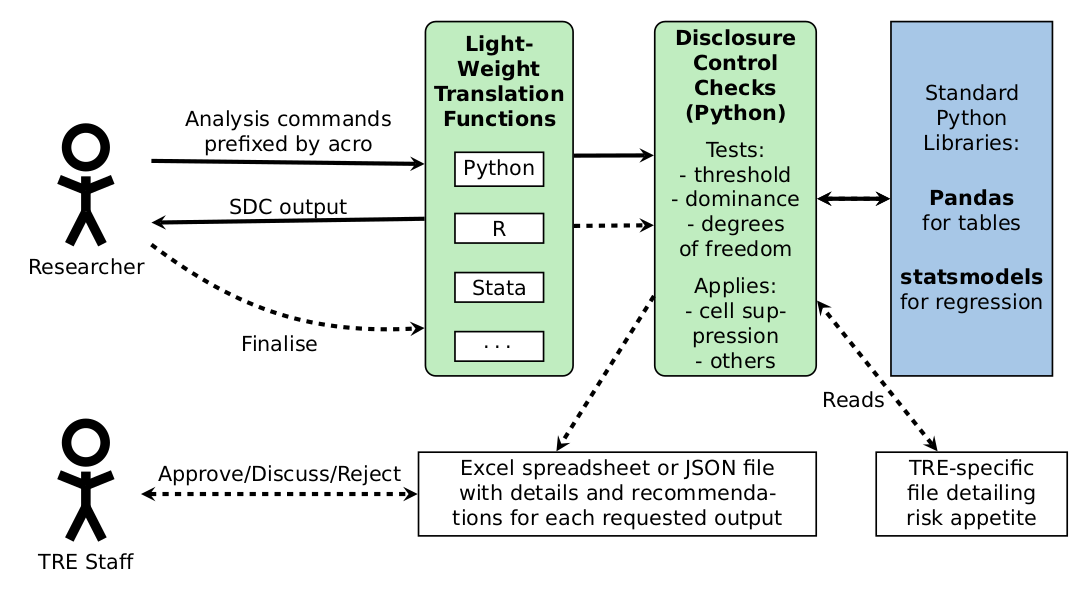
ACRO is a free and open source tool that supports the semi-automated checking of research outputs (SACRO) for privacy disclosure within secure data environments. SACRO is a framework that applies best-practice principles-based statistical disclosure control (SDC) techniques on-the-fly as researchers conduct their analysis. SACRO is designed to assist human checkers rather than seeking to replace them as with current automated rules-based approaches.
The ACRO package is a lightweight Python tool that sits over well-known analysis tools that produce outputs such as tables, plots, and statistical models. This package adds functionality to:
- automatically identify potentially disclosive outputs against a range of commonly used disclosure tests;
- apply optional disclosure mitigation strategies as requested;
- report reasons for applying SDC;
- and produce simple summary documents trusted research environment staff can use to streamline their workflow and maintain auditable records.
This creates an explicit change in the dynamics so that SDC is something done with researchers rather than to them, and enables more efficient communication with checkers.
A graphical user interface (SACRO-Viewer) supports human checkers by displaying the requested output and results of the checks in an immediately accessible format, highlighting identified issues, potential mitigation options, and tracking decisions made.
Additional programming languages used by researchers are supported by providing front-end packages that interface with the core ACRO Python back-end; for example, see the R wrapper package: ACRO-R.
Installation
ACRO is available through PyPI and Conda.
If installed in this way, the examples and data files used therein will need to be copied from the repository.
PyPI:
$ pip install acro
Conda:
$ conda install acro
Examples
See the example notebooks for:
Try Online with MyBinder
Try an example notebook online on MyBinder.org.
Documentation
The github-pages contains pre-built documentation.
Additionally, see our paper describing the SACRO framework to learn about its principles-based SDC methodology and usage.
Training Materials
For training videos about ACRO, see training videos.
Contributing
See CONTRIBUTING.md
Acknowledgement
This work was funded by UK Research and Innovation under as part of the DARE UK (Data and Analytics Research Environments UK) programme, delivered in partnership with Health Data Research UK (HDR UK) and Administrative Data Research UK (ADR UK). The specific projects were:
- Semi-Automatic Checking of Research Outputs (SACRO) [Grant Number MC_PC_23006] - a phase 1 Driver project
- TREvolution [Grant Number MC_PC_24038] - phase 2:Transformative Components.



Explore related projects
trimstray/the-book-of-secret-knowledge
A collection of inspiring lists, manuals, cheatsheets, blogs, hacks, one-liners, cli/web tools and more.
258,387 starsHack-with-Github/Awesome-Hacking
A collection of various awesome lists for hackers, pentesters and security researchers
125,488 starsswisskyrepo/PayloadsAllTheThings
A list of useful payloads and bypass for Web Application Security and Pentest/CTF
82,670 starscaddyserver/caddy
Fast and extensible multi-platform HTTP/1-2-3 web server with automatic HTTPS
79,034 stars