ultralytics/xview-docker
ultralytics/xview-docker has 75 GitHub stars and 3 forks. GitHot measured 0 stars in 24 hours. Last checked 2026-11-14 18:46 UTC. Last push 2026-08-28.
측정된 스타 증가
- in 24h
- 0
- in 7 days
- 기록 수집 중
- in 15 days
- 기록 수집 중
- in 1 month
- 기록 수집 중
서로 겹치는 기간의 순증가량이며 일별 합계가 아닙니다. 측정값이 없으면 비워 둡니다. 스타는 관심도를 나타내며 품질을 보장하지 않습니다.
소개
Docker container, inference pipeline, and submission tooling for deploying trained YOLOv3 object detection models in the xView satellite imagery challenge.
개발 도구README.md
Original
Introduction 👋
Welcome to the Ultralytics xView Docker submission repository! This codebase is open-source and distributed under the AGPL-3.0 license. Discover more about Ultralytics and our innovative projects by visiting our official website at https://www.ultralytics.com.


Project Overview 📄
This repository, hosted at https://github.com/ultralytics/xview-docker, provides the necessary tools to dockerize and deploy machine learning models specifically for the xView detection challenge 🔍. It is intended to be used alongside the trained models available in our xView YOLOv3 repository.
Prerequisites 🔖
Before you begin, ensure you have Docker and Python 3.6 or newer installed. You'll also need several Python packages. Install them using pip:
pip3 install -U -r requirements.txt
Make sure you have the following essential packages installed:
- numpy: For efficient numerical operations.
- scipy: Used for various scientific and technical computations.
- torch: The core deep learning framework (PyTorch).
- opencv-python: A library for computer vision tasks.
- tqdm: Provides progress bars used during inference.
Dockerization Steps 🐳
Follow these steps to containerize this repository using the provided run.sh script for the xView challenge.
Step 1: Copy Best Model Checkpoint
Retrieve the best performing model checkpoint from the training process conducted in our xView YOLOv3 repository and place it in the designated checkpoints directory:
mkdir xview-docker/checkpoints
cp xview-yolov3/weights/best.pt xview-docker/checkpoints
Step 2: Build and Tag The Docker Container
This sequence of commands removes any old Docker images, grants execution permissions to the run.sh script, builds the new Docker image, and applies a specific tag (e.g., ultralytics/xview:v30):
sudo docker image prune -a
cd xview-docker && chmod +x run.sh
sudo docker build -t friendlyhello .
sudo docker tag friendlyhello ultralytics/xview:v30
Step 3: Run Container on Example Image
Test the newly built container using an example image. This command runs the container, specifying CPU and memory limits via the Docker run command, executes the run.sh script on a sample TIFF image, and displays the output text file:
time sudo docker run -it --memory=8g --cpus=1 ultralytics/xview:v30 bash -c './run.sh /1047.tif /tmp && cat /tmp/1047.tif.txt'
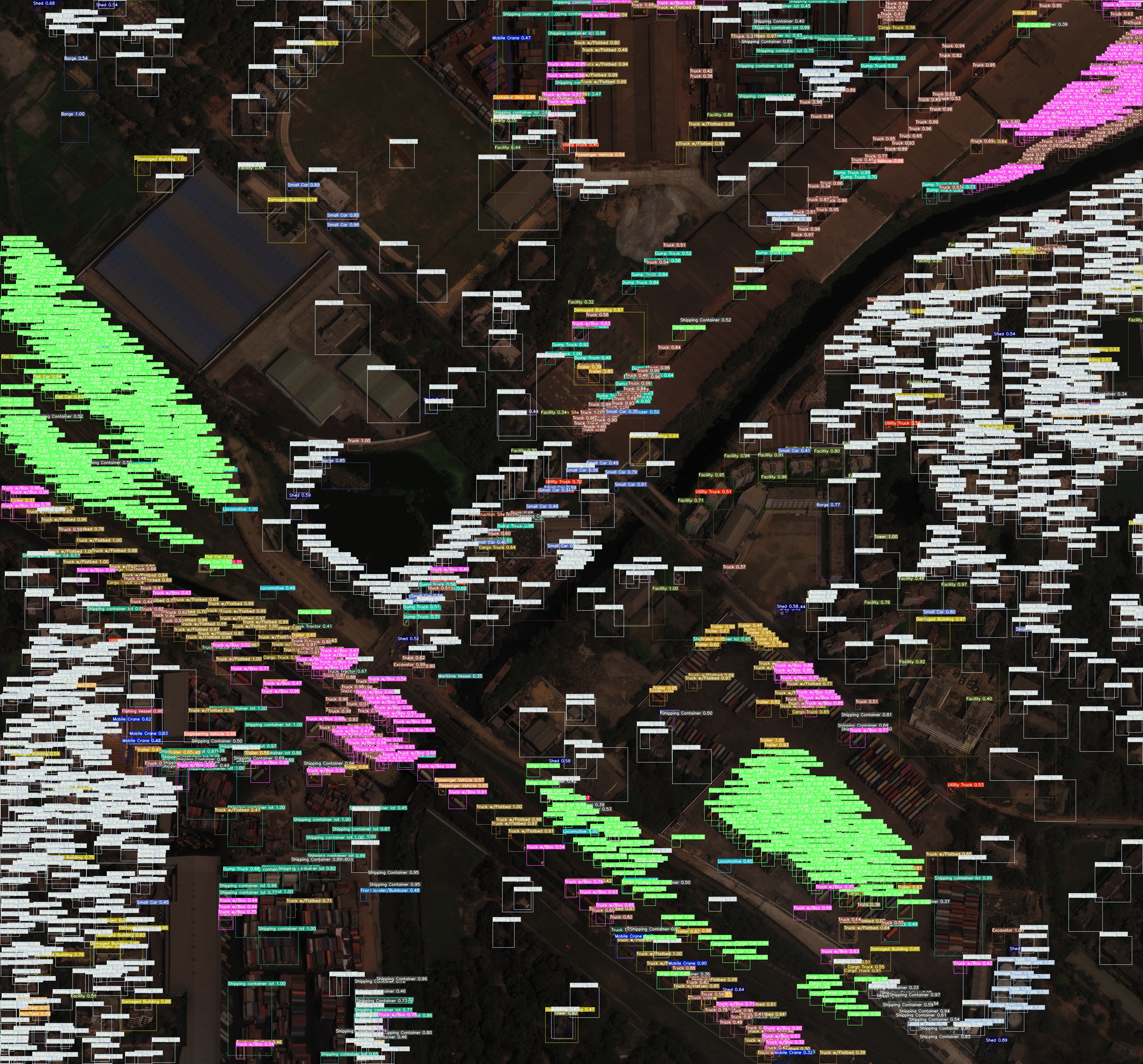
Here's a sample output visualization:
Step 4: Push to Docker Hub
After successful testing, upload your container image to Docker Hub, making it ready for submission to the xView challenge:
sudo docker push ultralytics/xview:v30
Your container can now be found hosted at https://hub.docker.com/r/ultralytics/xview/, prepared for the challenge 🚀.
Contribute 🤝
We warmly welcome contributions from the community! Whether it's fixing bugs, adding new features, or enhancing documentation, your input is highly valuable. Please refer to our Contributing Guide to get started. We're also keen to hear about your experiences with Ultralytics products—please consider filling out our Survey. A huge 🙏 thank you to all our contributors!
License ©️
Ultralytics provides two licensing options to accommodate diverse needs:
- AGPL-3.0 License: Ideal for students and enthusiasts, this OSI-approved open-source license promotes collaboration and knowledge sharing. See the LICENSE file for details.
- Enterprise License: Designed for commercial applications, this license permits the integration of Ultralytics software and AI models into commercial products without the open-source obligations of AGPL-3.0. For commercial use cases, please contact us via Ultralytics Licensing.
Contact Us 📬
For bug reports, feature requests, and contributions, please visit GitHub Issues. For broader questions and discussions regarding this project or other Ultralytics initiatives, join our vibrant community on Discord!