
openclaw/slacrawl
openclaw/slacrawl has 238 GitHub stars and 29 forks. Star changes are not measured yet. Last checked 2026-11-13 22:33 UTC. Last push 2026-11-13.
측정된 스타 증가
- in 24h
- 기록 수집 중
- in 7 days
- 기록 수집 중
- in 15 days
- 기록 수집 중
- in 1 month
- 기록 수집 중
서로 겹치는 기간의 순증가량이며 일별 합계가 아닙니다. 측정값이 없으면 비워 둡니다. 스타는 관심도를 나타내며 품질을 보장하지 않습니다.
소개
cli terminal app for slack with sqlite backend
개발 도구README.md
Originalslacrawl 💾 — Your Slack history, on your terms.





slacrawl mirrors Slack workspace data into local SQLite for full-text search, terminal browsing, reporting, and read-only SQL. It is for people who want a queryable Slack archive that stays under their control.
Install
Homebrew is the shortest path on macOS or Linux:
brew install openclaw/tap/slacrawl
The tap can trail the newest release. GitHub Releases provides signed and notarized macOS archives, Linux archives, and Debian/RPM packages for AMD64 and ARM64.
To build the latest source, install Go 1.27.0 or newer, then run:
git clone https://github.com/openclaw/slacrawl.git
cd slacrawl
make build
./bin/slacrawl --help
macOS binaries require macOS 13 or newer.
The repository also includes a Dockerfile for container builds.
Quick start
Set SLACK_BOT_TOKEN, or SLACK_USER_TOKEN for user-only API sync, to a token that can read the workspace. Then replace the example workspace and channel IDs:
slacrawl init --workspace T01234567
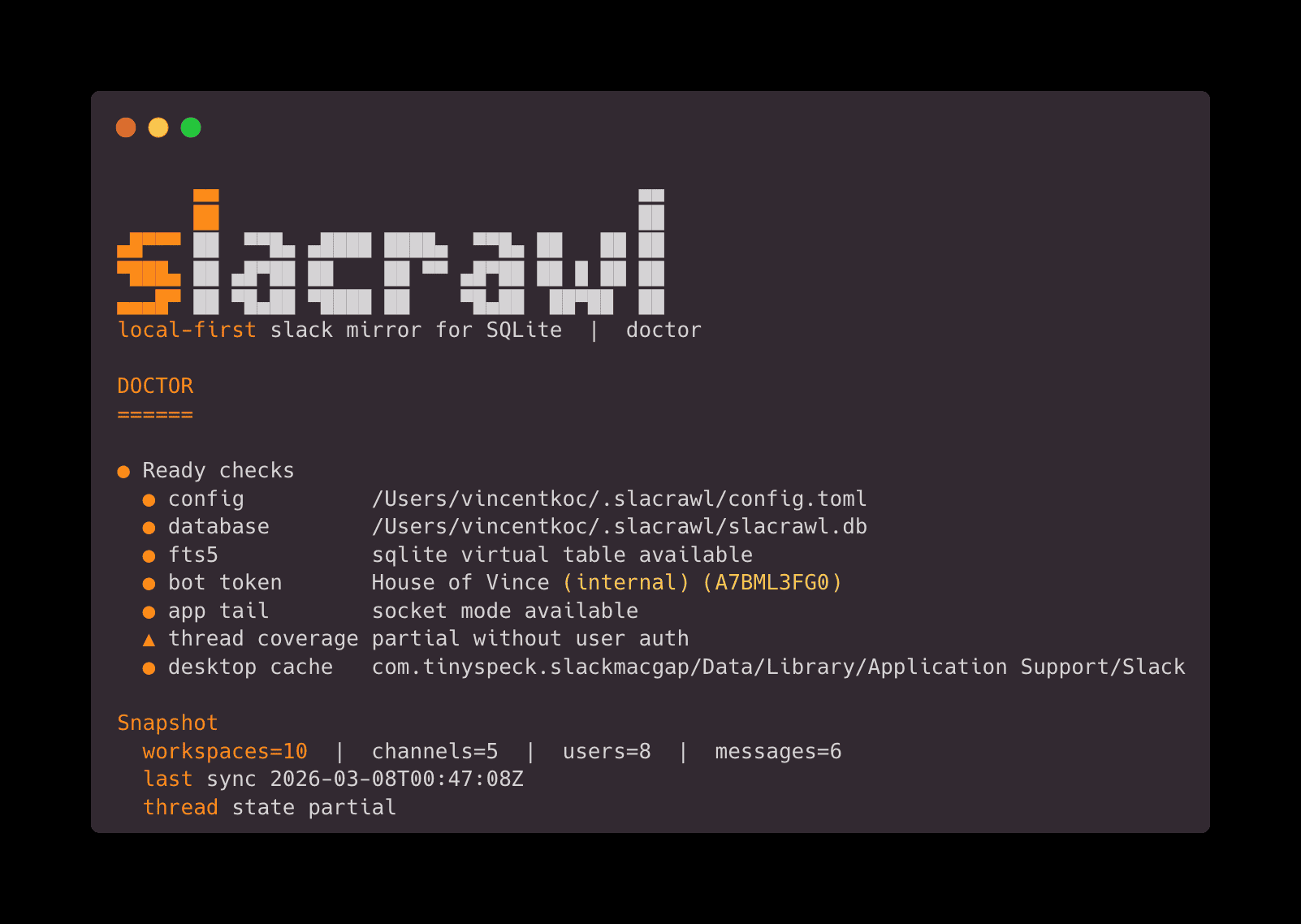
slacrawl doctor
slacrawl sync --source bot --channels C01234567
slacrawl search "incident"
slacrawl tui
init writes ~/.slacrawl/config.toml; database-backed commands use ~/.slacrawl/slacrawl.db by default. A configured bot takes precedence; failed bot authentication never falls back to the user token. Without a bot, the user owns discovery, profiles and history. Live Socket Mode tailing still requires both bot and app tokens.
Slacrawl prefers the user token for historical replies and optional DMs. With no user token configured, API sync fetches channel replies with the bot where its scopes and membership permit; workspace thread coverage stays partial. A rejected user credential never triggers bot reply fallback.
Already have a Slack export? Import its ZIP or extracted directory instead of syncing from the API:
slacrawl import ~/Downloads/slack-export.zip --workspace T01234567
Set [sync].include_dms = false in the selected config to exclude DM and group-DM
conversations from workspace JSON export imports. Unqualified types or ambiguous
conversation ownership stop the import. Omitted/true retain DM inclusion.
Dry-run checks the export without initializing or repairing the archive.
See Slack export admission for
supported formats, file-change detection, and privacy limits.
Choose an ingestion source
Every source feeds the same SQLite archive and search index.
| Source | Command | Use it for |
|---|---|---|
| Slack API | slacrawl sync --source bot |
Token-backed channel history, users, threads, and incremental refreshes |
| Slack Desktop | slacrawl sync --source wiretap |
Read-only recovery from local macOS or Linux desktop caches |
| MCP connector | slacrawl sync --source mcp --workspace T01234567 |
Connector-backed history without a direct Slack API integration |
| External provider | slacrawl sync --source provider:archive --workspace T01234567 |
A trusted local JSONL adapter for another archive |
| Slack export | slacrawl import <path> --workspace T01234567 |
ZIP or directory exports |
Treat one config and database as one visibility boundary. Keep personal and company archives in separate configs, database paths, and share remotes. See Configuration for tokens, multiple workspaces, MCP, external providers, media caching, and source precedence; see Desktop mode for local-cache coverage and limitations.
Ordinary API sync also revisits retained thread roots, keeping unfinished replies
work across restarts and token changes. Explicit --since and Tail repair leave
that backlog alone. See Retained API threads
for scope and partial-coverage behavior.
External provider v1 sync rejects [sync].include_dms = false before reading its
checkpoint or launching the adapter. Use API sync or a supported Slack workspace
JSON export when excluding DMs. Omitted/true retain provider intake behavior.
Ordinary MCP sync also preserves unfinished replies across history overwrites
and restarts. Explicit --since, including --full --since, reads only threads
whose roots are returned in history, including roots identified by archived
children, and leaves older pending work alone. See
Retained MCP threads for missing
thread tools, cancellation and partial-coverage behavior.
Native MCP history/replies responses that report more pages or Slack history/message limits retain valid fetched writes but stop with an error before advancing successful sync state. See native response coverage.
Desktop recovery includes unsent drafts by default. Set
[slack.desktop].include_drafts = false to exclude future draft ingestion;
drafts already archived remain unchanged. Set [sync].include_dms = false to
also exclude future desktop DM intake; unclassified cache records are omitted
and reported. See Desktop admission limits.
Explore the archive
Search uses SQLite FTS5 with a substring fallback. The same archive is available through the TUI, structured commands, and read-only SQL:
slacrawl report
slacrawl messages --limit 20
slacrawl sql 'select channel_id, count(*) from messages group by channel_id;'
slacrawl --json status
Use --format text, --format json, or --format log on commands that support structured output. Color turns off when stdout is not a TTY; --no-color and NO_COLOR=1 force plain output.
Schema 9 retains a private, key-only native change journal and exposes its generation
and sequence anchors in status --json. This is the foundation for later
incremental delivery; no delivery worker or journal compaction is enabled. See
the journal contract.
Library callers can capture a bounded, read-only six-table native seed at one consistent journal head and project it through the private archive profile. This does not deliver data or qualify an incremental baseline; see native seed capture.
The internal delivery API upgrades recognized version-1 outboxes to version 2 on open, preserving pending requests and receipts exactly. Older binaries reject the upgraded file. Explicit library callers can stage a complete private seed and resume exact requests through the existing delivery driver; only the final verified receipt qualifies its native baseline. Ambiguous keys retain evidence but block completion. No scheduler is enabled. See the outbox contract.
Explicit operator commands are available as slacrawl delivery init,
stage-seed, stage-changes, and deliver. They require a separately qualified private scope,
explicit native/outbox paths and bounded operations; only deliver contacts the
registered service using CRAWL_REMOTE_TOKEN (or --token-env). They neither
sync nor migrate the source/outbox and reject --config. See
the command and scope contract before use.
Incremental staging uses the latest receipt-qualified baseline; unchanged H is
a no-op, while excluded changes still require an empty part and receipt.
Keep it current
Run an incremental API refresh after the first sync:
slacrawl sync --source bot
Use --latest-only to update only channels that already have local history, tail for Socket Mode events, or watch for recurring desktop-cache refreshes. Ordinary incremental sync preserves retention cutoffs; --full, an older explicit --since, desktop ingestion, or imports can deliberately restore older records.
API sync retains valid fetched pages but reports an error when Slack still signals more results without a continuation cursor, or reports a history/message limit. The attempted interval stays pending instead of advancing successful coverage. See API history completeness.
Share an archive
One machine can publish compressed, git-backed snapshots while other machines subscribe and query locally without Slack credentials. Routine updates merge safely and preserve destination-only rows; exact replacement requires update --restore.
See Git archive sharing for publisher and subscriber setup, snapshot tags, media behavior, and restore semantics.
Retention
purge previews its effect unless --force is supplied:
slacrawl purge --older-than 90d
slacrawl purge --older-than 90d --force --vacuum
Threads are retained or removed as a unit based on the parent timestamp. See Retention purge for workspace scoping, message-event compaction, cached media, and git-backed archive behavior.
Commands
| Area | Commands |
|---|---|
| Setup and health | init, doctor, status, check-update |
| Ingest and refresh | sync, import, tail, watch, files |
| Browse and query | search, tui, messages, mentions, users, channels, sql |
| Reports | report, digest, analytics |
| Offline projections | export prepare, export build, export verify |
| Git snapshots | publish, subscribe, update |
| Automation | metadata, completion |
The command reference describes every command, output modes, shell completion, and common workflows. slacrawl <command> --help is the authoritative flag reference.
Development
make build
make test
make check
make check runs the local CI gates, including formatting, vet, vulnerability and dead-code checks, tests, CLI smoke tests, and a release snapshot. Read CONTRIBUTING.md before changing behavior and SPEC.md for the implementation contract.
License
MIT. Built by Vincent Koc.