
kvark/blade
kvark/blade has 817 GitHub stars and 82 forks. GitHot measured +1 in 7 days. Last checked 2026-11-18 10:08 UTC. Last push 2026-11-14.
측정된 스타 증가
- in 24h
- 업데이트 지연
- in 7 days
- +1
- in 15 days
- 기록 수집 중
- in 1 month
- 기록 수집 중
서로 겹치는 기간의 순증가량이며 일별 합계가 아닙니다. 측정값이 없으면 비워 둡니다. 스타는 관심도를 나타내며 품질을 보장하지 않습니다.
소개
Sharp and simple graphics library
창작 및 미디어README.md
OriginalBlade









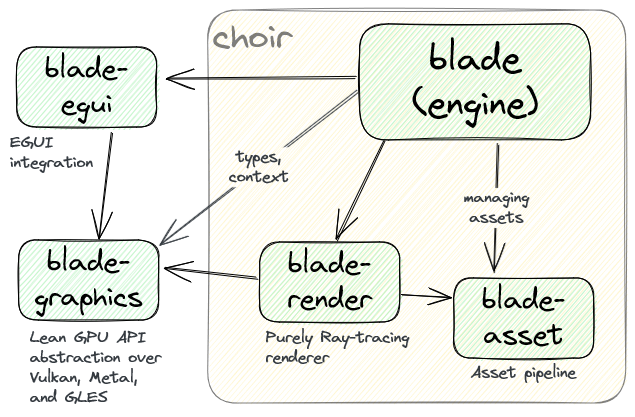
Blade is an innovative rendering solution for Rust. It starts with a lean low-level GPU abstraction focused at ergonomics and fun. It then grows into a high-level rendering library that utilizes hardware ray-tracing. It's accompanied by a task-parallel asset pipeline together with egui support, turning into a minimal rendering engine. Finally, the top-level Blade engine combines all of this with Rapier3D-based physics and hides them behind a concise API. Talks:
- In GPU we Rust (Rust AI meetup, 2024)
- Blade - lean and mean graphics library (Rust Graphics meetup, 2023)
- Blade asset pipeline (Rust Gamedev meetup, 2023)
- Blade scene editor (Rust Gamedev meetup, 2023)
Examples


Instructions
Just the usual :crab: workflow. E.g. to run the bunny-mark benchmark run:
cargo run --release --example bunnymark
CPU tests run with the default command:
cargo test
GPU integration tests are marked #[ignore] and need to be requested explicitly:
cargo test --test gpu_examples -- --ignored --nocapture
Platforms
Blade-graphics can run on:
- Linux (Vulkan and GLES)
- Windows (Vulkan)
- iOS/MacOS/tvOS (Metal)
- Android (OpenXR/Vulkan)
- Web (WebGL2)
The full-stack Blade Engine supports its rasterizer on WebGL2. The ray-traced renderer remains available only on backends and devices with ray-query support.
Research
Global Pass Barriers Without Per-Resource RHI Tracking: A Cross-Vendor Study with Blade measures Blade's synchronization model against matched wgpu workloads on AMD, NVIDIA, Intel, and Apple hardware. A repository copy is retained with the code. The synchronization guide summarizes the resulting design and what an engine using Blade is still responsible for.