
kdexd/virtex
kdexd/virtex has 564 GitHub stars and 62 forks. GitHot measured 0 stars in 24 hours. Last checked 2026-11-19 10:53 UTC. Last push 2025-08-22.
측정된 스타 증가
- in 24h
- 0
- in 7 days
- 기록 수집 중
- in 15 days
- 기록 수집 중
- in 1 month
- 기록 수집 중
서로 겹치는 기간의 순증가량이며 일별 합계가 아닙니다. 측정값이 없으면 비워 둡니다. 스타는 관심도를 나타내며 품질을 보장하지 않습니다.
소개
[CVPR 2021] VirTex: Learning Visual Representations from Textual Annotations
학습README.md
OriginalVirTex: Learning Visual Representations from Textual Annotations
Karan Desai and Justin Johnson
University of Michigan
CVPR 2021 arxiv.org/abs/2006.06666
Model Zoo, Usage Instructions and API docs: kdexd.github.io/virtex
VirTex is a pretraining approach which uses semantically dense captions to learn visual representations. We train CNN + Transformers from scratch on COCO Captions, and transfer the CNN to downstream vision tasks including image classification, object detection, and instance segmentation. VirTex matches or outperforms models which use ImageNet for pretraining -- both supervised or unsupervised -- despite using up to 10x fewer images.
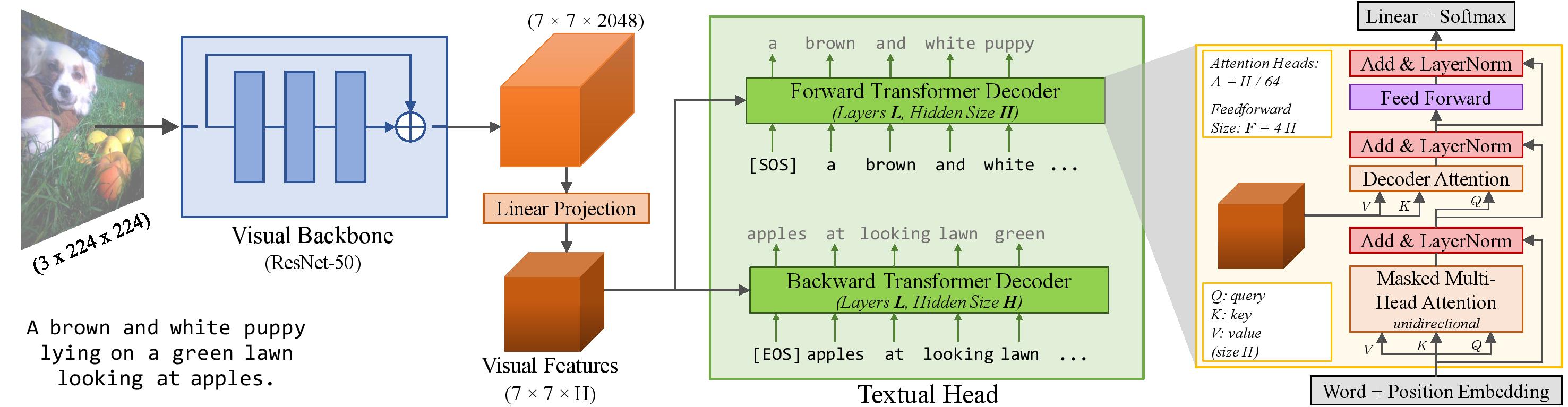
Get the pretrained ResNet-50 visual backbone from our best performing VirTex model in one line without any installation!
import torch

# That's it, this one line only requires PyTorch.
model = torch.hub.load("kdexd/virtex", "resnet50", pretrained=True)
Note (For returning users before January 2021):
The pretrained models in our model zoo have changed from v1.0 onwards.
They are slightly better tuned than older models, and reproduce the results in our
CVPR 2021 accepted paper (arXiv v2).
Some training and evaluation hyperparams are changed since v0.9.
Please refer CHANGELOG.md
Usage Instructions
- How to setup this codebase?
- VirTex Model Zoo
- How to train your VirTex model?
- How to evaluate on downstream tasks?
Full documentation is available at kdexd.github.io/virtex.
Citation
If you find this code useful, please consider citing:
@inproceedings{desai2021virtex,
    title={{VirTex: Learning Visual Representations from Textual Annotations}},
    author={Karan Desai and Justin Johnson},
    booktitle={CVPR},
    year={2021}
}
Acknowledgments
We thank Harsh Agrawal, Mohamed El Banani, Richard Higgins, Nilesh Kulkarni and Chris Rockwell for helpful discussions and feedback on the paper. We thank Ishan Misra for discussions regarding PIRL evaluation protocol; Saining Xie for discussions about replicating iNaturalist evaluation as MoCo; Ross Girshick and Yuxin Wu for help with Detectron2 model zoo; Georgia Gkioxari for suggesting the Instance Segmentation pretraining task ablation; and Stefan Lee for suggestions on figure aesthetics. We thank Jia Deng for access to extra GPUs during project development; and UMich ARC-TS team for support with GPU cluster management. Finally, we thank all the Starbucks outlets in Ann Arbor for many hours of free WiFi. This work was partially supported by the Toyota Research Institute (TRI). However, note that this article solely reflects the opinions and conclusions of its authors and not TRI or any other Toyota entity.