
iii-hq/iii has 18,928 GitHub stars and 1,273 forks. GitHot measured +1 stars in 24 hours and +52 in 7 days. Last checked 2026-11-08 11:43 UTC. Last push 2026-11-04.
그 어느 때보다 손쉽게 모든 서비스를 구성하고 확장하며 실시간으로 관찰할 수 있습니다.
측정된 스타 증가
- in 24h
- +1
- in 7 days
- +52
- in 15 days
- 업데이트 지연
- in 1 month
- 업데이트 지연
서로 겹치는 기간의 순증가량이며 일별 합계가 아닙니다. 측정값이 없으면 비워 둡니다. 스타는 관심도를 나타내며 품질을 보장하지 않습니다.
README.md
Originaliii



What is iii? · Install iii · Add Workers · SDKs · Agent Skills · Resources
What is iii?
iii is the easiest way to compose, observe, discover, extend, and react (CODER) to every service in your stack in real time.
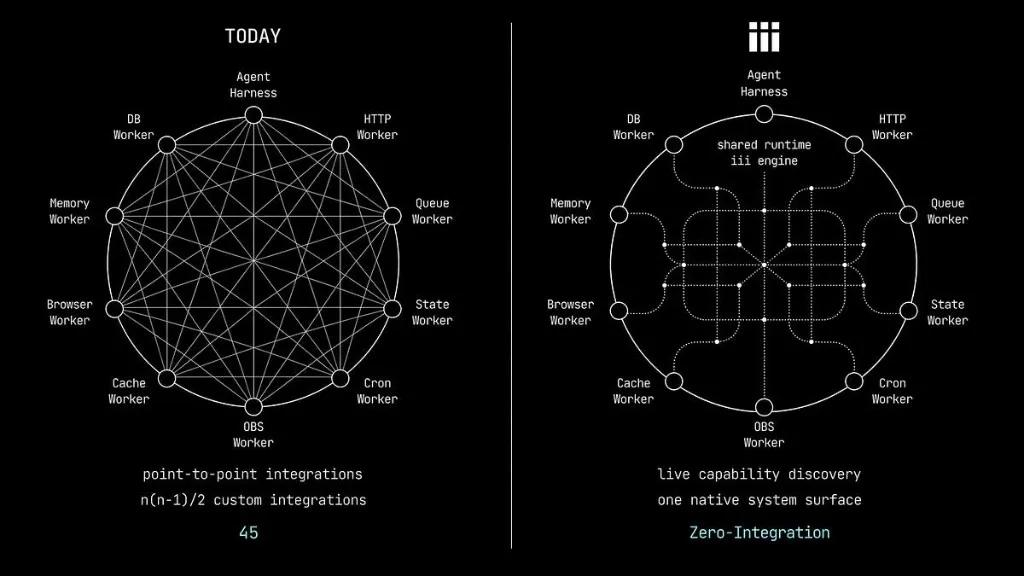
Every backend starts as a project before the first line of business logic. Queues, cron, HTTP, state, observability, agents, and sandboxes each usually bring their own integration story that complicates CODER. iii solves all of these concerns with one live system surface.
iii compose --namespace dev --up
iii trigger -n dev compose::add worker=queue
iii trigger -n dev compose::add worker=agent
iii trigger -n dev compose::add worker=<anything>
Each worker joins the live catalog. Every other worker is notified and can call it immediately. Browse available workers at workers.iii.dev.
That is the agent story too: when a task needs a capability the system does not have, an agent can add a worker, discover its functions, call them, and trace what happened. Same interface a developer uses.
Three Primitives
iii is powered by 3 primitives:
Workers are processes that register with the iii engine and then register triggers and functions. A TypeScript API service is a worker. A Python data pipeline is a worker. A Rust microservice is a worker. Any functionality can be transformed into a worker with a few lines of code. Compose can also add workers at runtime, so agents and applications can extend the system while it is running.
Triggers are anything that causes a function to run. A trigger can be a direct call to a function, an HTTP endpoint, a cron schedule, a queue subscription, a state change, a stream event, or anything else. Triggers are declarative: the Worker defines "this function runs when this thing happens," and iii handles routing, serialization, and delivery.
Functions are units of work with a stable identifier (e.g., content::classify,
orders::validate). It receives input, does work, and optionally returns output. Functions exist in
workers.
By mapping everything a service can do to these three primitives iii creates a development process that is both effortlessly composable, and completely observable.
What Changes
Before iii:
- New observability tool: uncountable integrations
- New agent harness: separate retry config, separate traces, separate timeouts
- New queue: vendor evaluation, procurement, and weeks of integration
After iii:
- Declare workers in
worker-compose.yaml - Run them with
iii compose --up - Done. It is in the system, traceable, and callable.
Platform teams publish workers. Application teams register functions and declare triggers. Agents use the same catalog and the same function calls.
Extending iii is adding a Compose worker. Composing iii is calling functions. Observing iii is opening the trace.
Install iii
Install iii:
curl -fsSL https://install.iii.dev/iii/main/install.sh | sh
Add Workers
Declare project workers in worker-compose.yaml, or add them through a running Compose daemon:
iii trigger -n dev compose::add worker=queue
Browse packages at workers.iii.dev and see the Compose documentation.
SDKs
| Language | Package | Install |
|---|---|---|
| Node.js | iii-sdk |
pnpm add iii-sdk or npm install iii-sdk |
| Python | iii-sdk |
pip install iii-sdk |
| Rust | iii-sdk |
Add to Cargo.toml |
| Go | iii-sdk |
go get github.com/iii-hq/iii/sdk/packages/go/iii |
Agent Skills for 3rd party harnesses
If you're using the iii harness then agent skills are automatically available.
If you're using another harness you can install iii's skills via:
npx skills add iii-hq/iii/skills
These cover every iii primitive: HTTP endpoints, queues, cron, state, streams, custom triggers, and more. See skills/ for the full list.
Each worker in iii-hq/workers also ships its own skill. Install them alongside the worker itself:
npx skills add iii-hq/workers --list        # list available worker skills
npx skills add iii-hq/workers --skill database # one worker
npx skills add iii-hq/workers --all         # every worker skill
The engine-owned workers (configuration, iii-worker-manager, iii-http-functions,
iii-stream, and iii-sandbox) and the automatically supplied engine functions, telemetry, and
observability workers live in this repo. HTTP, cron, queue, state, pubsub, and bridge are standalone
Compose workers. Install an engine skill with
npx skills add iii-hq/iii --full-depth --skill <name>; standalone workers ship their own skills in
iii-hq/workers.
Repository Structure
| Directory | What it is | README |
|---|---|---|
engine/ |
iii Engine (Rust) - core runtime, modules, and protocol | engine/README.md |
sdk/ |
SDKs for Node.js, Python, Rust, and Go | sdk/README.md |
skills/ |
Agent-readable reference material | skills/README.md |
website/ |
iii website | website/ |
docs/ |
Documentation site (Mintlify/MDX) | docs/README.md |
See CONTRIBUTING.md for workspace dependencies and CI/CD details.
Resources
Star History
License
The iii is licensed as such:
| Directory | License |
|---|---|
engine/ |
Elastic License 2.0 |
sdk/ |
Apache License 2.0 |
docs/ |
Apache License 2.0 |
website/ |
Apache License 2.0 |
The engine runtime and the CLI are licensed under the Elastic License 2.0 (ELv2). All SDKs, documentation, and the website are licensed under the Apache License 2.0.
See CONTRIBUTING.md for additional details.