
hustvl/DiffusionDriveV2
hustvl/DiffusionDriveV2 has 387 GitHub stars and 37 forks. GitHot measured 0 stars in 24 hours. Last checked 2026-11-18 13:19 UTC. Last push 2025-12-29.
측정된 스타 증가
- in 24h
- 0
- in 7 days
- 기록 수집 중
- in 15 days
- 기록 수집 중
- in 1 month
- 기록 수집 중
서로 겹치는 기간의 순증가량이며 일별 합계가 아닙니다. 측정값이 없으면 비워 둡니다. 스타는 관심도를 나타내며 품질을 보장하지 않습니다.
소개
DiffusionDriveV2: Reinforcement Learning-Constrained Truncated Diffusion Modeling in End-to-End Autonomous Driving
학습README.md
OriginalDiffusionDriveV2
Reinforcement Learning-Constrained Truncated Diffusion Modeling in End-to-End Autonomous Driving
Jialv Zou1, Shaoyu Chen3,†, Bencheng Liao2,1, Zhiyu Zheng4, Yuehao Song1,
Lefei Zhang4, Qian Zhang3, Wenyu Liu1, Xinggang Wang1,📧
1 School of EIC, Huazhong University of Science and Technology
2 Institute of Artificial Intelligence, Huazhong University of Science and Technology
3 Horizon Robotics
4 School of Computer Science, Wuhan University
📧 corresponding author | †Project Lead



News
Dec. 9th, 2025: We released our paper on Arxiv, and released the initial version of code and weights, along with documentation and training/evaluation scripts.
Table of Contents
Introduction
Generative diffusion models for end-to-end autonomous driving often suffer from mode collapse, tending to generate conservative and homogeneous behaviors. While DiffusionDrive employs predefined anchors representing different driving intentions to partition the action space and generate diverse trajectories, its reliance on imitation learning lacks sufficient constraints, resulting in a dilemma between diversity and consistent high quality. In this work, we propose DiffusionDriveV2, which leverages reinforcement learning to both constrain low-quality modes and explore for superior trajectories. This significantly enhances the overall output quality while preserving the inherent multimodality of its core Gaussian Mixture Model. First, we use scale-adaptive multiplicative noise, ideal for trajectory planning, to promote broad exploration. Second, we employ intra-anchor GRPO to manage advantage estimation among samples generated from a single anchor, and inter-anchor truncated GRPO to incorporate a global perspective across different anchors, preventing improper advantage comparisons between distinct intentions (e.g., turning vs. going straight), which can lead to further mode collapse. DiffusionDriveV2 achieves 91.2 PDMS on the NAVSIM v1 dataset and 85.5 EPDMS on the NAVSIM v2 dataset in closed-loop evaluation with an aligned ResNet-34 backbone, setting a new record. Further experiments validate that our approach resolves the dilemma between diversity and consistent high quality for truncated diffusion models, achieving the best trade-off.
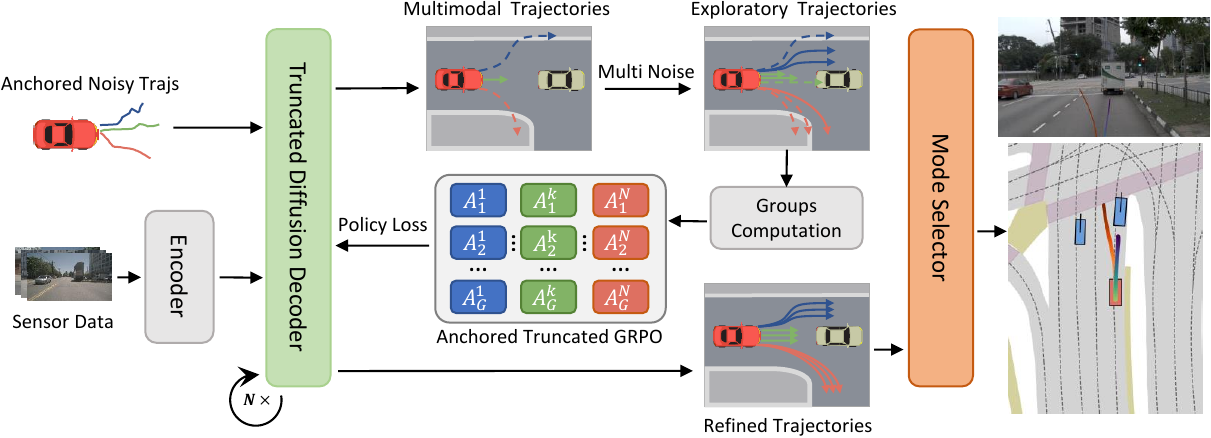
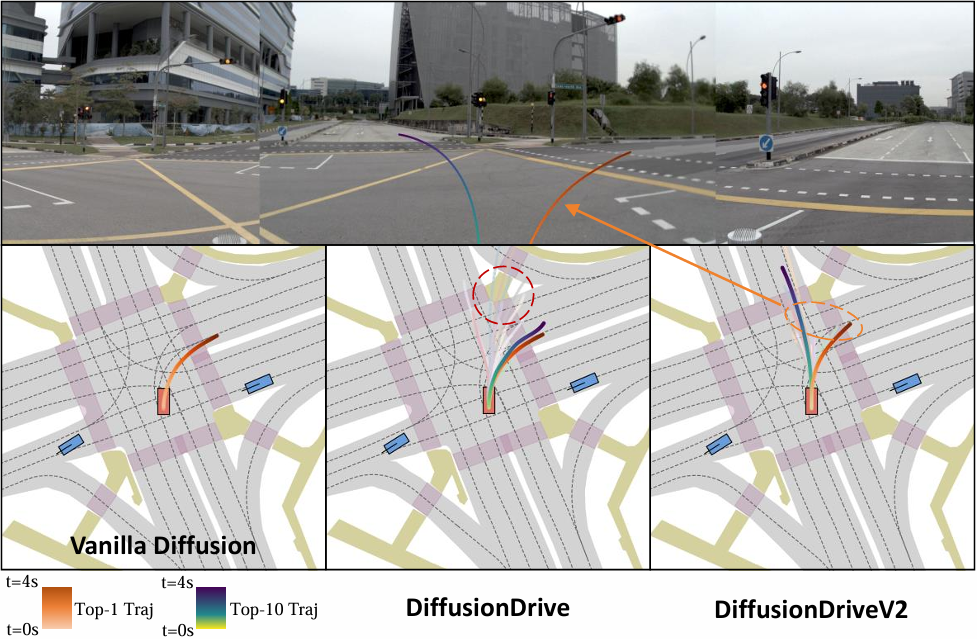
Qualitative Results on NAVSIM
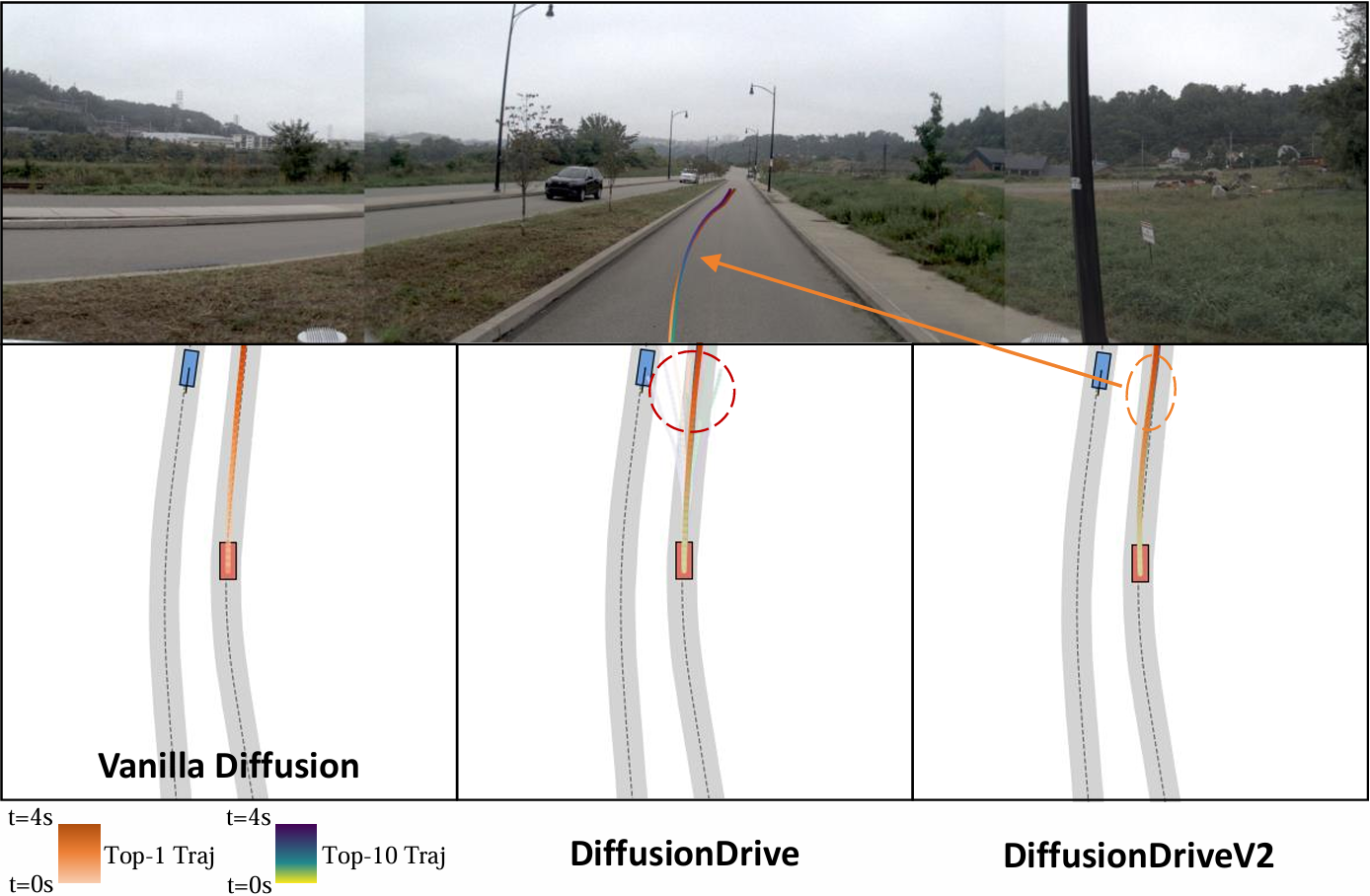 Turning left with diverse lane-changing behavior.
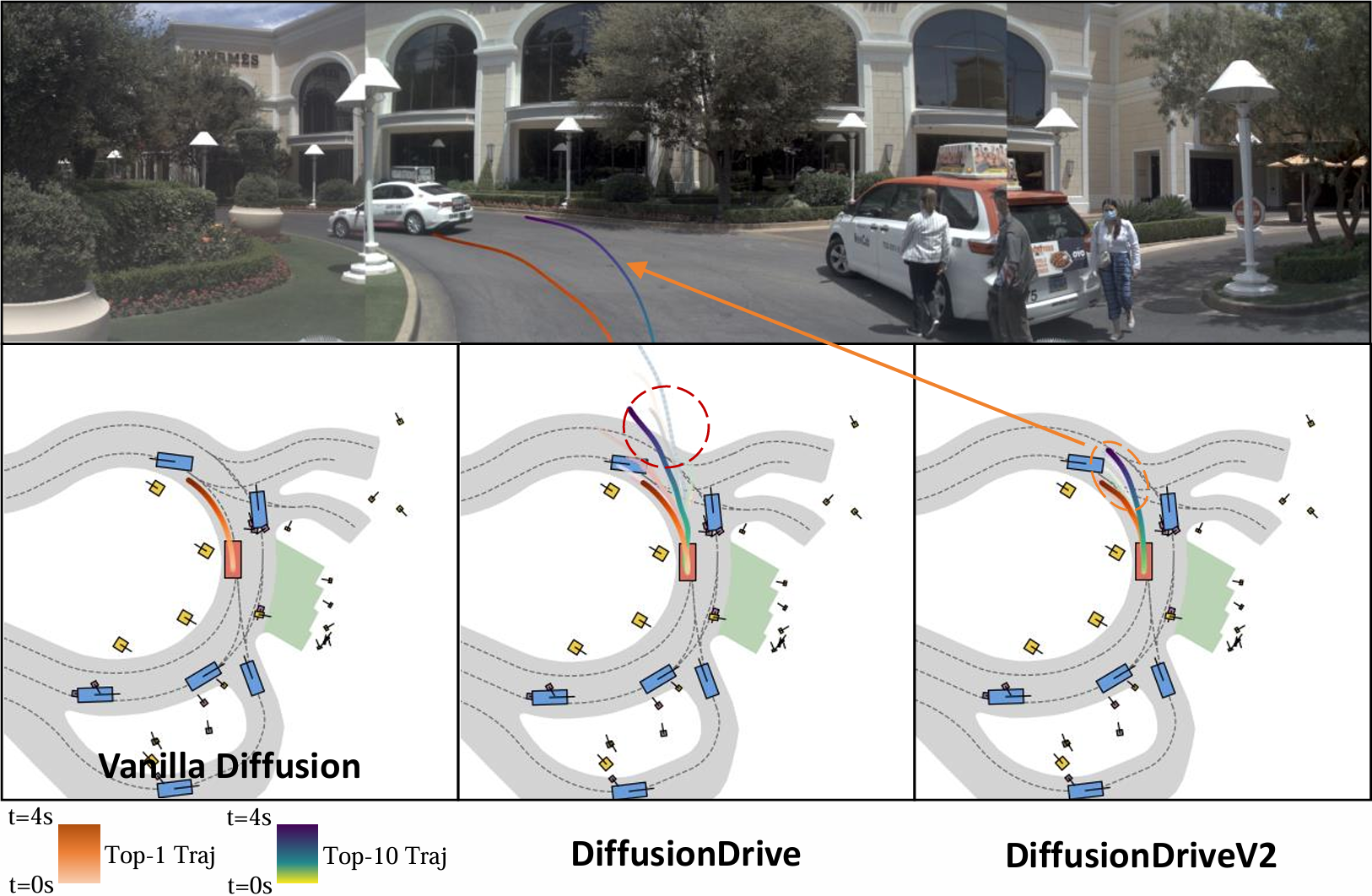 Complex driving scenarios with multiple potential solutions.
Getting Started
- Getting started from NAVSIM environment preparation
- Preparation of DiffusionDriveV2 environment
- Training and Evaluation
Contact
If you have any questions, please contact Jialv Zou via email ([email protected]).
Acknowledgement
DiffusionDrive is greatly inspired by the following outstanding contributions to the open-source community: NAVSIM, DiffusionDrive, DPPO, DeepSeek-R1 .
Citation
If you find DiffusionDriveV2 is useful in your research or applications, please consider giving us a star 🌟 and citing it by the following BibTeX entry.
@article{zou2025diffusiondrivev2,
  title={DiffusionDriveV2: Reinforcement Learning-Constrained Truncated Diffusion Modeling in End-to-End Autonomous Driving},
  author={Zou, Jialv and Chen, Shaoyu and Liao, Bencheng and Zheng, Zhiyu and Song, Yuehao and Zhang, Lefei and Zhang, Qian and Liu, Wenyu and Wang, Xinggang},
  journal={arXiv preprint arXiv:2512.07745},
  year={2025}
}