
braisdom/ObjectiveSql
braisdom/ObjectiveSql has 1,254 GitHub stars and 157 forks. GitHot measured 0 stars in 24 hours, -3 in 7 days, and -4 in 15 days. Last checked 2026-11-23 11:06 UTC. Last push 2024-05-06.
What you can do
- With one annotation your Class has fully featured capabilities of SQL programming
- Easy to relational(has_one, has_many and belongs_to) query and paged query
- Writing SQL expressions(arithmetic, comparison and logical) using Java syntax
측정된 스타 증가
- in 24h
- 0
- in 7 days
- -3
- in 15 days
- -4
- in 1 month
- 기록 수집 중
서로 겹치는 기간의 순증가량이며 일별 합계가 아닙니다. 측정값이 없으면 비워 둡니다. 스타는 관심도를 나타내며 품질을 보장하지 않습니다.
소개
Java 문법으로 SQL을 작성합니다.
데이터README.md
OriginalObjectiveSQL is an ORM framework in Java based on ActiveRecord pattern, which encourages rapid development and clean, codes with the least, and convention over configuration.
Key Features
- With one annotation your
Classhas fully featured capabilities of SQL programming - Easy to relational(
has_one,has_manyandbelongs_to) query and paged query - Writing SQL expressions(
arithmetic,comparisonandlogical) using Java syntax
Why ObjectiveSQL
- If your project focuses on data analysis based on relation database, and a lot of arithmetic expressions in SQL statement. ObjectiveSQL will help you write expressions conveniently and safely using Java syntax
- If you don’t want to write Java codes of database access and various configuration files, ObjectiveSQL's dynamic code generation will help you access the database without coding
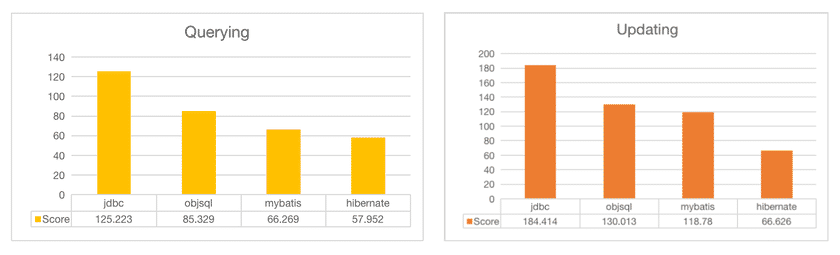
Performance(Oracle JMH)
Installation
IntelliJ IDEA plugin installation
Preferences/Settings -> Plugins -> Search with "ObjectiveSql" in market -> Install
Maven dependencies
<!-- In standalone -->
<dependency>
    <groupId>com.github.braisdom</groupId>
    <artifactId>objective-sql</artifactId>
    <version>1.4.6</version>
</dependency>
<!-- In Spring Boot -->
<dependency>
  <groupId>com.github.braisdom</groupId>
  <artifactId>objsql-springboot</artifactId>
  <version>1.3.4</version>
</dependency>
Refer to the pom.xml for more configuration
Examples
ObjectiveSQL provides full example for various databases below, You can open it directly with IntelliJ IDEA as a standalone project. In fact, they are not just examples, but also unit tests of ObjectiveSQL in various databases.
If you want to run without configuration, you can try: SQLite
Others: MySQL, Oracle, MS SQL Server, PostgreSQL, Spring Boot
Simple SQL programming without coding
You define just a JavaBean with annotations
@DomainModel
public class Member {
    private String no;

    @Queryable
    private String name;
    private Integer gender;
    private String mobile;
    private String otherInfo;

    @Relation(relationType = RelationType.HAS_MANY)
    private List<Order> orders;
}
Persistence
Member.create(newMember);
Member.create(new Member[]{newMember1, newMember2, newMember3}, false);

Member.update(1L, newMember, true);
Member.update("name = 'Smith => Jackson'", "name = ?", "Alice");

Member.destroy(1L);
Member.destroy("name = ?", "Mary");
Counting and querying
Member.countAll();
Member.count("id > ?", 1);
Member.queryByPrimaryKey(1);
Member.queryFirst("id = ?", 1);
Member.query("id > ?", 1);
Member.queryAll();
Paged querying
Page page = Page.create(0, 10);
PagedList<Member> members = Member.pagedQueryAll(page, Member.HAS_MANY_ORDERS);
Relation querying
Member.queryAll(Member.HAS_MANY_ORDERS);
Member.queryByPrimary(1, Member.HAS_MANY_ORDERS);
Member.queryByName("demo", Member.HAS_MANY_ORDERS);
...
Complex SQL programming
Order.Table orderTable = Order.asTable();
Select select = new Select();

// In ObjectiveSQL, Java operator can be overloaded
select.project(sum(orderTable.amount) / sum(orderTable.quantity) * 100)
        .from(orderTable)
        .where(orderTable.quantity > 30 &&
            orderTable.salesAt.between("2020-10-10 00:00:00", "2020-10-30 23:59:59"))
        .groupBy(orderTable.productId);
SELECT SUM(`T0`.`amount`) / SUM(`T0`.`quantity`) * 100
FROM `orders` AS `T0`
WHERE `T0`.`quantity` > 30 AND
       `T0`.`sales_at` BETWEEN '2020-10-10 00:00:00' AND '2020-10-30 23:59:59')
GROUP BY `T0`.`product_id`
Reference documentation
관련 프로젝트 살펴보기
불러오는 중…