
Sujit-O/pykg2vec
소개
지식 그래프 임베딩과 표현 학습을 위한 Python 라이브러리입니다.
학습측정된 스타 증가
- in 24h
- 0
- in 7 days
- 0
- in 15 days
- 기록 수집 중
- in 1 month
- 기록 수집 중
서로 겹치는 기간의 순증가량이며 일별 합계가 아닙니다. 측정값이 없으면 비워 둡니다. 스타는 관심도를 나타내며 품질을 보장하지 않습니다.
README.md
Original


Pykg2vec: Python Library for KGE Methods
Pykg2vec is a library for learning the representation of entities and relations in Knowledge Graphs built on top of PyTorch 1.5 (TF2 version is available in tf-master branch as well). We have attempted to bring state-of-the-art Knowledge Graph Embedding (KGE) algorithms and the necessary building blocks in the pipeline of knowledge graph embedding task into a single library. We hope Pykg2vec is both practical and educational for people who want to explore the related fields.
Features:
- Support state-of-the-art KGE model implementations and benchmark datasets. (also support custom datasets)
- Support automatic discovery for hyperparameters.
- Tools for inspecting the learned embeddings.
- Support exporting the learned embeddings in TSV or Pandas-supported format.
- Interactive result inspector.
- TSNE-based, KPI summary visualization (mean rank, hit ratio) in various format. (csvs, figures, latex table)
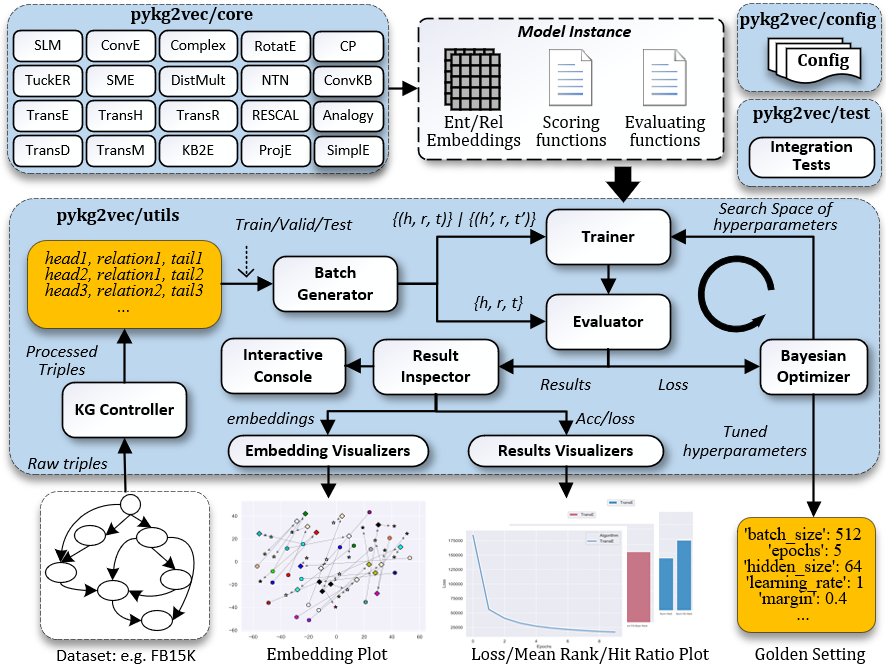
We welcome any form of contribution! Please refer to CONTRIBUTING.md for more details.
To Get Started
Before using pykg2vec, we recommend users to have the following libraries installed:
- python >=3.7 (recommended)
- pytorch>= 1.5
Quick Guide for Anaconda users:
- Setup a Virtual Environment: we encourage you to use anaconda to work with pykg2vec:
(base) $ conda create --name pykg2vec python=3.7
(base) $ conda activate pykg2vec
- Setup Pytorch: we encourage to use pytorch with GPU support for good training performance. However, a CPU version also runs. The following sample commands are for setting up pytorch:
# if you have a GPU with CUDA 10.1 installed
(pykg2vec) $ conda install pytorch torchvision cudatoolkit=10.1 -c pytorch
# or cpu-only
(pykg2vec) $ conda install pytorch torchvision cpuonly -c pytorch
- Setup Pykg2vec:
(pykg2vec) $ git clone https://github.com/Sujit-O/pykg2vec.git
(pykg2vec) $ cd pykg2vec
(pykg2vec) $ python setup.py install
For beginners, these papers, A Review of Relational Machine Learning for Knowledge Graphs, Knowledge Graph Embedding: A Survey of Approaches and Applications, and An overview of embedding models of entities and relationships for knowledge base completion can be good starting points!
User Documentation
The documentation is here.
Usage Examples
With pykg2vec command-line interface, you can
- Run a single algorithm with various models and datasets (customized dataset also supported).
# Check all tunnable parameters. (pykg2vec) $ pykg2vec-train -h # Train TransE on FB15k benchmark dataset. (pykg2vec) $ pykg2vec-train -mn TransE # Train using different KGE methods. (pykg2vec) $ pykg2vec-train -mn [TransE|TransD|TransH|TransG|TransM|TransR|Complex|ComplexN3| CP|RotatE|Analogy|DistMult|KG2E|KG2E_EL|NTN|Rescal|SLM|SME|SME_BL|HoLE| ConvE|ConvKB|Proje_pointwise|MuRP|QuatE|OctonionE|InteractE|HypER] # For KGE using projection-based loss function, use more processes for batch generation. (pykg2vec) $ pykg2vec-train -mn [ConvE|ConvKB|Proje_pointwise] -npg [the number of processes, 4 or 6] # Train TransE model using different benchmark datasets. (pykg2vec) $ pykg2vec-train -mn TransE -ds [fb15k|wn18|wn18_rr|yago3_10|fb15k_237|ks|nations|umls|dl50a|nell_955] # Train TransE model using your own hyperparameters. (pykg2vec) $ pykg2vec-train -exp True -mn TransE -ds fb15k -hpf ./examples/custom_hp.yaml # Use your own dataset (pykg2vec) $ pykg2vec-train -mn TransE -ds [name] -dsp [path to the custom dataset] - Tune a single algorithm.
# Tune TransE using the benchmark dataset. (pykg2vec) $ pykg2vec-tune -mn [TransE] -ds [dataset name] # Tune TransE with your own search space (pykg2vec) $ pykg2vec-tune -exp True -mn TransE -ds fb15k -ssf ./examples/custom_ss.yaml - Perform Inference Tasks (more advanced).
# Train a model and perform inference tasks.
(pykg2vec) $ pykg2vec-infer -mn TransE

# Perform inference tasks over a pretrained model.
(pykg2vec) $ pykg2vec-infer -mn TransE -ld [path to the pretrained model]
* NB: On Windows, use pykg2vec-train.exe, pykg2vec-tune.exe and pykg2vec-infer.exe instead.
For more usage of pykg2vec APIs, please check the programming examples.
Citation
Please kindly consider citing our paper if you find pykg2vec useful for your research.
  @article{yu2019pykg2vec,
  title={Pykg2vec: A Python Library for Knowledge Graph Embedding},
  author={Yu, Shih Yuan and Rokka Chhetri, Sujit and Canedo, Arquimedes and Goyal, Palash and Faruque, Mohammad Abdullah Al},
  journal={arXiv preprint arXiv:1906.04239},
  year={2019}
  }
관련 프로젝트 살펴보기
불러오는 중…